

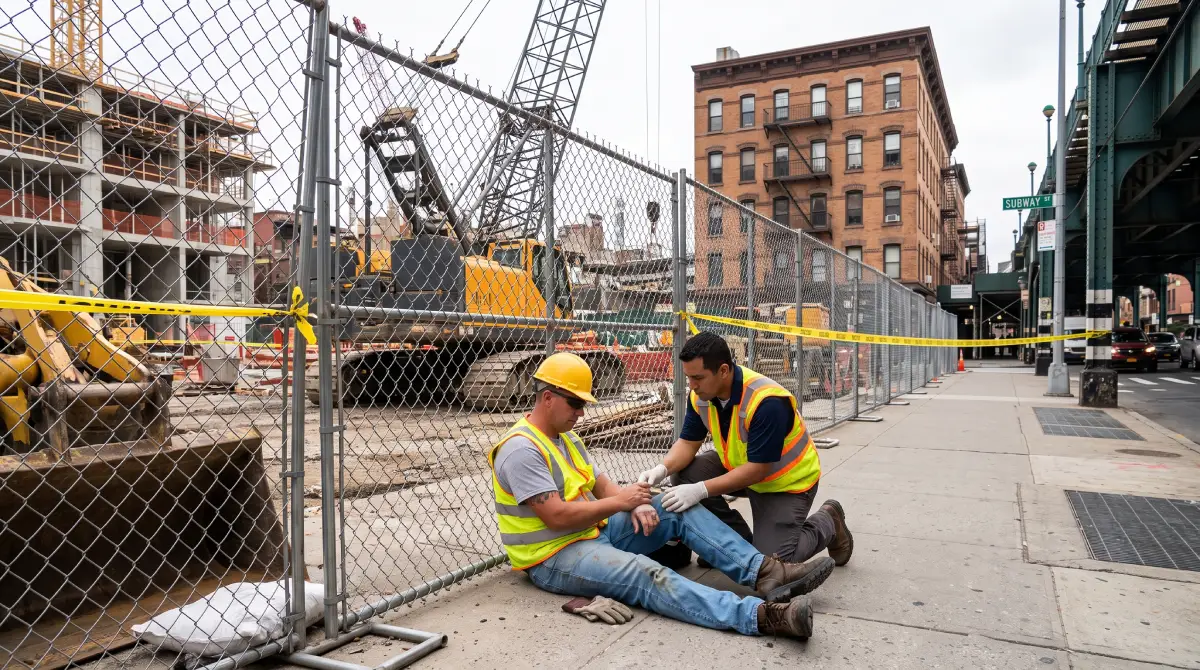
If a fall, a falling load, or a machine put you in the hospital, a Brooklyn construction worker injury lawyer at Silver Law Group can tell you in one free call whether you have a case beyond workers’ compensation. That call is free, runs 24 hours a day, and is handled in English, Spanish, or Russian by an attorney, not a call screener. You pay nothing up front, and no fee at all unless money comes in. If you can’t get out of bed, the attorney comes to your hospital room or your home anywhere in Brooklyn, reviews your paperwork, and explains your options in plain terms. Most injured workers are told only about workers’ comp. That is often the smaller half of what New York law lets a construction worker collect. Call 212-470-4544 to find out what the rest of your claim is worth.
Do You Have a Construction Injury Case in Brooklyn?
Two separate claims can run at the same time after a construction injury, and confusing them costs workers money. The first is workers’ compensation, which pays regardless of who caused the accident. You can be partly to blame, fully to blame, or blameless, and comp still covers your medical treatment and a portion of your wages.
The second claim is the one insurers hope you never hear about. When someone other than your direct employer caused your injury, you can bring a separate lawsuit against that party for everything comp leaves on the table.
That third party is usually one of these:
- The property owner, who owes construction workers a non-delegable safety duty
- The general contractor running the site
- A subcontractor whose crew or equipment created the hazard
- The manufacturer of a defective ladder, hoist, saw, or lift
The test is simple to state and worth asking out loud: did a party you don’t work for contribute to how you got hurt? A scaffold with no guardrail, a hole left uncovered, a load hoisted overhead without a spotter, a live wire nobody flagged. If the answer is yes, workers’ comp is your floor, not your ceiling. A short conversation about who was on your site and who controlled the hazard is usually enough to tell whether the second claim exists.
New York Labor Law Protections for Construction Workers
New York gives construction workers protections no other injured worker in the state has, written into three sections of the Labor Law.
Labor Law §240(1), known as the scaffold law, is the strongest. It imposes absolute liability on owners and contractors for gravity-related injuries: a fall from a height, or an object that falls and strikes you. Absolute liability means that once a height-safety violation is proven to have caused the injury, the owner and contractor cannot blame your carelessness to escape responsibility. A missing guardrail, an unsecured ladder, a hoist without proper rigging, a load that drops from a floor above. These are the classic §240(1) cases, and they carry the most force of anything in the statute.
Labor Law §241(6) covers hazards that are not about height. It ties liability to specific violations of the Industrial Code, the state’s detailed construction safety rulebook, covering things like debris-strewn walkways, unguarded floor openings, and inadequate shoring in a trench. To win under §241(6), your lawyer has to point to the exact code provision that was broken, which is where careful case-building matters.
Labor Law §200 is the general duty to keep a worksite reasonably safe. It reaches dangerous conditions and unsafe methods that the other two sections don’t squarely cover.
One warning about the lawyers you may be comparing. A number of firm websites and even some filed papers cite “Labor Law 240(6).” No such provision exists. The height protections live in §240(1); the Industrial Code protections live in §241(6). A firm that miscites the statute it claims to specialize in is telling you something about how carefully your case would be handled.
Non-Union and Undocumented Workers
Your immigration status does not close the courthouse door. In Balbuena v. IDR Realty, New York’s highest court held that an undocumented construction worker injured on the job can still recover lost wages and other damages. How you were paid, whether on the books or off, and whether you carried a union card change none of this. The Labor Law protects the worker on the scaffold, not a payroll classification. This matters in Brooklyn in particular, where most construction fatalities involve non-union workers, the same workers most often told, wrongly, that they have no claim. If someone on your site said you can’t sue because of your papers or your pay arrangement, they were wrong, and it costs you nothing to confirm that in a free call.
Common Brooklyn Construction Accidents and Injuries
Falls are the leading killer on construction sites, accounting for 58% of construction deaths in the city. The rest cluster into a handful of predictable, preventable categories.
- Falls from scaffolds, ladders, roofs, and unguarded floor edges, which cause traumatic brain injuries, spinal damage, and broken bones
- Struck-by injuries from falling tools, materials, or swinging loads
- Caught-between injuries, where a worker is pinned between equipment, a wall, or a collapsing structure
- Electrocution from live wires, ungrounded tools, or contact with overhead lines
- Trench collapse, which suffocates or crushes workers when shoring is skipped or inadequate
Brooklyn’s building boom concentrates these risks in specific places. The high-rise towers around Atlantic Terminal and Downtown Brooklyn put crews dozens of stories up, where a single unsecured tie-off turns into a fatal fall. The Greenpoint and Williamsburg waterfront has traded low industrial buildings for tall residential construction on soft, water-adjacent ground, where deep excavation and trench work raise collapse risk. The injuries that follow are rarely minor. A worker who survives a fall from height often faces spinal fusion, a shattered pelvis, or a brain injury that ends the career he was building. Those long-term consequences are exactly what the second claim exists to pay for, and exactly what workers’ comp alone will not.
Who Is Liable for Your Construction Injury
The party who signs your paycheck is usually the one party you cannot sue. Workers’ compensation is a trade-off: you get benefits without proving fault, and in exchange the comp system generally bars you from suing your direct employer for the injury. That bar is why the identity of everyone else on the site matters so much.
The defendants in the second claim are the parties who controlled the site or the hazard but do not employ you:
- The property owner carries a non-delegable duty under the Labor Law, meaning the owner stays legally responsible for height and code safety even after hiring others to do the work
- The general contractor answers for the overall coordination and safety of the site
- A subcontractor whose work, crew, or equipment caused your injury can be sued directly, since it is not your employer
- The manufacturer of defective equipment is liable when a failed part, not misuse, caused the harm
On a typical Brooklyn job, several of these parties share a single site, and more than one may be responsible for what happened to you. Sorting out who controlled the ladder, the hoist, or the open floor is the heart of the investigation, and it decides which pockets your recovery comes from.
Compensation a Brooklyn Construction Worker Can Recover
What you can collect depends entirely on which claim you’re in, and the gap between the two is large.
Workers’ compensation pays:
- A portion of your lost wages, typically capped at two-thirds of your average weekly wage and subject to a state maximum
- Your medical treatment for the work injury
- Benefits for permanent disability
What comp does not pay is often the largest loss of all: nothing for pain and suffering, and only partial wages while your bills arrive in full.
The third-party claim reaches everything comp leaves out. Against an owner, contractor, or subcontractor who caused the injury, you can pursue:
- Your full lost wages, not the capped fraction
- Future lost earning capacity, when the injury cuts your career short or bars you from the trade
- Pain and suffering, for the physical and emotional toll comp ignores entirely
- The cost of lifelong medical care, including future surgeries, therapy, and assistive equipment
A younger worker with a spinal injury may lose thirty years of a trade income. Comp is not built to replace that; the third-party case is. This is the practical reason the two-claim strategy matters. Running comp alone, which is what many injured workers do without a lawyer, can leave the bulk of the actual loss uncompensated.
How Your Claim Moves Through Kings County Court
Brooklyn injury lawsuits are filed at the Kings County Supreme Court, Civil Term, at 360 Adams Street, across from Borough Hall. Knowing where the case lives is less important than knowing how it moves, and it moves in stages.
The first stage is investigation: securing the accident site records, safety logs, and witness accounts before they disappear, and identifying which Labor Law section fits the facts. Next comes filing the complaint and the discovery phase, where both sides exchange evidence and take sworn testimony. Most cases then reach a negotiation stage, where the defendants’ insurers weigh what a Brooklyn jury might do against the cost of settling.
That last calculation is where trial readiness pays off. An insurer settles fairly only when it believes the lawyer across the table will actually try the case in front of a Kings County jury and win. Every case at Silver Law Group is built from day one as if it will be tried, which is what gives a settlement demand its weight.
Deadlines to File Your Brooklyn Construction Claim
Miss a filing deadline and the strongest case in the borough becomes worthless, so the clocks start the day you are hurt.
- CPLR §214 gives you three years from the date of injury to file a personal injury lawsuit against a third party.
- EPTL §5-4.1 gives the family two years from the date of death to bring a wrongful death claim when a worker is killed.
- Workers’ compensation runs on its own schedule: written notice to your employer within 30 days of the accident, and a formal comp claim filed within two years.
- If your accident happened on a city-owned site, a New York City Housing Authority property, or a School Construction Authority job, GML §50-e requires a Notice of Claim within 90 days, long before the three-year lawsuit deadline.
That 90-day rule is the trap that ends the most public-site cases. A worker hurt on an NYCHA or SCA project who waits even a few months, thinking he has three years, can lose the claim entirely. The safest move after any construction injury is to have the deadlines checked immediately, because the shortest one governs everything.
Why Injured Brooklyn Workers Choose Silver Law Group
Silver Law Group does not publish verdict numbers, and you should be skeptical of the firms that lead with them. What matters to your case is how it is built and who builds it. Every case here is prepared as if it is going to trial, which is the posture that makes insurers pay full value rather than a nuisance discount. When a defense adjuster knows the file is ready for a Kings County jury, the conversation changes.
You also work with a partner-level attorney directly, not a rotating cast of assistants who have never met you. The same lawyer who reviews your accident learns your medical picture, understands what the injury did to your ability to earn, and speaks for you through negotiation and, if it comes to it, trial.
The rest is practical. Consultations are free and available around the clock in English, Spanish, or Russian. If you cannot travel, the attorney comes to your hospital bed or your home in Brooklyn. And because the firm works on contingency, hiring a lawyer costs you nothing out of pocket. Call 212-470-4544 and get a straight answer about what your claim is actually worth.