

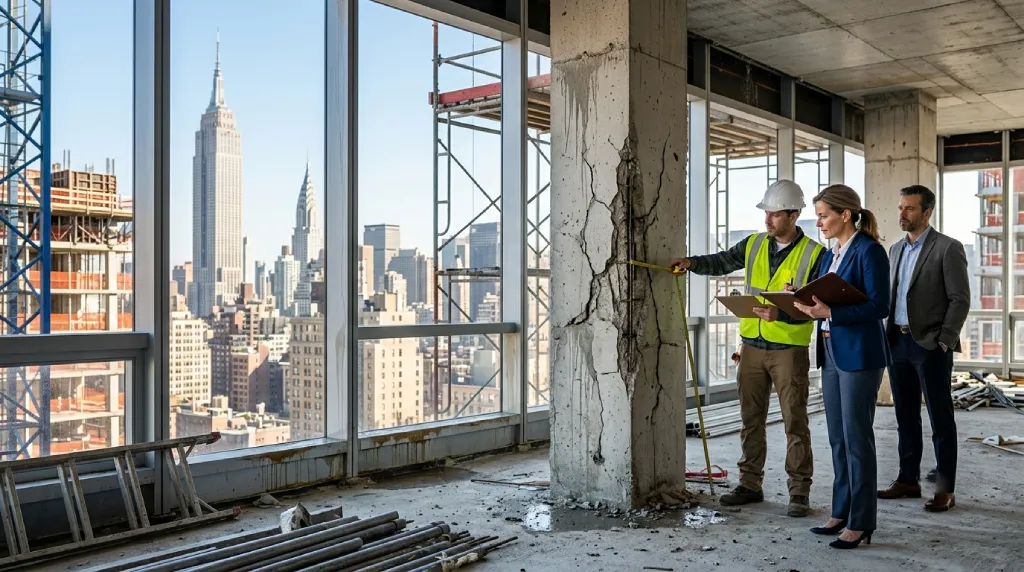
If you have a construction defect claim in Manhattan, Silver Law Group represents property owners, condo boards, unit owners, and contractors in disputes involving deficient design, materials, or workmanship. A Manhattan construction defect lawyer from our firm will evaluate your contracts, inspect your property, and identify every responsible party — at no charge until we assess whether you have a viable claim. Call us today for a free consultation in English, Spanish, or Russian.
What Is a Construction Defect Under New York Law?
Not every imperfection in a finished building is a legally actionable construction defect. To have a claim, the condition must represent a failure to meet contract specifications, applicable New York City building codes, or accepted industry standards — and that failure must have caused measurable harm. New York courts classify defects based on their origin: who designed the building, who built it, and who supplied the materials. That classification drives who bears legal responsibility.
Many defects are latent — meaning they were not visible when construction was completed. They surface years later through water infiltration, cracking, structural movement, or system failures. Latent defects are common in Manhattan’s aging building stock and in recently completed luxury residential towers where speed-to-market pressures encourage shortcuts. If you are seeing damage that did not exist when you moved in or when construction ended, there may be a legal claim even if the defect was invisible at first.
Types of Construction Defects in Manhattan
New York construction law recognizes four primary categories of defects, each carrying different legal implications for who bears responsibility.
Design Defects
Design defects originate with architects, engineers, or other design professionals. They occur when the plans and specifications are themselves flawed — even if the contractor built exactly what was drawn. Structurally inadequate load calculations, waterproofing specifications that cannot handle New York precipitation, drainage systems designed to back up, and facades that cannot withstand wind loads are all examples of design failures. Design professionals carry separate professional liability (E&O) insurance and are named defendants in their own right, independent of the general contractor.
Workmanship Defects
Workmanship defects occur when contractors or subcontractors fail to execute work in accordance with contract documents or industry standards. Improper concrete pours, incorrectly installed roofing membranes, poor masonry joints, faulty wiring, and inadequate waterproofing application are among the most common examples. These defects expose the general contractor and the relevant subcontractors to liability. When the GC accepted non-conforming work without requiring correction, their exposure extends to the subcontractor’s failures.
Material Defects
Material defects arise from the use of substandard, counterfeit, or incorrect materials that fail to perform as specified. In some cases the material was defective when it left the manufacturer — creating a product liability claim against the supplier that runs separately from your construction contract claims. Alternatively, the contractor may have substituted an inferior product without your authorization, which is both a breach of contract and potentially a basis for fraud damages.
Installation Defects
Installation defects involve correct materials improperly installed. Windows installed without proper flashing, HVAC systems connected out of sequence, plumbing that violates minimum slope requirements, and structural components installed contrary to the engineer’s specifications all qualify. These are often the most difficult defects to prove because liability depends on expert analysis of how the work was performed versus how it was specified — not simply what materials were used.
Who Can Be Held Liable for a Construction Defect in Manhattan?
Construction defect cases in New York frequently involve multiple potentially responsible parties. Liability depends on the type of defect, the contracts in place, and each party’s role in the project. Identifying all liable parties from the outset is essential — settling a claim against one defendant without preserving your rights against others can permanently limit your recovery.
Developers and Sponsors
In condo and co-op projects, the sponsor is often the primary defendant. Under New York’s Martin Act and the condo Offering Plan, sponsors make written representations about construction quality, materials, and systems that become legally binding on buyers. Boards of managers and individual unit owners can sue based on failures to deliver what the Offering Plan promised — even after the sponsor has sold all units and moved on.
General Contractors
General contractors are responsible for managing the overall construction process, supervising subcontractors, and ensuring work complies with plans and specifications. Defective work performed by a subcontractor may also expose the GC to liability if the GC failed to supervise adequately or accepted non-conforming work without requiring correction before closing out the project.
Subcontractors
Individual trade contractors — plumbing, electrical, roofing, concrete — may be directly liable for defects within their scope of work. They are routinely named alongside the GC and developer in multi-party litigation. In cases involving latent defects, subcontractors may attempt to argue that the defect resulted from a different trade’s work; resolving those disputes requires forensic expert analysis.
Architects and Engineers
Design professionals may be liable when the defect originated in the plans rather than in the execution. New York imposes a privity limitation on design professional claims — in many cases, only parties with a direct contractual relationship can sue the architect or engineer. Exceptions exist where the defect caused property damage or personal injury beyond purely economic loss, and your attorney will evaluate which pathway applies to your situation.
Material Suppliers and Manufacturers
When defective materials — not defective installation — caused the damage, the supplier or manufacturer may face product liability claims independent of the construction contract. These claims run on different legal theories and different statutes of limitations than breach of contract claims, which is why early legal analysis matters.
Who Does Silver Law Group Represent?
Property Owners and Homeowners
Individual property owners who discover defects after purchasing or renovating a Manhattan home can pursue claims against the contractor, developer, or architect responsible. Your recovery may include the full cost of repair, diminution in the property’s market value, and consequential damages such as temporary relocation costs.
Condominium Boards and Homeowners Associations
Condo boards have standing under New York law to sue developers for defects affecting common elements of the building. The Offering Plan is the governing document for these claims. Boards generally have 6 years from the date of the first unit sale, but the clock starts running the moment the board takes control from the sponsor. Retaining an independent engineer at the time of turnover — before defects are accepted as normal wear — is one of the most important steps any new board can take.
Individual Condo Unit Owners
Unit owners have separate rights regarding defects within their individual units, distinct from the board’s claims over common areas. Both claims can proceed simultaneously. If the board is pursuing the developer for common element failures and your unit has its own defects, you do not have to wait for the board’s litigation to resolve before pursuing your own claim.
Contractors and Subcontractors
Silver Law Group also represents contractors and subcontractors defending against wrongful defect claims. Property owners and developers sometimes withhold payment or threaten litigation based on defect allegations that are exaggerated, attributed to the wrong trade, or used as pretext for avoiding payment obligations. Construction disputes routinely involve counterclaims for unpaid contract amounts, and your right to enforce those claims does not disappear simply because the owner is threatening to sue.
Developers and Sponsors
We advise developers and sponsors responding to construction defect claims from condo boards or individual buyers. Navigating the Martin Act context, managing DOB-related consequences, and negotiating durable settlements requires counsel who understands the full exposure — not just the civil litigation side. Early engagement reduces the total cost of resolution.
Compensation Available in Manhattan Construction Defect Cases
What you can recover depends on the nature of the defect, the damages it caused, and the contracts in place. The following categories represent the most common forms of recovery in Manhattan construction defect cases.
Cost of Repair and Remediation
The most common form of recovery. This includes what it costs to properly fix the defective work: removal of defective materials, reconstruction to correct standards, and restoration of finishes damaged in the process. In Manhattan, remediation costs are consistently higher than the national average because of labor costs, access constraints, and building-specific logistics.
Diminution in Property Value
When defects cannot be fully repaired or have permanently affected the property’s market value, owners may claim the difference between the defect-free property value and its current condition. In Manhattan’s luxury market, even partially remediated defects can carry significant valuation impact.
Loss of Use and Consequential Damages
Lost rental income during repair periods, hotel and temporary housing costs during displacement, and additional carrying costs — mortgage interest, maintenance fees, and common charges — attributable to the defect dispute. These costs are recoverable when you can document them with records.
Mold and Environmental Remediation Costs
Water intrusion defects frequently trigger mold growth requiring specialized remediation with its own cost basis, separate from structural repairs. Mold remediation in Manhattan buildings can run from tens of thousands to hundreds of thousands of dollars depending on the extent of infiltration.
Engineering and Expert Fees
In many construction defect cases, the reasonable costs of investigation and expert analysis are recoverable as part of the overall damages claim — particularly when the contract or applicable statute provides for this recovery.
Attorney’s Fees
In certain circumstances — particularly where the construction contract includes an attorney’s fee provision or where consumer protection statutes apply — attorney’s fees may be recoverable from the responsible party in addition to your damages.
Why Choose Silver Law Group as Your Manhattan Construction Defect Lawyer?
Silver Law Group has represented New York construction defect clients for over two decades, handling disputes involving condo boards, individual unit owners, property developers, and contractors across Manhattan, the outer boroughs, and the greater New York metropolitan area. Our attorneys have experience with both sides of construction defect disputes — we understand how developers and contractors build their defenses, and we use that knowledge when representing injured property owners and boards.
Our office is located in Manhattan. Every case begins with a free consultation — in person or by phone, in English, Spanish, or Russian. For construction defect matters involving property damage, fee structures are explained fully at the outset and are based on the scope and complexity of your matter. You will know exactly what the engagement looks like before you commit.
For personal injury claims arising from construction site accidents — including scaffold law violations under New York Labor Law Sections 240 and 241 — Silver Law Group handles those cases on a contingency basis: no fee unless you recover.