

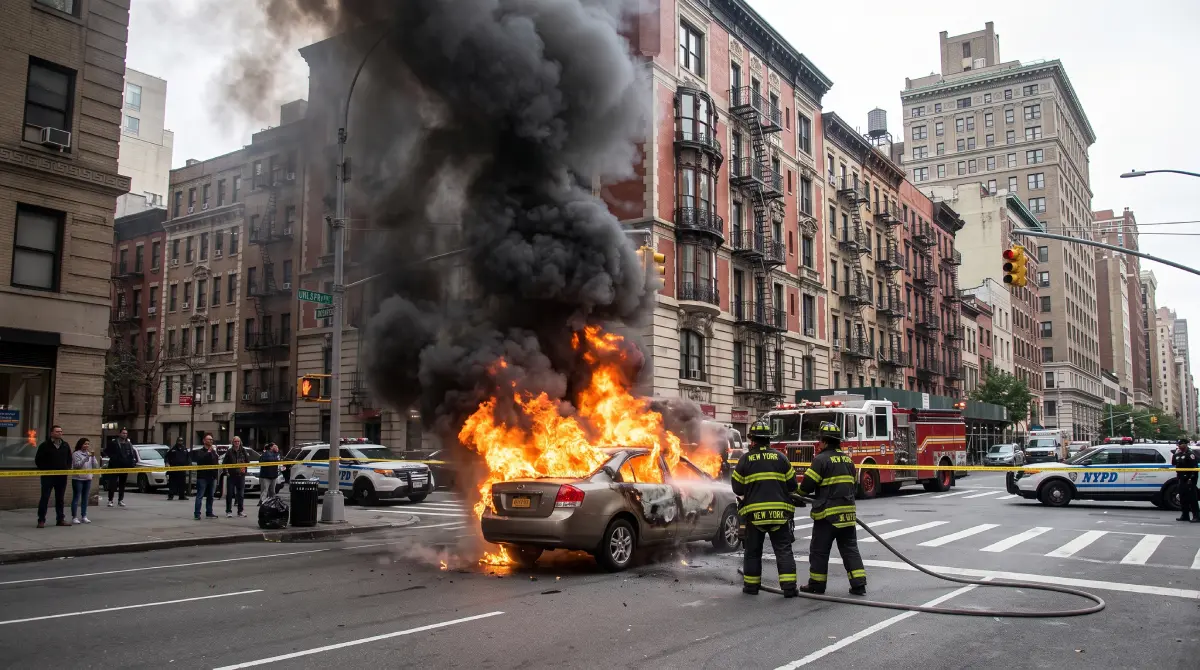
A vehicle fire burns drivers, passengers, pedestrians, and the people riding in Manhattan taxis and rideshare cars, and the injuries are often permanent. A Manhattan car fire lawyer at Silver Law Group handles these cases along two paths: a negligent driver who caused the crash that started the fire, or a defective vehicle or part that ignited on its own. Every case starts with a free consultation, and you pay no fee unless you recover. We answer 24/7 and consult in English, Spanish, and Russian from our Midtown office at 49 West 37th Street.
Do You Have a Case After a Car Fire in Manhattan
Three different parties can owe you money after a car fire, and which one applies depends on what lit the fire. If another driver’s negligence caused the collision that started it, that driver and their insurer are on the hook. If a fuel-system or electrical defect ignited the vehicle, the manufacturer or the seller can be liable under New York’s strict products liability rule, which means you do not have to prove they were careless, only that the product was defective and the defect caused your injury. A third party can be responsible too: a repair shop that reconnected a fuel line wrong, or a parking garage operator whose building conditions let one fire spread.
Partial fault does not end your claim. New York follows pure comparative negligence under CPLR 1411, so if you are found 20 percent responsible, your recovery drops by 20 percent, but it is never wiped out.
What Causes Vehicle Fires
US fire departments answered an average of about 196,000 highway vehicle fires a year from 2018 through 2022, and those fires killed roughly 579 people annually, according to the NFPA. Most start in the engine compartment. The usual ignition sources:
- Fuel-line leaks that drip onto hot engine parts
- Electrical faults and shorted wiring
- Fuel ruptures after a collision
- Defective parts, including recalled components
- Neglected maintenance that lets a small problem become a fire
Collisions cause only a small share of vehicle fires, but they account for roughly 60 percent of the fatal ones, the US Fire Administration reports. The cause of the fire decides who is liable. A crash fire points to the other driver; a fire with no crash points to a defect or a bad repair.
Electric Vehicle and Lithium-Ion Battery Fires
A damaged lithium-ion battery can go into thermal runaway, a chain reaction where one overheating cell heats the next until the whole pack ignites. What makes these fires different is timing: an EV or hybrid battery can reignite hours or even days after the crash that damaged it, long after the tow truck has left. That risk is closer to home in Manhattan than most drivers think, with a growing electric taxi and rideshare fleet on the streets and thousands of these cars sitting overnight in enclosed parking garages where a delayed reignition has nowhere to vent.
Fires That Start While Parked or in a Parking Garage
When a parked car catches fire with no collision involved, the fire itself is evidence. Cars do not ignite on their own unless something is wrong, whether a defect or a repair done badly. In Manhattan’s enclosed, multi-level garages, that first fire rarely stays one car; heat and burning fuel spread down a row of tightly packed vehicles before FDNY can reach the level. Two parties can owe you: the operator of the garage, if its layout or fire suppression failed, and the owner of the vehicle that ignited, if a defect or a neglected repair started it.
Injuries Caused by Car Fires
Fire injuries range from painful to fatal, and the severity drives both your treatment and your claim. Burns are graded by depth:
- First-degree burns damage only the top layer of skin and usually heal on their own.
- Second-degree burns reach the layer beneath and blister.
- Third-degree burns destroy the full thickness of skin and often need grafts.
- Fourth-degree burns extend into muscle, tendon, or bone.
Beyond burns, fire victims suffer smoke inhalation and airway damage, permanent disfigurement, and in the worst cases wrongful death. Severe burns in Manhattan are usually treated at the William Randolph Hearst Burn Center at NewYork-Presbyterian/Weill Cornell on East 68th Street, the largest burn center in New York State.
Smoke Inhalation and Delayed-Onset Injuries
The firewall between a car’s engine and cabin stops flames, but it does not stop smoke and toxic fumes. You can walk away from a fire with no burns and still have breathed in enough to injure your lungs and airway, and that damage often shows up hours or days later, as tightness, a cough, or trouble breathing. Get examined the same day even if your skin is untouched. Waiting hurts your lungs and your claim at once, because a gap between the fire and your first medical record gives an insurer room to argue the fire did not cause your injury.
Burns, Scarring, and Significant Disfigurement Under New York Law
Significant disfigurement is one of the serious injury categories written into New York Insurance Law 5102(d). That matters because no-fault normally blocks you from suing for pain and suffering. A burn that leaves permanent, visible scarring can meet the 5102(d) threshold, which lifts that block and lets you sue the at-fault party directly for the disfigurement and the pain that comes with it.
What a Manhattan Car Fire Injury Claim Is Worth
No honest lawyer will quote your case a number before investigating it, and anyone who does is guessing. What a claim is worth depends on facts that take time to gather. A car fire claim can recover:
- All medical care, past and future, from emergency treatment and skin grafts to reconstructive surgery and the follow-ups that come years later
- Rehabilitation, including physical therapy and long-term wound care
- Lost income and reduced earning capacity if burns keep you from your job
- Pain and suffering
- Compensation for permanent disfigurement
- In a fatal fire, the losses the family suffers under New York’s wrongful death law
Three things move the value most: how severe the burns are, whether the scarring is permanent, and how many parties and insurance policies you can reach. A crash caused by another driver may open one policy; a defect claim against a manufacturer can open far larger coverage, which is one reason preserving the burned vehicle matters so much.
What to Do After a Vehicle Fire in Manhattan
The hours after a fire decide how strong your claim will be. Take these steps in order.
- Get clear of the vehicle and call 911. A burning car can reignite or reach the fuel tank, so put distance between you and it first, then call.
- Get medical care the same day. Burns and smoke injuries both worsen after the fact, and the record you create now anchors your claim.
- Get the NYPD collision report, and ask whether the FDNY fire marshal made a cause determination. The marshal’s finding on how the fire started can decide who is liable.
- Photograph the scene and the vehicle from every angle before anything is moved.
- Decline any recorded statement to an insurer. The adjuster will call within days; you can say you will follow up in writing and hang up.
Above all, do not let the burned vehicle go to a scrapyard. The wreck is the single most important piece of evidence in a defect claim — engineers examine the fuel system, the battery, and the wiring to prove what failed. Once it is crushed or sold for parts, that proof is gone, and a strong products case can collapse with it. Tell your insurer in writing that the vehicle must be preserved, and call a lawyer before you sign anything releasing it.
How No-Fault Insurance Works After a Car Fire
New York no-fault pays your early medical bills and part of your lost earnings no matter who caused the fire, but only if you file the application within 30 days of the crash. Miss that window and you can lose the coverage entirely. No-fault has a hard limit, though: it never pays a cent for pain and suffering, which is why the serious-injury threshold and a direct lawsuit matter so much for burn victims. And a products claim against the carmaker sits completely outside no-fault, so a defect case follows its own track and its own, longer deadline.
What It Costs to Hire a Manhattan Car Fire Lawyer
Hiring a Manhattan car fire lawyer costs you nothing up front. Silver Law Group works on a contingency fee, which means the fee is a percentage of what we recover for you and comes out of that recovery, not out of your pocket. If we do not win or settle your case, you owe no attorney’s fee at all, so the risk sits with the firm, not with you. That is deliberate: a burn victim who cannot work should not have to find money for a retainer to hold a manufacturer accountable. Every case starts with a free consultation, and if your injuries keep you from traveling, the attorney will come to your home or hospital room.
Deadlines to File a Car Fire Lawsuit in New York
A car fire claim runs on several clocks at once, and the shortest one that applies to your case controls everything.
- 30 days to file your no-fault application after the crash.
- 90 days for a Notice of Claim under GML 50-e if a city vehicle, an MTA bus, or another public entity was involved — and then one year and 90 days to sue under GML 50-i.
- Two years to bring a wrongful death claim under EPTL 5-4.1 if the fire killed someone, measured from the date of death.
- Three years to sue for personal injury or product liability under CPLR 214, measured from the injury date.
These run on top of each other, not one after the next. If a public entity is involved, the 90-day notice can end your case months before the three-year lawsuit deadline ever comes into play. Talk to a lawyer while every clock is still open.
Why Choose Silver Law Group After a Vehicle Fire
Insurers handle car fire claims the same way every time: they delay, they ask for a recorded statement, and they offer a fast, low number while you are still in treatment and worried about bills. Silver Law Group works the other side of that. What you get:
- Free consultations in English, Spanish, and Russian
- Someone who answers 24/7, because fires do not wait for business hours
- A contingency fee, so there is no fee unless you recover
- Trial-ready preparation on every case, which is what makes an insurer take a settlement seriously
- An attorney who comes to your home or hospital room when you cannot travel
The office is in Midtown Manhattan at 49 West 37th Street, 7th Floor. Call 212-470-4544 to start.