

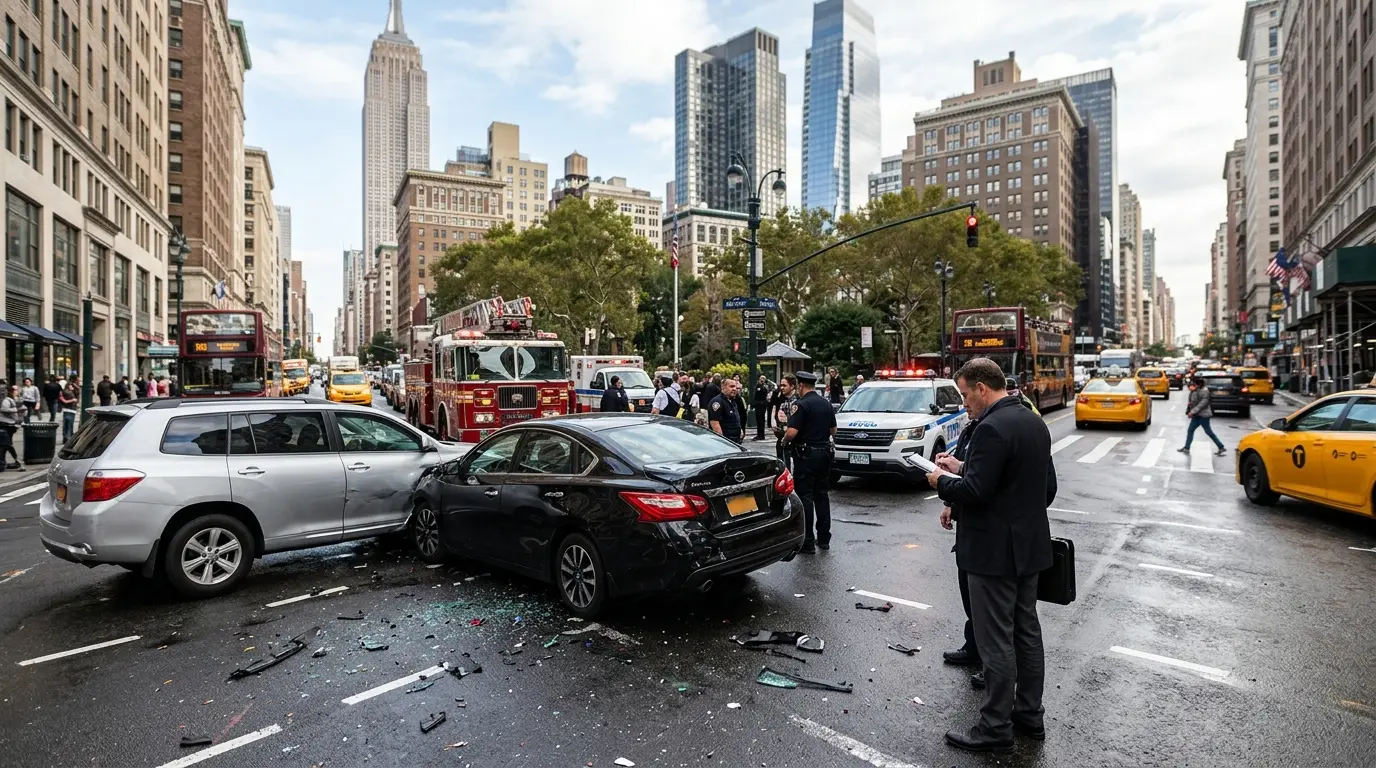
If you need a Manhattan car accident lawyer, Silver Law Group offers free consultations — in person, by phone, or by video — with no obligation and no upfront cost. Our firm handles every case on contingency: you pay nothing unless we recover money for you. The fee comes from the settlement. If there is no recovery, there is no fee.
New York City’s streets are not forgiving. Manhattan’s intersections, expressways, and commercial traffic create conditions where serious crashes happen every day. If you were hurt, you are probably dealing with medical bills that keep arriving, a gap in your paycheck, and at least one call from an insurance adjuster who is not on your side. That call was not made in your interest. It was made to settle your claim quickly and cheaply.
What Happens After a Car Accident in Manhattan — and Why It Matters Fast
The first 72 hours after a crash are the most important for your legal claim. Traffic camera footage gets overwritten. Witness memories fade. Physical evidence disappears from the scene. Insurance adjusters move immediately — because they are alert of the incident and take advantage of your vulnerable state.
New York is a no-fault state, this means, your auto insurance pays your initial medical bills and a portion of lost wages through the Personal Injury Protection (PIP) benefits you pay for regardless of who caused the crash. However, everything has its limits.
If an insurance adjuster has already called you, understand what that call was: an attempt to record your statements, minimize your injuries, and close your claim before you understand what it is worth. Do not give a recorded statement without speaking to an attorney first.
Silver Law Group consultations are free, with no obligation. English, Spanish, and Russian. Call before you say anything else to an adjuster.
Manhattan Car Accident Lawyer — When You Can File a Claim Against the At-Fault Driver
New York’s no-fault system limits your right to sue — unless your injuries meet the serious injury threshold under Insurance Law §5102(d). If they do, you can bring a liability claim against the driver who caused the crash for your full damages.
Under §5102(d), qualifying injuries include:
- A bone fracture
- Significant disfigurement
- Permanent loss of use of a body organ, member, function, or system
- Permanent consequential limitation of use of a body organ or member
- Significant limitation of use of a body function or system
- A medically determined injury or impairment of a non-permanent nature that prevents you from performing substantially all of the material acts that constitute your usual and customary daily activities for at least 90 out of 180 days following the accident
Read that last category carefully. If your injuries kept you out of work, unable to perform normal activities, and you have medical documentation of that, you may qualify even without a fracture.
3 Years — New York’s statute of limitations for personal injury claims under CPLR §214. Miss this deadline and your claim is permanently barred — regardless of how serious your injuries are.
New York’s No-Fault Rules — What They Cover and What They Don’t
PIP covers medical bills related to your crash injuries and 80% of lost wages, up to $50,000 total. That limit applies per accident, not per person on the policy. Once your medical treatment exceeds $50,000 — or once your injuries qualify as serious under §5102(d) — your no-fault coverage is no longer the end of the story.
At that point, you can pursue the at-fault driver directly for economic damages (past and future medical costs, lost earnings, rehabilitation) and non-economic damages (pain and suffering, loss of enjoyment of life). No-fault was designed to speed up small injury claims. It was not designed to be the only compensation available when someone is seriously hurt.
Common Causes of Car Accidents in Manhattan
Manhattan’s traffic density means that when something goes wrong, it rarely involves just two vehicles. Multi-vehicle crashes are common on narrow side streets, in tunnels, and on high-speed corridors like the FDR Drive and West Side Highway. Liability can be split across multiple parties — the at-fault driver, a commercial fleet employer, or even the City.
The most common causes Silver Law Group sees in Manhattan car accident cases:
- Distracted driving — phone use, GPS, eating behind the wheel
- Failure to yield at intersections — one of the leading causes of pedestrian and cyclist fatalities in Manhattan
- Speeding on the FDR Drive and West Side Highway
- Running red lights, especially in Midtown during off-peak hours
- Drunk and impaired driving
- Commercial vehicle negligence — delivery trucks making illegal stops, taxi drivers cutting lanes, rideshare vehicles stopping suddenly in traffic
Who Is Liable — and Why Manhattan Cases Are More Complicated Than They Look
New York follows pure comparative fault under CPLR §1411. That means you can recover even if you were partly at fault for the crash — your recovery is reduced by your percentage of fault, not eliminated. If a jury finds you were 20% at fault and your damages are $500,000, you recover $400,000.
Insurance companies know this rule. They use it to argue that you share blame — even when the facts do not support it — because reducing your fault percentage reduces their payout. This is one reason why the investigation stage matters so much.
Manhattan cases also involve layered liability that does not exist in most other jurisdictions:
- Uber and Lyft drivers — Insurance coverage depends on which period applies — whether the driver had a passenger, was waiting for a match, or was offline entirely. Each period triggers a different coverage layer, with limits ranging from personal auto coverage to $1.25 million in liability.
- Yellow cab and black car crashes — Medallion companies and fleet owners may carry liability separate from the individual driver’s coverage.
- Delivery fleet corporate liability — A driver employed by a delivery company who causes a crash while on duty exposes the employer to liability under respondeat superior.
- City of New York liability — Dangerous road conditions — potholes, malfunctioning signals, failed guardrails — can expose the City to liability, but filing deadlines are shorter and the notice requirements are strict.
Silver Law Group’s investigation begins at the first consultation. We pull police reports, request traffic camera footage before it is overwritten, identify all potential defendants, and determine which insurance layers apply.
Rideshare and Taxi Accidents in Manhattan
Uber and Lyft crashes involve a three-period coverage structure that determines which policy applies at the time of your collision. Period 1 (app on, no ride accepted): $50,000/$100,000 liability coverage through Uber or Lyft. Period 2 and 3 (ride accepted through passenger dropoff): $1.25 million in liability coverage through the TNC. If the driver was offline, only their personal auto policy applies.
Yellow cabs operating under a medallion may be covered under a commercial fleet policy held by the medallion owner — not just the driver. City-licensed vehicles also involve regulatory layers that affect how and against whom you file. Identifying the correct coverage layer immediately is not a formality. It determines whether your claim is worth pursuing and who pays.
Injuries Silver Law Group Handles in Manhattan Car Accident Cases
Insurance companies assign low values to injuries they can argue will heal on their own. That is their opening position. The documented reality of your injury — and your long-term prognosis — is what determines actual value.
Silver Law Group handles Manhattan car accident cases involving:
- Traumatic brain injury (TBI) and concussion — symptoms often do not appear until days after the crash; without immediate medical documentation, insurers dispute causation
- Spinal cord injuries — including herniated discs, nerve damage, and paralysis
- Broken bones and fractures — automatically qualifying injuries under §5102(d)
- Soft tissue injuries — whiplash, torn ligaments, tendon damage; undervalued by insurers but often debilitating
- Internal injuries — organ damage, internal bleeding
- Burns and scarring
- Wrongful death — when a family member did not survive the crash
If you feel okay right now, get medical attention anyway. TBI and spinal injuries frequently do not manifest fully for 24 to 72 hours. An immediate medical visit creates a documented record that directly connects your injuries to the crash. Without that record, insurers argue your injuries came from somewhere else.
$1M–$5M+ — Settlement and verdict range for serious car accident injuries in New York, including spinal cord injuries, TBI, and multi-fracture cases. Soft tissue claims without documentation regularly settle for far less — often under $50,000. Documentation is the difference.
What Compensation You Can Recover
The insurance company’s first offer is not a fair calculation of what your case is worth. It is the minimum number they believe you will accept without a lawyer.
In a Manhattan car accident case, your recoverable damages fall into two categories:
- Economic damages — Past and future medical bills, lost wages, reduced future earning capacity, the cost of ongoing physical therapy and rehabilitation, home care, and any assistive equipment your injuries require.
- Non-economic damages — Pain and suffering, emotional distress, loss of enjoyment of life, and the long-term impact of your injuries on your relationships and daily experience.
In wrongful death cases, recoverable damages include funeral and burial costs, the financial support the deceased would have provided to the family, and loss of companionship under EPTL §5-4.3.
Silver Law Group builds your damages picture using your medical records, treating physicians, independent medical experts, and economic analysts who calculate the lifetime cost of your injuries. That documentation is what drives settlements above the insurer’s initial offer — and what supports a jury verdict when an insurer refuses to settle at fair value.
Contingency means this: Silver Law Group advances all costs of investigating and litigating your case. You pay nothing while your case is pending. If we recover money for you, our fee comes from that recovery as a percentage. If we do not recover, you owe nothing — not for legal fees, not for case expenses.
How Long Do You Have to File a Car Accident Claim in Manhattan?
New York’s standard deadline for personal injury claims is 3 years from the date of the accident under CPLR §214. Miss it and your claim is gone — regardless of how serious your injuries are or how clear the other driver’s fault.
Several situations shorten that deadline significantly:
- Claims against the City of New York — You must file a Notice of Claim within 90 days of the accident. The lawsuit itself must be filed within 1 year and 90 days. If a city vehicle caused your crash — an MTA bus, a sanitation truck, a police car — this shorter deadline applies.
- Dangerous road conditions — If a defective road, signal, or guardrail contributed to your crash and the City is liable, the 90-day notice requirement applies.
- Wrongful death — 2 years from the date of death, not the date of the accident.
Waiting does not protect you. Evidence disappears. Witnesses become unavailable. The adjuster’s early settlement offer — already low — will be withdrawn once you have an attorney. The time to call is now, not after you have tried to handle this yourself.
90 Days — The deadline to file a Notice of Claim against the City of New York. If a city vehicle or a dangerous municipal road condition caused your crash, this deadline begins the day of the accident — not the day you hire a lawyer.