

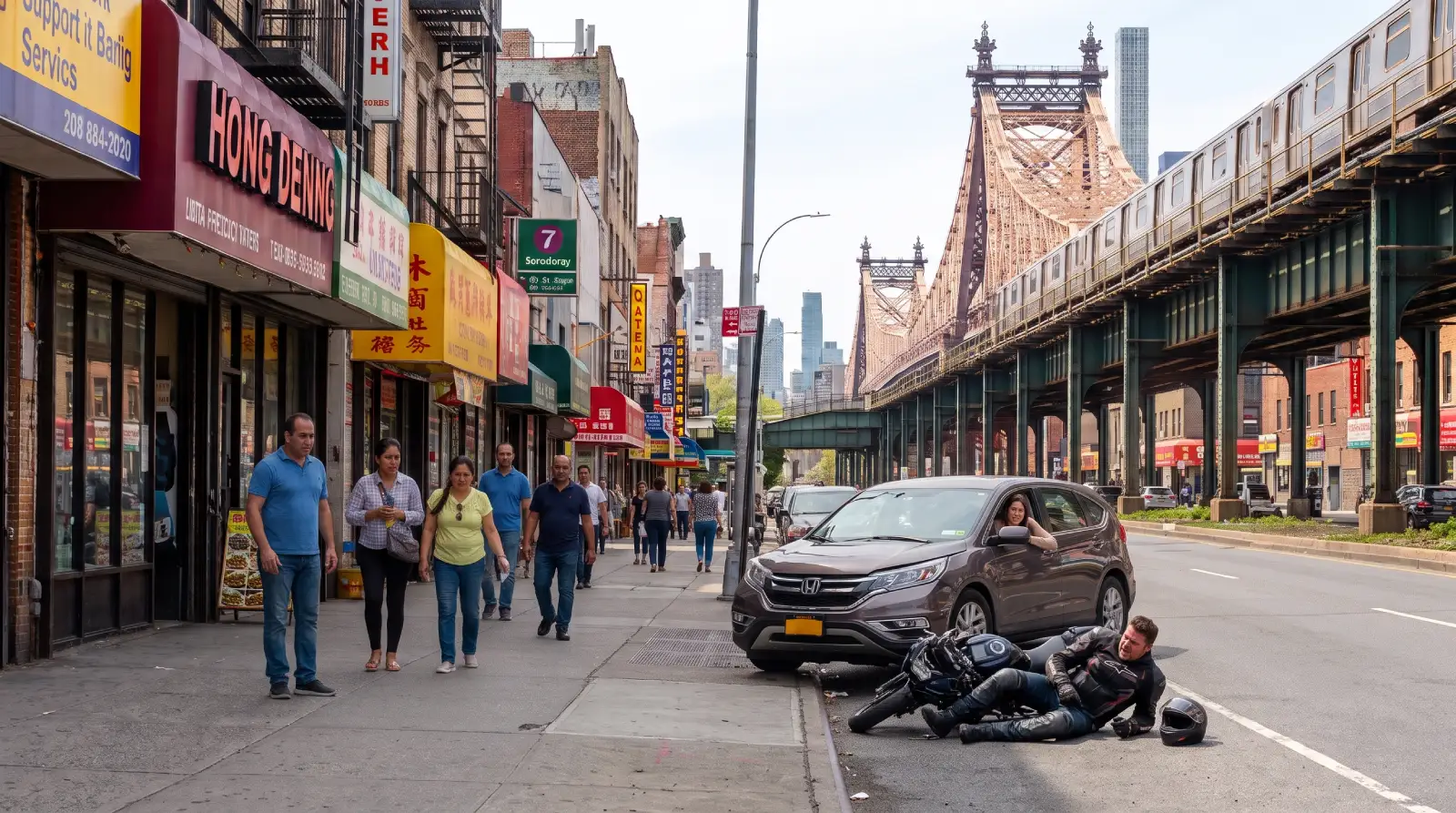
Get hurt by someone else’s carelessness in Queens, and the first call you make matters. A Queens personal injury lawyer at Silver Law Group will tell you for free, around the clock and in English, Spanish, or Russian, whether your claim is worth pursuing, and you owe no fee unless we recover money for you. As an accident and injury attorney serving the whole borough, we represent people hurt everywhere from a rear-end wreck on the Van Wyck Expressway to a fall in a Flushing apartment lobby. Our injury attorneys work on contingency, so hiring this personal injury law firm costs nothing upfront and nothing at all unless you win.
Where Serious Injuries Happen in Queens
Queens traffic deaths fell from 74 in 2024 to 57 in 2025 in NYC DOT’s count, progress that still leaves the borough among the deadliest in the city. Most of that danger concentrates on a few roads.
Queens Boulevard earned the name “Boulevard of Death” from the city’s own transportation department. Even after DOT finished the final phase of its redesign in 2024 through Sunnyside and Long Island City, its wide crossings and long signal cycles still strand pedestrians in lanes where drivers turn faster than they should.
The high-speed crashes tend to happen on the Long Island Expressway, the Van Wyck Expressway, and the Grand Central Parkway. Surface arteries like Northern Boulevard and Woodhaven Boulevard produce a different kind of wreck, where trucks and buses share space with cyclists and people crossing mid-block. Two airports, JFK and LaGuardia, pour taxi, rideshare, and delivery traffic into all of it, and the borough’s constant construction narrows lanes and drops workers into live roadways.
Types of Personal Injury Cases We Handle in Queens
As a law firm for accidents of every kind, Silver Law Group handles the full range of injury claims that come out of Queens, and each case type has its own detailed page.
- Car and truck crashes on roads like the LIE and Queens Boulevard, where highway speeds turn a fender-bender into a hospital stay.
- Motorcycle accidents, which leave riders exposed to far worse harm than the drivers who cut them off.
- Pedestrian and bicycle collisions at the borough’s dangerous intersections and unprotected crossings.
- Slip-and-fall and premises liability claims: an unshoveled walk in Astoria, a broken stair in a Jackson Heights walk-up, water left standing in a store aisle.
- Construction and Labor Law injuries on Queens job sites, from falls off scaffolding to falling debris, where New York’s Labor Law gives injured workers rights beyond a standard negligence claim.
- Medical malpractice at Queens hospitals and clinics.
- Wrongful death, when a family loses someone to another party’s negligence.
- MTA bus and subway crashes and rideshare collisions, which carry their own shorter deadlines.
Do You Have a Personal Injury Case?
Four things have to be true for you to have a case, and a Queens example makes them concrete. Say you slip on an unshoveled sidewalk in Astoria. First, the property owner owed you a duty to keep that walk reasonably safe. Second, they breached it by leaving ice there long enough that they should have cleared it. Third, that breach caused your fall and your injury, not some unrelated condition. Fourth, you have damages, whether a broken wrist, an ER bill, or weeks off work. Miss any one of the four and the claim fails, which is why a rear-end crash on the Long Island Expressway that leaves no injury and no cost is not a case, even though someone plainly broke the rules. The free case review exists to sort this out for you before you commit to anything.
What If You Were Partly at Fault?
New York follows pure comparative negligence under CPLR 1411, which means being partly to blame does not lock you out. If you were 30% at fault for a crash, you can still recover 70% of your damages. Even a driver found mostly responsible can collect something. So the fact that you think you share blame is not a reason to skip the call. It is a reason to let a lawyer, not the insurance adjuster, decide what your percentage actually is.
What Is Your Queens Personal Injury Case Worth?
No lawyer can tell you what your case is worth at the first call, and anyone who tries is guessing. Value depends on your injury, your treatment, your lost income, and how the accident changed your daily life. Recoverable damages fall into a few groups.
- Economic damages cover your medical bills, lost wages, and the cost of future care you’ll need after the case closes.
- Non-economic damages cover pain and suffering, plus the loss of enjoyment of life when an injury takes away things you used to do.
- Wrongful death damages, in a fatal case, compensate the surviving family for their loss rather than the victim directly.
Two people with the same diagnosis can end up with very different claims, because the value tracks how the injury actually plays out in a life.
The Serious Injury Threshold in Car Accident Claims
New York is a no-fault state for car crashes, so your own insurer pays your initial medical bills and part of your lost wages no matter who caused the wreck. There’s a catch on timing: the no-fault application generally has to reach your insurer within 30 days of the crash, and people who wait lose the benefit. No-fault also caps what you can pursue. To sue the at-fault driver for pain and suffering, your injury has to clear the “serious injury” threshold under Insurance Law 5102(d), which includes categories like a bone fracture, significant disfigurement, permanent limitation of a body organ or member, and significant limitation of use. A sprain that heals in a month usually won’t qualify; a fractured wrist from a Queens Boulevard crash will.
Injuries We See in Serious Queens Crashes
The crashes that clear that threshold tend to leave lasting damage: traumatic brain injuries, spinal cord injuries, multiple fractures, internal organ damage, and severe burns. In Queens, the most seriously hurt are usually taken to one of the borough’s two Level I trauma centers — NYC Health + Hospitals/Elmhurst at 79-01 Broadway, or Jamaica Hospital Medical Center on the Van Wyck Expressway near JFK. Get examined even if you feel functional at the scene. A brain injury can hide behind adrenaline for hours, and internal bleeding can take a day to surface, so the medical record you start now is what proves later that the crash caused what you’re dealing with.
What to Do After an Accident in Queens
The hours and days after an accident shape both your recovery and your claim. A few steps protect both.
- Get medical care now, not next week. Treatment is what heals you, and the record is what ties your injury to the accident.
- Report what happened. Call the police for a crash, tell the property owner or manager for a fall, and notify your employer in writing for a work injury.
- Photograph everything you can — the vehicles, the icy step, the wet floor, your visible injuries — before the scene changes.
- Get the police crash report number before you leave, or ask how to obtain the report later. It anchors the official version of events.
- Say no to recorded statements from any insurance adjuster. You are not required to give one, and it exists to catch you in a version that hurts your claim.
How We Build and Prove Your Claim
Proving a claim is mostly documentation, done early. The work breaks into three parts.
- Investigate what happened — the police and incident reports, any surveillance or traffic-camera video before it’s overwritten, and witnesses while their memory is fresh.
- Connect your diagnosis to your life through medical records that show not only the injury but the work you can’t do and the treatment still ahead.
- Take over the insurer, so from the day you hire us you stop fielding adjuster calls.
A file that’s organized and ready for trial is what moves an insurance company off a lowball number, because the adjuster can see what a jury would see.
Dealing With the Insurance Company
An adjuster is friendly for a living, but the job is to close your claim for as little as possible. The first offer usually lands fast and low, timed for the moment you’re worried about bills and haven’t spoken to a lawyer. Take it, and you sign away the right to anything more, even if your injury turns out worse than it looked in week one. The recorded statement is the other trap — a few careless words about how you “feel fine” become the quote the insurer reads back later. We handle every conversation with the at-fault driver’s insurer from day one, so nothing you say off the cuff ends up shrinking your recovery.
Where Your Queens Case Is Filed
Most Queens injury suits that seek substantial damages are filed in Queens County Supreme Court, Civil Term, which sits at two locations:
- 88-11 Sutphin Boulevard in Jamaica
- 25-10 Court Square in Long Island City
Filing there doesn’t mean you’ll see a courtroom. Most cases settle before trial, and we prepare every one as if it won’t, because an insurer settles fairly only when the file in front of it is ready to be tried.
Suing the City, the MTA, or a Public Hospital
If a city vehicle, an MTA bus or subway, an NYC Health + Hospitals facility, or a school-bus operator caused your injury, the rules change and the clock speeds up. You have to file a formal Notice of Claim within 90 days of the injury under General Municipal Law 50-e, and you generally have only one year and 90 days to actually sue under 50-i. These windows run far shorter than the deadlines for ordinary claims, and municipalities enforce them strictly. Waiting to see how you heal can quietly kill a valid claim, so a case against a public defendant is the one to call about first.
How Long You Have to File a Queens Personal Injury Claim
New York sets hard deadlines, called statutes of limitations, and blowing one almost always ends the case for good, no matter how strong it was.
- Most negligence and personal injury claims run three years from the injury, under CPLR 214.
- Medical malpractice gives you two and a half years under CPLR 214-a. Lavern’s Law can extend that clock in specific situations, like a surgical object left inside you or certain undiagnosed cancers, running the deadline from when the problem is found.
- Wrongful death claims must be brought within two years of the date of death, under EPTL 5-4.1.
- Claims against the city, the MTA, or another public body run on the 90-day Notice of Claim above, well short of any of these.
These are outer limits, not targets. Evidence and witnesses fade long before the deadline, so the sooner a lawyer starts, the more there is to work with.
What It Costs to Hire a Queens Personal Injury Lawyer
Hiring a Queens personal injury lawyer here costs nothing out of pocket, because we work on contingency. You pay no money upfront and no hourly bill along the way. Our fee is a percentage of whatever we recover for you, taken out of the settlement or award only if we win. If we recover nothing, you owe us no fee.
That structure ties our pay to your result and puts the risk on us, not on a family already stretched by medical bills. The first consultation is free either way, so finding out whether you have a case never costs you a dollar.
Why Injured Queens Residents Choose Silver Law Group
A few things set this firm apart for injured people in Queens, and none of them is a billboard number.
- We run free consultations and case reviews in English, Spanish, and Russian — a real fit for Queens, one of the most linguistically diverse places in the country.
- Someone is available 24/7, because a crash at 2 a.m. shouldn’t have to wait until Monday.
- We work on contingency, so there’s no fee unless we recover for you.
- We prepare every file for trial, which is what makes insurers take it seriously.
- If your injury keeps you home or in a hospital bed, the attorney comes to you.
Our office is at 49 West 37th Street, 7th Floor, in Midtown Manhattan, a short trip from Queens, and you can reach a lawyer at Silver Law Group any time at 212-470-4544.