

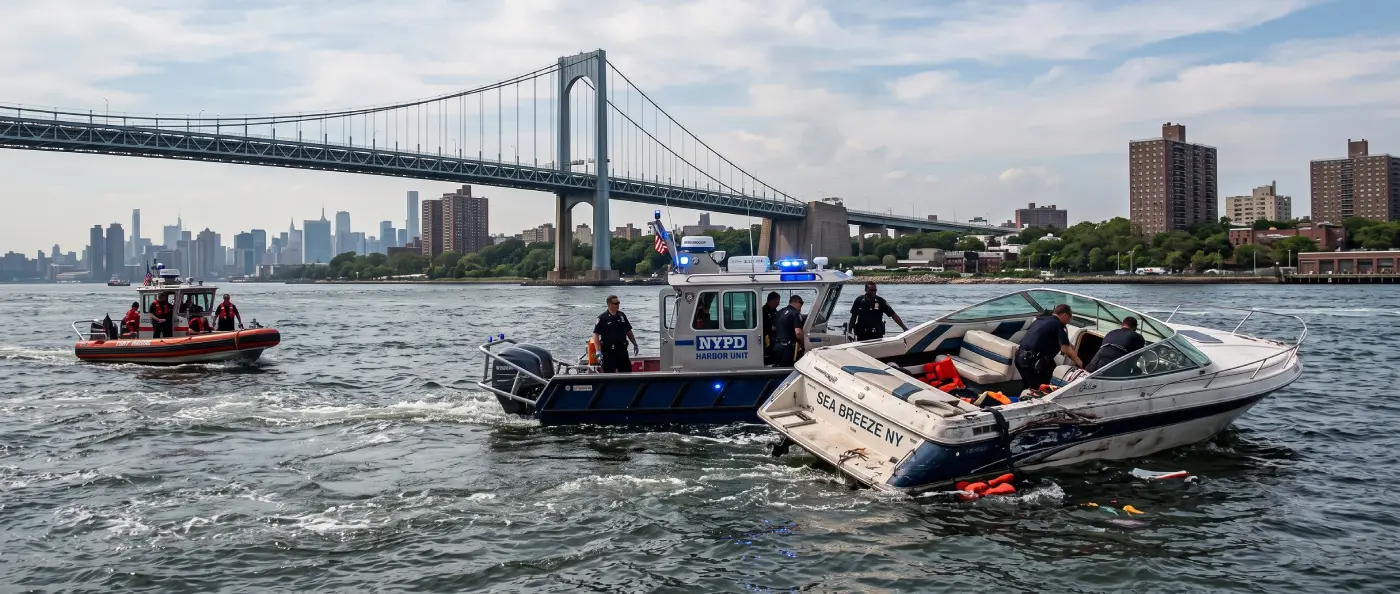
A Queens boat accident lawyer at Silver Law Group represents people hurt on and around the water in this borough, from Jamaica Bay and Rockaway Inlet to Flushing Bay and the East River. Almost every case follows one of three paths: a claim against a negligent operator or the owner who handed over the controls, a claim against a commercial vessel or rental operator, or a product claim over a defective vessel or component. Which path fits your injury decides who pays you and how fast you have to move. The consultation is free, available 24 hours a day in English, Spanish, or Russian, at 212-470-4544.
Where Boat Accidents Happen in Queens
Most Queens water claims come out of five places.
- Jamaica Bay and its channels off Broad Channel, Howard Beach and Hamilton Beach
- Rockaway Inlet, under the Marine Parkway–Gil Hodges Memorial Bridge, and the water beneath the Cross Bay Veterans Memorial Bridge
- Flushing Bay, off the World’s Fair Marina and College Point
- Little Neck Bay off Bayside
- The East River through Hell Gate, past Astoria, Long Island City and Hunters Point South
What makes these waters dangerous is who shares them. A rented center console, a fishing charter, a sightseeing boat, an NYC Ferry vessel on schedule and a tug moving commercial traffic all use the same narrow channels, and the channels do not widen at the moments they are busiest. Wake from a larger vessel throws passengers off small craft that never touched anything. Sightlines around Hell Gate and the inlet close fast, and a boat traveling at planing speed covers the distance before an operator finishes turning his head.
Do You Have a Boat Accident Case?
A Queens injury claim on the water has to show four things:
- The other party owed you a duty of reasonable care.
- They breached it — by speeding in a no-wake zone, running without a lookout, overloading the boat, drinking, or letting an unqualified person drive.
- That breach caused your injury.
- You have damages: medical treatment, lost income, permanent harm.
You do not have to be the operator, and you do not have to be on the water at all. Passengers hurt on the boat they were riding in have a claim against that operator or owner. Swimmers off the Rockaways and paddlers struck by a vessel have a claim. So do people hurt on docks, floating piers and gangways, where the fall happens on land-side property and the vessel is beside the point.
Who Can Be Held Liable
More than one party is usually responsible:
- the operator at the helm
- the vessel owner who handed the controls to someone unqualified or impaired
- the rental or charter company
- the marina or dock owner
- the tour or ferry operator
- the maintenance yard that serviced the engine or fuel system
- the manufacturer of a defective engine, steering system or fuel line
Finding every defendant matters far more here than in a car case. Behind a car crash there is almost always a liability policy, because New York requires one. Behind a recreational boat there may be nothing. Naming the marina, the rental company or the component manufacturer is often what turns a claim with no money behind it into one that can actually pay your bills.
Boating While Intoxicated and Safety-Certificate Violations
Navigation Law 49-a sets two thresholds: .08 BAC for a private vessel, and .04 BAC for a public or commercial vessel carrying passengers for hire. The lower number exists because a charter captain holds other people’s lives in his hands. No criminal charge is needed for that evidence to work in your civil case. Breath results, field observations, the officer’s report and witness accounts of what the operator drank at the dock all prove negligence on their own, and a case dropped by prosecutors can still be proven to a civil jury under a lower standard of proof. Navigation Law 78, known as Brianna’s Law, has required since January 1, 2025 that every operator of a motorized vessel in New York hold a state boating safety certificate, regardless of age. Fines run from $100 to $250 for operating without one. When the operator who hurt you never held the certificate, that violation goes straight to the question of whether he should have been driving the boat at all.
Common Queens Boat Accident Injuries
Water injuries do not resemble car injuries, and the mechanisms matter to your claim.
- Propeller strikes — deep lacerations, severed tendons, amputations to swimmers and to anyone who goes over the side near a running engine
- Drowning and near-drowning — oxygen deprivation causing permanent brain injury even when the person is pulled out alive
- Blunt trauma — fractures, spinal injury and internal bleeding from a collision, a hard landing off a wake, or being thrown against the hull
- Hypothermia and cold-water shock — the involuntary gasp reflex on immersion pulls water into the lungs within seconds
- Burns from fuel-vapor ignition in the bilge or at the fuel dock
- Carbon monoxide poisoning in enclosed cabins and behind swim platforms
Get evaluated the same day at a Level I trauma center: Jamaica Hospital Medical Center, Elmhurst Hospital Center or NewYork-Presbyterian Queens in Flushing. If the accident happened on the peninsula, St. John’s Episcopal in Far Rockaway is the closest emergency department. Carbon monoxide exposure and internal bleeding can look mild at the dock and present hours later, and the record created that day is what an insurer will read two years from now.
What a Queens Boat Accident Claim Is Worth
The recoverable categories are:
- past and future medical care, including surgery, rehabilitation and assistive equipment
- lost wages and diminished earning capacity
- pain and suffering
- disfigurement and scarring, which matter in propeller and burn cases
- loss of services to a spouse or family
Value tracks two things: how well the injury is documented and how permanent it is. There is no published average worth quoting, and any lawyer who gives you a number in the first phone call is guessing. Where the operator was intoxicated or acted recklessly, punitive damages may also be available, which are meant to punish the conduct rather than reimburse your losses.
Why New York’s No-Fault Rules Do Not Apply to Boats
No-fault covers motor vehicles. A boat is not a motor vehicle. That single distinction changes the whole shape of your claim compared to what you know from car accidents. After a car crash in Queens, your own insurer pays medical bills up front out of a $50,000 basic PIP fund, and you cannot sue for pain and suffering unless you meet the serious injury threshold in Insurance Law 5102(d). Neither applies on the water. Nobody is paying your hospital bills up front, and no threshold stands between you and a lawsuit — you can sue for pain and suffering from the first day, for any injury, without proving a fracture or 90 days of disability. The practical consequence is that your health insurance carries the bills in the meantime, and the liability claim reimburses those liens and pays your damages at the end.
What Happens If the Boat Owner Had No Insurance
New York does not require private recreational boat owners to carry liability insurance at all. Commercial vessels, charter operators and rental companies generally do carry it, which is one reason the identity of the boat changes the value of the case. When a private owner turns out to be uninsured, these are the routes an attorney checks:
- the owner’s homeowner’s policy, which sometimes extends to smaller boats
- an umbrella policy sitting above the home or auto coverage
- uninsured boater coverage on your own marine policy, if you own a vessel
- the marina’s or rental company’s liability policy, where their conduct contributed
- product liability coverage, where a component failure caused the casualty
The Limitation of Liability Act — Why Vessel Owners Move Fast
Under 46 U.S.C. 30523, a vessel owner can petition a federal court to cap total liability at the post-casualty value of the boat plus pending freight. A boat that burned to the waterline is worth almost nothing after the casualty, which is the point of the maneuver. Under 46 U.S.C. 30529(a), the owner has to file that action within six months of receiving written notice of a claim. Once filed, it can freeze every other lawsuit and pull all claimants into a single limited fund to divide among themselves. Six months is not long, and the clock starts on the owner’s side. A boat case left sitting on a desk is a boat case that can be answered by a federal filing before anyone has taken a deposition.
What to Do After a Boat Accident in Queens
- Account for everyone who went into the water, then get treated, even if you feel able to walk off the dock.
- Call 911, or hail Channel 16 on VHF if you are still on the water. Depending on location, the NYPD Harbor Unit, FDNY Marine units or U.S. Coast Guard Sector New York will respond.
- Photograph the vessel damage, the debris, the weather and the water conditions before anything is moved. Boats get towed, hauled and repaired within days, and the repair destroys the evidence.
- Write down hull registration numbers, the operator’s name, the owner’s name, and contact information for every passenger and witness on both boats.
- Do not give a recorded statement to any insurer — not the other boat’s carrier, not the rental company’s, not your own — before you have talked to a lawyer. Adjusters call early precisely because you are medicated, shaken and unsure what happened.
The Five-Day State Accident Report
Navigation Law 47-b requires the operator or owner of a vessel involved in an accident causing injury, death, disappearance, or more than $1,000 in property damage to file a written report with the New York State Office of Parks, Recreation and Historic Preservation within five days. That report is a contemporaneous account written before anyone has hired counsel, and a copy of it becomes evidence in your injury claim. The duty falls on the operator or owner. If you were a passenger, or a swimmer struck by a boat, nothing is required of you — but the absence of a filed report is itself worth something when the operator later tells a different story.
Injured on a Ferry, Charter, Tour or Fishing Boat
Commercial passenger vessels owe a heightened duty of care to the people who pay to ride them. The trade-off is that these claims run on much shorter clocks than an ordinary Queens injury case. Under 46 U.S.C. 30526, a ticket contract can require written notice of a passenger injury claim within six months and suit within one year. That language sits in the terms of carriage almost nobody reads at the gangway. Keep the ticket, the booking confirmation, the email receipt and any printed terms. In Queens, NYC Ferry landings at Rockaway (Beach 108th Street off Beach Channel Drive), Astoria and Long Island City serve thousands of riders, and a fall on a gangway or an injury during a hard landing at any of them raises a question of who the defendant is. NYC Ferry is an NYCEDC system operated by a private company under contract, which means the entity that owns the system and the entity that crewed your boat are not the same, and suing the wrong one wastes time you may not have.
Jet Ski and Personal Watercraft Accidents
Personal watercraft cause a share of serious injuries out of proportion to their size. They accelerate fast, they are rented to people who have never operated one, and off the Rockaways they run in the same water as swimmers who cannot be seen from a standing position at speed. Navigation Law 73-a sets a minimum operating age of 14 for personal watercraft, and the Brianna’s Law certificate requirement applies to jet ski operators just as it does to anyone else running a motorized vessel. A rental company that skipped the safety instruction, handed the key to a visibly intoxicated customer, rented to someone below the age minimum, or failed to inspect the craft can be sued alongside the rider who hit you. That second defendant usually carries the insurance the rider does not.
Marina, Dock and Boat Fire Claims
Plenty of water injuries happen with both feet on wood. Rotted or wet dock boards, unlit gangways at night, missing ladders, unsecured cleats and fuel-system failures at Queens marinas are premises liability and product liability claims, governed by the same negligence rules that apply to any property owner in the borough. Fire is the version of this that spreads. On August 13, 2025, a fire at Marina 59 on Beach 59th Street in the Rockaways involved four boats and injured three people, including a firefighter who was taken to St. John’s Episcopal Hospital. A docked vessel that ignites does not burn alone: it takes the boats tied beside it, the dock structure underneath, and anyone standing on the pier when the fuel goes.
If a Boating Accident Was Fatal
EPTL 5-4.1 gives two years to bring a wrongful death claim, and it runs from the date of death. That is a full year shorter than the personal injury deadline, and families routinely lose the claim by assuming they have three years. Only the personal representative of the estate can file. If no estate has been opened, that step comes first, and it takes time. Recoverable losses include funeral and burial costs, the financial support the family lost, the loss of parental guidance to children, and, through a separate survival claim, the conscious pain and suffering your family member experienced before death. Drownings and capsizings in Jamaica Bay and Rockaway Inlet often support both state law and federal maritime theories at once, which affects where the case is filed and what damages are available.
Federal Maritime Law or Queens Supreme Court?
The East River, Jamaica Bay and Rockaway Inlet are navigable waters of the United States. A claim arising on them can fall under federal admiralty jurisdiction, depending on the vessel involved and whether the activity bore a substantial relationship to traditional maritime commerce. A collision between a tug and a charter boat sits squarely there. Two friends in a small outboard may not. The concrete question is which courthouse. State court means Queens County Supreme Court at 88-11 Sutphin Boulevard in Jamaica, in front of a Queens jury. Federal admiralty means the Eastern District of New York in Brooklyn, where a maritime claim brought on the admiralty side is tried by a judge rather than a jury. The choice also changes which limitations period governs and how fault gets divided among multiple vessels. It is decided at the start of the case, not the middle, which is why the analysis belongs in the first weeks.
How Long You Have to File a Queens Boat Accident Claim
Five different clocks can apply to the same accident:
- CPLR 214 — three years for personal injury
- EPTL 5-4.1 — two years for wrongful death, from the date of death
- 46 U.S.C. 30106 — three years for a maritime tort
- 46 U.S.C. 30526 — six months’ written notice and one year to sue, where a passenger ticket imposes it
- General Municipal Law 50-e and 50-i — a 90-day Notice of Claim and suit within one year and 90 days, if a City or State entity owned the vessel, pier or marina
The shortest applicable deadline controls everything. A ferry passenger with a three-year personal injury period on paper can be out of court in twelve months because of a clause in the ticket. Identifying which clocks are running is a days-and-weeks question, not a months question.
How Comparative Fault Works on the Water
CPLR 1411 puts New York under pure comparative negligence, meaning a partially at-fault injured person still recovers, with the award reduced by their own percentage. Found 30 percent responsible, you collect 70 percent. There is no cutoff percentage that wipes out the claim. That rule matters because of the three arguments boating insurers raise almost every time. You were not wearing a life jacket. You had been drinking on board. You were standing on the bow, or sitting on the gunwale, where you should not have been. None of them bars your claim under New York law. Each is an argument about a percentage, and each is answered with evidence about what the operator did — the speed, the alcohol, the missing certificate, the lookout nobody posted.
What It Costs to Hire a Queens Boat Accident Lawyer
Nothing up front. Silver Law Group handles boat accident cases on contingency, which works this way: you pay no retainer and no hourly bill, the firm advances the case expenses as they come up, and the fee is a percentage taken from the recovery at the end of the case. If there is no recovery, there is no fee and you owe nothing for the work. The consultation is free and carries no obligation, whether or not you decide to bring a claim.
Why Queens Boat Accident Victims Choose Silver Law Group
- Free consultations, 24 hours a day, including nights and weekends when a family is still at the hospital
- Contingency representation, with no fee unless there is a recovery
- Cases handled in English, Spanish and Russian, for Queens communities from Corona, Elmhurst, Jackson Heights and Astoria to Rego Park, Forest Hills and Kew Gardens
- An attorney who will come to your hospital room or your home when injuries make travel impossible
- Trial-ready preparation from the start, so the insurer’s first offer is treated as an opening number rather than a ceiling
Talk to a Queens Boat Accident Lawyer Today
Boat cases lose evidence faster than car cases. Damaged vessels get repaired, salvaged or sold within weeks. Tidal conditions, debris fields and skid patterns on a dock are gone by the next day. If the owner has already been put on written notice, the six-month window for a federal limitation filing may be running right now. Call Silver Law Group at 212-470-4544. The office is at 49 West 37th Street, 7th Floor, in Midtown Manhattan, and the consultation is free, available 24/7 in English, Spanish, and Russian, with no fee unless there is a recovery.