

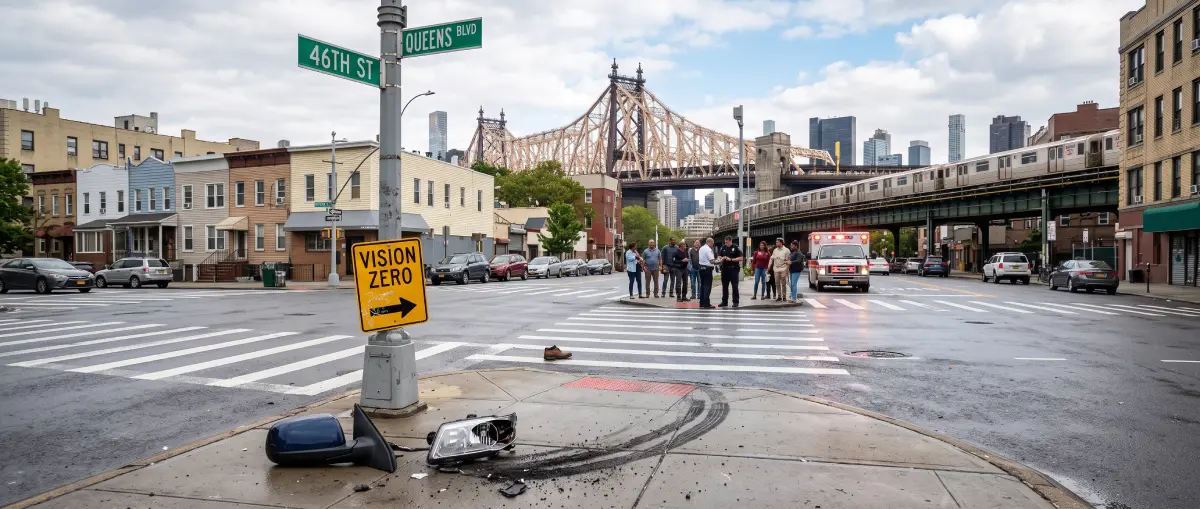
The driver who hit you in Queens drove off, and you are now being told there is nobody to sue. That is usually wrong: a Queens hit & run lawyer can open a claim through your own policy, a household member’s policy, or a state fund, and compensation is available in most of these cases even when police never identify the car. Whether the driver is found changes what your case is worth, but it rarely decides whether you have one. Silver Law Group takes these calls 24 hours a day at 212-470-4544, in English, Spanish, and Russian, and there is no fee unless money is recovered for you.
Leaving the Scene of a Crash Is a Crime in New York
Vehicle and Traffic Law §600 requires a driver who knows they have struck a person or a vehicle to stop, stay at the scene, and give their name, address, driver’s license, and insurance information. The duty is not conditional on who caused the crash. A driver who thinks you ran the light still has to stop. Fleeing a crash that injured someone is a misdemeanor. When the injury is a serious physical injury, it becomes a Class E felony carrying a fine of $1,000 to $5,000. When someone is killed, it is a Class D felony with a fine of $2,000 to $5,000. The criminal exposure matters to your civil case for a reason that has nothing to do with punishment. Running is evidence. A jury is allowed to treat flight as consciousness of guilt, meaning the driver’s own conduct after the crash suggests they knew they were at fault. Defense lawyers cannot explain that away with a diagram of the intersection, which is why an identified hit-and-run defendant is often in a weaker position than a driver who stayed and argued.
Can You Still Get Paid If the Driver Is Never Found? Yes.
Most Queens hit-and-run victims are paid by an insurance policy they already have access to, not by the person who fled. Your own coverage, a resident relative’s coverage, and a state-created fund all exist because the legislature knew drivers disappear. No plate number and no name does not mean no claim. There are four routes to money after a hit and run, and they are not mutually exclusive. No-fault starts paying medical bills within weeks regardless of who fled. Uninsured motorist coverage handles the pain and suffering claim against a driver who was never identified, subject to one strict catch. MVAIC covers people with no insurance anywhere in their household. And if the driver is later identified, you can sue that person directly, with no policy cap standing between you and the full value of the case.
Pathway One: Your Own No-Fault (PIP) Benefits
New York no-fault pays without regard to fault, which means it pays even though the at-fault driver is a mystery. Basic personal injury protection covers your medical treatment and 80% of lost earnings up to $2,000 per month, with everything counting against a $50,000 cap on basic economic loss. The application must reach your insurer within 30 days of the crash. Blow that deadline and the benefits are gone, and you will be paying for the emergency room visit and the MRI out of pocket while the rest of the claim is still being built.
Pathway Two: Uninsured Motorist (UM) Coverage and the Physical-Contact Rule
Every auto policy issued in New York carries uninsured motorist coverage, with a floor of $25,000 per person and $50,000 per accident. Optional supplementary uninsured/underinsured motorist (SUM) coverage raises that ceiling up to your own policy’s liability limits, which is why the SUM endorsement is worth checking before you assume the case is small. UM coverage applies to a driver who was never identified, so the unknown hit-and-run driver is exactly the scenario it was written for. The catch is in Insurance Law §3420(f)(3). A UM claim based on an unidentified vehicle requires actual physical contact between that vehicle and you or your car. A phantom vehicle that swerves into your lane, forces you into a barrier on the Van Wyck, and keeps going without ever touching you generally will not support the claim. That physical-contact requirement is current law and is scheduled to sunset in 2029. UM claims also do not go before a Queens jury. They are resolved in arbitration against your own insurance company, which will defend the claim the way any opposing carrier would, because it is paying with its own money.
Pathway Three: MVAIC, the Safety Net for the Uninsured
If you own no car and no one in your household has auto insurance, the Motor Vehicle Accident Indemnification Corporation exists for you. MVAIC operates under Insurance Law Article 52 and covers pedestrians and cyclists struck by a fleeing driver, which is a large share of hit-and-run injuries in a borough where people walk across Queens Boulevard and ride Northern Boulevard every day. It provides up to $50,000 in no-fault benefits plus bodily-injury coverage of $25,000 per person and $50,000 per accident. MVAIC enforces its deadlines without sympathy. In order:
- Report the crash to police within 24 hours.
- File the Notice of Intention within 90 days for a hit-and-run.
- File the no-fault application within 30 days.
- Submit a notarized Household Affidavit establishing that no other coverage is available to you.
Every one of those is a place where an unrepresented claim dies quietly.
Pathway Four: Suing the Driver Directly If They Are Identified
When NYPD or an independent investigation puts a name to the driver, the case changes shape. You sue that person and their insurer directly, and no UM or MVAIC ceiling applies to what a jury can award. The $25,000 per person floor that caps a UM arbitration is irrelevant once there is a defendant with a liability policy and personal assets. A spinal injury that would be squeezed into a capped arbitration becomes a full-value case in Queens County Supreme Court. That gap between capped and uncapped recovery is the entire reason the search for the driver is worth running hard and running fast.
What a Queens Hit-and-Run Claim Is Worth
Value is built from the categories of loss the law recognizes, not from a number a lawyer guesses at over the phone. The economic damages are the ones with receipts behind them:
- Emergency treatment, surgery, imaging, therapy, and the future care your doctors project
- Lost wages, plus reduced earning capacity where the injury changes what work you can do
- Property damage, including the vehicle the fleeing driver wrecked
Non-economic damages require crossing the serious-injury threshold in Insurance Law §5102(d) — a fracture, significant disfigurement, or a permanent limitation of use, among the listed categories. Once you clear it, pain and suffering, disfigurement, and loss of enjoyment of life come into the case, and in a serious injury they are usually the largest part of it. Where a hit-and-run kills someone, the family’s claim is a wrongful-death action under EPTL §5-4.1 for pecuniary loss: the financial support, services, and parental guidance the family lost. Silver Law Group does not publish verdict or settlement amounts, and will not promise you a figure. What drives value in practice is documentation and the credible prospect of trial. An insurer that expects the file to settle cheaply prices it that way; a file prepared for a jury from the first month gets priced differently.
Why You Must See a Doctor Even If You Feel Fine
Adrenaline masks injury for hours. People walk away from a crash on Jamaica Avenue, sleep badly, and wake up unable to turn their head, and by then the record shows a two-day gap between the collision and any complaint. The most badly hurt Queens crash victims go to one of the borough’s two Level 1 trauma centers: NYC Health + Hospitals/Elmhurst on Broadway, or Jamaica Hospital Medical Center on the Van Wyck Expressway. Go the same day, and keep the follow-up appointments. Every gap in treatment gives the insurer an argument that the injury was minor, or that something other than the crash caused it.
What to Do in the First 48 Hours After a Queens Hit-and-Run
The first two days decide how much evidence you will still have in month three.
- Call 911 and get an NYPD accident report. Every no-fault, UM, and MVAIC claim requires one, and police take the report even with no plate number.
- Photograph the damage to your vehicle and to yourself, and write down the direction the car fled, its color, make, and any part of the plate you saw.
- Get names and phone numbers from witnesses at the scene. People who saw the impact will not be standing there when an investigator arrives next week.
- Do not repair your vehicle yet. Paint transfer and impact marks identify the striking car and are physical proof of contact under the UM rule.
- Give no recorded statement to any insurance company, including your own, before you have spoken with a lawyer. Two clocks are already running while you do this. The MVAIC Notice of Intention is due in 90 days, and nearby camera footage is being overwritten on a much shorter cycle.
How We Find a Driver Who Fled in Queens
Finding the car is investigation work, not luck. Most of it has to happen inside the first week.
- Camera canvass. Businesses, ATMs, and doorbell cameras within a block of the scene are checked and preserved before the systems overwrite, often within 72 hours. Preservation letters go out to every owner who has footage.
- FOIL requests. Formal requests to NYPD and NYC DOT pull traffic-camera video and automated license-plate-reader data, which is densest along heavily monitored corridors like Queens Boulevard, Northern Boulevard, and Jamaica Avenue.
- Physical evidence. Paint transfer, height and angle of impact marks, and debris left on your vehicle narrow the make, model, and color of the car that hit you.
- The criminal file. Where the Queens County District Attorney is prosecuting the driver under VTL §600, the evidence developed in that case can be pulled into your civil claim. A driver identified in week one becomes an uncapped defendant. A driver identified in month eight, after the deli’s system has recycled its drive, usually stays unidentified.
What It Costs to Hire a Queens Hit & Run Lawyer
Nothing up front, and nothing at all unless there is a recovery. The first consultation is free whether or not you hire the firm. If Silver Law Group takes the case, the fee is a percentage of the money actually recovered for you, taken out of that recovery when it comes in. No recovery, no fee. That is why the cost of a camera canvass, an accident reconstruction, or a UM arbitration never lands on you while you are missing paychecks. The firm carries the case on the same bet you are making.
Deadlines That Can Quietly End Your Hit-and-Run Claim
They do not arrive together. They arrive in sequence, and the earliest ones come while you are still in treatment.
- 30 days to file your no-fault application with your insurer
- 90 days to file the MVAIC Notice of Intention
- Three years to file a personal-injury lawsuit under CPLR §214
- Two years to file a wrongful-death claim under EPTL §5-4.1
One rule cuts in your favor. Under CPLR §207, the lawsuit clock can be paused when the defendant leaves New York for four continuous months or more, or lives within the state under a false name. That provision was written for people who make themselves hard to find, which describes a driver who fled a crash and then disappeared. It does not excuse a missed no-fault or MVAIC filing, and it is never something to plan around, but it can save a case where the driver surfaces years later.
Why Injured Queens Residents Choose Silver Law Group
Your injury suit is filed in Queens County Supreme Court, Civil Term, at 88-11 Sutphin Boulevard in Jamaica. The driver’s criminal case, if there is one, is handled separately at the Criminal Term at 125-01 Queens Boulevard in Kew Gardens. Those are two different buildings, two different standards of proof, and two different outcomes, and the criminal one does not pay your bills.
- Free consultation, and contingency representation with no fee unless money is recovered
- Every case prepared as if it will be tried, which is what changes an insurer’s number
- Someone reachable 24/7, including the night of the crash when footage still exists
- Consultations and case handling in English, Spanish, and Russian, across Queens neighborhoods from Jackson Heights and Corona to Rego Park and Forest Hills
- Attorneys who will come to your home or hospital room when your injuries make travel to the Midtown office impossible
Talk to a Queens Hit-and-Run Attorney Today
A camera two doors down from where you were hit is overwriting its footage right now, and if MVAIC is your route, the 90-day Notice of Intention clock started on the day of the crash. Call 212-470-4544 for a free consultation, available 24/7 in English, Spanish, and Russian. No fee unless we recover for you. The office is at 49 West 37th Street, 7th Floor, in Midtown Manhattan.