

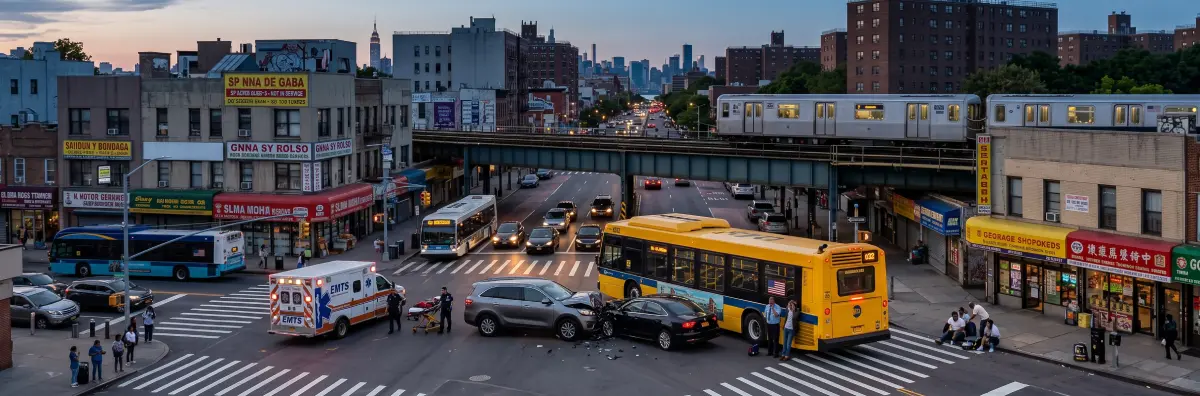
If you were hurt riding in someone else’s vehicle, a Queens passenger injury lawyer can tell you in one phone call whose insurance is supposed to be paying for your treatment right now. That answer is the same whether you were in a friend or family member’s car, an Uber or Lyft, a yellow cab, an MTA bus, or an Access-A-Ride van. Passengers are almost never assigned fault for a crash, because you did not steer, brake, or decide when to change lanes. That single fact makes passenger claims among the strongest injury claims in New York, and it means the dispute runs between the drivers instead of against you. Silver Law Group answers the phone 24 hours a day at 212-470-4544. Consultations are free and available in English, Spanish, and Russian, and there is no fee unless we recover money for you.
Do You Have a Case If You Were Injured as a Passenger in Queens
You almost certainly do. A passenger who was sitting still, belted in, and doing nothing to control the vehicle is rarely blamed for a collision, so the question your case turns on is not whether you did something wrong. It is which driver was negligent, and that is a question your lawyer and the insurers fight over, not you. Depending on what caused the crash, a Queens passenger can recover from:
- the driver of the vehicle you were riding in, if that driver caused or contributed to the collision
- the driver of another vehicle who struck your car, bus, or cab
- both drivers at once, when each of them contributed to what happened
- a government entity, such as the MTA, New York City Transit, or the city agency responsible for a defective roadway or missing signal
- a vehicle manufacturer, when a tire, brake, seatbelt, or airbag failed and made your injuries worse
More than one of these can apply to the same crash. Naming every responsible party early is what keeps a claim from collapsing when one insurer refuses to pay.
Whose Insurance Pays When You Are an Injured Passenger
Two separate insurance systems apply to your injuries, and confusing them is the most common mistake injured passengers make. The first is New York no-fault. Your medical bills and lost wages are paid through the Personal Injury Protection coverage on the vehicle you were riding in, regardless of who caused the crash, and regardless of whether you own a car or carry any insurance of your own. You do not have to prove anyone was negligent to open that benefit. The second system is the bodily-injury liability claim, and it works nothing like the first. That claim is brought against whichever driver was negligent, it pays for pain and suffering and for losses no-fault will not touch, and it requires proof of fault and proof that your injury is serious under New York law. Where passengers get lost is the overlap. A single Queens crash can involve the PIP coverage on the host vehicle, the liability policy of the host driver, the liability policy of the other driver, a commercial policy on a taxi or rideshare, uninsured motorist coverage, and a government claim against the MTA. Each insurer has an incentive to point at the others while your bills go unpaid. Sorting out which policy is primary, which is excess, and which one you must file with in the next 30 days is the specific work a passenger injuries law firm does at the start of a case.
When Two Drivers Blame Each Other
You do not have to prove which driver was at fault in order to be paid. As a passenger, you can bring claims against both drivers’ insurers at the same time and let them apportion fault between themselves. A disputed-liability crash at an intersection like Northern Boulevard and Main Street, where each driver swears the other ran the light, would stall either driver’s own claim for months. It does not stall yours, because fault has to land somewhere, and it cannot land on the person in the back seat.
Passenger Injuries by Vehicle Type in Queens
The vehicle you were riding in decides which insurance pays and which deadline controls your case. A private car, a rideshare, a yellow cab, an MTA bus, and an Access-A-Ride van each follow different rules, and one of them cuts your filing window from three years down to 90 days.
Private Car Passengers
Riding with a friend, a relative, or a coworker puts you under that car’s no-fault PIP for medical bills and lost wages. If the person driving you caused the crash, their bodily-injury liability coverage is the source of everything no-fault does not pay. The money comes out of an insurance policy that the driver already bought and already pays for. It does not come out of their savings, their paycheck, or their house.
Uber and Lyft Passengers
A Queens Uber or Lyft crash is governed by the New York City Taxi and Limousine Commission, not by the statewide rideshare rules most people have read about online. Because the trip happened inside the five boroughs, the vehicle is a TLC-licensed for-hire vehicle, and VTL 1693(12) expressly exempts New York City from the $1.25 million state rideshare minimum. What applies instead is the TLC for-hire commercial liability minimum of $100,000 per person and $300,000 per accident, on top of no-fault PIP for your treatment. Queens generates an unusual share of these cases because of JFK and LaGuardia. Airport runs down the Van Wyck and along the Grand Central Parkway put rideshare passengers on the busiest roads in the borough at the worst hours.
Taxi and Livery Passengers
Yellow-cab and livery passengers are covered by the vehicle’s TLC for-hire insurance and by no-fault PIP for medical bills and lost earnings. Beyond ordinary negligence, a cab or livery operator carrying passengers for hire is a common carrier, and under Bethel v. New York City Transit Authority (1998) a common carrier owes its passengers reasonable care under the circumstances. That duty covers how the driver operates the vehicle and the condition of the vehicle you were placed in.
MTA Bus and City Bus Passengers
A bus passenger claim carries the single most urgent deadline on this page. If you were hurt on an MTA or NYCTA bus, you must file a Notice of Claim within 90 days under General Municipal Law §50-e, and missing that window can end an otherwise strong case before a lawsuit is ever filed. You have a claim even when no collision occurred at all: a sudden hard stop, a sharp turn, or a lurch away from the curb that throws you into a stanchion is a valid injury claim. Routes funneling through hubs like Jamaica Center and Flushing–Main Street run packed, with standing riders holding a pole and nothing else. Get the bus number and route before you leave the scene, because the MTA will need both to pull the vehicle’s records.
Access-A-Ride and Paratransit Passengers
Access-A-Ride vehicles are treated as buses for claim purposes, which means the same 90-day Notice of Claim requirement under General Municipal Law §50-e applies to you. These cases also involve private contractors operating under a government contract, so identifying the correct entity to serve is part of the work, and serving the wrong one wastes the clock. Paratransit riders are frequently elderly or disabled, and injuries from an improperly secured wheelchair, a failed lift, or an unassisted transfer are common in neighborhoods heavily served by the network, including Astoria and Corona.
What Your Queens Passenger Injury Claim Is Worth
No-fault PIP covers up to $50,000 in medical bills and lost wages combined. Lost earnings are paid at up to $2,000 per month for as long as three years after the crash. That is the floor of what you receive, not the ceiling of what your case is worth. What PIP does not pay for is pain and suffering. Not one dollar of it. To recover for the pain, the sleeplessness, the surgery you did not need before, and the things you can no longer do, you have to cross what New York calls the serious injury threshold.
The Serious Injury Threshold
Insurance Law §5102(d) defines serious injury, and your claim for pain and suffering rises or falls on it. The qualifying categories include:
- a bone fracture
- significant disfigurement
- permanent loss of use of a body organ, member, function, or system
- significant limitation of use of a body function or system
- a medically determined injury that prevents you from performing your usual daily activities for at least 90 of the 180 days following the crash
You only need one. Meeting a single category opens the door to recovery for all of your injuries, economic and non-economic alike, including the ones that would not have qualified on their own. This is why the medical record you build in the first weeks matters so much, and why gaps in treatment are the first thing a defense adjuster looks for.
Damages a Passenger Can Recover
What a passenger claim covers depends on the injury, the treatment, and the work you lost, and it is calculated case by case rather than from any average. The categories are:
- Medical expenses, past and future, including surgery, imaging, physical therapy, injections, home care, and assistive equipment
- Lost wages and lost earning capacity, covering time out of work and any permanent reduction in what you can earn going forward
- Pain and suffering, available once the serious injury threshold is met
- Wrongful death damages for the family, if a passenger was killed in the crash
Suing the Driver of the Car You Were In
Filing a claim against your sister, your coworker, or the friend who offered you a ride home feels wrong to most people, and it stops a lot of injured passengers from ever calling a lawyer. Here is what actually happens. The claim is made against the auto liability insurance that driver already carries, the insurer hires and pays the defense lawyer, and the insurer writes the check. Your friend’s personal savings are not the target of the claim. Declining to file does not protect that person. It shifts the cost of their negligence onto you, in the form of co-pays, unpaid time off, and treatment you stop going to because you cannot afford it. The policy exists precisely for the person sitting in the passenger seat.
If You Were Hurt by an Uninsured or Hit-and-Run Driver
A driver with no insurance, not enough insurance, or the nerve to speed off does not end your claim. Uninsured and supplementary underinsured motorist coverage, known as SUM coverage, sits on the vehicle you were riding in and often on your own household auto policy as well. Either one can be the source of your recovery. Hit-and-run cases follow the same path even when the fleeing driver is never identified. Report the crash to the police promptly, keep whatever description of the vehicle you or any witness can give, and call before an insurer tells you there is nothing to pursue. SUM claims carry their own notice requirements that are shorter than the deadline to sue.
What to Do After You Are Injured as a Passenger in Queens
The first week decides how much of your case survives. Take these steps in order:
- Get examined, even if you feel fine. Concussions, disc injuries, and internal bleeding often surface days later, and an untreated gap in your chart becomes the insurer’s argument that you were not really hurt.
- Get the police report, and write down the other vehicle’s plate number. On a bus, record the bus number and the route.
- Photograph the scene, the vehicles, the interior of the bus or cab, and your visible injuries, before anything is repaired or cleaned.
- Collect witness names and phone numbers at the scene. Passengers scatter within minutes and are almost impossible to find later.
- Decline any recorded statement to an insurance adjuster or an MTA investigator until you have spoken with a lawyer. That recording is taken to be used against you, and it is taken while you are medicated and shaken.
- File your no-fault application within 30 days of the crash. Queens emergency options include NewYork-Presbyterian Queens in Flushing, Jamaica Hospital Medical Center, Elmhurst Hospital Center, and Mount Sinai Queens in Astoria. If an ambulance took you somewhere else, follow up with your own doctor that same week.
How Long You Have to File a Passenger Injury Claim in New York
Four separate clocks can run on a single passenger case, and the shortest one usually governs whether you get paid at all:
- 30 days to file the no-fault PIP application after the crash, which is what turns on payment for your medical treatment
- 90 days to serve a Notice of Claim under General Municipal Law §50-e for any claim against the MTA, New York City Transit, or another municipal defendant, followed by a lawsuit deadline of one year and 90 days under General Municipal Law §50-i
- Three years to sue for personal injury under CPLR §214
- Two years to bring a wrongful death claim under EPTL §5-4.1 if a passenger died
A passenger hurt on a Q-line bus is on the 90-day clock from the day of the crash, not the three-year one. That is the difference between a case and a missed case.
What It Costs to Hire a Queens Passenger Injury Lawyer
Nothing upfront, and nothing at all unless we recover money for you. Silver Law Group works on a contingency fee, which means our fee is a percentage of the recovery and comes out of that recovery when it arrives. You do not write a retainer check, you are not billed by the hour, and you are not invoiced for the work as the case moves. If there is no recovery, there is no fee. An injured passenger who is out of work and watching bills arrive should never wait to call because of what a lawyer might cost.
Why Injured Passengers in Queens Choose Silver Law Group
- Free consultations, 24 hours a day, in English, Spanish, and Russian. Queens is the borough where that matters most, and it matters in Jackson Heights, Corona, Elmhurst, Rego Park, and Forest Hills, where the person hurt in the back seat often is not the person most comfortable arguing with an adjuster in English.
- Representation regardless of immigration status. We do not condition the case on it and we do not make it a topic.
- A contingency fee, so the case costs you nothing while it is pending.
- A trial-ready posture. Files are built from the start to be tried, and to pursue every party responsible for the crash rather than settling with the first insurer willing to write a small check.
- Attorneys who come to you. If you are in a hospital bed at Elmhurst or Jamaica Hospital, or immobilized at home, we come there. Our office is at 49 West 37th Street, 7th Floor in Midtown Manhattan, and you can reach us at 212-470-4544 around the clock, but you do not need to travel to it to start a case.
Local Knowledge of Queens Roads and Courts
Passenger injuries in this borough recur in the same places. Queens Boulevard earned the name “Boulevard of Death” for a reason, and the same pattern repeats on Northern Boulevard, along Roosevelt Avenue under the elevated 7 line, on Woodhaven Boulevard, and on the Van Wyck Expressway, where merges into airport traffic produce rear-end and sideswipe collisions that leave the passenger with the worst of it. If your case does not settle, it is filed and tried in Queens County Supreme Court, Civil Term, at 88-11 Sutphin Boulevard in Jamaica.