

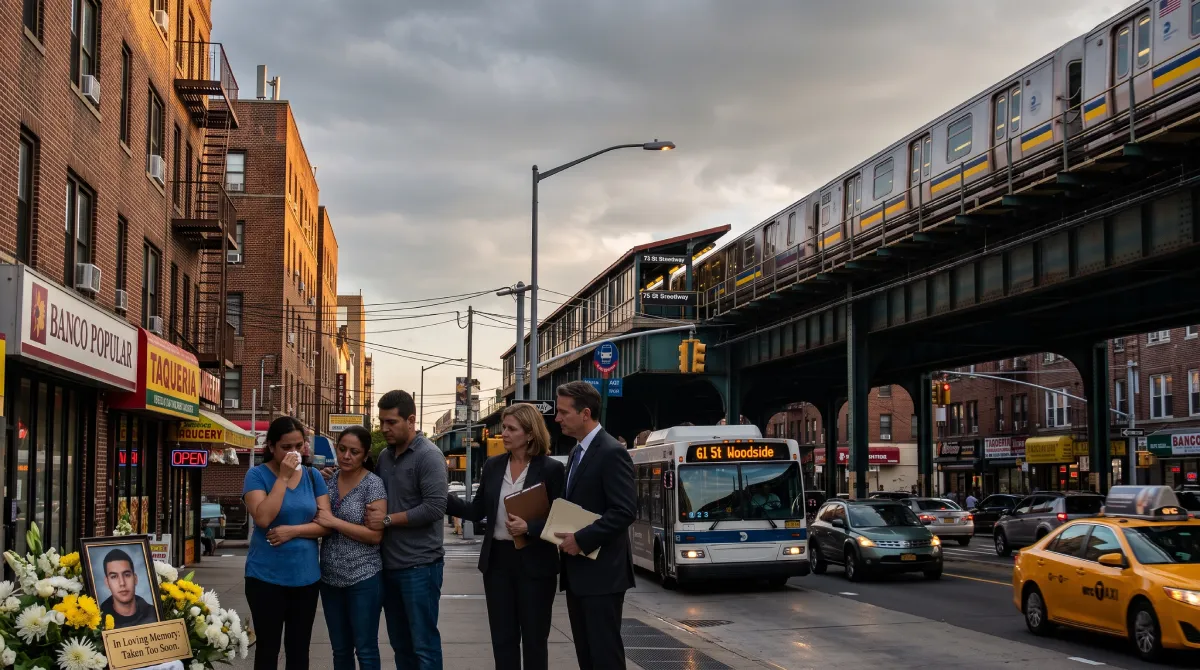
A Queens wrongful death lawyer at Silver Law Group represents your family after a fatal accident took someone you counted on. You are grieving and already facing hospital bills, a missing paycheck, and an insurance adjuster who wants a recorded statement. We take the legal fight off your hands. The consultation costs nothing, we answer the phone 24/7, and we work with you in English, Spanish, or Russian. If you cannot travel to our Midtown Manhattan office at 49 West 37th Street, the attorney comes to your home or your loved one’s hospital room. We bring wrongful death cases for families across Queens, from Jamaica to Astoria, and prepare each one for trial from the first meeting instead of assuming the insurer will offer a fair number.
Do You Have a Queens Wrongful Death Case?
New York lets you bring a wrongful death claim when someone died because another person or company acted wrongfully — through a careless act, neglect, or a failure to do something the law required. A drunk driver on the Van Wyck, a property owner who ignored a broken stair, a surgeon who missed a bleed: each is a “wrongful act, neglect, or default” under the statute if it caused the death.
Having a case is not the same as feeling wronged. To win, your loved one’s estate has to prove three things:
- Negligence, meaning the at-fault party owed a duty and broke it, like a driver who ran a red light or a hospital that ignored a test result.
- Causation, meaning that breach actually caused the death and not something unrelated. This is where a defense expert pushes hardest, especially when your loved one had prior health problems.
- Financial loss to the distributees, meaning the survivors the law recognizes lost real economic support when your loved one died.
That third element surprises many families. New York’s wrongful death law pays for the money the death cost the survivors, not for the pain of losing a parent, spouse, or child. That limit shapes how the entire case is built, and a later section explains it in full.
Who Can File a Wrongful Death Claim in New York
You may be the closest person to the one who died and still not be the person who files the lawsuit. New York routes a wrongful death claim through the estate, and the law names who benefits from it. Under EPTL 4-1.1, the distributees — the relatives entitled to recover — are set in a fixed order: a surviving spouse and children first, then parents if there is no spouse or child, and down the family tree from there. These are the people whose financial loss the case is built to prove.
A distributee does not sue on their own. Only the estate’s personal representative, the administrator or executor appointed by the Surrogate’s Court, can bring the claim, and there is only one claim. Every distributee’s loss folds into that single case, and any recovery is later divided among them according to what each lost. If three siblings each hired a lawyer, they would still need one representative and one lawsuit; the court will not hear three competing wrongful death suits over the same death. That is why the first practical step is not filing the lawsuit at all. It is getting someone appointed to stand in for the estate.
Getting a Personal Representative Appointed in Queens Surrogate’s Court
Before the case can start, the court has to appoint someone to represent your loved one’s estate. In Queens, that happens at the Queens County Surrogate’s Court, 88-11 Sutphin Boulevard in Jamaica. If your loved one left a will, the named executor is confirmed; if there was no will, a close relative petitions to become the administrator. Only after that appointment can the estate’s representative sign the papers that begin the lawsuit.
This step stalls families who try to handle it alone, and the delay eats into a filing deadline you may not have room to lose. We prepare and file the Surrogate’s Court petition for you, track it through Jamaica, and move to start the case the moment the appointment comes through, so the two tracks run together instead of one waiting on the other.
What a Queens Wrongful Death Case Is Worth
New York measures a wrongful death case by the money the survivors lost, and EPTL 5-4.3 draws the line at “pecuniary” injuries: economic loss, not grief. Within that line, the recoverable categories are broader than most families expect:
- Lost earnings and support: the income and financial help your loved one would have provided over a working lifetime, projected forward by an economist who accounts for raises, benefits, and remaining career years.
- The value of household work now falls on someone else, whether that is childcare, cooking, home repairs, or the driving. Those services can be counted and paid for out of the case.
- Children who lost a parent can recover for lost parental guidance: the instruction and advice that parent would have given as they grew up.
- Pre-death medical bills for the fatal injury are recoverable, and so are funeral and burial costs, so those do not come out of your pocket.
Because most of these losses reach into the future, the number is not something you total from receipts. An economist projects your loved one’s future contributions — what they would have earned and provided across the years they had left — and reduces it to present value. A vocational expert may testify about the career that was cut off. The stronger the record of who your loved one was to the people who depended on them, the fuller that projection.
What the statute leaves out matters as much as what it includes, and it is the reason New York wrongful death cases are built the way they are.
The Grieving Families Act and What New York Still Denies
The one thing a New York wrongful death case cannot pay for is your grief. It does not cover the emptiness of losing a spouse or the companionship of a parent or child who is gone. That has been the rule since the 1800s, and it nearly changed. The Grieving Families Act would have let juries award damages for emotional suffering and lost companionship, bringing New York in line with most of the country.
Governor Hochul vetoed that bill for the fourth time on December 5, 2025, so grief and companionship stay off the table. New York and Alabama are now the only two states that still bar families from recovering emotional damages in a wrongful death case. For you, the effect is direct: the case can be built only on the financial side of the loss, which is why documenting your loved one’s earnings, support, and role at home matters so much. Knowing that boundary up front keeps a lawyer from promising you something the statute will not deliver.
Survival Claims for Pre-Death Pain and Suffering
There is a second claim many families do not know exists, and it reaches exactly what the wrongful death claim cannot. A survival action under EPTL 11-3.2 belongs to your loved one’s estate for what they went through before they died: the conscious pain and suffering between the injury and death.
If someone lived hours or days after a crash on the Grand Central Parkway, aware and in pain, that suffering has value the law recognizes, even though the wrongful death claim itself pays only the survivors’ financial loss. The two claims run together in the same lawsuit. The wrongful death claim compensates the distributees for what the death cost them; the survival claim compensates the estate for what your loved one endured. Where the death was not instant, the survival claim can be a major part of the case, and it turns on the medical record, on what the trauma team documented about consciousness, pain, and response in those final hours. That is one more reason to secure the hospital chart early, while it is still complete.
Fatal Accidents We Handle Across Queens
Fatal cases reach us from every part of Queens and from very different kinds of negligence. The road matters, the setting matters, and each type carries its own proof.
- Highway and boulevard crashes. Queens Boulevard, the Van Wyck Expressway, the Grand Central Parkway, and Northern Boulevard all carry the kind of speed and truck traffic that turns a collision fatal. How the crash happened — a lane change or a following truck — shapes who is liable and what the camera and vehicle data must show.
- Construction falls. When a worker dies in a fall from a height or is struck by materials, New York Labor Law 240 and 241 can hold owners and contractors strictly responsible for safety failures, a stronger footing than ordinary negligence.
- Medical malpractice deaths. A missed diagnosis, a surgical error, or a mismanaged emergency can kill, and a medical malpractice wrongful death case turns on hospital records and expert review rather than a police report.
- Premises deaths. A deadly fall on a broken stair, a fire, or an assault that an owner’s neglect allowed can support a claim against whoever controlled the property.
- Nursing home deaths. Neglect, untreated bedsores, and medication errors in a facility can cause a resident’s death and give the family a claim against the home.
The kind of accident decides who the defendants are, which records win the case, and which deadline runs. A city-owned road or a public hospital, for instance, starts a much shorter clock, covered below.
When the Deceased Shared Fault
Insurers raise the same defense in almost every fatal case: that your loved one was partly to blame. Do not let that end the conversation. New York follows pure comparative fault under CPLR 1411, which means a share of fault reduces the recovery but never erases it. If your loved one is found ten percent responsible, the recovery drops by ten percent and the claim survives.
New York recently added a 51% bar for some motor-vehicle cases, which would cut off a claim once the injured person is found more than half at fault. That change does not apply here. The 2026 motor-vehicle 51% bar excludes wrongful death cases, so a fatal claim still runs on pure comparative fault no matter how the fault splits. A pedestrian who crossed mid-block on Northern Boulevard, or a driver who was speeding when another car ran the light: in a death case, partial fault lowers the number but does not defeat the claim.
This is one place where the adjuster’s version and the law’s version diverge, and where an early, careful reconstruction of the crash matters. Fault is not a single fact handed down at the scene. It is argued from the police report, the physical evidence, and often an accident reconstruction expert, and the percentage is not settled until the case makes it settled.
What to Do After a Fatal Accident in Queens
In the days after a fatal accident, a few concrete steps protect the case your family may need later. None of this is about lawyering; it is about not losing evidence that disappears fast.
- Get the police report and the accident’s paper trail. The crash report, any citations, and the officers’ names anchor what happened. Ask how to obtain the report and keep the reference number.
- Preserve the medical and autopsy records. If your loved one was treated at Elmhurst Hospital, Jamaica Hospital, or NewYork-Presbyterian Queens, those trauma-center charts document the injuries and any conscious suffering before death. The autopsy or medical examiner’s findings establish the cause, so request them and keep copies.
- Say nothing to the other side’s insurer. An adjuster may call within days sounding sympathetic. You do not have to give a recorded statement, and you should not; a few words about your loved one’s movements or health can be turned into a fault argument later.
- Stay off social media about the accident. A post, a photo, even a comment can be pulled into the case and read against you. Assume the defense is looking.
Do these things even before you decide on a lawyer. Evidence you save this week is evidence no one can later argue was lost or made up.
Deadlines and Claims Against the City
A wrongful death claim runs on a clock, and the clock is shorter than most families assume. Under EPTL 5-4.1, you generally have two years from the date of death to file the lawsuit — not two years from when you learn a mistake caused it, and not the three years that applies to a nonfatal injury. Two years from the death.
When the death involves a government defendant, a second and much tighter deadline lands first. If a city vehicle, a city-maintained road, or a public hospital like Elmhurst played a part, you have to serve a Notice of Claim under General Municipal Law 50-e within 90 days of the death, before any lawsuit is filed. GML 50-i then sets the window for the suit itself. Miss the 90-day notice and the claim against the city can be gone no matter how strong it was.
These deadlines are why waiting is the one thing that can quietly cost you the case. The two-year period sounds long while you are grieving, and the 90-day notice can pass before a family even realizes a public entity was involved. We calendar every deadline the day we take the case, file the Notice of Claim when a government defendant is in the picture, and get the lawsuit in well before EPTL 5-4.1 runs. If your loved one died recently and a city vehicle, road, or hospital may be responsible, that 90-day clock is already running.
Talk to a Queens Wrongful Death Lawyer at Silver Law Group
You should not have to think about legal bills while you are planning a funeral, and with us you never do. We take wrongful death cases on contingency: you pay no fee up front and no fee at all unless we recover money for your family. Our fee comes as a percentage of that recovery, so it exists only if you get compensation, and the firm carries the cost and the risk of building the case, not you.
We prepare every case as if it will be tried. Insurers deal more fairly when the file in front of them looks ready for a jury, and our attorneys are prepared to litigate in Queens County Supreme Court rather than accept whatever the adjuster first offers. That readiness is what gives a grieving family real bargaining power it would not otherwise have.
The first conversation is free and puts you under no obligation. We answer 24/7, we meet in English, Spanish, or Russian, and if you cannot come to our Midtown office at 49 West 37th Street, the attorney will come to your home or the hospital. Call Silver Law Group at 212-470-4544 to talk with a Queens wrongful death lawyer about what your family is facing.