

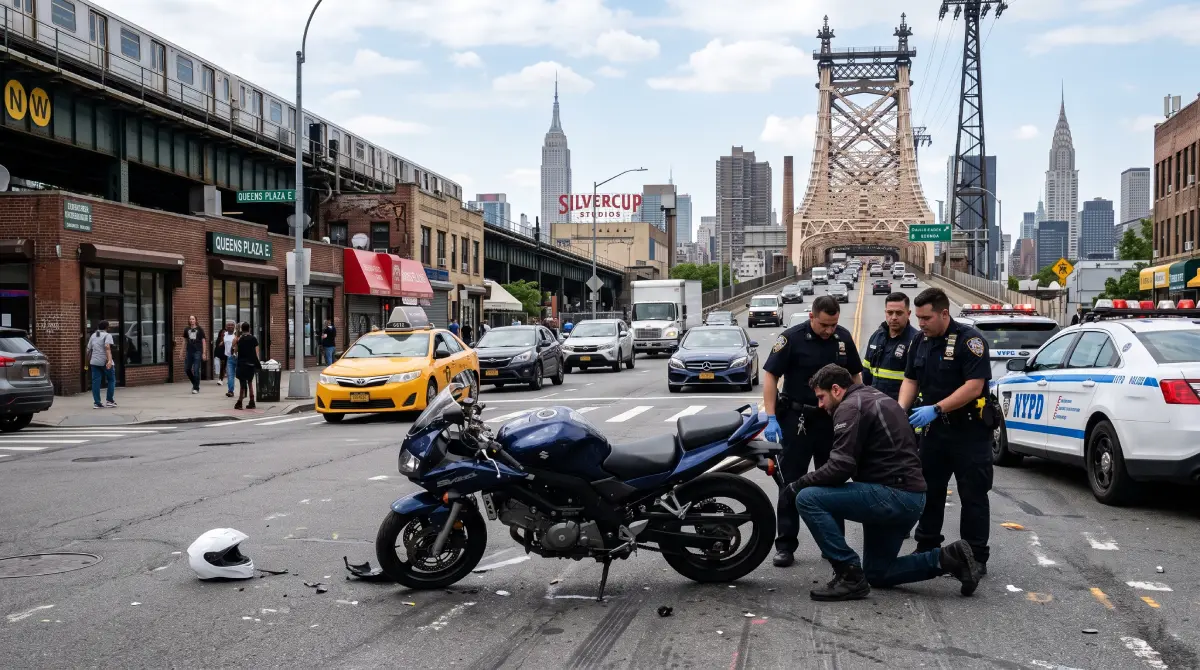
Why a Queens Motorcycle Claim Is Not a Car Accident Claim
Insurance Law §5102(f) defines “motor vehicle” for no-fault purposes and writes motorcycles out of it. You get no Personal Injury Protection benefits, no 30-day no-fault application to file, and no $50,000 in basic economic loss standing behind your emergency room bill. A car occupant hurt in the same intersection has that cushion. You do not. Everything you recover comes from a liability claim against the driver who hit you, or against another responsible party: the delivery company that employed that driver, a vehicle owner, sometimes the City. That claim has to be proven before anyone pays a cent of it.
No PIP Means No Automatic Payment of Your Medical Bills
The 30-day no-fault deadline every car accident page warns about does not apply to you. There is no application to file, because there is no coverage to apply for. What actually pays while the case is pending:
- Private health insurance, including a spouse’s or a parent’s plan
- Medicaid or Medicare
- Workers’ compensation, if you were riding for work when the crash happened
- Treatment on a lien or letter of protection, where the provider agrees to be paid out of the recovery.
Open one of these channels the same week. Riders lose months waiting on an insurer that was never going to pay them, and the treatment gap that waiting creates becomes the defense’s best argument two years later.
The One Advantage Riders Have: The Serious Injury Threshold
Exclusion from no-fault cuts in your favor on damages. Because a motorcyclist is not a “covered person” under Insurance Law §5102(j), the threshold in Insurance Law §5104(a) generally does not gate your claim for pain and suffering the way it gates a car occupant’s. An injury that would be argued out of a car case can still support a full non-economic damages claim for a rider. The rule runs the other way too. If a car occupant sues you, that person is a covered person and has to clear the threshold first.
Passengers on a Motorcycle Are Excluded Too
A passenger on the back of a bike sits outside no-fault for the same reason the rider does, and has to bring a third-party liability claim to get anything paid. Passengers frequently have a claim against both drivers, including the friend they were riding with. That is uncomfortable, and it is usually the only route to coverage, because the claim runs against an insurance policy rather than against the person.
Do You Have a Case? How Fault Is Decided in a Queens Motorcycle Crash
Liability comes down to which driver broke a specific rule of the road written in the Vehicle and Traffic Law. Adjusters do not start there. Nearly every motorcycle file opens with the assumption that the rider was speeding, weaving, or splitting lanes, and the insurer’s investigation is built to confirm it. The statutes below are what move a file off that assumption.
Left-Turn Collisions
VTL §1141 requires a driver turning left to yield to any vehicle approaching from the opposite direction that is within the intersection or so close as to constitute an immediate hazard. VTL §1163(a) adds that no turn may be made until it can be done with reasonable safety. When you were going straight on a green and a car cut across your path, those two sections make the turning driver the presumptive defendant, and the burden falls on that driver to explain the turn.
Lane-Change and Blind-Spot Crashes
VTL §1128 bars a driver from moving out of a lane until they have ascertained the move can be made safely. A motorcycle’s narrow profile stays hidden in the mirrors of an SUV, box truck, or delivery van far longer than a car does, and on the multilane runs of the Long Island Expressway, the Van Wyck Expressway, and Woodhaven Boulevard that blind spot can be occupied for a mile at a time. “I never saw the motorcycle” is not a defense. It is an admission of the exact thing §1128 required the driver to do first.
Dooring and Delivery Traffic
An opening door throws a rider into the travel lane with no time to brake, and the serious injury usually comes from the second impact rather than the door itself. Queens produces this crash wherever curb activity and moving traffic sit inches apart: Roosevelt Avenue in Jackson Heights, Steinway Street in Astoria, Main Street in Flushing, Jamaica Avenue in Jamaica. When the door belongs to a commercial or rideshare vehicle, the driver’s employer may be liable as well, and that policy is often far larger than the driver’s own.
Potholes, Metal Plates and Defective Pavement
Suing New York City over a road defect runs through the Pothole Law, NYC Administrative Code §7-201(c)(2). The City cannot be sued over a pothole, sunken metal plate, or broken pavement unless it received prior written notice of that specific defect before your crash, as a condition precedent to the lawsuit. The classic form of that notice is the Big Apple Pothole and Sidewalk Protection Corporation maps filed with the Department of Transportation, which chart defects block by block. A 311 call by itself usually does not satisfy the requirement. Two exceptions get around it. The City created the defect through its own affirmative act, or the City made a special use of that stretch of roadway. Proving either takes investigation while the defect is still there to photograph and measure.
Hit-and-Run and Uninsured Drivers
A driver who flees is treated as an uninsured motorist under your own motorcycle policy, which means the claim goes somewhere instead of nowhere.
- UM coverage applies when the at-fault driver is unidentified or carries no insurance
- SUM coverage applies when the at-fault driver’s limits are lower than the limits on your own policy
- MVAIC, under Insurance Law Article 52, is the route for a rider with no policy in the household.
MVAIC’s conditions are unforgiving. The crash must have been reported to police within 24 hours, and a Notice of Intention must be filed within 90 days for a hit-and-run or 180 days for an identified uninsured vehicle. Miss either and that door closes for good.
How Insurance Companies Blame Queens Riders and How That Argument Is Beaten
Four accusations show up in nearly every motorcycle file, and each has an answer.
- Lane splitting. Riding between lanes is prohibited under VTL §1252(c), but riding two abreast within a single lane is legal, and adjusters routinely conflate the two.
- Speeding. Usually asserted from the damage rather than from evidence. Skid measurements, camera footage, and the final rest positions either support it or bury it.
- No helmet. Helmets and eye protection are required under VTL §381(6) and §381(7).
- No license or registration. A licensing violation did not cause the other driver to turn across a green light, and it does not answer the VTL section they broke.
The helmet accusation frightens riders more than the rest, and it is the weakest of the four. Under Spier v. Barker, 35 N.Y.2d 444, non-use of a safety device goes only to mitigation of damages and never to liability. The defense carries the burden and must prove through expert testimony that the non-use actually caused the specific injuries you suffered, not that helmets are generally a good idea. A shattered tibia is unaffected by what was on your head.
The 2026 Change to New York’s Comparative Fault Rule Every Rider Should Know
On May 27, 2026, New York added CPLR §1411(b). In personal injury actions subject to Article 51 of the Insurance Law, a claimant whose fault is greater than the combined fault of the defendants recovers nothing at all. That is a sharp break from CPLR §1411(a), the pure comparative rule that still governs other negligence cases, under which a plaintiff found 70 percent at fault still collects 30 percent of the damages. Whether §1411(b) reaches motorcyclists is an open question, because riders sit outside Article 51’s covered-person framework, the same exclusion that denies you PIP in the first place. The practical effect is immediate. A fault percentage assigned to you now carries risk it did not carry last year, and that percentage gets built out of evidence gathered in the first weeks: the footage from the corner deli, the witness who watched the light change, the measurement of where the debris landed.
The 90/180-Day Serious Injury Category Was Eliminated
The same 2026 budget legislation struck the 90/180-day category from the list of serious injuries in Insurance Law §5102(d). What remains is death, dismemberment, significant disfigurement, fracture, loss of a fetus, permanent loss of use of a body organ or member, permanent consequential limitation of use, and significant limitation of use. Any page still describing a 90/180-day category is out of date, along with the advice built on it.
Where Motorcycle Crashes Happen in Queens
These crashes cluster at wide, multilane intersections where drivers turn across fast-moving traffic.
- Queens Boulevard, a designated Vision Zero Priority Corridor running roughly seven miles from Long Island City to Hillside Avenue in Jamaica, carried the nickname Boulevard of Death for decades
- Northern Boulevard, another Vision Zero priority corridor, runs from Astoria out to Douglaston past service roads and commercial curb cuts
- Woodhaven and Cross Bay Boulevards push highway speeds through residential blocks
- The Grand Central Parkway, the Long Island Expressway, and the Van Wyck Expressway put riders into merge conflicts at speed
- Rockaway Boulevard, Astoria Boulevard, and Union Turnpike are wide arterials with constant left-turn traffic
Queens Trauma Centers Where Injured Riders Are Taken
Queens has three Level I trauma centers, and a badly hurt rider is usually taken to Jamaica Hospital Medical Center on the Van Wyck Expressway, NYC Health + Hospitals/Elmhurst at 79-01 Broadway, or NewYork-Presbyterian Queens at 56-45 Main Street in Flushing. Those records are the backbone of a serious injury case, because the imaging, the operative reports, and the arrival notes describe your condition before anyone had a claim to defend. Request your own records early, then keep every follow-up appointment. Gaps in treatment are the first thing an adjuster looks for, and a three-week gap gets characterized as recovery rather than as the weeks you had no ride to physical therapy.
Queens Crash Numbers in Context
NYC DOT reported 57 traffic deaths in Queens in 2025, down 23 percent from 74 in 2024. Citywide, traffic deaths fell to a record-low 205, with motorcycle-user deaths down 32 percent. The 2026 figures point the other direction for riders. NYPD data showed 13 deaths involving motorized two-wheelers by April 19, 2026, up from seven over the same period in 2025, five of them motorcycles. The overall trend is improving. The risk to riders specifically is not.
Injuries That Drive the Value of a Queens Motorcycle Case
A rider absorbs the entire crash with their body. The injuries that carry these cases:
- Traumatic brain injury, including bleeds that develop hours after a rider walked away from the scene
- Spinal cord injury and paralysis, complete or incomplete
- Open and comminuted fractures requiring plates, rods, and screws, often across several surgeries
- Degloving injuries and severe road rash needing skin grafts
- Internal organ damage, including lacerations to the spleen, liver, and kidneys
- Amputation, traumatic at the scene or surgical afterward.
Because there is no PIP cap and no no-fault insurer processing bills, the full lifetime cost of an injury like this has to be projected and proven from scratch: the future surgeries, the home modifications, the attendant care, the wage you will never earn again. Treating physicians, life care planners, and economists build that projection. It is the work a motorcycle injury lawyer starts while you are still in treatment, not after.
What a Queens Motorcycle Accident Claim Is Worth
No honest lawyer quotes you an average, and New York publishes no official settlement figure. Anyone who gives you a number on the first phone call is selling something. What actually moves value:
- How permanent the injury is, and whether the permanence is documented objectively
- Surgical history, completed and projected
- Future care, priced and supported by a treating physician
- Lost earning capacity, measured against the work you actually did
- The strength of the liability proof, since a disputed-fault file is worth less than a clean one
- The total insurance available across every possible defendant.
The last variable is the one nobody warns you about. New York’s minimum bodily injury limits are $25,000 per person and $50,000 per accident, and a driver carrying the minimum cannot pay past the policy. Finding additional defendants, such as an employer, a vehicle owner, or a contractor whose steel plate was in the roadway, plus your own SUM coverage, is often the only way past that ceiling.
Economic and Non-Economic Damages
Economic damages are the ones with receipts. Past and future medical costs, lost wages, lost earning capacity, replacement of the motorcycle and your gear, and out-of-pocket transportation to appointments all belong here. Non-economic damages cover what the injury took from your life. Pain and suffering, scarring and disfigurement, emotional distress, and loss of enjoyment of the things you can no longer do. This is where the no-fault exclusion works for you, since the threshold that limits a car occupant’s pain and suffering claim generally does not limit a rider’s.
If a Rider Was Killed
A wrongful death claim under EPTL §5-4.1 must be brought within two years of the date of death, and only by the personal representative of the estate, which means someone has to be appointed before the case can be filed. Recoverable damages include funeral and burial costs, the financial support the family lost, and the loss of parental guidance to the rider’s children. A separate survival claim can seek the conscious pain and suffering your family member experienced between the impact and death.
What to Do After a Motorcycle Accident in Queens
The first hours decide how hard the rest of the case is.
- Call 911 so NYPD responds and a collision report is generated.
- Accept transport and get examined, even if adrenaline has you standing and talking.
- Photograph the roadway surface and the final rest positions of both vehicles before anything is moved.
- Get the plate and insurance information from every vehicle involved.
- Collect witness phone numbers on the spot, because nobody is findable a week later.
- Say nothing to the other driver’s adjuster until you have spoken with a lawyer.
Preserve the Motorcycle and Your Gear
Do not repair the bike, do not sell it, and do not let an insurer take it for salvage. Keep the helmet, jacket, gloves, and boots exactly as they came off you, unwashed and unrepaired. Most motorcycles carry no event data recorder. There is no black box to download, so the crush pattern on the bike and the abrasion pattern on your gear are frequently the only reconstruction evidence that exists. An insurer that salvages the bike in week two has removed the best witness you had.
Get the Video Before It Is Overwritten
Queens corridors are dense with cameras: bodegas, gas stations, warehouse loading docks, and the MTA buses running the length of Northern and Queens Boulevards. Most of those systems overwrite within days, a few within weeks. A preservation letter sent immediately is often the difference between a case the adjuster disputes and one they cannot.
Deadlines That Can End a Queens Motorcycle Claim
Several clocks run at once, and no insurer will remind you about any of them.
- CPLR §214 allows three years from the crash to file a personal injury lawsuit
- EPTL §5-4.1 allows two years from the date of death for a wrongful death claim
- General Municipal Law §50-e requires a Notice of Claim within 90 days against New York City or another public entity
- General Municipal Law §50-i then limits the lawsuit itself to one year and 90 days
- MTA and New York City Transit claims carry their own 90-day notice requirement, which controls whenever a bus is involved
Why Three Years Is Not as Long as It Sounds
The three-year deadline is not what ends these claims. The short ones do: 90 days for a Notice of Claim against the City after a pothole or metal plate crash, 24 hours to report a hit-and-run to police, 90 or 180 days for an MVAIC Notice of Intention. Any of those can expire while you are still in a cast. Evidence runs on a shorter clock still. Video overwrites in weeks. Skid evidence washes off in the first heavy rain. Witnesses who talked freely at the scene stop answering unknown numbers by the second month.
What It Costs to Hire a Queens Motorcycle Accident Lawyer
Nothing out of pocket, at any stage. The consultation is free, whether you call or an attorney comes to you. Silver Law Group handles these cases on contingency, which works this way: the firm advances the case expenses, including police and medical records, accident reconstruction, expert reports, and filing fees, and the attorney’s fee is a percentage of what you recover at the end. No recovery means no fee, and you are not billed for the work that was done. That is the entire fee structure. You do not need money to hire a lawyer for a motorcycle accident, which matters, because most people who make these calls are out of work with a fractured leg and an adjuster phoning twice a week.
Why Riders in Queens Call Silver Law Group
The reasons are practical ones, for a person who is hurt and out of work.
- Free consultations in English, Spanish, and Russian
- Available 24 hours a day, including the night of the crash
- An attorney who comes to your hospital room or your home when you cannot travel
- Every case prepared as though it will be tried
- Contingency representation, with no fee unless you recover.
The office is at 49 West 37th Street, 7th Floor in Midtown Manhattan, a short ride from Astoria, Flushing, Jamaica, or the Rockaways. Call 212-470-4544 and speak with a motorcycle accident attorney about what happened, which deadlines are already running, and what to do this week.