

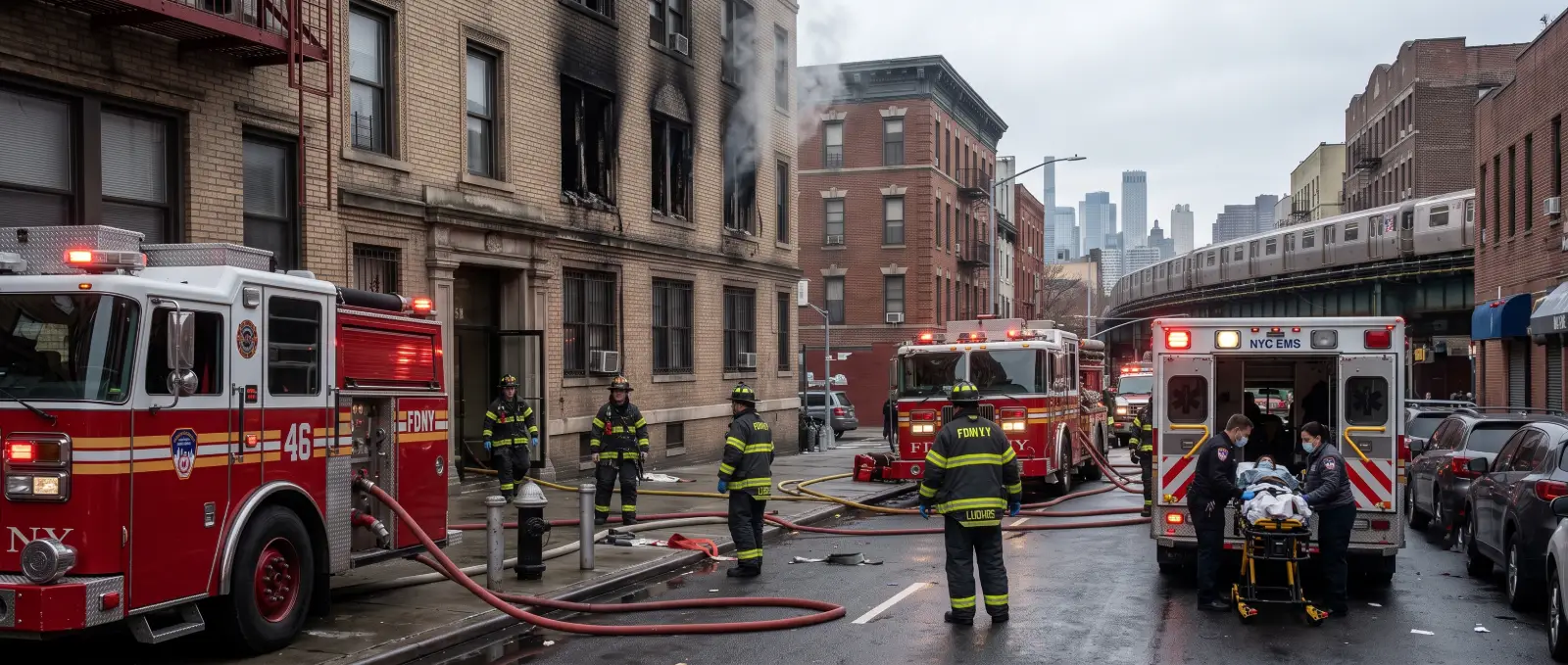
A serious burn hits your body and your finances at once, and a New York fire injury lawyer works on terms built for that moment: no fee unless you recover. Silver Law Group represents burn and fire injury victims across all five boroughs — the Bronx, Brooklyn, Queens, Manhattan, and Staten Island — and everywhere in New York State. Every case starts with a free consultation, available 24/7 in English, Spanish, and Russian. If you’re in a hospital bed or can’t leave home, the attorney comes to you, and you can call 212-470-4544 to start today.
Do You Have a Burn or Fire Injury Case in New York
You have a case when someone else’s carelessness caused your burn. New York negligence law breaks that into four parts you have to prove: that the other party owed you a duty of care, that they broke it, that the breach caused your injury, and that you suffered real harm because of it. A landlord who ignores a broken smoke detector, a manufacturer who ships a space heater with faulty wiring, a contractor who leaves a live line exposed — each fits that structure differently, but each can owe you money.
Most New York burn claims run on one of three tracks. Premises liability covers property owners and landlords whose buildings weren’t kept safe, which matters in a city full of older, densely packed housing. Product liability covers defective appliances, wiring, and consumer goods that ignite or overheat. The third track is workplace and third-party liability, where a job-site burn can point past your employer to another company whose equipment or conduct started the fire.
Which track your case follows decides who you sue and what you have to prove.
Common Causes of Burn and Fire Injuries in New York
The same hazards send New Yorkers to burn units year after year:
- Apartment and residential building fires
- Gas leaks and explosions
- Workplace and construction accidents
- Defective products, from space heaters to lithium-ion batteries
- Electrical burns from exposed or faulty wiring
- Chemical burns
- Scalding liquids and steam
- Vehicle fires after a crash
Doctors grade burns in four degrees. First-degree burns stay in the outer skin and usually heal on their own. Second-degree burns reach the layer beneath and blister. Third-degree burns destroy the full thickness of skin along with the nerve endings in it; fourth-degree burns go deeper still, into muscle, tendon, or bone. Third- and fourth-degree burns drive the largest claims, because they mean skin grafts, repeated surgeries, permanent scarring, and often a lifetime of care.
Who Can Be Held Liable for a New York Burn Injury
More than one party can be on the hook for a single fire. Depending on the facts, the defendant may be a:
- Landlord or property owner
- Product manufacturer or distributor
- Employer or contractor
- Utility company
- City of New York or a public agency
Landlord liability often turns on specific duties written into the New York City Housing Maintenance Code. Buildings with three or more apartments must have self-closing doors under HMC §27-2041.1, so a fire in one unit stays contained instead of filling the hallway with smoke; a door that was propped, broken, or never installed can be direct evidence of neglect. In any unit where a child under six lives, HMC §27-2046.4 requires the owner to provide stove knob covers or locking safety knobs on gas stoves. When a burn happens on a construction site or at work, New York Labor Law §§200, 240, and 241 place safety duties on owners and contractors, and a violation can establish liability without the usual fight over what was reasonable.
What a New York Burn Injury Case Is Worth
No two burn cases are worth the same, because value tracks the injury: how deep the burn went, whether the scarring is permanent, how much work you’ll miss, and what your future care will cost. New York law lets you recover for:
- Past and current medical bills
- Future treatment, including skin grafts and reconstructive surgery
- Lost wages and reduced earning capacity
- Pain and suffering
- Disfigurement and permanent scarring
- Emotional distress and PTSD
New York puts no cap on personal injury damages, so the ceiling on a burn case is set by the evidence, not by a statute. That is where preparation matters. Silver Law Group builds each case as if it will be tried and works with life-care planners who document, in dollars, what decades of treatment and lost earning power actually cost. An insurer treats a file that is ready for trial very differently from one that is not.
What to Do After a Burn or Fire Injury in New York
What you do in the first days can decide the case. Take these steps in order:
- Get medical care and follow the treatment plan — Gaps in treatment become the insurer’s argument that you weren’t really hurt.
- Preserve evidence — Keep the charred appliance, the burned clothing, photos of the scene and your injuries, and the names of anyone who saw it happen.
- Say nothing recorded to any insurance adjuster — A recorded statement exists to be used against you later.
- Stay off social media — A single photo can be twisted into proof you’re fine.
- Call a lawyer early — while the evidence is still fresh.
In New York City fire cases, the FDNY fire marshal runs a cause-and-origin investigation, and that report is often the backbone of proving how the fire started and who let it happen. Your lawyer can request it and build on it. And if you were burned at work, you may have two claims running at the same time: a workers’ compensation claim tied to your employer and a separate third-party lawsuit against whoever else caused the fire, whether a subcontractor, a property owner, or an equipment maker.
What It Costs to Hire a New York Burn Injury Lawyer
Nothing, unless you win. Silver Law Group takes burn and fire cases on contingency, which works like this: you pay no money upfront and no hourly bills while the case runs. The firm fronts the costs of building it — the fire-origin experts, the medical records, the life-care planner, the court fees — out of its own pocket. The attorney’s fee is a percentage of the recovery, so it only exists if there is a recovery. If the case does not win, you owe no fee. That structure is deliberate: it lets someone with a hospital bill and no paycheck hire the same caliber of lawyer a large company can.
How Long You Have to File a Burn or Fire Injury Claim in New York
A burn claim in New York runs on more than one clock, and the shortest one controls. For most personal injury cases, CPLR §214 gives you three years from the date of the injury to sue. If the fire killed a family member, the wrongful death clock under EPTL 5-4.1 is shorter — two years from the date of death.
The tightest deadline applies when a public entity is at fault. If the City, the New York City Housing Authority, or another public agency shares blame — a NYCHA building fire, for example — General Municipal Law §50-e requires a Notice of Claim within 90 days of the injury, and GML §50-i cuts the window to sue down to one year and 90 days. Miss the 90-day notice and the case can end before it starts.
Partial fault does not lock you out. Under CPLR §1411, New York follows pure comparative negligence, so if you’re found partly responsible for the fire, your recovery is reduced by your share but never barred. Even if a jury put half the blame on you, half of your damages is still yours to collect.
Neighborhoods and Boroughs We Serve
Silver Law Group handles burn and fire cases in every part of New York City. Each borough has its own page for the local details:
New York’s injury law reads the same in all five boroughs — the same statutes, the same deadlines. What changes is the ground under the case: which courthouse hears it, which hospital treated the burn, and each area’s own history of building fires. The firm’s office sits in Midtown Manhattan at 49 West 37th Street, 7th Floor, but you do not have to come to it. If a burn has you in a hospital bed or housebound, the attorney comes to you.
Why Choose Silver Law Group for Your New York Burn Injury Case
Burn cases are won on preparation and lost on delay, and the reasons to call this firm are concrete. Consultations are free, run 24/7, and happen in English, Spanish, or Russian, so nothing stands between you and the first call. Representation is on contingency, which means cost never decides whether you have a lawyer. Every case is prepared for trial — the posture that moves insurers and large corporations off their first low offer. And when a burn keeps you flat on your back, the attorney meets you where you are, at the hospital or at home.
The work is the promise: the phone answered at 3 a.m., the FDNY marshal’s report pulled, the case built to be tried. Call 212-470-4544 to start with a free consultation.