

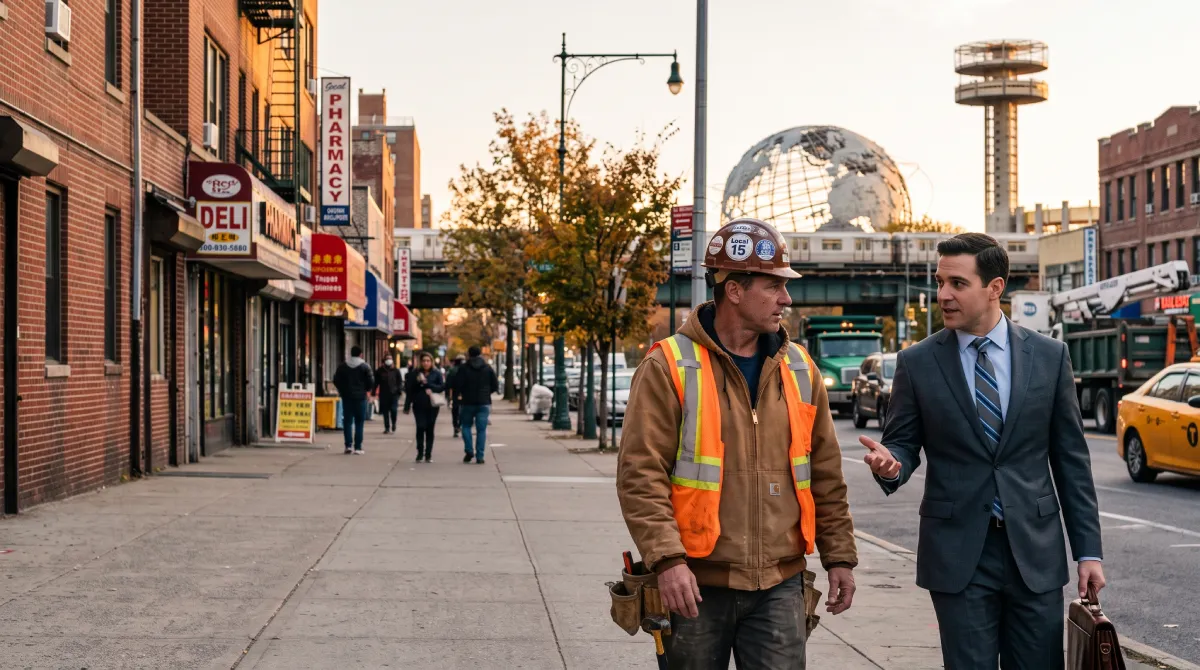
If you were hurt on a Queens jobsite, a Queens construction worker lawyer can usually pursue two claims for you at once, not one. Workers’ compensation pays your medical treatment and part of your lost wages through your employer’s insurer, regardless of fault. A separate Labor Law lawsuit against the property owner and general contractor reaches what comp never touches: your pain, your suffering, and the full earnings comp only partly replaces. Filing one does not cost you the other. Every case starts with a free consultation, available 24/7 in English, Spanish, or Russian at 212-470-4544.
How Dangerous Queens Construction Work Has Become
The city’s Department of Buildings counted 44 construction accidents involving injury or death in Queens in its 2025 year-end summary — 42 injuries and 4 deaths. Those four deaths were the most of any borough that year, out of 10 recorded across the city. Citywide, falls did the most damage: workers falling accounted for 163 of the 320 total incidents.
None of that is abstract in Queens. Long Island City keeps rising in high-rise residential towers, and the Astoria waterfront runs residential builds year-round. Willets Point is mid-transformation, from Etihad Park, the new soccer stadium, to the housing at Willets Point Commons.
Flushing has commercial and hospital work; Jamaica has development clustered around its transit hubs. The Port Authority’s roughly $19 billion JFK rebuild, together with the LaGuardia program, keeps thousands of trade workers on active airfields.
Do You Have a Case Under New York Labor Law
Most injured Queens workers have a claim that goes beyond workers’ compensation, and the statute that fits your accident decides how hard that claim is to win. This is the question people call about first: does the law actually cover what happened to me? New York’s Labor Law answers it in three sections, and the difference between them is the difference between a case that is close to automatic and one you have to fight for.
Labor Law §240, the Scaffold Law
Labor Law §240(1) puts what the courts call absolute liability on the property owner and general contractor for injuries tied to elevation. That covers falls from ladders, scaffolds, hoists, roofs, unprotected floor openings, and open elevator shafts, and it covers being struck by an object that should have been secured overhead. Here is what makes it powerful: your own carelessness is not a defense. If a safety device failed and you were hurt in a fall or a drop, the owner and contractor answer for it even when they argue you were partly to blame. The one real exception is for owners of one- and two-family homes who do not direct or control the work.
Labor Law §241(6) and the Industrial Code
Labor Law §241(6) reaches construction, demolition, and excavation hazards that are not about height. It works differently from §240: instead of a broad rule, it borrows specific safety commands from the Industrial Code at 12 NYCRR Part 23, and your case has to point to the exact rule that was broken. The ones that come up most on Queens sites are §23-1.7 for general hazards like tripping and falling debris, §23-1.21 for ladders, §23-5 for scaffolding, §23-4 for excavation, and §23-1.13 for electrical work. Unlike a §240 claim, comparative fault is a defense here, so the owner can argue your share of the blame and cut what you recover.
Labor Law §200 and Ordinary Negligence
Labor Law §200 is the catch-all. It writes the common-law duty to keep a workplace safe into the statute, and to win under it you have to show the owner or contractor either knew about the dangerous condition or actually controlled how the work was done. On its own it is harder to prove than §240. A well-built case pleads all three together — §240, §241(6), and §200 — so that if one theory falls apart, the claim keeps standing on the others.
Non-Union, 1099, Cash-Paid and Undocumented Workers
Your Labor Law protection does not turn on whether you are in a union, whether you get a W-2 or a 1099, or what your immigration status is. In Balbuena v. IDR Realty LLC, 6 N.Y.3d 338 (2006), New York’s highest court held that undocumented workers keep their full tort and Labor Law rights after a jobsite injury. So the thing crews get told on Queens sites — that being paid in cash or off the books means you have no case — is simply wrong. The check you cashed does not decide whether the owner left a scaffold without a rail; the two questions are unrelated, and the second one is what your claim is built on.
Who Can Be Held Liable for Your Queens Construction Injury
A third-party lawsuit can reach almost everyone responsible for the site except the one company you might expect. The parties usually on the hook are:
- the property owner
- the general contractor
- subcontractors that controlled the area where you were hurt
- the maker or rental company of a defective machine, ladder, or tool
- a staffing agency that placed you without a safe assignment
The company that cannot be sued is your own employer. Workers’ compensation is the exclusive remedy against them, which is the trade-off for comp paying out no matter who was at fault. That is why the owner and contractor matter so much, and why every defendant has to be identified early: on a large Queens site with several contractors sharing the ground, the one who created the hazard is not always the one whose name is on your paycheck.
When the Owner Is a Public Agency
A large share of Queens construction is publicly owned or publicly funded, and that changes your deadlines before it changes anything else. The Port Authority of New York and New Jersey owns JFK and LaGuardia. The MTA and New York City Transit run the transit projects. The New York City School Construction Authority builds the schools, and NYCHA owns developments like Queensbridge, Astoria, and Ravenswood Houses. NYCEDC leads projects such as Willets Point. If any of these is the defendant, the clock on your claim gets much shorter, and the specifics are in the deadlines section below.
Workers’ Compensation and a Lawsuit Run Side by Side
Workers’ compensation and your Labor Law lawsuit pay for different things, which is why you file both. Comp covers your medical treatment and roughly two-thirds of your average weekly wage, and it pays that regardless of fault. What it does not pay is anything for pain and suffering, and it does not make up the rest of the wages you actually lost. The Labor Law lawsuit against the owner and general contractor is what covers that gap.
Filing for comp does not forfeit the lawsuit, and the lawsuit does not end your comp. One caution: the comp insurer will place a lien on whatever your third-party case recovers, so it can be paid back for what it spent. Your attorney negotiates that lien down before any money reaches you, which is often the difference between a recovery that feels real and one the lien swallows.
What a Queens Construction Injury Case Is Worth
What your case is worth depends on facts a lawyer has to see before saying anything honest about value. A few things move the number more than the rest. Whether Labor Law §240 applies matters most, because it strips the comparative-fault defense and stops the owner from blaming you. Injury severity counts too, and whether you needed surgery.
Permanent loss of earning capacity can outweigh all of it — if you cannot go back to the trades, the case has to account for every year of work the injury took. The damages workup carries real weight here: a claim backed by a life-care plan and a lost-earnings projection stands on evidence, not on a demand letter. No honest lawyer quotes you a figure before reading the file, and any who does is guessing.
What to Do After a Construction Accident in Queens
Get to a hospital the same day, even if the pain feels manageable. Serious jobsite injuries in the borough go to its Level I trauma centers: NYC Health + Hospitals/Elmhurst at 79-01 Broadway, Jamaica Hospital Medical Center at 8900 Van Wyck Expressway, and NewYork-Presbyterian Queens at 56-45 Main Street in Flushing. After treatment, the record you build in the first days is what your claim rests on.
- Give your employer written notice of the injury within 30 days, as Workers’ Compensation Law §18 requires.
- Photograph the hazard and the missing safety equipment before the site is cleaned up and the evidence disappears.
- Get the names of workers who saw it happen.
- Ask for a copy of the incident report.
- Sign nothing and give no recorded statement to any insurer.
- Stay off social media while your case is open.
What It Costs to Hire a Queens Construction Worker Lawyer
There is no money upfront and no hourly bill. A Queens construction worker lawyer at Silver Law Group works on contingency, which means the fee is a percentage of what the case recovers and comes out of that recovery at the end. If there is no recovery, there is no fee, and you owe nothing for the work. That structure exists so that being hurt and out of a paycheck does not decide whether you can afford a lawyer. The first consultation is free, it can happen in English, Spanish, or Russian, and an attorney will come to you at the hospital, at home, or at the jobsite instead of asking an injured worker to travel across the borough to an office.
How Long You Have to File a Queens Construction Claim
Every claim you have runs on its own clock, and the shortest one you miss can end the rest.
- CPLR §214 gives you three years to sue a private owner or contractor.
- Workers’ Compensation Law §18 requires written notice to your employer within 30 days, and Workers’ Compensation Law §28 gives you two years to file the C-3 claim form with the Workers’ Compensation Board.
- EPTL §5-4.1 gives two years to bring a wrongful death claim if a worker was killed.
- General Municipal Law §50-e requires a Notice of Claim within 90 days against the City of New York, NYCHA, or the School Construction Authority, with the lawsuit itself filed within one year and 90 days.
- Public Authorities Law §1212 sets the same 90-day notice requirement for New York City Transit.
- A JFK or LaGuardia site means the Port Authority, and McKinney’s Unconsolidated Laws §7107 requires the notice of claim to be served at least 60 days before suit and the lawsuit to be started within one year of the accident, not three.
The public deadlines are the trap. A worker who assumes the deadline is three years across the board can lose a City or Port Authority claim in 90 days without knowing it closed.
Where a Queens Construction Case Is Litigated
A Labor Law case from a Queens jobsite is filed in Queens County Supreme Court at 88-11 Sutphin Boulevard in Jamaica; the county also runs a courthouse in Long Island City at 25-10 Court Square. That venue matters more than it sounds. A Queens jury is drawn from the same working neighborhoods you come from, people who know what a 12-hour shift on a site is and what a back injury takes from someone who lifts for a living. Carriers know it too, and a firm that prepares the case for that jury, and is willing to try it rather than grab the first offer, is worth more at the negotiating table than one the insurer expects to settle cheap.
Why Injured Queens Workers Call Silver Law Group
The consultation is free and someone answers 24/7. The firm works in English, Spanish, and Russian, which matters for the Spanish-speaking crews on Queens sites and the Russian-speaking families of Rego Park and Forest Hills. An attorney travels to you at the hospital, at home, or on the site rather than making you come to an office. The contingency arrangement costs you nothing unless the case recovers. And every file is prepared as if it will be tried in Queens County Supreme Court, which is what makes a demand carry weight. The office is at 49 West 37th Street, 7th Floor, New York, NY 10018, in Midtown Manhattan; the direct line is 212-470-4544.