

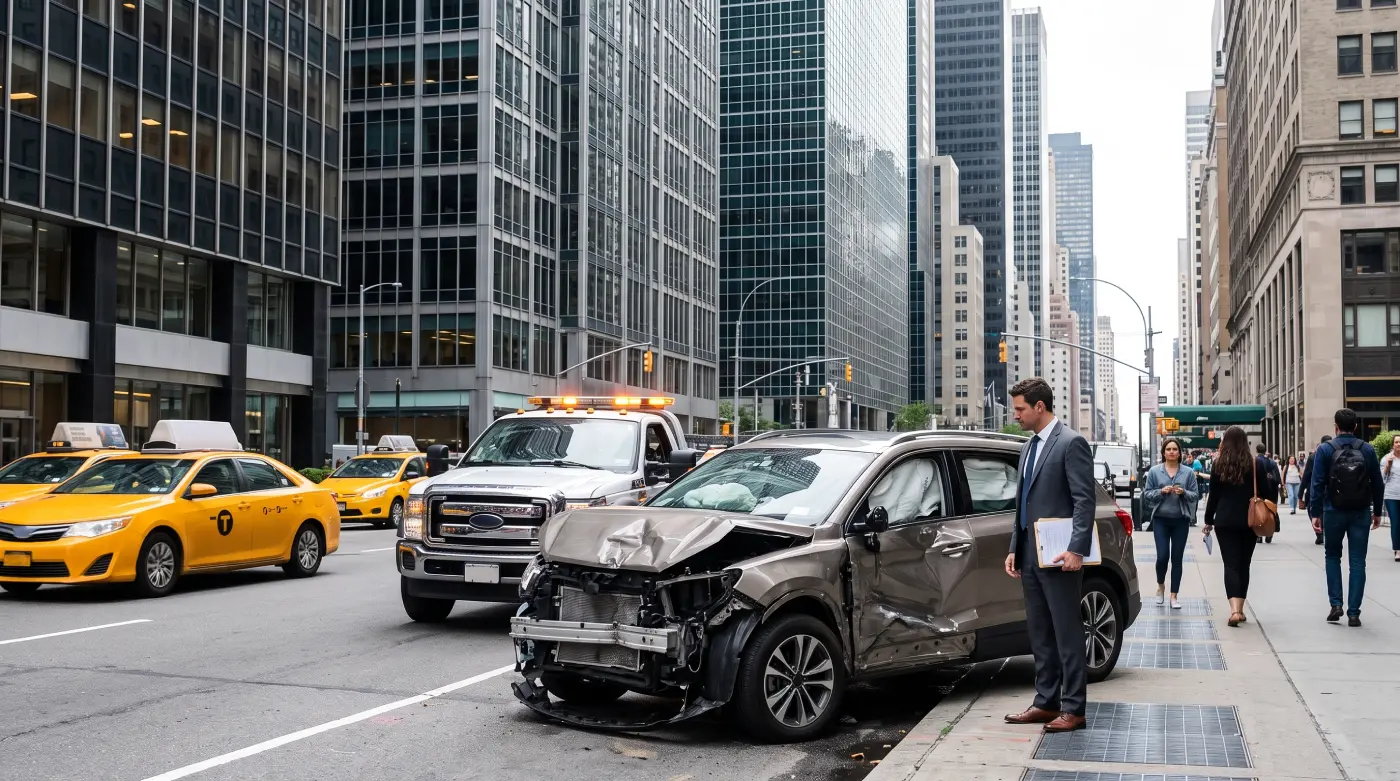
A Manhattan total loss attorney can push back when your insurer declares your car a total loss and hands you a check that does not match what the car was worth. Silver Law Group takes those disputes on a free consultation, in English, Spanish, or Russian, and you can reach the firm at 212-470-4544 any hour. Insurers count on drivers accepting the first actual cash value number without question. A wrongful or lowball valuation can leave you thousands short on a car you still owe money on. The work is specific: reading the carrier’s comparables, checking the sales tax and salvage math, and forcing a fair number before you sign anything.
When New York Calls Your Car a Total Loss
New York sets no fixed percentage that turns your car into a total loss. Some states declare a total the moment repairs hit 70 or 80 percent of value; New York does not work that way. Under Regulation 64, codified at 11 NYCRR 216.7, an insurer reaches the total-loss decision by weighing the cost to repair your car plus its salvage value against its actual cash value. When repair cost plus what the wrecked car can be sold for as salvage meets or passes the actual cash value, the carrier writes the car off instead of fixing it.
That math matters to you because both sides of it move. An insurer can inflate a repair estimate or lean on a low actual cash value to justify totaling a car you would rather keep, or to hold its own payout down. There is no bright-line rule to hide behind, which cuts both ways: the carrier has discretion, and so does an independent appraiser reading the same file. A Manhattan total loss claim often turns on whether the repair estimate and the valuation were honest, not on a percentage. A lawyer’s first move is to check whether the repair estimate and the actual cash value were real numbers or numbers built to justify the write-off.
What Your Totaled Car Is Really Worth
Actual cash value is the whole ballgame in a total-loss claim, and 11 NYCRR 216.7(c)(1) tells the insurer how to calculate it. The regulation gives the carrier three approved methods. The first is a retail average drawn from two current used-car pricing manuals for your car’s make, model, year, and condition. The second is a quote from a dealer within a convenient distance willing to sell you a comparable vehicle for a set price. The third is a values database approved by the Department of Financial Services that pulls comparable sales from within 100 miles of where you live.
Each method should land near the price you would actually pay to replace your car with the same year, mileage, and condition in the Manhattan market. That is the standard the number has to meet, and Manhattan replacement prices are not upstate prices. The regulation also requires the insurer to add New York City sales tax of 8.875 percent to the vehicle’s value before subtracting anything for salvage. Carriers skip or shortchange this tax more often than drivers realize, and on a mid-value car that omission alone can cost you several hundred dollars.
The order of operations is where offers go wrong. The tax gets added to actual cash value first; the salvage deduction, if you keep the car, comes after. Reverse those steps or drop the tax, and the check shrinks. When a total loss lawyer reviews your offer, the valuation method, the comparable vehicles behind it, and the tax line are the first three things pulled apart, because that is where a lowball number usually hides.
Recovering Diminished Value After Repairs
Even a well-repaired car is worth less after a serious crash, and that lost value has a name: diminished value. A buyer will pay less for a car with an accident on its history report, no matter how clean the bodywork looks. New York lets you recover that gap, but only in a specific lane. Diminished value is a third-party property-damage claim in tort. It sits outside no-fault entirely, so you pursue it against the driver who hit you and their insurer, not through your own no-fault benefits.
New York courts measure the loss under the rule from Prahler: your recovery is the lesser of the cost of repairs or the difference between the car’s value before the crash and its value after. That lesser-of ceiling is why diminished value pays off most on newer, higher-end, low-mileage cars. A three-year-old luxury sedan with 20,000 miles has real market value to lose; a ten-year-old commuter car with 130,000 miles has already absorbed most of its depreciation and has little gap left to claim.
One more line matters. A first-party diminished value claim, made against your own collision coverage rather than the at-fault driver, rarely succeeds in New York, because most policies are read to exclude it. If your car lost resale value in a crash someone else caused, the realistic path runs through their liability coverage, and a lawyer builds it with an appraisal that documents the before-and-after numbers.
How We Challenge a Lowball ACV Offer
A lowball actual cash value offer is rarely one big lie; it is usually several small ones stacked together. Pulling them apart is the work. Here is what that looks like on your file:
- Attacking the comparables. The carrier’s number rests on the used cars it picked to compare yours against. If those comps are higher-mileage, lower-trim, or pulled from a cheaper market, the average they produce is too low, and swapping in honest matches raises the floor.
- Demanding itemized condition deductions. When an insurer knocks value off for wear, tires, or interior condition, it has to show the dollar amount for each deduction, not a vague lump reduction. Made to itemize, many of those deductions shrink or disappear.
- Commissioning an independent appraisal. A licensed New York appraiser inspects your car and documents its real condition and value, which gives you a credible number to set against the carrier’s.
- Invoking the appraisal clause. Most auto policies contain an appraisal provision that lets either side, when the two valuations deadlock, force a binding third-party appraisal instead of a lawsuit.
- Filing a complaint with DFS. When a carrier will not deal in good faith, a complaint to the Department of Financial Services at dfs.ny.gov puts the dispute in front of the regulator that wrote Regulation 64.
Not every claim needs all five. The right lever depends on where the offer is weakest, and a total loss lawyer picks the one that moves your number fastest rather than running up the meter.
Who Pays: No-Fault, Collision, or the At-Fault Driver
No-fault does not pay for your car. New York’s no-fault system covers medical bills and lost earnings after a crash, but it excludes property damage entirely, so the dented metal is never a no-fault matter. That surprises a lot of drivers who assume their no-fault benefits cover everything.
Three routes exist for the car itself. The first is your own collision coverage, if you carry it. Your insurer pays the actual cash value of the car minus your deductible, then goes after the at-fault driver’s carrier to get its money back through subrogation. Under most policies your deductible comes back to you if that subrogation succeeds, so the deductible is often a temporary hit rather than a permanent loss.
The second route is the at-fault driver’s liability coverage. New York requires only $10,000 in property-damage liability coverage, which on a modern vehicle is often not enough to cover a full total loss. When the at-fault policy is that thin and your own collision coverage is better, filing through collision first usually gets you paid faster and larger.
The third situation is the driver who has no insurance at all, which shifts the analysis toward your own uninsured motorist and collision coverages. Whichever route your claim runs through, the property-damage insurer is bound by Regulation 64, so the same valuation rules and the same 8.875 percent sales tax apply no matter who is cutting the check.
When You Owe More Than the Insurance Check
Being upside-down means you owe more on your car loan or lease than the car is worth. It is common on newer vehicles, where the loan balance in the first couple of years often runs ahead of the car’s depreciating value. A total loss in that position creates a problem the insurance check does not solve on its own.
When your car is financed or leased, the actual cash value payment goes to your lienholder first, not to you. The bank or leasing company is paid off up to the car’s value, and only a surplus, if any, reaches you. If the actual cash value is less than what you still owe, the payment clears part of the debt and leaves you owing the rest on a car you no longer have.
Gap coverage is what closes that hole. If you bought gap insurance with the loan or lease, it pays the difference between the actual cash value the insurer approves and the balance you still owe. That is why the actual cash value number is worth fighting for even when a lender takes the check: a higher approved value shrinks the gap, and a lowball value leaves you or your gap insurer covering more than you should.
Keeping Your Car: Salvage Title in New York
You can keep your totaled car in New York, but the paperwork and the title change go with it. New York brands a vehicle a salvage vehicle when the cost of repairs reaches 75 percent of its retail value, a threshold set under 11 NYCRR 216.7(b)(16) and carried through DMV rules at 15 NYCRR 20.20. Once a car crosses that line, its title is branded and it cannot be driven or registered until it clears inspection.
If you choose to keep the car after a total loss, the insurer pays you the actual cash value minus the salvage value it would otherwise have collected, since you are keeping the part it would have sold. That deduction is where the salvage figure suddenly matters to your pocket, and an inflated salvage number quietly lowers your check.
The state also requires forms. A salvage vehicle gets reported on an MV-907A, the salvage certificate, and a car you intend to rebuild and drive again has to pass an MV-83 rebuilt-salvage examination before the DMV will issue a title that allows registration. That inspection checks the repairs and the source of the parts, and it is stricter than an ordinary safety check. Keeping the car can be worth it, but run the salvage deduction and the rebuild cost against the payout before you decide, because the branded title also follows the car to every future buyer.
Deadlines That Can End Your Manhattan Claim
A property-damage claim in New York has a three-year deadline, and it runs from the date of the crash. CPLR 214(4) gives you three years to sue for damage to your car, and the same three-year clock covers a diminished value claim. Miss it and the right to sue is gone, no matter how strong the valuation dispute was.
A different and much shorter set of clocks applies when the vehicle that hit you belonged to the City of New York, whether it was a city truck, a Sanitation vehicle, or another municipal car. Then you must serve a Notice of Claim within 90 days of the crash under General Municipal Law 50-e. That notice is a strict prerequisite; skip it or file it late and the case can be dismissed before anyone looks at the valuation. After the notice, GML 50-i shortens the overall window to one year and 90 days to bring the lawsuit, well short of the ordinary three years.
Manhattan is dense with city vehicles, so this is not a rare scenario here. A lawsuit over a Manhattan crash is filed in Supreme Court, New York County, and the deadline that governs it depends entirely on who owned the other vehicle. The safe move is to have the ownership and the deadline pinned down early, because the 90-day notice can expire while you are still arguing with an adjuster about the check.
Talk to a Manhattan Total Loss Attorney
Every total loss case at Silver Law Group starts with a free consultation, and the firm works on contingency, so there is no fee unless the firm recovers for you. You pay nothing up front. The fee is a percentage of what the firm recovers, and if there is no recovery, there is no fee, which means the cost of challenging a lowball valuation does not come out of your pocket before you see a result. That structure exists so a driver already out a car can afford to fight an unfair number.
The office is in Midtown Manhattan at 49 West 37th Street, 7th Floor, and you can call 212-470-4544 any hour. Consultations are available in English, Spanish, and Russian, and if your injuries or your situation make it hard to travel, the attorney can come to your home or hospital room instead.
Bring the insurer’s offer and any release before you sign it. Once you sign a release accepting a total-loss check, you generally give up the right to ask for more, so the review before signing is the moment that matters most. A Manhattan total loss lawyer reads the valuation, the comparables, the tax line, and the salvage math, and tells you plainly whether the number is fair or whether there is more to recover. That review costs you nothing.