

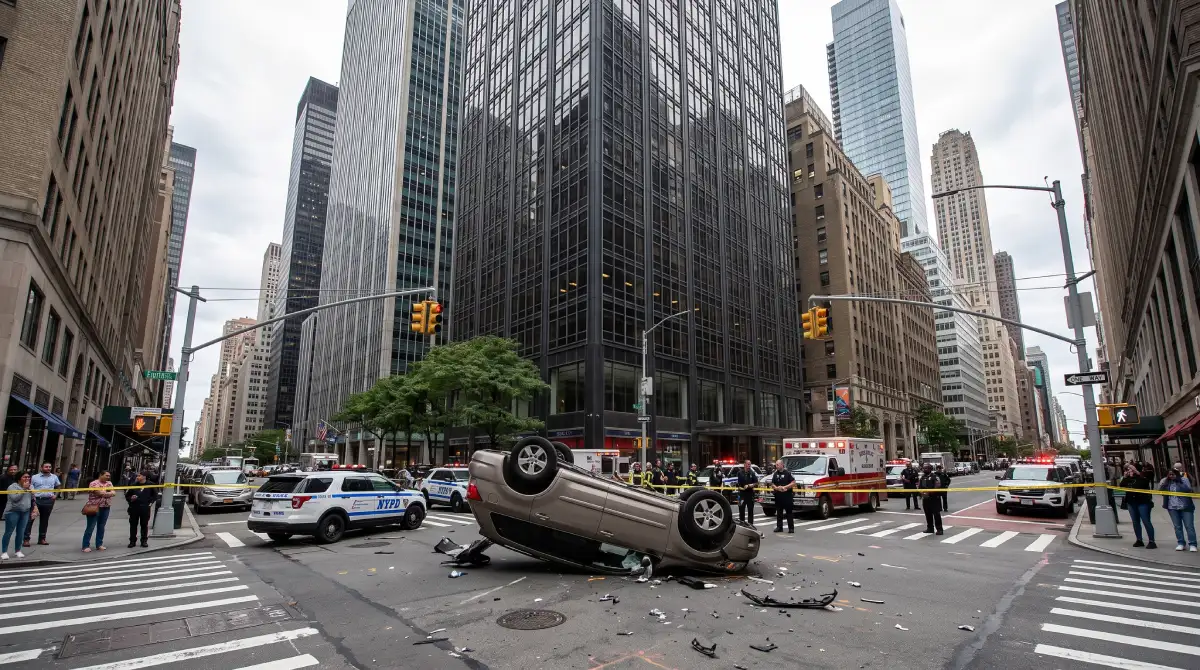
Silver Law Group handles Manhattan rollover claims involving SUVs, box trucks, and cargo vans, and the first conversation costs you nothing. A Manhattan rollover accident lawyer on our team will review your crash for free, any hour, in English, Spanish, or Russian, at 212-470-4544. A rollover is not an ordinary collision; the roof pillars and the restraint system take the load as the vehicle turns over, which sends people to trauma surgery for spinal cord and crush injuries rather than to urgent care. If an adjuster has already called asking for a recorded statement, wait — what you say in the first week can cut your recovery, and knowing who is responsible for a Manhattan rollover comes first.
Do You Have a Rollover Injury Case in Manhattan
Fault in a rollover rarely rests on one fact. Most cases come down to four questions, and a single Manhattan crash can raise more than one at once.
Did the driver take a ramp too fast or overcorrect? Was a truck or van loaded so its weight rode high on one side? Did the road surface, barrier, or signage fail? And was the vehicle itself built to tip?
The ramps are where geometry turns against a top-heavy vehicle. The FDR Drive runs narrow and elevated along the East Side with tight entrance and exit curves laid out for the traffic of an earlier century, and the Henry Hudson Parkway ramps on the West Side bend hard as they climb and drop. An SUV or a loaded van carrying speed into one of those curves loads its outside tires, and once the center of gravity crosses the tipping point, the roll happens in under a second.
You do not have to prove the whole chain yourself. If more than one cause contributed — a driver’s speed and a badly loaded trailer, say — you can pursue each responsible party. What matters at the start is preserving proof of what the vehicle and the road were doing at the moment it went over.
When a Defective SUV or Roof Design Caused the Roll
Some rollovers happen because the vehicle was engineered to fail the physics. An SUV built tall and narrow, with its mass riding high, reaches its tipping angle sooner than a car does; when a manufacturer sells that profile without the stability control or track width to hold it down, the design itself is a cause of the crash. That is a products liability claim against the maker, separate from anything the driver did.
The roof is the second failure point. Federal Motor Vehicle Safety Standard 216 sets how much load a roof must hold without crushing toward the occupants. When a roof caves past that standard in a roll, the people belted inside lose survival space, and a neck or head injury a sound roof would have prevented becomes the manufacturer’s responsibility. A products case like this runs parallel to a negligence case against the at-fault driver, and you can bring both in the same lawsuit.
Who Can Be Held Liable Beyond the Other Driver
The driver who rolled or ran you off the road is often only the first name on the claim. A rollover usually has more than one cause, and New York lets you hold each responsible party to its share. Depending on what the evidence shows, the following may owe you money:
- The negligent driver, for speeding, overcorrecting, or losing control on a curve.
- A trucking or delivery company, when its driver was on the clock or its schedule pushed unsafe driving.
- The cargo loader who stacked or secured freight so the vehicle rode top-heavy.
- A tire manufacturer, if a tread separation or blowout started the roll.
- A rideshare platform, when the vehicle that flipped was carrying a passenger for hire.
- New York City or the State DOT, for a ramp left in disrepair or a curve missing the warning signs and barriers that belong there.
Each defendant carries its own insurance, so adding a company or a manufacturer to a case can open coverage that a single driver’s policy would never reach.
What Your Manhattan Rollover Claim Could Be Worth
A rollover claim adds up the losses the crash forced on you, not a number an ad promises. In a serious case, that can include:
- Medical costs — the trauma admission, surgery, imaging, rehabilitation, and the care your injuries will still need years out.
- Lost earnings, including time off now and the earning power you lose if you cannot return to the same work.
- Pain and suffering for the physical injury and its daily toll.
- Permanent disability, such as a spinal cord injury, an amputation, or a brain injury that changes how you live.
One New York rule can cap the non-economic part of a recovery. Under the state’s provision, a $100,000 limit on pain-and-suffering damages applies only when the at-fault driver was uninsured, was convicted of driving while impaired, or was fleeing a felony at the time. It is a narrow exception, not the ceiling on an ordinary case, and it does not touch your medical bills or lost wages. Which category your case falls into changes the math, and it is one of the first things a lawyer will check against the police report and the other driver’s coverage.
What to Do After a Manhattan Rollover Crash
The hours and days after a rollover decide how strong your claim will be. Take these steps in order.
- Get to a Level I trauma center. In Manhattan that means Bellevue, NewYork-Presbyterian, or Harlem Hospital — the hospitals equipped for the internal and spinal injuries a roll causes, even when you feel able to walk away. The record they create is also the medical spine of your claim.
- Protect the vehicle’s black box. Most modern SUVs, trucks, and vans record speed, braking, steering, and belt use in the seconds before a crash. That data can be overwritten or lost once the vehicle is repaired or scrapped, so it needs to be preserved fast.
- Get the MV-104 crash report. New York police file this report after a serious collision, and it fixes the official account of what happened. You are entitled to a copy, and your lawyer will read it against the physical evidence.
- Say nothing recorded to the other insurer. The at-fault driver’s adjuster may call within a day, friendly and quick, asking you to describe the crash on tape. You are not required to give that statement, and an early recorded answer given in pain is one of the easiest ways to hand the insurer a discount on your case.
New York’s 2026 Comparative Fault Change and Your Recovery
New York changed how shared fault works partway through 2026, and it matters to every rollover claim filed after that date. Under CPLR 1411(b), effective May 26, 2026, you are barred from recovering at all if your own share of fault is greater than the combined fault of everyone you are suing. For decades before that, a badly injured plaintiff could still recover a reduced amount even when mostly at fault; now, once your share crosses past the defendants’ total, the door closes.
That makes the fault fight the whole game in a rollover, where insurers argue the driver simply took the curve too fast. If they can push your share above the combined share of the other parties, they owe nothing. Seatbelt nonuse plays in too: not wearing a belt will not end your case, but New York still uses it to cut your damages by the portion of the injury the belt would have prevented, so the defense will raise it. Building the fault record early, from the black box and the scene, is how you keep your share where it belongs.
How No-Fault and the Serious Injury Threshold Apply
Before you can sue the at-fault driver for pain and suffering, two insurance rules stand in the way, and rollovers usually clear both. First, no-fault: your own personal injury protection coverage pays your initial medical bills and part of your lost wages no matter who caused the crash, so you file that claim promptly regardless of fault. No-fault does not pay for pain and suffering.
To reach pain and suffering, your injury has to cross the serious injury threshold in Insurance Law §5102(d). After the 90/180-day category was removed from the statute in 2026, the categories that matter most in a rollover are:
- A fracture — the broken bones a roll routinely causes.
- A permanent limitation of a body organ, member, or system.
- Significant disfigurement, including the scarring from a crush injury or a fire.
Catastrophic rollover injuries such as a spinal cord injury or a serious fracture clear this bar without much argument, which is one reason rollover cases so often proceed against the at-fault driver rather than stalling at no-fault.
Deadlines to File a Manhattan Rollover Lawsuit
A rollover claim runs on more than one clock, and the shortest one can end your case before you knew it started.
- Three years to sue for your injuries, under CPLR §214, counted from the date of the crash.
- Two years to bring a wrongful death claim, under EPTL §5-4.1, if the rollover killed a family member.
- Ninety days to file a Notice of Claim, under General Municipal Law §50-e, when you are blaming New York City or the MTA for a defective ramp or missing signage.
That 90-day notice is the trap. If a City-owned road or an MTA structure helped cause the roll and you wait past three months to put them on notice, the three-year window stops helping you against them. When a public defendant might share the blame, the first call to a lawyer cannot wait.
Why Injured Manhattan Clients Choose Silver Law Group
You pay Silver Law Group nothing to start and nothing along the way. We work on contingency, which means our fee is a percentage of what we recover for you and comes out only if we win money for your case; if there is no recovery, you owe no attorney’s fee. That arrangement lets an injured person hire a trial-ready lawyer without an insurer’s checkbook, and it puts the firm’s payment on the same side as yours.
The rest is built for people in the middle of a hard week:
- Free consultations, day or night, because a rollover does not happen on business hours.
- English, Spanish, and Russian, so you explain your own case in your own words.
- Home and hospital visits, when a spinal injury or a trauma admission means you cannot come to us.
Our office is in Midtown, at 49 West 37th Street, and a Manhattan rollover lawsuit is filed in the Supreme Court, New York County. Working with a firm that appears in that courthouse and prepares every case as if it will be tried there is what keeps the other side honest at the table.
Speak With a Manhattan Rollover Accident Attorney Today
The evidence that proves a rollover disappears fast. Traffic cameras on City streets and private security cameras on nearby buildings record over their footage within days, and a vehicle sent to a scrapyard takes its black box with it. Calling early is how that proof gets preserved before it is gone.
Reach Silver Law Group at 212-470-4544 for a free, confidential consultation, any hour, in English, Spanish, or Russian. A Manhattan rollover accident attorney will tell you where you stand and what to do next, with no fee unless we recover for you. The first conversation costs nothing and puts the clock on preserving your case instead of the insurer’s.