

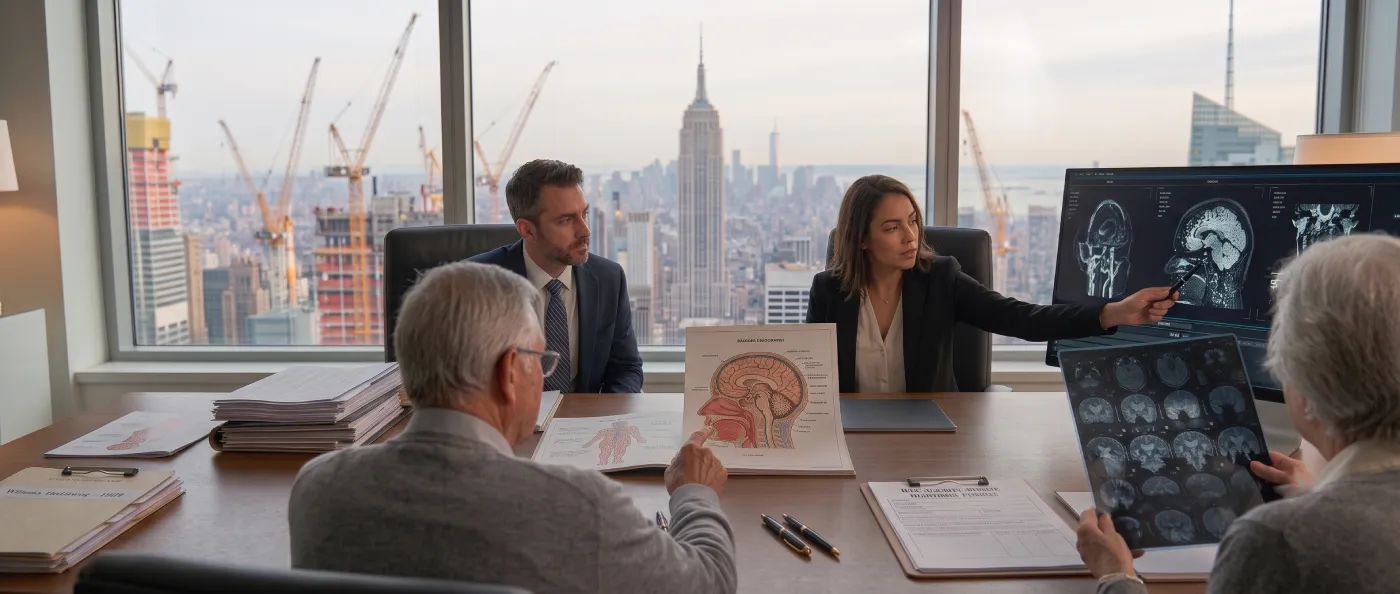
Manhattan Brain Injury Lawyer — Fighting for Maximum Compensation
Silver Law Group has been representing brain injury victims throughout Manhattan and New York City for years, recovering millions of dollars for clients whose lives were upended by someone else’s carelessness. A traumatic brain injury is not a routine injury. It can mean months of hospitalization, years of rehabilitation, and permanent cognitive and emotional changes that make it impossible to return to the work you did before. The compensation you recover needs to reflect that reality — not just today’s medical bills, but everything ahead.
Every case starts with a free consultation, in person or by phone, in English, Spanish, or Russian. There is no retainer, no upfront cost, and no fee unless we win.
Why Choose Our Manhattan Brain Injury Attorneys
Silver Law Group’s attorneys are recognized by peers and professional organizations for their work in serious personal injury litigation. The firm’s attorneys are members of the New York State Bar Association and have been acknowledged through peer-review programs that evaluate legal skill, ethical standards, and professional achievement. More important than awards: the firm has a proven record of taking brain injury cases to trial in the Supreme Court of New York when insurers refuse to pay what a case is worth.
You won’t be handed off to a paralegal. An attorney works your case from the first call through resolution. And you pay nothing unless the firm recovers for you — not a consultation fee, not a filing fee, nothing.
Our Track Record of Results
Silver Law Group has recovered significant verdicts and settlements for clients with traumatic and acquired brain injuries across New York City and surrounding counties. Cases have included multi-million dollar results for victims of construction site falls, motor vehicle collisions, and medical malpractice. These outcomes reflect years of experience with complex TBI litigation, including working with top neurological experts and life-care planners who can document the full economic and human cost of a brain injury — in court if necessary.
Compassionate, Aggressive Representation
Brain injury cases require attorneys who understand what daily life looks like for a person who cannot remember conversations, suffers from chronic headaches, or can no longer drive to work. Silver Law Group’s attorneys listen. They take the time to understand how your injury has changed your routines, your relationships, and your ability to earn a living — then build a legal strategy that captures the full scope of that loss. When insurers see a firm that is genuinely prepared to go to trial, settlement offers change.
What Is a Traumatic Brain Injury?
A traumatic brain injury (TBI) is a disruption in normal brain function caused by a blow, jolt, bump, or penetrating wound to the head. An acquired brain injury (ABI) results from internal events — most often oxygen deprivation — rather than external force.
Types of Brain Injuries We Handle
Traumatic Brain Injury (TBI)
Caused by a blow, jolt, or penetrating head wound, TBIs include concussions, cerebral contusions, coup-contrecoup injuries (damage at both the impact site and the opposite side of the brain), diffuse axonal injuries caused by sudden acceleration or deceleration, and skull fractures. Vehicle accidents, falls from height, and blunt force all produce these injuries.
Concussions
The most common form of TBI, a concussion results from a direct impact that causes the brain to move inside the skull. Symptoms include persistent headaches, short-term memory loss, difficulty concentrating, balance problems, and sensitivity to light or noise. Concussions are frequently underestimated because initial imaging may appear normal — and because symptoms often worsen or first appear days after the injury. Do not let an insurer use a delayed diagnosis against you.
Acquired Brain Injury (ABI)
An acquired brain injury occurs when the brain is deprived of oxygen — anoxic injury (complete deprivation) or hypoxic injury (partial deprivation). Common causes include surgical complications, anesthesia errors, near-drowning, and cardiac events. ABIs are frequently tied to medical malpractice, and the resulting damage — to memory, cognition, and motor control — can be as severe as any external trauma.
Penetrating Brain Injuries
When an object pierces the skull and enters brain tissue, the resulting injury carries a high fatality rate and almost always results in permanent neurological damage for survivors. Penetrating brain injuries occur in violent assaults and workplace accidents — including construction sites where nail guns, power tools, or falling debris are involved. Liability in these cases often extends to employers, property owners, and equipment manufacturers.
Common Causes of Brain Injuries in Manhattan
Manhattan’s density creates conditions for brain injuries that do not exist in the same volume anywhere else in the country. High-rise construction sites, grid-locked traffic, crowded subway platforms, and icy sidewalks are not background noise — they are the settings where serious TBIs happen every day. Who is liable depends on where the injury occurred, who controlled the environment, and whether safety rules were followed.
Construction Accidents
New York Labor Law Section 240, the Scaffold Law, holds property owners and general contractors strictly liable when a worker is injured in a fall from height or struck by a falling object on a job site. Labor Law Section 241 imposes additional safety requirements on construction, demolition, and excavation sites. A brain injury from a scaffold collapse, an unsecured ladder, or a falling tool may entitle you to compensation from the property owner, general contractor, and subcontractors — even if you were a worker on the site.
Motor Vehicle Accidents
Car crashes, taxi and rideshare collisions, truck accidents, and pedestrian knockdowns are among the leading causes of traumatic brain injuries in New York. Brain injuries in vehicle accidents are a primary driver of TBI-related death statewide. Distracted driving, reckless speed, and failure to yield produce brain injuries at intersections and crosswalks throughout Manhattan — from the Queensboro Bridge on-ramps to crosstown traffic in Midtown.
Slip and Fall Accidents
Property owners in New York have a legal duty to maintain safe conditions. When they fail — leaving a wet floor unmarked in a retail store, ignoring a broken staircase railing in an apartment building, or failing to salt an icy sidewalk — and someone falls and suffers a brain injury, that property owner may be liable. A sudden fall does not need to involve a visible head wound to cause a serious TBI. Subway stations, building lobbies, and restaurant entrances in Manhattan are frequent locations for these accidents.
Medical Malpractice
Brain injuries that result from a provider’s failure to meet the standard of care are medical malpractice claims. Anesthesia errors during surgery, oxygen deprivation in the operating room, failure to diagnose and treat a stroke or meningitis in time, and medication errors can all cause permanent brain damage. These cases move under a different statute of limitations: in New York, malpractice claims must be filed within two years and six months of the date of the act or omission.
Other Causes
Brain injuries also result from bicycle accidents where a rider is struck by a vehicle, sports injuries, defective helmets or safety equipment, MTA subway incidents (including platform falls and train door injuries), and assaults. Each cause points to a different potentially liable party — a manufacturer, a government agency, an employer, or an individual — and requires a different legal theory. Getting the cause and the liable party right from the beginning is how a case is built or lost.
Symptoms and Long-Term Effects of Brain Injuries
Brain injury symptoms fall into four categories: cognitive, physical, emotional, and sensory. Cognitive effects include memory loss, difficulty concentrating, slowed processing speed, and problems with executive function — planning, decision-making, managing daily tasks. Physical symptoms include persistent headaches, seizures, fatigue, loss of coordination, and sleep disruption. Emotionally, brain injury survivors frequently experience depression, anxiety, irritability, and personality changes that strain marriages and family relationships. Sensory effects include vision and hearing problems, tinnitus, and altered sense of taste or smell.
Some of these symptoms appear immediately. Others surface days or weeks after the injury, when the initial adrenaline fades and the brain’s inflammation response peaks. Long-term costs — ongoing neurological care, cognitive rehabilitation, home modifications, and lost future earnings — form the financial foundation of a brain injury compensation claim. These are real, documentable losses. A life-care planner and vocational expert can quantify them in court.
Proving Negligence in a Manhattan Brain Injury Case
Every personal injury claim requires proof of four elements: duty of care, breach of that duty, causation, and damages. A Manhattan property owner has a duty to maintain a safe premises. A driver has a duty to obey traffic laws. A surgeon has a duty to meet the standard of care. Breach is what happens when they don’t. Causation connects that breach to your brain injury — and in TBI cases, this almost always requires expert medical testimony from a neurologist who can explain, in terms a jury understands, how the accident produced the injury shown on your imaging.
Evidence Used in Brain Injury Claims
Building a brain injury case requires moving fast. Medical records, MRI and CT scan results, accident scene photographs, surveillance footage, police and incident reports, and witness statements must be collected before they are lost, deleted, or overwritten. Attorneys also work with neurological experts, neuropsychologists, vocational assessors, and life-care planners to document both the medical reality of the injury and its economic consequences. The earlier legal counsel is involved, the more evidence is preserved.
Compensation Available for Manhattan Brain Injury Victims
A successful brain injury claim may recover both economic and non-economic damages, and in limited cases involving gross negligence, punitive damages as well. The total value of a claim depends on the severity of the injury, the strength of the liability evidence, and the completeness of the documentation — which is why early legal involvement matters.
Economic Damages
Economic damages cover every dollar-denominated loss: emergency room treatment, hospitalization, surgery, inpatient rehabilitation, physical and occupational therapy, cognitive therapy, prescription medications, medical equipment, home modifications for accessibility, transportation to medical appointments, and all lost income during recovery. For permanent injuries, economic damages also include the present value of diminished future earning capacity — what you would have earned over the remainder of your career, calculated by an economist.
Non-Economic Damages
Non-economic damages address losses that do not come with a receipt. Pain and suffering — the physical pain and emotional anguish caused by the injury — are typically the largest single component of a TBI settlement. They also include loss of enjoyment of life (the activities, relationships, and experiences you can no longer access), loss of consortium for spouses and dependents whose relationships have been altered by the injury, and compensation for cognitive or personality changes that diminish quality of life even when you appear physically intact.
Punitive Damages
New York courts award punitive damages when the defendant’s conduct was not merely careless but grossly negligent or intentional — a drunk driver who ignored multiple warnings, an employer who knowingly violated safety regulations after prior citations, or a nursing home that concealed documented abuse. Punitive damages are not guaranteed and are decided by a jury, but in the right case, they significantly increase total recovery and signal that the defendant’s behavior has consequences.
How the Legal Process Works
The process begins with a free consultation — in person at the firm’s office, by phone, or at your home if you cannot travel. From there, the attorney conducts an investigation: collecting medical records and imaging, visiting the accident scene, preserving surveillance footage, and retaining expert witnesses. Once the medical picture is clear, a demand letter goes to the at-fault party’s insurer. Negotiations follow. If the insurer refuses to offer fair value, the case moves to litigation. Most cases settle before trial — but Silver Law Group prepares every file as if it is going to court, because insurers offer more when they believe a firm will actually try the case.
The Role of Insurance Companies
An insurance adjuster’s job is to close your claim for as little as possible. They may call within days of the accident to offer a fast settlement — before you know how serious your injury is, before you have spoken with a lawyer, and before you understand what your case is actually worth. They may also ask for a recorded statement that can later be used to limit your recovery. Do not speak with any insurance company — not even your own — before consulting with a brain injury attorney. What you say in those early conversations can affect the outcome of your case.