

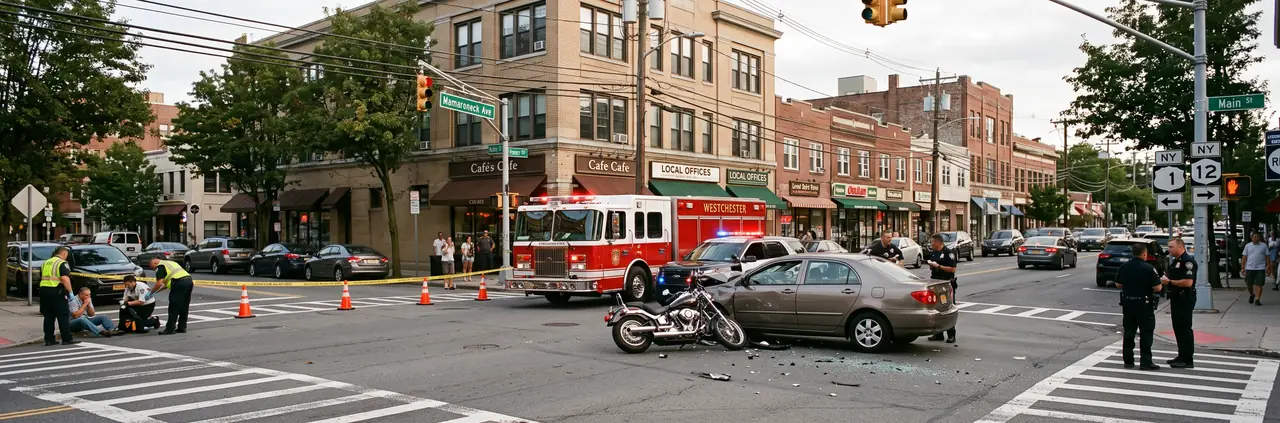
A Westchester County personal injury lawyer at Silver Law Group will review your case for free, by phone or in person, in English, Spanish, or Russian. Call 212-470-4544 and a person answers — 24 hours a day, weekends and holidays included. You pay nothing up front. The fee comes out of the recovery, and only if there is one. If you are still in a hospital bed or stuck at home in a brace, the attorney travels to you. Bring whatever you have: the police report number, the name of the insurance company that already called, the discharge papers from the emergency room. The first conversation costs you nothing and obligates you to nothing.
Do You Have a Personal Injury Case in Westchester County?
Four elements decide whether a claim exists. Lose one and there is no case to bring, no matter how badly you were hurt.
Duty. A driver owes everyone else on the road reasonable care. A store owes the customers it invites inside a dry floor. A general contractor owes the crew on its site a ladder that is secured. Breach. Someone fell short of that duty by running the red light, leaving the spill unmarked for an hour, or sending a worker up unsecured staging. Causation. That failure is what injured you. This is where most fights happen, because the insurer wants your herniated disc blamed on an old gym injury or on simple aging. Damages. You have losses the law can count: treatment, missed paychecks, lasting physical limits.
Our injury attorneys handle these claims across the county most often:
Car and truck crashes, including claims against commercial carriers whose drivers were on a delivery route or a schedule Pedestrian and bicycle crashes at intersections and in parking lots Slip, trip, and fall injuries in supermarkets, apartment buildings, and parking garages Construction falls and falling-object injuries under Labor Law 240 and 241, which place responsibility on the owner and general contractor for gravity-related hazards rather than on the injured worker’s employer Dog bites, which turn on what the owner already knew about the animal before it bit you Medical malpractice, including a misread scan, a surgical error, or a diagnosis that came months late
Workers’ compensation pays your medical bills and part of your wages after a job-site injury, but it pays nothing for pain and suffering and it does not touch the owner or contractor. A construction case often runs on both tracks at once.
Where Westchester Injuries Happen
I-287, the Cross Westchester Expressway, carries commuter traffic and tractor-trailers through the same merges between Rye and Tarrytown, and rear-end impacts cluster where that traffic stacks at the interchanges. The parkways cause a different kind of crash. The Bronx River Parkway, the Saw Mill River Parkway, and the Sprain Brook Parkway were laid out for cars that drove slower than yours does, with tight curves, short entrance ramps, low stone overpasses, and no shoulder worth the name in long stretches. The Taconic State Parkway adds distance and darkness to the same design, and single-vehicle and head-on crashes there tend to be severe. Away from the highways, the geography changes again:
Yonkers — steep residential streets, double-parked delivery vehicles, and busy retail corridors where pedestrians cross mid-block White Plains — garage ramps, downtown crosswalks, and office-building lobbies and stairwells Mount Vernon — dense intersections, older sidewalk slabs lifted by tree roots, and multi-family buildings where interior stair lighting fails
Each of these settings changes who you sue. A crash on a parkway is usually a claim against another driver’s insurer. A fall on a cracked sidewalk may be a claim against the abutting property owner, the municipality, or both, and that distinction carries a much shorter clock.
What Your Westchester Injury Claim Is Worth
No lawyer can tell you a number on the first call. Anyone who does is guessing to win your signature. What a claim actually includes:
Medical costs already incurred, from the ambulance through surgery and physical therapy Lost earnings, including overtime and lost opportunities for advancement you can document Future care — repeat surgery, injections, home assistance, assistive equipment, or a lifetime of pain management Pain and suffering, which covers what the injury does to your daily life rather than what it costs on paper
Three things move value more than anything else. Severity comes first: a displaced fracture repaired with hardware is worth more than a sprain because the treatment, the recovery, and the permanent effect are all greater. Permanence comes second. A shoulder that never again lifts above your head changes your work and your sleep for decades, and that is valued very differently from an injury that resolves in four months. The third is the ceiling nobody controls — the available insurance. A catastrophic injury caused by a driver carrying minimum coverage may recover far less than the harm is worth, which is why we look early for an umbrella policy, a commercial vehicle policy, an employer behind the driver, or your own underinsured motorist coverage. Published “average settlement” figures tell you nothing about your case. They blend fender-benders with spinal fusions across states with different laws, and we will not quote them to you.
Meeting the Serious Injury Threshold
After a motor vehicle crash in New York, no-fault pays your medical bills and some lost wages, but you cannot sue the at-fault driver for pain and suffering unless your injury fits a category in Insurance Law 5102(d). The statute lists:
Death Dismemberment Significant disfigurement A fracture Loss of a fetus Permanent loss of use of a body organ, member, function, or system Permanent consequential limitation of use of a body organ or member Significant limitation of use of a body function or system
The first five are proven with a record: an X-ray, an operative report, a photograph of a scar. The last three are argued, and they are where the defense spends its money. Proving a significant limitation takes objective findings — range-of-motion measurements taken over time, MRI results read against your reported symptoms, and a treating doctor who explains why the restriction is permanent rather than temporary. Gaps in treatment undercut that proof faster than almost anything else.
What to Do After an Accident in Westchester County
Get examined the same day, even if you walked away. Adrenaline hides spinal and head injuries for hours, and the medical record created in the first 24 hours is the spine of everything that follows.
Go to the emergency room. Westchester Medical Center in Valhalla is the Hudson Valley’s only Level I trauma center for adults and children, which means it is staffed around the clock for the injuries that cannot wait — head trauma, internal bleeding, crushed limbs. Ask to be taken there if the injury is severe. Tell the doctor about every symptom, including the ones that feel minor. Neck stiffness and headaches written down on day one are hard to dismiss later as something unrelated. Report the crash to your own no-fault insurer in writing within 30 days. Miss that window and the carrier can deny the medical bills and wage benefits it would otherwise have paid, regardless of who caused the crash. Photograph what you can before it is cleaned up or repaired: the vehicle positions, the spill, the broken step, the missing handrail, your visible injuries. Get the names and phone numbers of witnesses. A supermarket will not give you the shopper who saw you fall, and store video is often overwritten within weeks unless a lawyer demands its preservation in writing. Keep every bill, every out-of-pocket receipt, and every note your employer gives you about missed time.
Do not give the other driver’s insurer a recorded statement before you have spoken to an attorney. That call is not a formality.
A straightforward crash claim may resolve in under a year. A disputed liability case with surgery and a contested threshold can run considerably longer, because the case cannot be valued until your treatment reaches a stable point.
How Insurers Fight Westchester Injury Claims
The adjuster who calls within days of your crash is pleasant, sympathetic, and building a file against you. Four tactics do most of the damage:
The recorded statement. You are asked how you are feeling. You say “a little better,” because you are being polite. That sentence is read back to a jury three years later. The treatment gap. You skipped six weeks of therapy because of childcare or a copay you could not afford. The defense argues the gap proves you healed, and a judge may let that argument reach the jury. Pre-existing conditions. Your old MRI is pulled and every degenerative finding on it is credited for your current pain. New York law allows recovery when a crash aggravates a prior condition, but proving aggravation takes a treating physician who compares the before and the after directly. Surveillance. Investigators photograph you carrying groceries or lifting a child. One good afternoon, filmed out of context, is offered as proof that you are fine.
Send every adjuster call, letter, and release to your lawyer before you respond. You are required to cooperate with your own no-fault carrier; you owe the other side’s insurer nothing but what the law demands, and that is a line an accident and injury attorney draws for you.
If You Were Partly at Fault
Partial fault does not automatically end a claim, but the rule now depends on what kind of case you have. For motor vehicle actions commenced on or after May 26, 2026, CPLR 1411(b) bars recovery entirely when your share of fault is greater than the other side’s — above 50 percent and you collect nothing in tort. At exactly 50 percent you still recover, reduced by half. That change gives the defense a reason to push every percentage point it can onto you, and it makes early evidence preservation more valuable than it used to be. Falls, construction injuries, and other non-motor-vehicle claims stay under CPLR 1411(a), the pure comparative rule. There, fault only reduces what you recover. A worker found 30 percent responsible for his own fall still recovers 70 percent of his damages, with no cutoff. If a police report blamed you, that is not the final word. Reports are written quickly, sometimes without any statement from the person who was unconscious at the scene, and they can be contradicted by video, vehicle damage patterns, and witnesses.
What a Westchester County Personal Injury Lawyer Costs
Nothing out of pocket. There is no retainer to sign a check for, no hourly rate, and no bill arriving while your case is pending. Silver Law Group works on contingency. Our fee is a percentage of what we recover for you, taken from the recovery itself when the case resolves. If there is no recovery, there is no fee, and you owe us nothing for the time we put in. Cases also carry expenses — court filing fees, record retrieval, deposition transcripts, expert physicians who review your films and testify. This law firm for personal injury advances those costs so the case can be built properly, and they are repaid out of the recovery at the end rather than demanded from you while you are out of work. Before anything is signed, you get the fee percentage in writing and an explanation of how expenses are handled. Ask the questions you want answered at the free consultation; it is the same answer whether you hire us or not.
Deadlines for Filing a Westchester County Injury Claim
Westchester injury claims run on several clocks at once, and the shortest one controls. Three years — CPLR 214. Most negligence claims, including car crashes, falls, and construction injuries, must be filed within three years of the date you were hurt. Two years and six months — CPLR 214-a. Medical, dental, and podiatric malpractice runs from the act or omission, or from the end of continuous treatment for the same condition. The shorter window catches people who spend a year trying to find out what went wrong. Two years — EPTL 5-4.1. A wrongful death claim runs two years from the date of death, separate from any survival claim for the pain the person suffered before dying. Ninety days — GML 50-e. A claim against Westchester County, a city, a town, a village, a school district, or the Bee-Line bus system requires a written Notice of Claim served within 90 days of the incident. It must state what happened, where, when, and what injuries resulted. Serve it late without court permission and the case is over before it starts. One year and ninety days — GML 50-i. After the notice is served, the lawsuit itself must be commenced within one year and 90 days of the event. The municipality may also demand a hearing under oath before suit, which you attend with your attorney. Thirty days. Written notice to your no-fault insurer after a motor vehicle crash, as described above. Potholes and sidewalk defects add another layer: many municipalities answer a defect claim only if they received prior written notice of that specific hazard. Finding out whether such notice exists takes a records request, and it takes time you may not have.
Talk to a Westchester County Injury Lawyer Today
Every file here is prepared as though it will be tried, because an insurer that sees a firm ready to put the case before a Westchester jury negotiates differently than one that does not. That preparation starts at the first meeting, not months later when settlement talks stall. If you cannot travel, the attorney comes to your home or your hospital room. Consultations are free and available in English, Spanish, and Russian, and the phone is answered any hour of the day or night. Call 212-470-4544 for a case review, or contact Silver Law Group, P.C. at 49 West 37th Street, 7th Floor, New York, NY 10018. No fee unless we recover for you.