

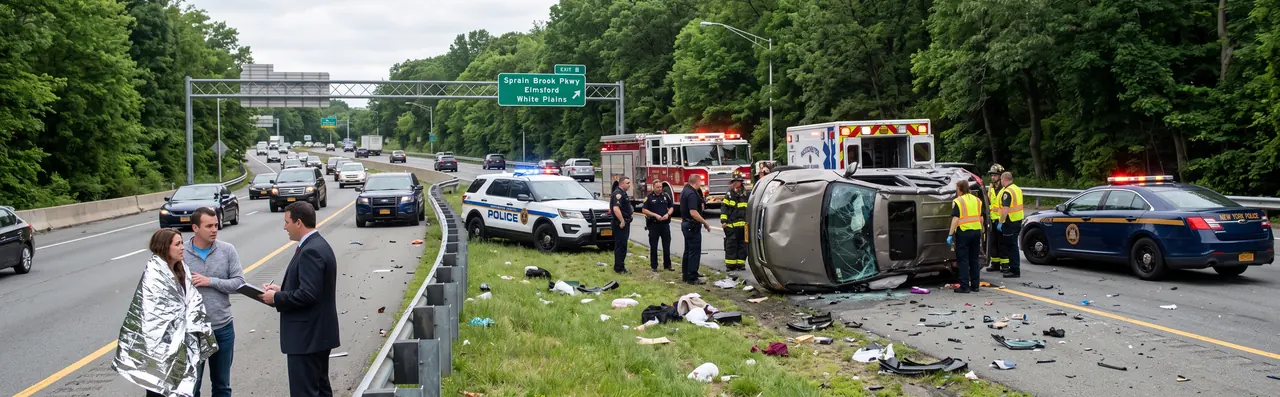
Call 212-470-4544 before you give any insurance company a recorded statement about your rollover. A Westchester County rollover accident lawyer at Silver Law Group answers that call at any hour, free of charge, for crashes anywhere from Yonkers to Peekskill.
The adjuster who phones in the first few days is collecting your words to use later. A statement you give from a hospital bed, on pain medication and before anyone has looked at the vehicle, can be quoted back to argue that you sped or overcorrected on your own.
Rollover cases are won with physical evidence: roof deformation, tire marks, guardrail damage, and the data stored inside the car. That evidence starts disappearing as soon as the wreck is towed and sold for salvage. The consultation costs nothing, and the call can be made tonight.
Do You Have a Westchester Rollover Claim?
Rollovers happen in one of two ways, and either one can support a claim.
A tripped rollover starts when the tires on one side hit something that stops their sideways slide, like a curb, a guardrail, or soft ground past the edge of a paved shoulder. Momentum carries the roof over the stopped wheels. An untripped rollover usually starts with a swerve. A driver jerks the wheel to avoid a car cutting into the lane, overcorrects, and the vehicle tips over on flat pavement.
The untripped type is where many injured people give up too early. The car that forced you to swerve never touched you, so the insurer calls it a single-vehicle crash and blames your steering. New York negligence law does not require contact. If a driver cut you off and caused your rollover, that driver is responsible, as long as they can be identified through witnesses, dashcam video, traffic cameras, or a plate number. Video is often recorded over within days, so finding it is the first job.
You may have a claim if you are:
- The driver, when another motorist, a defective part, or a dangerous road caused the roll
- A passenger in any seat, including a passenger with a claim against the driver of their own vehicle
- Someone thrown from the vehicle or hit by it
- A family member of someone killed, through a wrongful death claim brought by the estate
Why SUVs and Pickups Roll Over on Westchester Roads
Height is the problem. An SUV or pickup carries its weight higher off the road than a sedan, so a sharp turn that makes a car skid can make a taller vehicle tip. The Insurance Institute for Highway Safety’s 2023 fatality data shows the result. Rollovers accounted for 38% of pickup occupant deaths and 35% of SUV occupant deaths, compared with 21% for people in cars.
Westchester’s roads supply the conditions. The Taconic State Parkway winds north through tight curves that leave little room to recover from a mistake, whether yours or another driver’s. On I-684 and I-287, a sudden lane change at highway speed gives the driver beside it a fraction of a second to react, and a hard swerve in a tall vehicle at that speed is how untripped rollovers begin. In January 2026, a rollover on the Saw Mill River Parkway near the Eastview exit in Greenburgh showed how fast a parkway crash can turn over.
If you were in an SUV, expect the other driver’s insurer to blame the vehicle’s design. That argument does not cancel their driver’s fault. It may add a second defendant, the manufacturer, which is why rollover SUV accident lawyers investigate the vehicle and the other driver at the same time.
Who Is Liable for a Westchester Rollover Crash
One rollover can lead to several claims running at once, each against a different insurer:
- Other drivers whose cut-off or tailgating forced the swerve
- Truck operators and the companies that employ them
- Makers of the vehicle and its tires
- The owner of the road, either New York State or Westchester County
Stacking claims matters when one driver’s policy is too small to cover a spinal injury.
Other Drivers and Commercial Trucks
Most rollovers caused by another vehicle trace back to one of these:
- A cut-off that leaves you a split second to swerve
- Tailgating that forces a hard brake-and-steer when traffic stops short
- A truck load that shifts or exceeds its weight limit, tipping the truck itself or pushing it into your lane
When cargo slides in a turn, it drags the truck’s center of gravity toward the outside of the curve. In June 2026, a garbage truck rolled over in Yonkers after its load shifted on the 6A on-ramp to the northbound Thruway.
A crash with a commercial truck brings in more than the driver. The employer is generally responsible for its driver’s negligence on the job, and whoever loaded the truck may share fault. Trucking companies keep driver logs, maintenance records, and loading records, and they have no reason to keep them longer than they must. A preservation letter sent in the first days puts them on notice that this evidence cannot be destroyed.
Roof Crush, Tire, and Stability Defects
Federal Motor Vehicle Safety Standard 216a requires the roof of a passenger vehicle with a gross vehicle weight rating under 6,000 pounds to withstand a force equal to three times the vehicle’s unloaded weight. The standard became mandatory for model year 2016. When a roof caves into the head space during a rollover, the manufacturer has to answer for why it collapsed.
Roof strength is one of several defects that can turn a survivable rollover into a catastrophic one:
- Tread separation or a blowout that starts the roll
- Electronic stability control that fails to engage during a swerve
- A roof that crushes into the occupant space
Product claims have one big advantage over car-insurance claims. Insurance Law 5104 limits pain-and-suffering suits between covered persons in a car crash to cases of serious injury. A vehicle or tire manufacturer is not a covered person, so your claim against the manufacturer does not have to meet the serious injury threshold.
The proof is inside the car. The event data recorder stores speed, braking, and seatbelt use from the seconds before the crash. Once the vehicle is declared a total loss, the insurer can sell it for salvage within days, and that data goes with it. Do not sign the vehicle over until your lawyer has arranged an inspection and a download.
Dangerous Parkway Design and Maintenance
Who owns the road decides where you sue. The Hutchinson River, Sprain Brook, and Cross County parkways are maintained by New York State, so a claim for a defect on them goes to the New York State Court of Claims, where a judge decides the case without a jury. The Bronx River Parkway is different. Westchester County owns it, so a claim for a defect there is brought against the County.
Three road defects matter most in rollovers. A guardrail end can launch a vehicle into the air instead of stopping it. Poor drainage lets water pool on a curve. And at a shoulder drop-off, the pavement edge sits above the ground beside it: a tire that slips off catches on the edge, and the jerk back onto the road can flip the car. Photograph the spot before road crews repair it.
Rollover Injuries and the Serious Injury Threshold
Rollover injuries follow a pattern because the people inside are thrown in several directions while the roof comes down toward them:
- Spinal cord and neck injuries when the roof crushes into the head space
- Head trauma and multiple fractures from full or partial ejection
- Broken ribs, pelvis, and limbs as the cabin twists through each roll
- Deep cuts from shattered glass
The worst of these injuries are often treated at Westchester Medical Center in Valhalla, the region’s Level I adult trauma center. The records made there in the first hours become the core medical evidence in your case.
To sue the at-fault driver for pain and suffering, you must prove a serious injury under Insurance Law 5102(d). The 2026 amendment eliminated the old 90/180-day category, which covered injuries that kept you from your usual activities for 90 of the first 180 days after the crash. A fracture still qualifies on its own, so many rollover victims meet the threshold with an X-ray. Soft-tissue and spinal injuries without a fracture now need objective medical proof of a significant or permanent limitation, which is why consistent treatment and imaging matter from the first week.
What a Westchester Rollover Claim Is Worth
What your claim is worth depends on two things: how much of your loss falls outside no-fault, and how much fault the insurer can pin on you.
New York no-fault coverage pays up to $50,000 for medical bills and lost wages, no matter who caused the rollover. It does not pay for your vehicle, and it pays nothing for pain and suffering. A claim against the people responsible can recover:
- Medical costs and lost earnings above the no-fault limit
- Future surgery, rehabilitation, and home care
- Lost earning capacity if you cannot go back to your job
- Pain and suffering, once the serious injury threshold is met (or without it, in a claim against a manufacturer)
- Vehicle damage, through the at-fault driver’s property damage coverage or your own collision coverage
Two rules can shrink that number. Under CPLR 1411(b), a claimant in a lawsuit filed on or after May 26, 2026 who is more at fault than all defendants combined cannot recover. Below that line, your award is cut by your share of fault, so if you are found 30% at fault, you receive 30% less.
The second rule is about seatbelts. Under VTL 1229-c(8), proof that you were not buckled in can reduce damages for injuries a belt would have prevented. It does not shift the blame for causing the crash.
Insurers press both arguments in rollover cases, because a crash that looks like a single-vehicle accident invites blame on the driver. The answer is evidence gathered early: the data recorder download, witnesses who saw the car that cut you off, and an accident reconstruction. Rollover accident attorneys who know these rules build the fault case before the insurer finishes building its own.
What Happens After a Rollover in Westchester County
The first month after a rollover sets up everything that follows. The steps usually run in this order:
- Get medical care and keep every record, starting with the emergency room visit.
- File an MV-104 report with the DMV within 10 days, as VTL 605 requires when someone is injured. A police report does not replace it.
- Send the no-fault application to the right insurer, usually the insurer of the vehicle you were in, within 30 days of the crash. Late applications can be denied.
- Keep the vehicle out of salvage until an independent inspection is done and the event data recorder is downloaded.
- Your lawyer notifies every insurer, sends preservation letters to trucking companies and road owners, and files suit if needed in Westchester County Supreme Court, 111 Dr. Martin Luther King Jr. Blvd., White Plains.
- The case moves through exchange of evidence, depositions, and exams by the insurer’s doctors, then to settlement talks or trial.
Most of the work in White Plains happens without you. You will be needed for your deposition and for trial, if there is one.
Rollover Claim Deadlines in New York
Each defendant in a rollover case comes with its own clock, and missing one usually ends that claim for good:
- Three years from the crash to sue a driver, trucking company, or manufacturer for your injuries, under CPLR 214
- Two years from the date of death to bring a wrongful death suit, under EPTL 5-4.1
- 90 days to serve a Notice of Claim on Westchester County for a defect on a county road such as the Bronx River Parkway, under GML 50-e
- One year and 90 days to file the lawsuit against the County, under GML 50-i
- 90 days to file a claim or serve a notice of intention in the Court of Claims for a defect on a State parkway such as the Hutchinson River, Sprain Brook, or Cross County, under Court of Claims Act 10(3)
The 90-day deadlines are the dangerous ones. A family dealing with surgery and rehab can lose three months without noticing, and a road defect may not be obvious until someone inspects the crash site. If a parkway’s guardrail, drainage, or shoulder may have played any part in your rollover, treat 90 days as your real deadline. The 30-day no-fault window runs alongside all of these.
No Fee Unless You Recover: Why Westchester Families Choose Silver Law Group
Silver Law Group handles rollover cases on a contingency fee. You pay nothing up front and nothing by the hour. The firm’s fee is an agreed percentage of the settlement or verdict, paid out of the recovery when the case ends. If there is no recovery, you owe no fee, so the firm only gets paid when you do.
How the firm works with Westchester clients:
- Free consultations in English, Spanish, and Russian, with a lawyer who can explain each document in the language you are most comfortable with
- An attorney who comes to your home in Westchester or to your hospital bedside, including at Westchester Medical Center in Valhalla, so a broken pelvis does not delay your case
- Phones answered 24/7, so you can talk to a lawyer before the adjuster takes your statement
- Every case prepared for trial in Westchester County Supreme Court from the first week, because insurers make lower offers to lawyers they expect to settle
The office is at 49 West 37th Street, 7th Floor, New York, NY 10018, in Midtown Manhattan, and you never have to travel there to get your case started. A rollover accident lawyer can start preserving your vehicle and the road evidence the same day you call. Call 212-470-4544 now, before the car is sold for salvage.