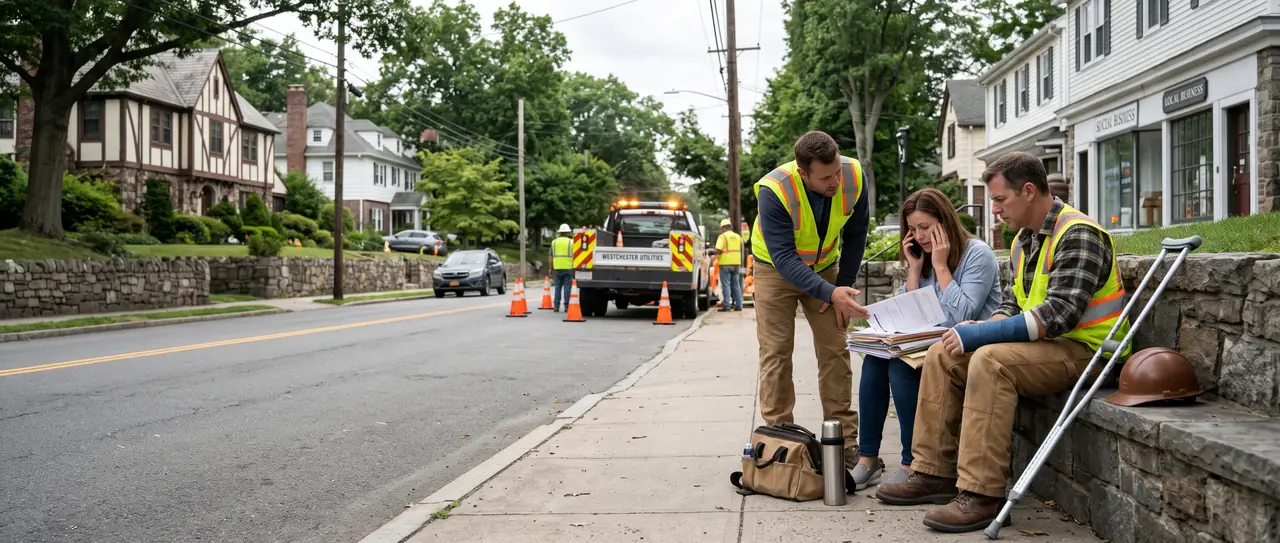
If you were hurt on the job anywhere from Yonkers to Peekskill, a Westchester workers compensation attorney can get your weekly checks started and push back when the insurance carrier tries to cut them short. Silver Law Group represents injured employees across the county, including nurses in Valhalla, warehouse crews off I-287 and laborers on the Yonkers waterfront.
New York’s comp system pays your medical bills and part of your lost wages. You don’t have to prove anyone was at fault. But the carrier controls the money, and it decides what to pay before you have a say. Your first consultation is free, and we hold it in English, Spanish or Russian. Call 212-470-4544 at any hour and an attorney will tell you whether you have a comp claim, a lawsuit against someone outside your company, or both.
Do You Have a Workers’ Compensation Claim in Westchester?
You probably have a claim if you are an employee and your job caused your injury or illness. Workers’ comp is no-fault coverage. That means the carrier cannot deny you because you made a mistake, and you never have to show that your employer was careless.
Coverage reaches further than most people expect:
- Sudden accidents, such as a fall from a ladder or a hand caught in a press
- Occupational illnesses that build over months or years, including lung disease from dust, hearing loss from loud equipment and carpal tunnel from repeated motion
- Crashes while driving for work, such as a delivery run on I-287 or a service call up the Saw Mill River Parkway (your ordinary commute usually does not count)
- Injuries during work errands and off-site assignments your employer sent you on
A work crash can also support a separate lawsuit against the other driver. We cover those claims below.
The label on your paycheck does not decide whether you are covered. Some employers call their workers independent contractors and pay them on a 1099 so they can skip buying comp insurance. The Workers’ Compensation Board looks at how the job actually works: who sets your hours, who supplies the tools, and who controls how the work gets done. If the company controls those things, you may be an employee entitled to benefits no matter what your contract says. A workplace injury attorney can put that evidence in front of a judge before the carrier’s denial becomes final.
Westchester Jobs Where Workers Get Hurt Most
Four groups of Westchester workers show up again and again in comp claims:
- Hospital staff who lift and turn patients, often on short-staffed shifts
- Municipal and school workers: custodians, sanitation crews, highway departments and cafeteria staff
- Construction crews on the Yonkers waterfront, working at height near heavy equipment
- Warehouse and delivery drivers who load trucks all day and then spend hours on county highways
The injuries follow the work. Most fall into these categories:
- Falls from scaffolds, ladders, loading docks and wet floors
- Lifting injuries to the lower back, shoulders and neck
- Repetitive strain in the wrists, elbows and hands
- Machinery accidents, including crush injuries, amputations and deep cuts
A repetitive strain claim usually has no single accident date, so the carrier will often say your condition came from age or something outside work. Your treating doctor’s notes about your job duties are what answer that argument.
What Workers’ Comp Pays in 2026–2027
Your weekly check follows a fixed formula. You get two-thirds of your average weekly wage, multiplied by your percentage of disability. If you cannot work at all, your rate is 100 percent. If your doctor finds you 50 percent disabled and able to do light duty, your check is half of that two-thirds figure.
For injuries between July 1, 2026 and June 30, 2027, state law caps the weekly benefit at both ends:
- Maximum weekly benefit: $1,281.50
- Minimum weekly benefit: $384.45, or your actual weekly wage if you earned less than that
- Your rate is set by the date you were injured and does not rise when new maximums take effect in later years
Your average weekly wage comes from your earnings in the year before the injury. Look at the carrier’s number. A wage figure that leaves out overtime, shift differentials or a raise you got shortly before the injury lowers every check for the rest of your claim, and fixing it early is far easier than fixing it after months of payments.
New York does not pay lost wages for the first seven days of disability. If your disability lasts more than 14 days, the carrier must go back and pay you for that first week. Medical treatment is covered from day one either way.
The percentage of disability is where most fights happen. The carrier’s doctor will often call you less disabled than your own doctor does, and every point counts against your check. That dispute goes to a Workers’ Compensation Law Judge, and you need medical evidence ready when it does.
Medical Care, IMEs and Schedule Loss of Use Awards
For anything other than an emergency, you must see a doctor authorized by the Workers’ Compensation Board. If you go to someone outside that network, the carrier may refuse to pay. In an emergency, go straight to the closest hospital. For serious trauma in the county, that often means Westchester Medical Center in Valhalla, and the carrier pays for that care too.
The carrier has the right to send you to an independent medical examination, or IME, with a doctor it picks and pays. You must attend. Missing an IME without a good reason can get your benefits suspended. Assume the IME report will downplay your injury, and make sure your own doctor’s records are detailed enough to answer it.
Once you reach maximum medical improvement, your permanent injury gets classified:
- Schedule loss of use awards cover permanent damage to arms, legs, hands, feet, vision and hearing. You are paid a set number of weeks based on the body part and how much use you lost.
- Non-schedule awards cover the back, neck and other parts of the body not on the schedule. They are based on how much your injury limits your ability to earn a living.
Suing Beyond Comp: Third-Party Claims in Westchester Supreme Court
Workers’ Compensation Law §11 makes comp your exclusive remedy against your own employer. In practice, you cannot sue the company that signs your paycheck, even if its carelessness caused your injury. That rule stops at your employer, though. Anyone else who caused the harm can be sued in civil court, and that lawsuit can pay you for pain and suffering and for your full lost earnings. Comp pays neither.
The most common third-party claims look like this:
- Labor Law §240 claims against property owners and general contractors when a worker falls from a height or gets hit by a falling object because safety devices like harnesses, scaffolds or proper ladders were missing or failed
- Labor Law §241(6) claims against the same parties when a violation of the state Industrial Code causes a construction injury
- Negligence claims against a driver who hit your work vehicle on the Saw Mill River Parkway, a manufacturer whose machine had no guard, or a subcontractor whose crew created the hazard
§11 also contains a grave-injury exception. If your injury is grave, which covers death, permanent and total loss of use of an arm, leg, hand or foot, total blindness or deafness, paralysis, or a brain injury that causes permanent total disability, the owner or contractor you sue can bring your employer into the case to share the cost. For you, that matters because it puts more insurance money behind a lawsuit for a life-changing injury.
CPLR 214 gives you three years from the date of injury to file most personal injury lawsuits. Westchester cases are filed in Westchester County Supreme Court at 111 Dr. Martin Luther King Jr. Blvd in White Plains. Construction defendants start building their defense the day of the accident by photographing the site, interviewing the foreman and taking down the scaffold. Our workers compensation lawyers send preservation letters early so that evidence still exists when the case reaches discovery.
How the Insurance Carrier’s Lien Affects Your Settlement
Under Workers’ Compensation Law §29, the comp carrier holds a lien on any money you recover from a third party. Out of your settlement or verdict, the carrier gets paid back for the medical and wage benefits it has already paid, minus its fair share of your legal costs. You cannot settle a third-party case on your own terms. You need the carrier’s written consent or a court order approving the compromise. If you settle without either one, you put your future comp benefits at risk. We negotiate the lien amount alongside the settlement so you know your actual net before you sign anything.
What Happens After You File: Hearings at the White Plains Board Office
Most Westchester claims follow the same sequence once your paperwork goes in:
- You give your employer written notice of the injury and file Form C-3 with the Workers’ Compensation Board.
- Your employer reports the injury to its insurance carrier, and your doctor sends medical reports to the Board.
- The carrier must start paying, or formally contest the claim, within 18 days of your injury or 10 days after it learned of the injury, whichever comes later.
- If the carrier disputes anything (whether you were an employee, whether the injury happened at work, how disabled you are), the Board schedules a hearing.
- A Workers’ Compensation Law Judge hears testimony and medical evidence and issues a decision.
- Either side can ask the Board to review the decision within 30 days.
- After the Board rules, the losing party can appeal to the Appellate Division, Third Department.
Hearings happen either virtually or in person at the Board’s White Plains office, 75 S. Broadway. Many hearings are short. Others turn on a single question, such as whether the carrier’s IME doctor or your treating doctor is more believable. Your attorney cross-examines doctors, submits wage records and objects to missing payments. Carrier lawyers appear at these hearings every week. You should not go up against them alone.
If the carrier misses the payment deadline in step 3 without contesting the claim, tell your attorney right away. Those deadlines are part of the law, not suggestions.
What a Westchester Workers’ Comp Attorney Costs
You pay nothing up front for a comp claim, and you never write a check to your lawyer. Workers’ Compensation Law §24 requires the Board to approve every attorney fee in a comp case. The judge sets the fee based on the work done and the benefits you got, and the carrier takes it out of your award before the money reaches you. An attorney who charges you any other fee for comp work commits a misdemeanor under §24. That rule protects you from surprise bills and upfront retainers.
Third-party lawsuits work differently. They run on a contingency fee. Before the case starts, we put in writing the percentage of the recovery our fee will be. We pay the work forward. If the lawsuit produces no recovery, you owe no fee. Our workers compensation law firm gets paid only when you do, so we have every reason to build the third-party case properly from the first week.
Deadlines That Can End a Westchester Claim
Three statutory deadlines decide whether a Westchester claim survives. Two of them start the day you get hurt:
- WCL §18: Give your employer written notice within 30 days. A text to your supervisor may not be enough, so put it in writing with the date, the place and the body part injured. The Board can excuse late notice in some cases, but the carrier will fight it.
- WCL §28: File Form C-3 with the Board within two years of the accident. Your employer’s own accident report does not count as your claim.
- For occupational disease, you have two years from the date of disablement and from the date you knew, or should have known, that your job caused the illness. The later date controls, which matters for hearing loss and lung conditions that show up long after the exposure began.
A third-party lawsuit has its own CPLR 214 three-year clock, which runs separately from these. A claim against a city, county, or school district can carry a much shorter notice deadline, so tell us right away if a public entity may be involved.
If Your Employer Retaliates After You File
Workers’ Compensation Law §120 makes it illegal for your employer to fire you, demote you, cut your hours or treat you differently because you filed for comp or testified in a comp case. You file a retaliation complaint with the Workers’ Compensation Board, and you have two years from the retaliatory act to do it.
If the Board finds retaliation, it can order:
- Reinstatement to your job
- Back pay for the wages you lost
- Attorney fees, paid by your employer rather than taken out of your benefits
Retaliation rarely comes with a written admission. It usually looks like a sudden “performance problem” weeks after you report the injury, or a light-duty assignment no one could actually perform. Save texts, schedules and performance reviews from before and after your claim. The timing of those documents is often the strongest evidence you have.
Why Westchester Workers Choose Silver Law Group
An injured worker in Westchester needs a lawyer who will come to them and who is prepared to go to trial. This is what you get:
- A response 24 hours a day, 7 days a week, including nights and weekends when most offices are closed
- An attorney who comes to your home or hospital room anywhere in Westchester, from New Rochelle to Peekskill, when you can’t travel
- Consultations in English, Spanish or Russian
- Trial-ready third-party litigation in Westchester County Supreme Court, with every case prepared as if a jury will hear it
- A Midtown office at 49 West 37th Street, 7th Floor, New York, NY 10018, a direct ride from Westchester into Grand Central on Metro-North
Our workplace injury attorneys handle both sides of your case together: the comp hearings in White Plains and the lawsuit against the owner, contractor or driver. Each side affects the other, through the §29 lien and through the medical evidence, so handling them in one place keeps them from working against each other. Call 212-470-4544 now for a free consultation.