

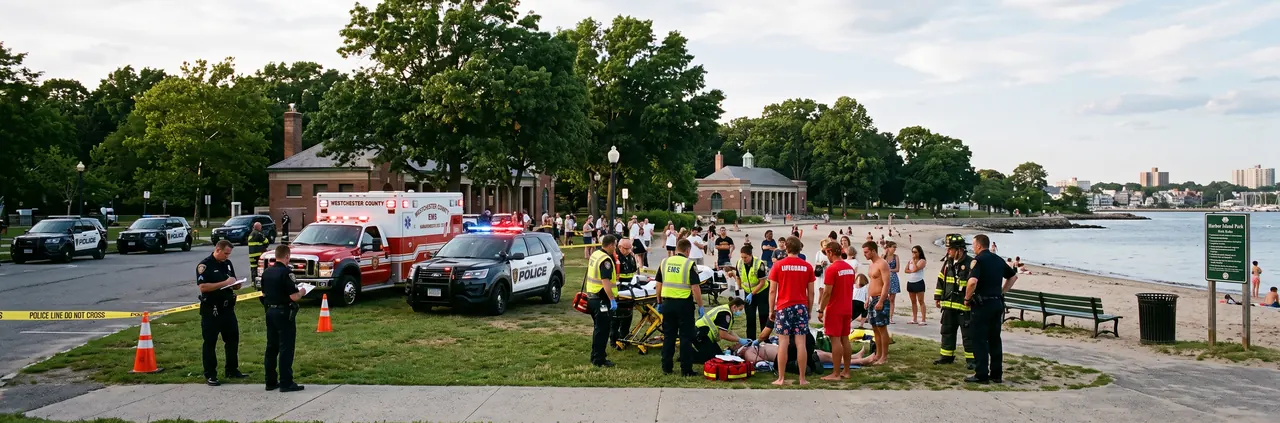
If your child or another family member drowned or nearly drowned, a Westchester County drowning accident attorney at Silver Law Group can start locking down evidence before the pool owner’s insurer settles on its own version of events. We handle drowning and near-drowning claims from Yonkers to Peekskill, at backyard pools, apartment and condo pools, hotel pools, summer camps and the county’s public swimming sites.
Small physical facts that do not last usually decide these cases. A gate latch gets repaired, an alarm gets new batteries, and a camera system records over the afternoon in question. The sooner a lawyer sends preservation letters, the more of that record survives.
Call 212-470-4544 for a free consultation, at any hour.
Do You Have a Westchester Drowning or Pool Accident Case?
You have a case if someone responsible for the water failed to act with reasonable care and that failure caused the drowning or the injury. A New York negligence claim has to prove four things:
- The owner or operator owed the swimmer a duty of care
- They breached it, for example by leaving a gate unlatched or a pool unwatched
- The breach caused the drowning or near-drowning
- The swimmer or the family suffered real losses as a result
Older law sorted visitors into three tiers. An invitee, such as a hotel guest or swim club member, was owed the highest care. A licensee, such as a social guest, was owed only a warning about known hazards, and a trespasser was owed almost nothing.
New York dropped that system in 1976, in Basso v. Miller, and replaced it with one standard of reasonable care under the circumstances. The visitor’s status still matters, because it shapes what the owner should have seen coming.
Children change the analysis most. Many states apply an “attractive nuisance” rule to child trespassers drawn to a pool. New York reaches a similar result through foreseeability: an owner who knew neighborhood kids could slip through a gap in the fence had reason to expect a child in the water, and reasonable care meant closing the gap.
Fault can be shared. Under CPLR 1411, New York’s pure comparative fault rule, a swimmer’s own carelessness reduces the award by their percentage of fault but never wipes it out. A teenager who dove into shallow water can still recover from an owner who left the pool unguarded.
Backyard and Private Residential Pools
Residential pools in New York must meet two hard code requirements, and a missing one is strong evidence of negligence.
Executive Law 378(14) requires a pool alarm on residential pools 24 inches deep or more that were built, installed or substantially modified after December 14, 2006. The alarm has to sound when someone enters the water. The building code also requires:
- a barrier at least 48 inches high around the pool
- gates that close on their own
- latches that lock automatically when the gate swings shut
Each of these can be checked after the fact, and that is the first thing a swimming pool drowning lawyer should look at. Was the alarm installed, switched off or dead? Did the gate spring work, or was a chair holding the gate open?
Homeowners often disable alarms because they go off during normal swimming. That choice, made for convenience, is the kind of fact a jury remembers.
County Pools, Beaches and Summer Camps
Westchester County runs its own pools and beaches, and each one operates under written state and county supervision rules. County-run swimming sites include:
- Playland pool and beach in Rye
- Saxon Woods pool
- Sprain Ridge pool in Yonkers
- The Brook at Tibbetts Brook Park in Yonkers
- Willson’s Waves at Willson’s Woods Park in Mount Vernon
- Glen Island beach in New Rochelle
- Croton Point beach on the Hudson
The State Sanitary Code at 10 NYCRR Subpart 6-1 governs public pools and bathing beaches, and Article XII of the Westchester County Sanitary Code adds local rules on top. Together they set minimum standards for lifeguard staffing, supervision and safety equipment, and they require operators to hold permits from the County Health Department. Summer camps that take children swimming answer to the same health inspectors.
When a lifeguard log shows a guard left the chair, or an inspection report shows a pool ran short-staffed, the violation becomes evidence in your drowning case. Claims against the county or a town-run camp also carry a 90-day notice deadline, covered in the deadlines section below.
Who Is Liable for a Drowning in Westchester
More than one party is often responsible, and each may carry its own insurance policy. Depending on where the drowning happened, the claim can reach:
- Homeowners, for an unfenced pool, a disabled alarm, or a party where no adult was watching the water
- Condo and apartment boards, which control building pools and decide on staffing, gates and repairs
- Hotels and motels that open a pool to guests and choose whether to post a lifeguard
- Private swim clubs, which sell access to the water and are responsible for supervising it
- Summer camps and day programs that bring children to pools, lakes or beaches
- Lifeguard staffing contractors that supply guards for a pool they do not own
- Manufacturers of drain covers and other pool equipment
Drain claims work differently from the others. The federal Virginia Graeme Baker Pool and Spa Safety Act requires anti-entrapment drain covers on public pools and spas, because suction at a drain can hold a swimmer underwater. When a cover is defective or missing, the manufacturer can be sued under product liability law alongside the pool operator, who should have caught the problem.
Public operators are not exempt. In 2025 a child nearly drowned while attending a summer camp run by the Town of Greenburgh. The Westchester County Health Department later found the camp had operated without a required permit for several years, cited it for inadequate supervision, and ordered the town to pay a civil penalty.
Records like that inspection file can be requested under the Freedom of Information Law. They sometimes show a pattern of violations that started long before your family’s visit.
What Is a Drowning or Near-Drowning Claim Worth?
No honest lawyer can put a number on a drowning claim before the medical picture is clear. The damages fall into two groups:
- Economic losses such as emergency and ICU care, rehabilitation, future treatment, home care, lost wages and lost earning capacity
- Pain, suffering and the loss of ordinary life, including school, work or sports the survivor can no longer do
Three facts then set the range: how severe and permanent the injury is, how much insurance the responsible parties carry, and what share of fault a jury might assign the swimmer under CPLR 1411. A severe brain injury covered by one small homeowners policy is a very different case from the same injury at a hotel with layered commercial coverage.
Near-Drowning and Hypoxic Brain Injury
The damage in a near-drowning happens during the minutes underwater, while the brain goes without oxygen. Brain cells start to die, and the result is hypoxic brain injury. It can mean memory and attention problems, or it can mean permanent loss of speech, movement and independence. Children who survive a long submersion may need care for the rest of their lives.
Water drawn into the lungs causes a second injury. Aspiration can inflame lung tissue, lead to pneumonia, and cause breathing failure hours after a swimmer seemed fine. Any child pulled from a pool should be checked at a hospital, even if they are talking and alert.
The most serious Westchester cases go to Valhalla. Westchester Medical Center is the Level I adult trauma center there, and Maria Fareri Children’s Hospital on the same campus is the Level I pediatric trauma center. Pediatric ICU notes, neurology consults and MRI studies from those hospitals become the core medical proof in your claim.
Valuing a brain injury means projecting decades of cost: therapy, special education, home nursing, an accessible home, and the parent who can no longer work full-time. We work with treating doctors and life care planners to put each of those costs in writing. An insurer will not pay for care no one has documented.
Wrongful Death Damages for Families
New York limits what a family can recover after a fatal drowning in ways that surprise most people. EPTL 5-4.3 allows damages only for pecuniary losses, meaning the money and services the person who died would have provided:
- lost income and financial support
- household services, and for a parent who died, the guidance a child loses
- medical bills and funeral costs
A separate survival claim belongs to the estate. If the swimmer was conscious before losing consciousness, the estate can recover for that pain. Witness accounts and the medical findings often decide how much of it can be proven. Only a personal representative appointed by the Surrogate’s Court can bring these claims.
New York still does not allow compensation for grief. The Grieving Families Act would have changed that, but it was vetoed in December 2025, so a family’s sorrow and lost companionship remain outside what the law pays for. When a child dies, careful proof of every economic loss carries even more weight.
What Happens Next in a Westchester Drowning Case
What evidence exists a year from now depends on the first few weeks. This is the order we work in:
- Send preservation letters for security camera and doorbell footage before the system deletes it.
- Photograph the gate, latch, fence and pool alarm as they were, and bring in a pool safety expert where the condition is disputed.
- Demand lifeguard logs, staffing schedules, training certificates and incident reports from the operator.
- Request Westchester County Health Department inspection reports and permit records for public pools, beaches and camps.
- Collect EMS and hospital records and identify witnesses while memories are fresh.
- File suit in Westchester County Supreme Court, 111 Dr. Martin Luther King Jr. Blvd., White Plains, if the insurer will not pay fair value.
Expect a call from an insurance adjuster within days. The adjuster will ask for a recorded statement and describe it as routine. Decline, and give them your lawyer’s phone number.
A grieving parent’s words, recorded the week of the funeral, can be quoted back later to argue the child was left unsupervised.
How Much a Westchester County Drowning Accident Attorney Costs
You pay nothing up front to hire Silver Law Group. We work on a contingency fee, which means there is no attorney fee unless your family recovers money through a settlement or a verdict. If we win, our fee is a percentage of that recovery, taken from the settlement or verdict itself and never billed to you out of pocket. If we do not win, you owe us no fee.
That structure puts the financial risk on the firm. A swimming pool accident lawyer who is paid only from a recovery has every reason to build the case fully and to turn down an early, low offer. The percentage is written into your retainer agreement before any work begins, and we go through it with you at the free consultation.
Deadlines for Westchester Drowning Claims
Who owns the water decides which deadline governs your claim. The shortest clock usually decides what has to happen this month.
- CPLR 214 gives an injured swimmer three years from the date of the incident to sue a private owner or operator.
- EPTL 5-4.1 gives the estate two years from the date of death to bring a wrongful death action.
- General Municipal Law 50-e requires a Notice of Claim within 90 days when the pool, beach or camp belongs to the county, a city, a town or a village, including the county pools and the Greenburgh camp described above.
- GML 50-i then allows one year and 90 days to file an injury lawsuit against that municipality.
- Court of Claims Act section 10 sets a 90-day deadline to file a claim, or a notice of intention to file one, when the State of New York owns the property.
- CPLR 208 stops the three-year clock from running for a child injured before 18 until the child turns 18.
Infancy tolling has limits. It does not excuse a missed 90-day notice against the county or a town, because a late notice needs a judge’s permission and a judge can say no.
Families of injured children should not treat CPLR 208 as extra time anyway. Footage, witnesses and the condition of a gate disappear on the original schedule, even when the legal deadline moves.
Why Westchester Families Choose Silver Law Group
A family dealing with a drowning needs a lawyer who answers the phone and prepares every case for court. Working with us means:
- Free consultations in English, Spanish and Russian, so every relative who saw what happened can tell it in their own language
- 24/7 availability, including the night of the incident
- An attorney who comes to you, at home or at the bedside in Valhalla
- Trial-ready preparation from the first week, so the insurer knows the case can go before a Westchester jury
Our office is at 49 West 37th Street, 7th Floor, New York, NY 10018, in Midtown Manhattan, and we handle drowning cases throughout Westchester County. Call 212-470-4544 to speak with a drowning lawyer today.