

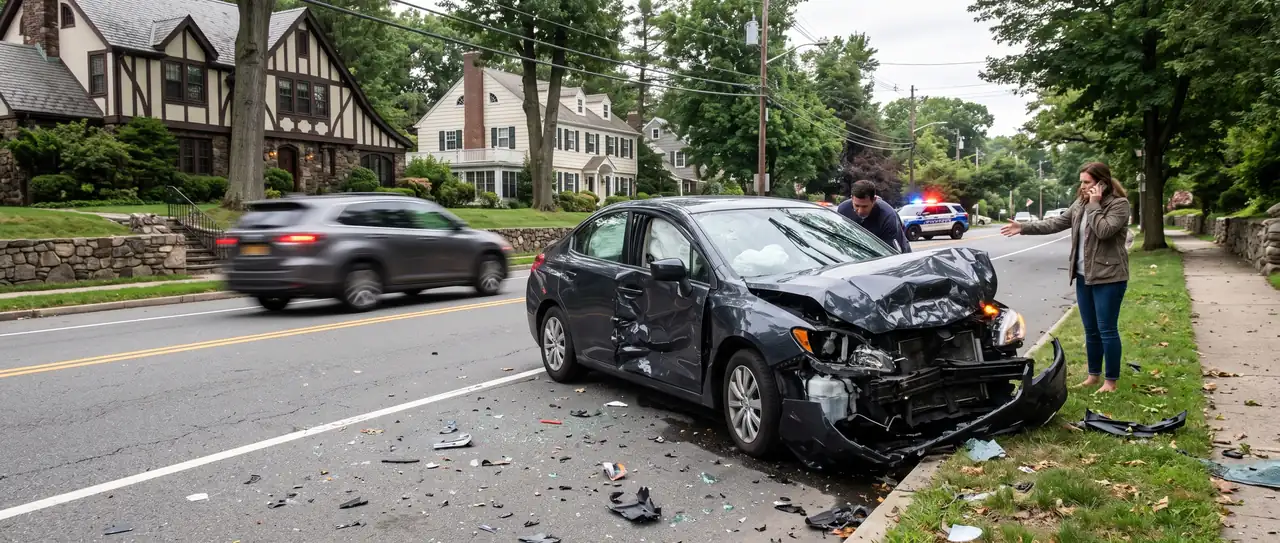
A Westchester County total loss attorney usually ends up handling two claims that come from one crash. A car is rarely totaled by a light tap. It takes an impact hard enough to bend the frame, and that same force goes through the people in the seats. That means you likely have a property claim for the vehicle and a separate injury claim for yourself. Different adjusters handle them, under different rules and deadlines. The adjuster pricing your car has no reason to ask about your neck pain, and the no-fault carrier paying for your MRI does not care what your car was worth. Silver Law Group works both claims together so one is not settled in a way that hurts the other. Call 212-470-4544 for a free consultation in English, Spanish or Russian, or ask an attorney to meet you at home or in the hospital.
Do You Have a Claim After Your Car Was Totaled in Westchester?
If another driver caused the crash, you can file the vehicle claim with either of two insurers. Your choice decides how fast you get paid and what you can collect.
- A claim against the at-fault driver’s insurer pays your car’s value with no deductible and can include a rental or loss-of-use payment. The catch is that nothing gets paid until that insurer accepts that its driver was at fault.
- A claim on your own collision coverage moves faster, because your insurer owes you under your policy whoever was at fault. You pay your deductible first, and your insurer can then go after the other driver’s carrier to get it back.
Collision coverage is optional in New York, so check your declarations page before you count on it.
Fault on Westchester roads is often disputed. A chain-reaction stop on the Cross Westchester Expressway (I-287), a merge on the Hutchinson River Parkway, a lane change at speed on the Sprain Brook Parkway, or a left turn across traffic on Central Park Avenue can each leave two drivers blaming each other. When the other insurer stalls on liability, filing under your own collision coverage gets you paid while the fault fight goes on.
If you were hurt, the injury claim runs alongside the vehicle claim whichever route you pick for the car.
When Is a Car a Total Loss in New York?
New York sets one fixed line in 15 NYCRR 20.20. When a vehicle eight model years old or newer is damaged so badly that repairs would cost more than 75% of its retail value, it is treated as salvage. Once it is rebuilt, its title carries a “Rebuilt Salvage” brand. That brand follows the car to every future buyer, which is why the 75% figure matters to you even if you never plan to sell.
The 75% line governs the title. It does not govern the insurer’s decision, and insurers often total cars well below it. Their math compares the repair estimate plus what the wreck will bring at a salvage auction against the car’s actual cash value. If repairs would cost them more than paying you off, they total the car. Adjusters also total cars early when they expect hidden damage to frame rails, sensors or wiring to push the repair bill up once the panels come off.
So a total loss decision is a business calculation, and you can question it. If you would rather have the car repaired, ask for the repair estimate and the salvage figure the insurer used. Cars older than eight model years fall outside the title-branding rule, but insurers still total them, often because their value is low enough that a modest repair bill crosses the line.
How Insurers Must Value Your Totaled Car
New York does not let an insurer pick a number. Regulation 64, at 11 NYCRR 216.7(c), limits a cash settlement to a short list of valuation methods:
- the average retail value of a substantially similar vehicle in two approved valuation guides
- a quote from a qualified dealer within 25 miles of where your car is mainly garaged, with at least three days for you to confirm that the quoted car exists
- a computerized database approved by the state that produces local market values from licensed dealer sales
Each method is supposed to price a car like yours: same year, make and model, with similar options, mileage and condition. For a car garaged in Westchester, the dealer quote has to come from your market, not from a discount lot far outside it.
The regulation also limits payouts on recently bought cars. If you bought the car within 180 days before the crash and the valuation comes out higher than what you paid plus documented improvements, the insurer may cap its offer at that purchase price and those improvements, minus any deductible. The cap does not apply to cars bought in a private sale or received as a gift.
Sales tax belongs in the payment too. Under 11 NYCRR 216.6(b), actual cash value includes sales tax, so the settlement should cover the tax you will pay on a replacement car. Look for it as a line in the valuation. If it is missing, the offer is short before anyone argues about comparables.
How to Challenge a Lowball Total Loss Offer
A first offer is where the negotiation starts, and these steps build the record you need to push back.
- Ask in writing for the detailed valuation. Regulation 64 requires the insurer to give you a copy of its calculation no later than the day it pays the claim, including options that are not part of the base price.
- Check that report against your actual car. Photograph the trim badge and the option equipment, find the original window sticker if you kept it, and gather receipts for recent work such as new tires, brakes or a rebuilt transmission.
- Send comparable listings for the same year, make, model and trim with similar mileage, for sale at dealers near you. Include screenshots that show the price and the VIN.
- Use the 35-day right if you cannot find a replacement. If you tell the insurer in writing, within 35 calendar days after it mailed the payment, that you cannot buy a substantially similar car for that amount, it must reopen the claim. It then has to make an offer that lets you buy such a car or pay the difference between its payment and what one costs. The exception is when its final offer named a specific comparable car that stayed available for at least three days after you got the offer.
- File a complaint with the New York State Department of Financial Services, which regulates auto insurers. A complaint about a valuation that ignores Regulation 64 is sent to the insurer, and the insurer has to respond.
Injuries From a Crash That Totaled Your Car
Your own no-fault coverage pays first for injuries, whoever caused the crash. It covers necessary medical bills and part of your lost wages, and no one has to prove fault before it starts paying. It does not pay for pain and suffering.
To sue the other driver for pain and suffering, your injury has to meet the serious-injury threshold in New York Insurance Law 5102(d). The statute lists the qualifying injuries:
- death
- dismemberment or significant disfigurement
- a fracture
- loss of a fetus
- permanent loss of use of a body organ, member, function or system
- permanent consequential limitation of use of a body organ or member
- significant limitation of use of a body function or system
- a medically determined injury that kept you from doing substantially all of your usual daily activities for at least 90 of the 180 days after the crash
Most fights happen over the last three categories. They are won or lost in the medical records, through range-of-motion measurements, MRI findings and your doctor’s notes on what you could no longer do.
Crashes violent enough to total a car send many Westchester drivers to Westchester Medical Center in Valhalla, a Level I trauma center. If you left the scene feeling fine, get examined within days anyway. Concussion and spinal injury symptoms can appear late, and a gap between the crash and your first treatment is the first thing the other insurer will point to.
What Your Westchester Total Loss Claim Can Recover
Your claim covers more than the car’s value. Depending on fault and coverage, you can claim:
- towing from the crash scene
- storage fees at the tow yard or body shop
- a rental car, or a loss-of-use payment for the days you had no vehicle
- personal property destroyed in the car, like a laptop, phone or child car seat
- your collision deductible, if you went through your own policy first
- medical costs no-fault did not pay
- lost wages beyond what no-fault covered
- pain and suffering, if your injury meets the serious-injury threshold
Storage charges grow every day the car sits, and insurers push back on days they think were unnecessary. Once the car has been inspected, have it released to the insurer’s yard.
Fault changes the totals. New York uses pure comparative fault under CPLR 1411, so your recovery is cut by your share of the blame but never wiped out by it. If you are found 30% responsible for a collision on Central Park Avenue, you collect 70% of your damages. Adjusters know this rule. They often assign you a fault percentage early to shrink both the vehicle payment and the injury claim, and that percentage is worth contesting with the police report and photos.
When the At-Fault Driver’s Insurance Falls Short
New York requires drivers to carry only $10,000 in property-damage liability coverage. If the other driver bought the minimum and your car was worth more, their policy cannot pay its full value.
You have two places to turn. For the car, move the claim to your own collision coverage, which pays your car’s actual cash value minus your deductible no matter how small the other driver’s policy is. For injuries, use the SUM (supplementary uninsured/underinsured motorist) coverage on your own policy. SUM can pay injury losses above the other driver’s bodily injury limits, up to the SUM limit you bought. It does not pay for the car.
Bring your declarations page to the first meeting. The SUM limit printed on it can matter more than anything in the other driver’s policy.
What Happens After You Call Silver Law Group
Evidence disappears in the first week, so that is where the work starts.
- We inspect the car before it goes to salvage. Insurers move totaled cars to auction yards quickly. Once a car is sold, the crush pattern, airbag module data and seatbelt marks go with it, so our first call goes to wherever your car is being stored.
- We get the police report, along with your MV-104 if you filed one. We also collect photos, witness names and any dashcam or nearby camera video before it is recorded over.
- We negotiate both claims. The vehicle claim usually settles first because Regulation 64 sets the rules, and we check every line of the valuation before you sign over the title. The injury claim waits until your treatment shows how badly you were hurt, so you never settle before you know what you are giving up.
- If the insurers will not pay fair value, we sue in Westchester County Supreme Court, 111 Dr. Martin Luther King Jr. Blvd, White Plains.
From the day you sign on, adjusters call us instead of you.
What Does a Westchester County Total Loss Attorney Cost?
You pay nothing up front. Silver Law Group works on a contingency fee. That means the fee is a percentage of the money we recover for you, it is set in writing before we start, and it comes only out of that recovery. If we recover nothing, you owe no attorney fee.
Hourly billing works the opposite way. In a dispute over the car alone, the gap between the insurer’s offer and your car’s real replacement cost may be smaller than a few weeks of an hourly lawyer’s bills. You could win the argument and still come out behind. A car total loss attorney working on contingency gets paid only by closing that gap, so the cost of the lawyer can never be bigger than what you get back.
Deadlines for Westchester Total Loss and Injury Claims
Several deadlines start running on the day of the crash, and the shortest run out first.
- Within 10 days, file a Report of Motor Vehicle Accident (MV-104) with the DMV if the damage exceeds $1,000. Almost every totaled car crosses that line.
- Give written notice of your no-fault claim within 30 days under 11 NYCRR 65-1.1. Late notice lets the insurer deny your medical and wage benefits.
- If a Bee-Line bus was involved, file a Notice of Claim within 90 days under General Municipal Law 50-e, because Bee-Line is Westchester County’s bus system and claims against public entities follow that rule.
- You have three years under CPLR 214 to sue over your injuries or the damage to your car.
- A family has two years from the date of death to bring a wrongful death claim under EPTL 5-4.1.
The 35-day window to reopen a total loss payment, covered above, is the other short one. A missed no-fault or Notice of Claim deadline can end that part of your case even when the other driver’s fault is clear.
Why Westchester Drivers Choose Silver Law Group
Here is what a Westchester client gets from the first call:
- a free consultation in English, Spanish or Russian
- someone answering 24/7, including the night of the crash
- an attorney who comes to your home anywhere in Westchester, or to your bedside at Westchester Medical Center
- trial-ready preparation of every case, so insurers make their offers knowing the case can go before a jury in White Plains
Our office is at 49 West 37th Street, 7th Floor, New York, NY 10018, in Midtown Manhattan, and our lawyers travel to you in Westchester. Call 212-470-4544 to have your total loss valuation and your injury claim reviewed while every deadline is still open.