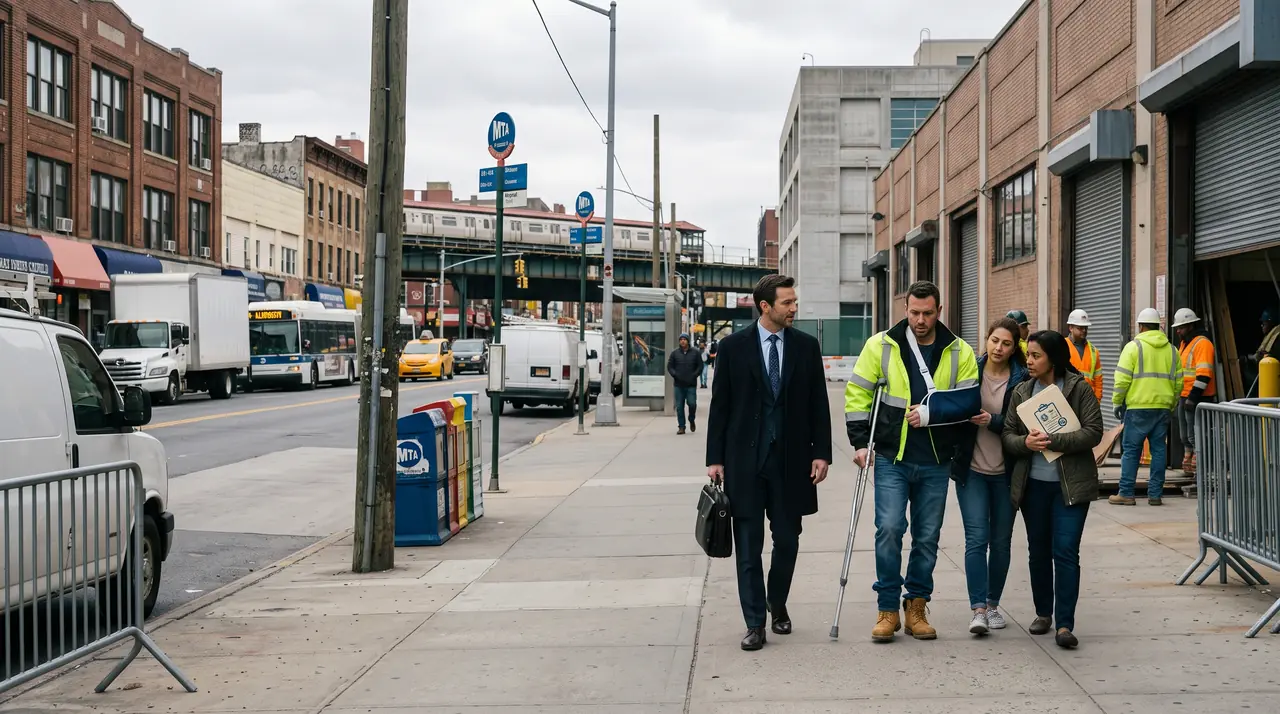
A New York workers’ compensation attorney can step in before the insurance carrier decides what your injury is worth. Timing matters here, because the carrier’s first wage calculation and first medical exam shape every check that follows. Silver Law Group represents injured workers from our office at 49 West 37th Street, 7th Floor, in Midtown Manhattan, and every case starts with a free consultation.
We go after unpaid lost wages and fight denied or cut-off claims before the Workers’ Compensation Board. We also look past your employer for a third-party lawsuit against the contractor, property owner or driver whose negligence put you in the hospital. You pay no fee unless you recover. Call 212-470-4544 at any hour.
Do You Qualify for Workers’ Compensation in New York?
You do not have to prove your employer did anything wrong. Workers’ compensation is no-fault coverage, so the carrier cannot deny benefits because the accident was partly your own mistake, or even entirely your own mistake. The trade-off is that comp pays your medical bills and part of your lost wages but nothing for pain and suffering. That gap is why the third-party claims described below matter.
Immigration status is not a factor. The Workers’ Compensation Board has said so directly. An undocumented worker hurt on a Manhattan job site has the same right to medical care and wage benefits as the citizen working next to him.
The harder question for many workers is whether they count as employees at all. Contractors, delivery companies and cleaning services sometimes pay workers on a 1099 and call them independent contractors, which lets the business skip the cost of coverage. That label does not decide your case. The Board looks at how the work actually ran: who set your hours, who supplied the tools, who told you how to do the job and who could fire you.
If those answers point to the company, you can qualify for benefits even though you were paid as a contractor. Bring pay records, texts with supervisors and any ID badge or uniform to your consultation. Those details show the working relationship the paperwork leaves out.
Common Manhattan Workplace Injuries
Where you work in Manhattan predicts how you get hurt. It often predicts whether someone besides your employer can be held responsible, too.
- High-rise construction. New York City Department of Buildings figures for 2025 show reported construction injuries fell 33% while construction deaths rose. Falls from scaffolds and floor openings, dropped materials and hoist failures still send workers to the hospital, and many of these sites support a Labor Law claim on top of comp.
- Garment District shops, in the blocks around our West 37th Street office. Sewing-machine operators, cutters and pressers develop carpal tunnel and tendon damage, and workers pushing loaded racks along the sidewalks strain their backs and shoulders.
- Restaurant kitchens: fryer burns, knife cuts, falls on greasy floors and steep cellar stairs, and back injuries from hauling deliveries.
- Hospital staff. Nurses, aides and patient transporters hurt their backs lifting patients and face needlestick injuries and assaults on the unit.
- Delivery cyclists employed by a restaurant or courier company. If a car or an opening door hits you on a delivery, comp covers you, and you may also have a claim against the driver.
Comp also covers injuries that have no single accident. Repetitive-stress conditions build over months of the same motion. Occupational diseases, such as hearing loss or lung damage from dust and fumes, can take years to show up. For an occupational disease, the two-year filing period generally runs from when you knew or should have known the illness was tied to your job.
What Workers’ Compensation Pays in New York
Weekly wage benefits come from a formula: two-thirds of your average weekly wage, multiplied by your percentage of disability.
If you are totally disabled, you get the full two-thirds. If a doctor rates you at 50% partial disability, that figure is cut in half. This is why the carrier’s doctor and your treating doctor so often disagree about the number.
The state caps the weekly check at both ends:
- a maximum of $1,281.50 per week for injuries from July 1, 2026 through June 30, 2027
- a minimum of $384.45 per week for the same period, or your full weekly wage if you earned less than that
Your date of injury fixes your rate. A later increase in the state maximum does not raise the check on an older claim, so a worker hurt in June 2026 stays under the previous year’s cap for the life of the claim.
Wage benefits also come with a seven-day waiting period. You get nothing for the first week unless your disability lasts more than 14 days. Once it does, the carrier owes you those first seven days retroactively. Medical care for the injury has no waiting period.
Check the carrier’s wage figure early. If it leaves out overtime or pay from a second job, every check that follows will be too low.
Permanent Injuries and Lump-Sum Settlements
When your treating doctor says you have reached maximum medical improvement, the claim moves from temporary benefits to a permanent award. The type of award depends on which part of your body was hurt.
A schedule loss of use award covers arms, legs, hands, feet, eyes and hearing. The statute gives each body part a set number of weeks, and the doctor’s percentage of lost use decides how many of those weeks you are paid. You receive the award even if you go back to work.
Injuries to the back, neck and other body parts outside the schedule are classified as non-schedule permanent partial disability. Under WCL 15(3)(w), those weekly benefits are capped at 225 to 525 weeks, depending on how much of your wage-earning capacity the injury took. A bigger loss means a longer cap.
Either type of claim can end in a Section 32 settlement. That is a lump sum that closes the case in exchange for your future benefits. Weigh the trade-offs before you sign:
- You get money now instead of weekly checks that a new exam could cut off.
- Once the case closes, it cannot be reopened if your condition gets worse.
- If the agreement also closes future medical care, you will pay for the next surgery yourself.
- The Board must approve the agreement before it takes effect.
Suing Beyond Workers’ Comp: Third-Party Workplace Injury Claims
Workers’ Compensation Law Section 11 bars you from suing your employer in most cases. Comp is what you get in exchange for that lost right. The bar does not protect anyone else, though. A third party whose negligence caused your injury can be sued for full damages, including the pain and suffering that comp never pays. For a Manhattan injury, that lawsuit is often filed in New York County Supreme Court at 60 Centre Street.
Third parties who are often responsible include:
- the owner of the building or property where you were working
- the general contractor running the site, even if your paycheck came from a subcontractor
- a negligent driver who hit you while you were driving, delivering or working near traffic
Construction falls get special protection. Labor Law 240(1), known as the Scaffold Law, makes owners and general contractors responsible when a worker falls from a height or is struck by a falling object because a scaffold, ladder, hoist or harness was missing or failed. Your own carelessness is not a defense under that section.
Labor Law 241(6) covers other site hazards. To use it, you have to tie the injury to a specific Industrial Code violation, such as an unguarded floor opening or debris left in a passageway.
Your comp benefits continue while the lawsuit runs. Under WCL 29, the comp carrier is repaid what it spent out of any lawsuit recovery. A workplace injury attorney therefore has to handle both claims together to protect what you actually take home.
What Happens After You Report a Work-Related Injury
The paperwork moves in a set order. A gap at any step gives the carrier a reason to delay.
- Tell your supervisor about the injury in writing, and keep a copy.
- Your employer must report the injury on Form C-2 within 10 days of learning about it.
- File your own claim with the Board on Form C-3. Your employer’s report does not take its place.
- Treat with a Board-authorized doctor and say the injury happened at work, so the doctor’s reports reach the Board.
- Expect the carrier to send you to an independent medical examination (IME) with a doctor it chooses and pays. Describe every symptom. Do not downplay your pain to seem tough.
- If anything is disputed, a workers’ compensation judge holds a hearing. Most hearings are held virtually. You can ask to appear in person at the Board’s Manhattan District Office at 215 West 125th Street, which serves New York and Bronx counties.
A work-related injury attorney files your C-3, tracks the carrier’s deadlines and prepares you for the IME, so the report reflects how you actually feel.
When Your Claim Is Denied or Benefits Stop
Carriers deny claims by filing a controversy. That is a formal notice disputing that the injury happened at work, that you were an employee or that your treatment is needed. Payments that have already started can also stop, usually after an IME doctor reports that you are less disabled than your own doctor says.
Neither move is final.
A workers’ compensation judge decides the dispute, and the medical conflict usually comes down to testimony. Your attorney cross-examines the IME doctor under oath about how long the exam lasted, which tests were skipped and why the findings contradict months of treatment records.
If the judge rules against you, you have 30 days from the decision to ask a Board panel to review it. The panel’s decision can then be appealed to the Appellate Division, Third Department. If you miss the 30-day window, the challenge usually ends there.
What a New York Workers’ Compensation Attorney Costs
You pay nothing upfront. The fee is contingent, which means your attorney is paid only from money you actually recover. If you recover nothing, you owe no fee.
- The consultation is free, and there is no retainer and no hourly bill.
- Under WCL 24, the Workers’ Compensation Board must approve every attorney fee. Your lawyer cannot set the amount alone.
- The approved fee comes out of the award, so you never write a check.
- The fee is 15% of schedule loss of use awards and Section 32 settlements.
- Money set aside for your future medical care is excluded from the fee.
A third-party lawsuit runs under its own contingency agreement. Its percentage is written into your retainer before any work begins and is paid only from the lawsuit recovery. Many injured workers put off calling workers’ compensation lawyers because they assume they cannot afford one. Under this fee structure, money is never the reason to go without help.
New York Workers’ Comp Deadlines
Up to six separate clocks can apply to one workplace injury, and they do not start or end together.
- WCL 18 gives you 30 days to notify your employer in writing. The Board can excuse late notice, but the carrier will use the delay against you.
- Two years under WCL 28 to file your Form C-3 with the Board
- If you are fired, demoted or punished for claiming, WCL 120 allows two years to file a DC-120 retaliation complaint.
- Three years under CPLR 214 to sue a negligent third party
- When a worker is killed, the family has two years from the date of death to bring a wrongful death suit under EPTL 5-4.1.
- 90 days to serve a Notice of Claim under GML 50-e before suing the City of New York, for example when a City vehicle or City work crew caused the injury
The shortest clock usually controls the case. Workers’ compensation attorneys see the 90-day City notice missed more than any other deadline, because it comes due long before the comp filing deadline seems urgent.
Why Injured Workers Choose Silver Law Group
Our workers’ compensation law firm runs your comp claim and any lawsuit as one case, handled by one team that knows both files.
- Free consultations in English, Spanish and Russian, so you can explain your injury in your own language
- A phone line answered 24/7
- An attorney comes to your home or hospital room if you cannot travel to Midtown
- Every lawsuit is prepared for trial from the first day, which gives the insurer a reason to take your claim seriously
Call 212-470-4544 or come to 49 West 37th Street, 7th Floor, New York, NY 10018. Bring your C-3 if you have filed one, any letters from the carrier and your last few pay stubs.