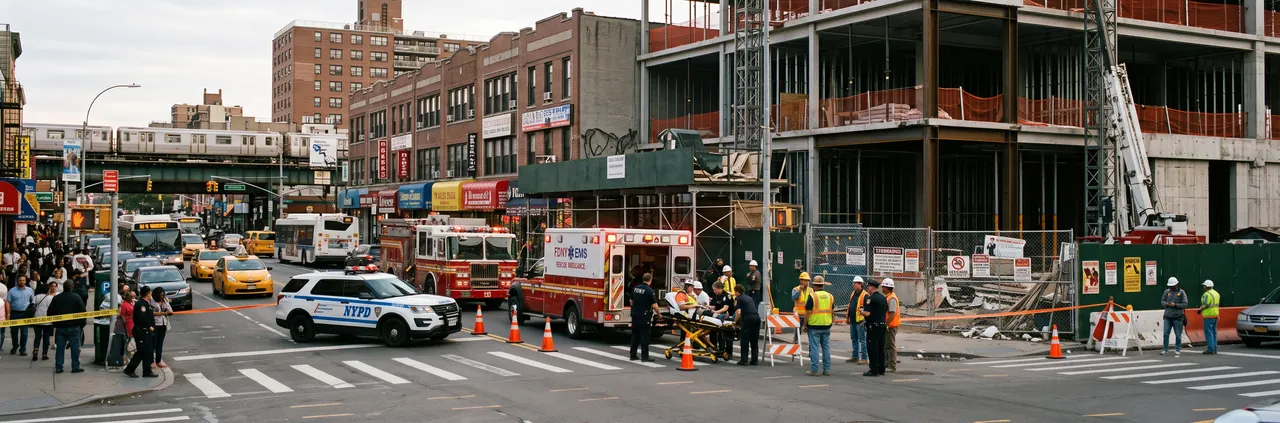
A fall from a scaffold in Long Island City and a burn in a Flushing restaurant kitchen start the same kind of claim, and a Queens workers’ compensation attorney at Silver Law Group can file it for you. We handle both sides of a work injury: the weekly checks and medical care your employer’s insurance carrier owes, and any lawsuit against a property owner, contractor or driver who caused the harm.
Our clients live and work in Flushing, Astoria, Corona, Ridgewood and every other part of the borough. Workers’ compensation pays part of your wages and your medical bills. It pays nothing for pain. A third-party case can.
Call 212-470-4544 now, before you give the carrier a recorded statement or sign a form you have not read. The call is free, and an attorney can speak with you in English, Spanish or Russian.
Do You Have a Workers’ Compensation Claim in Queens?
Almost every Queens employee has workers’ compensation coverage from the first day on the job, and fault plays no part. New York’s system is no-fault. You collect compensation even if your own mistake caused the accident, and in exchange your employer is shielded from most lawsuits. The carrier cannot cut your benefits by calling you careless.
Workers’ Compensation Law §21 tilts the starting point toward you. Unless there is substantial evidence to the contrary, the Board presumes your claim comes within the law. That puts the burden on the carrier to prove that an injury you reported at work did not come from work.
A few injuries fall outside the state compensation system:
- An injury caused solely by your intoxication on the job
- An injury you caused yourself on purpose
- Injuries to federal employees, whose claims go through a federal compensation program
- Railroad injuries, including those to Long Island Rail Road crews working out of Jamaica, which fall under federal railroad law
- Injuries to longshore and harbor workers, covered by a separate federal act
If you are unsure which system covers your job, bring a pay stub to the free consultation. The employer’s name on it usually settles the question in minutes.
Queens Jobs Where Workers Get Hurt
Queens holds two major airports, a fast-rising skyline and dense commercial strips, and each produces its own pattern of injuries.
- JFK’s New Terminal One, a project expected to bring about 6,000 union construction jobs, with steel, crane and concrete work going on inside an operating airport
- LaGuardia Airport ramps, baggage systems and terminal maintenance
- High-rise construction in Long Island City and downtown Jamaica, where falls and dropped materials cause the worst injuries
- Warehouses and distribution centers, with forklift strikes, conveyor accidents and back injuries from repetitive lifting
- Restaurant kitchens on Main Street in Flushing and Steinway Street in Astoria: burns, deep cuts, slips on greasy floors
- Hospitals, where aides and nurses injure their backs moving patients
- MTA and Sanitation Department work, from track and bus-depot injuries to crush injuries on collection routes
Many of these sites involve someone besides your employer, such as an airport contractor, a building owner or another driver. That second party is where a lawsuit for pain and suffering begins, and a work related injury attorney should identify it before evidence on the site disappears.
What Workers’ Comp Pays in New York
Your weekly cash benefit equals two-thirds of your average weekly wage, reduced in proportion if you can still do some work, and held within a state cap. For injuries between July 1, 2026 and June 30, 2027, the limits are:
- A maximum weekly benefit of $1,281.50
- A minimum weekly benefit of $384.45
- Rates fixed by your date of injury, so a worker hurt before July 1, 2026 stays on the earlier year’s figures
The average weekly wage is where carriers make mistakes. It comes from your earnings before the injury, and if the carrier leaves out overtime, every check that follows is too small. Compare the figure on the carrier’s paperwork against your pay stubs.
No cash is paid for the first seven days you are out of work. If your disability lasts more than 14 days, the carrier must pay those first seven days retroactively. A 10-day absence, by contrast, pays only for days eight through ten.
Medical care is a separate benefit with no weekly cap. The carrier pays for treatment of the work injury, including:
- Emergency care and hospital stays
- Surgery and follow-up visits
- Physical therapy and chiropractic care
- Prescriptions, MRIs and other diagnostic tests
You owe no copay or deductible. An authorized provider cannot bill you directly for covered treatment of a work injury.
Schedule Loss of Use Awards and Section 32 Settlements
Permanent damage to an arm, leg, hand, foot, eye or your hearing can bring a schedule loss of use award, a separate payment for the lasting harm itself. Each body part carries a fixed number of weeks in the statute. Once you reach maximum medical improvement, a doctor rates the percentage of use you have lost. That percentage, multiplied by the statutory weeks and your weekly rate, produces the award.
The carrier’s doctor will almost always rate the loss lower than your treating doctor does. Our workers’ compensation attorneys challenge that gap with medical testimony, because a few percentage points change the award directly.
A Section 32 settlement works differently. It is a lump-sum agreement that closes part or all of your case, and the Board must approve it before it takes effect. It can also close your right to future medical care for the injury, which means a later surgery could come out of your own pocket or your health plan. Read that clause twice, since an approved Section 32 deal is very hard to undo.
Suing Beyond Workers’ Comp: Third-Party Claims
Your employer is immune from suit for a covered injury, and comp is your only remedy against it. Everyone else on the site is not. A property owner, general contractor, subcontractor or negligent driver can be sued in court for pain and suffering and for the full lost earnings that comp only partly replaces.
Construction workers in Queens have two statutes on their side:
- Labor Law 240(1), the Scaffold Law, makes owners and contractors liable when a worker falls from a height or is hit by a falling object because a ladder, scaffold, harness or hoist was missing or inadequate. Your own carelessness is not a defense unless it was the sole cause.
- Labor Law 241(6) holds owners and contractors responsible when a violation of a specific Industrial Code rule causes an injury during construction, excavation or demolition.
Outside construction, the typical third-party case is a vehicle crash. A delivery driver rear-ended on the Van Wyck Expressway collects comp from the employer’s carrier and sues the other driver for pain and suffering.
WCL §11 keeps your employer out of the lawsuit in most cases. A defendant you sue can bring your employer in only if you suffered a “grave injury,” a short statutory list that includes death, loss of an arm, leg, hand or foot, paraplegia or quadriplegia, total blindness or deafness, and permanent total disability from a brain injury. When the injury qualifies, the employer’s liability insurer joins the case alongside the owner and contractor.
A workplace injury attorney files most of these Queens cases in Queens County Supreme Court at 88-11 Sutphin Boulevard in Jamaica. We prepare each one for a jury there from the start.
How the Insurance Carrier Lien Affects Your Settlement
The carrier that paid your comp benefits gets repaid out of any lawsuit you win. WCL §29 gives it a lien on your third-party recovery for the medical and wage benefits it has paid. That lien is reduced by the carrier’s proportional share of your legal fees and costs, because your lawsuit produced the money it is collecting.
You also cannot settle on your own. Settling the third-party case requires the carrier’s written consent or a court order approving the compromise, and settling without either can cut off your future comp benefits. Your attorney negotiates the lien before the settlement is signed, not after.
What Happens After a Queens Work Injury
The first two weeks after an injury set the course of the whole claim. Take these steps in order:
- Get emergency care. Elmhurst Hospital and Jamaica Hospital Medical Center are both Level I trauma centers in Queens. Tell the intake nurse the injury happened at work so the record says so.
- Give your employer written notice of the accident, with the date, place and what happened. Keep a copy.
- Move your follow-up care to a doctor authorized by the Workers’ Compensation Board. Treatment from an unauthorized provider usually goes unpaid, except in an emergency.
- File Form C-3, the Employee Claim, with the Board online or by mail. Your employer’s own accident report does not replace it.
- Wait for the carrier to accept or contest the claim. It may send you to its own doctor for an independent medical examination, and you must attend.
- If the claim is contested, the case goes to hearings through the Board’s Queens District Office at 168-46 91st Avenue in Jamaica. Most hearings now take place virtually by phone or video, so you rarely need to travel.
A workers’ compensation attorney appears with you at every hearing and handles the medical reports the judge relies on. Carriers deal differently with a represented worker from the first contested hearing.
What a Queens Workers’ Comp Lawyer Costs
You pay nothing upfront for a Queens comp case, and you never get an hourly bill. Two different fee rules apply, depending on which case you have:
- Your comp claim. Under WCL §24, workers’ compensation lawyers cannot set their own fee. The Workers’ Compensation Board approves it, and it is paid out of your award, for example 15% of a schedule loss of use award. You never write a check.
- Your third-party lawsuit. This runs on a separate contingency fee: a percentage of what you recover from the owner, contractor or driver, set in a written agreement before work begins. If there is no recovery, you owe no fee.
We put both fee terms in writing at the first meeting, so you see how the money is split before you sign anything.
Workers’ Compensation Deadlines in New York
Five separate clocks can run on one Queens work injury, and the shortest is 30 days.
- 30 days to give your employer written notice of the accident, under WCL §18. The Board can excuse late notice, but the carrier will use the delay against you.
- Two years to file your claim with the Board under WCL §28. For an occupational disease, the two years run from the date of disablement or from when you knew or should have known the disease came from work, whichever is later.
- An appeal of a Workers’ Compensation Law Judge’s decision goes on Form RB-89 within 30 days of the filed decision.
- CPLR 214 allows three years from the accident to sue a negligent owner, contractor or driver.
- A family’s wrongful death lawsuit must be filed within two years of the death under EPTL 5-4.1.
Occupational diseases catch workers off guard. A nurse’s aide’s spine or an airport ramp worker’s hearing can wear down for years before a doctor names the cause, so file as soon as a physician ties the condition to your job.
Why Queens Workers Choose Silver Law Group
Every case starts with a free consultation in English, Spanish or Russian. A line cook from Corona or a home health aide from Rego Park can tell the story in the language they think in, without an interpreter in the room.
We answer the phone 24/7. That matters when the injury happens on an overnight shift at JFK and the carrier’s adjuster calls the next morning.
If you are in a bed at Elmhurst Hospital or recovering at home in Ridgewood, an attorney comes to you. You do not need to travel to sign papers or explain the accident.
Our workplace injury attorneys prepare third-party cases for trial from the first week: site photos, safety logs, the names of everyone on the crew. As a workers’ compensation law firm that also tries injury cases, we run the comp claim and the lawsuit together, so the lien, the deadlines and the medical evidence line up. The office is at 49 West 37th Street, 7th Floor, in Midtown Manhattan, an easy ride from Queens on the 7 train.
Speak With a Queens Workers’ Compensation Attorney
Call 212-470-4544 today. If you are the spouse, parent or adult child of an injured worker, make the call from the hospital bedside, and we will explain the first steps on the phone and send an attorney to the hospital if needed. Have the accident date and the employer’s name ready; we can gather everything else. The consultation is free, and there is no fee unless you recover.