

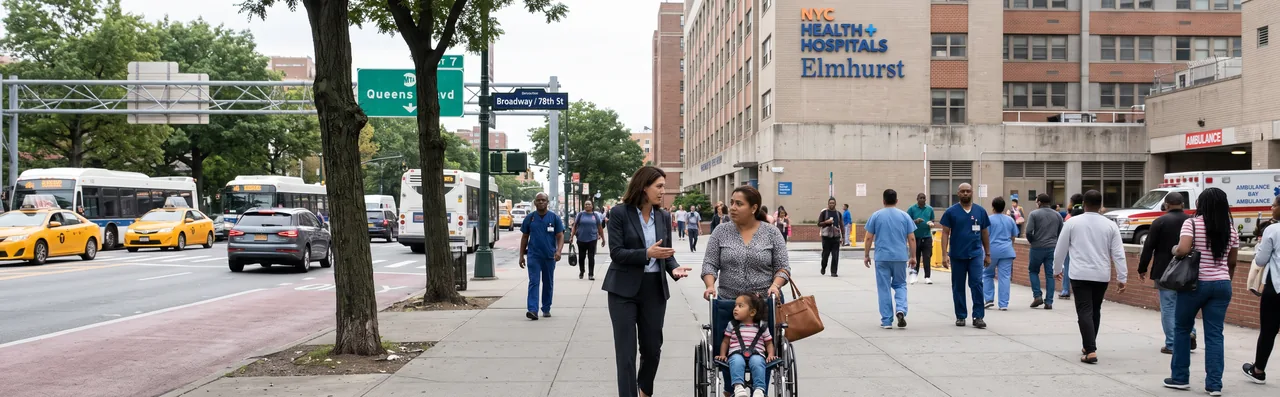
If a doctor, nurse, or hospital in Queens made a mistake that left you or someone you love worse off, a Queens medical malpractice lawyer at Silver Law Group can review your case for free. We take calls 24/7, because medical harm rarely shows up on a schedule and the hospital’s risk manager may already be gathering its side of the story.
A medical malpractice claim depends on the records, and the records start aging the day you leave the hospital. Call 212-470-4544 or request a case review now. That applies to a missed diagnosis at a Jamaica emergency room, a surgery in Flushing that went wrong, or a birth injury in Forest Hills. An attorney will read what happened, tell you whether it looks like negligence, and explain what the next step costs you. It costs nothing unless you recover.
Do You Have a Medical Malpractice Case in Queens?
New York law asks four questions of every malpractice claim, and you need a yes to all four.
- Did the provider owe you a duty of care? This is usually the simplest part. Once a doctor, nurse, or hospital agrees to treat you, the duty exists.
- Did the provider depart from accepted medical practice? The question is whether a reasonably careful provider in the same field would have acted differently, not whether the treatment failed.
- Did that departure cause your injury? The other side will argue your illness would have progressed anyway. Causation is where most defense lawyers fight hardest.
- Did you suffer real harm? You need an injury you can document, such as additional surgery, lost function, lost income, or a worse prognosis.
A bad outcome is not proof of negligence. Surgery carries risk, some cancers are aggressive even when caught early, and a medication can cause a reaction no one could have predicted. Negligence means a provider skipped something the standard of care required. That could be a test that should have been ordered, a lab result that was never read, or a sponge that was counted wrong.
More than one party is often responsible. A claim can name the attending physician, a resident, a nurse who missed a warning sign, the hospital that set staffing levels, or an urgent-care clinic that sent you home with the wrong diagnosis. An attorney for medical malpractice will work out who touched your care and what each one missed. In a hospital case, that list is usually longer than patients expect.
Common Malpractice Claims Against Queens Hospitals
The claims that come out of Queens hospitals tend to fall into a few patterns:
- Misdiagnosis and delayed diagnosis. Common examples are a heart attack read as indigestion, a stroke mistaken for intoxication, or a tumor missed on imaging.
- Surgical errors: operating on the wrong site, nicking a bowel or artery, leaving an instrument inside, or ignoring signs of post-operative infection.
- Anesthesia mistakes, including dosing errors and failure to monitor oxygen levels during a procedure.
- Birth injuries caused by a delayed C-section, mismanaged fetal distress, or improper use of forceps or vacuum.
- Medication errors, meaning the wrong drug, the wrong dose, or a dangerous interaction that the pharmacy or prescriber should have caught.
- Emergency room failures. Patients get discharged too early, triage misses the severity of symptoms, or specialists are never called.
These cases come from the borough’s biggest hospitals as well as its small practices. Patients bring claims involving Jamaica Hospital Medical Center, NewYork-Presbyterian Queens in Flushing, Mount Sinai Queens in Astoria, and LIJ Forest Hills. Each of these institutions has its own legal department and insurer. Expect both to be involved from the moment a complaint about your care reaches the hospital.
What Is Your Queens Medical Malpractice Case Worth?
The value of a malpractice case comes from three kinds of loss, and each one needs its own proof. Economic damages cover what you can put a receipt or pay stub to: hospital bills, corrective surgery, prescriptions, and the wages you lost while you couldn’t work. When an injury changes your working life permanently, economic damages also cover the income you will not earn in the years ahead.
Future-care damages often make up the largest share of a serious case. A child with a birth injury may need therapy, adaptive equipment, and home care for decades. An adult with a surgical nerve injury may need repeat procedures. To prove these costs, you need life-care planners and economists who can show a jury what that care will actually cost over time. A guess will not do.
Pain and suffering covers what no bill captures. That includes physical pain, the loss of activities you used to do, and the experience of living with a body that no longer works the way it did. Some states put a ceiling on this part of a malpractice award. New York does not. There is no statutory cap on malpractice damages here, so a Queens jury decides the number based on the evidence it hears.
Wrongful death claims work differently. New York still limits a family’s wrongful death recovery to pecuniary loss, meaning the financial support, services, and guidance the person would have provided. The family’s grief does not count toward that recovery. The legislature passed the Grieving Families Act to expand those damages, but the Governor vetoed it again in December 2025, so the narrower rule still applies. Your attorney has to build a death case around documented financial dependence. In practice, that means tax returns, household contributions, and the care the person gave to children or aging parents.
Many cases settle along the way, often after depositions show how strong the evidence is. Insurers offer more when they believe the case is ready for a jury.
What to Do Now If You Suspect Malpractice
The steps you take this month protect evidence the hospital controls.
- Request your complete chart, imaging, and billing records in writing from every provider involved. Billing codes can show tests that were ordered but never documented.
- Get corrective care from a different doctor or hospital. Your health comes first, and a new provider’s findings become independent evidence.
- Keep a dated symptom journal covering pain, sleep, missed work, and what each provider told you.
- Do not give a recorded statement to a hospital risk manager or an insurance representative. Their job is to limit what the hospital pays, and anything you say can be quoted back to you later.
What a Queens Medical Malpractice Lawyer Costs
You pay nothing upfront. Silver Law Group handles malpractice cases on contingency, which means our fee comes out of the money we recover for you. If there is no recovery, you owe no fee. The firm also pays for records, physician reviews, and expert witnesses while the case is open, so you never have to choose between paying an expert and paying rent.
New York sets the maximum fee in malpractice cases by statute. Judiciary Law 474-a uses a sliding scale, so the percentage drops as the recovery grows:
- 30 percent of the first $250,000
- 25 percent of the next $250,000
- 20 percent of the next $500,000
- 15 percent of the next $250,000
- 10 percent of anything above $1.25 million
Any personal injury malpractice attorney in the state works under the same ceiling. What does vary is how much a firm is willing to spend preparing your case. Ask about that before you sign.
Deadlines to File a Medical Malpractice Lawsuit in Queens
New York gives you less time to sue a doctor than to sue a driver. Under CPLR 214-a, a malpractice lawsuit must be filed within two and a half years of the negligent act. If you kept seeing the same provider for the same condition, the clock instead starts when that continuous treatment ended. That exception matters for patients managed over months by one specialist. It does not help someone who saw a doctor once and never went back.
Two discovery rules move the starting point for specific injuries:
- Foreign objects. If a sponge, clamp, or other object was left inside you, you have one year from the date you discovered it, or should reasonably have discovered it.
- Missed cancer. If a provider failed to diagnose a cancer or malignant tumor, the two-and-a-half-year period runs from when you knew or reasonably should have known about the negligence and the harm it caused. This rule has an outer limit: no case can be filed more than seven years after the act or the end of continuous treatment.
Children get extra time, but not unlimited time. CPLR 208 pauses the clock while the injured person is a minor. In malpractice cases, that pause cannot run more than ten years past the malpractice. Parents of a child with a birth injury should not assume they can wait until the child turns 18.
A death changes the deadline again. Under EPTL 5-4.1, the family’s wrongful death action must be filed within two years of the date of death. If the patient was treated at a public hospital, a shorter set of deadlines applies, explained below.
Suing Elmhurst Hospital or Queens Hospital Center
Elmhurst Hospital and Queens Hospital Center are run by NYC Health + Hospitals, a public corporation, and claims against them follow stricter rules. You must serve a Notice of Claim within 90 days of the malpractice under General Municipal Law 50-e. The lawsuit itself must then be filed within one year and 90 days under Unconsolidated Laws 7401(2). That is less than half the time you would have to sue a private hospital like Jamaica Hospital Medical Center.
If you miss the 90-day notice, a court can allow late notice. But the motion asking for permission must be made before the one-year-and-90-day suit deadline runs out. After that, the court has no power to help, however strong the case. If your care happened at either hospital, call now. Many lawyers for hospital negligence find out about these cases only after the notice window has already closed.
Why Queens Families Choose Silver Law Group
Queens is one of the most linguistically diverse places in the country, and a malpractice consultation depends on details. Silver Law Group holds free consultations in English, Spanish, and Russian. Families in Corona, Jackson Heights, and Rego Park can describe symptoms, medication names, and what a doctor said at discharge in the language they think in. The exact wording a doctor used at discharge can turn out to be the key fact in a case, and it gets lost when a teenage relative has to translate.
Every case is prepared as though it will go to trial. That means retaining the right specialist early, deposing nurses as well as doctors, and preparing exhibits a jury can follow. Hospital insurers track which firms actually try cases, and their offers reflect it.
The firm’s office is at 49 West 37th Street, 7th Floor, in Midtown Manhattan. It is a short subway ride from most of Queens, though many clients never need to make the trip, as the next section explains.
Talk to a Queens Medical Malpractice Attorney Today
Call 212-470-4544 at any hour. If you are recovering at home in Queens or still in a hospital bed, an attorney will come to you. Call before the chart gets harder to obtain and before the 90-day or two-and-a-half-year deadline that applies to your case gets any closer.