

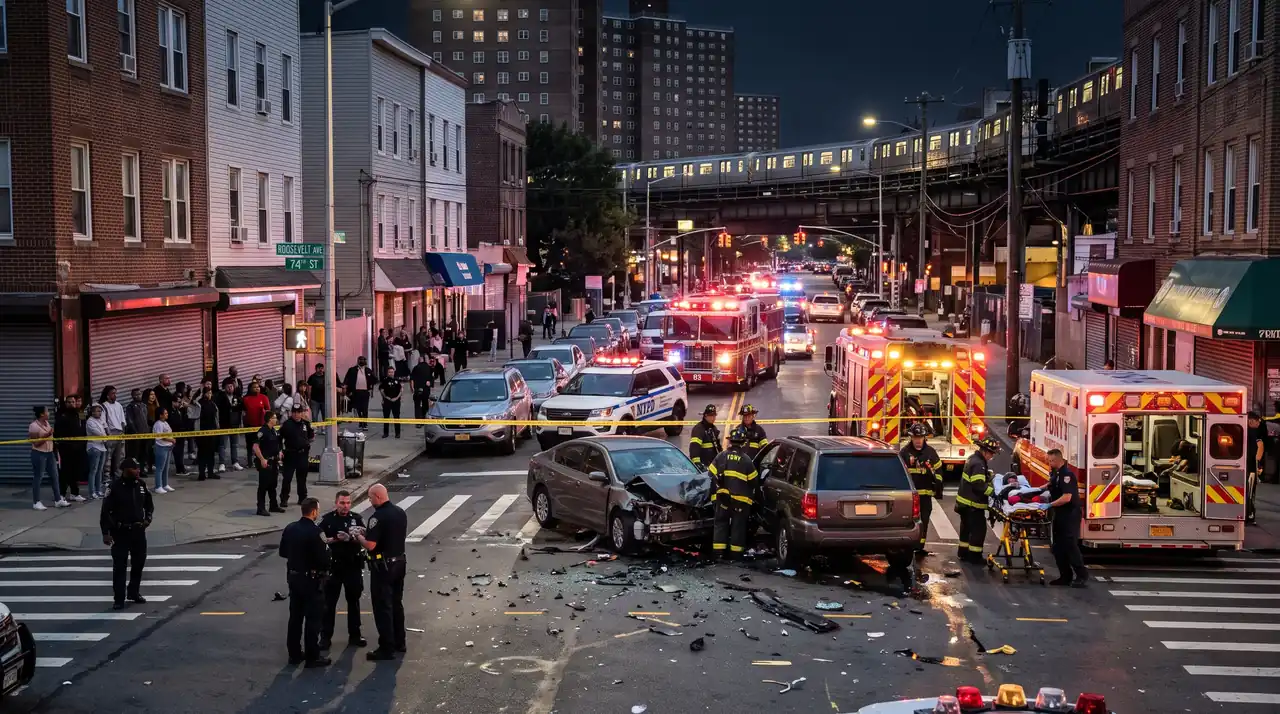
A Queens drunk driver accident attorney can sue for your injuries while the criminal DWI case is still open, and even if that case never ends in a conviction. Your civil claim and the criminal case run on separate tracks. The Queens District Attorney prosecutes the driver to punish a crime. Your lawsuit makes the driver, the vehicle owner, and sometimes the bar that served the drinks pay your medical bills, lost income, and pain.
A civil jury uses a lower standard of proof than a criminal jury. That means a plea bargain or an acquittal on the DWI charge does not decide your case for you, and you do not need the prosecutor’s permission to file. Call Silver Law Group at 212-470-4544 at any hour of the day or night for a free consultation in English, Spanish, or Russian.
Do You Have a Case Against a Drunk Driver in Queens?
You probably have a strong case if the driver broke Vehicle and Traffic Law 1192 and that violation caused your injury. New York treats a violation of a traffic safety statute as negligence per se, which means the violation itself proves the driver was careless. Your lawyer does not have to argue about what a reasonable driver would have done, because the statute already sets that rule.
Section 1192 covers several levels of impairment, and any one of them can support your claim:
- Driving while ability impaired (DWAI) under 1192(1), the lowest tier, where alcohol weakened the driver’s ability to drive
- DWI under 1192(2), a blood alcohol concentration (BAC) of 0.08 or higher
- Aggravated DWI under 1192(2-a), a BAC of 0.18 or higher
- Driving while impaired by a drug under 1192(4)
- Driving while impaired by alcohol and drugs combined under 1192(4-a)
The level of the charge matters in your civil case for a practical reason. A 0.18 reading or a combined alcohol-and-drug finding is the kind of evidence that supports a demand for punitive damages, explained below.
VTL 388 often brings a second defendant into the case. If the drunk driver was using someone else’s car with permission, such as a parent’s SUV, a friend’s sedan, or a company van, the owner is legally responsible for the driver’s negligence. As a result, the owner’s insurance policy can pay your claim, and the driver’s own policy may add more coverage.
Where Drunk and Drugged Driving Crashes Happen in Queens
Queens Boulevard, the Van Wyck Expressway, and the Cross Island Parkway carry the kind of traffic where an impaired driver does the most damage. Queens Boulevard runs through Elmhurst, Rego Park, Forest Hills, and Kew Gardens, with main lanes, service roads, and wide crossings, so pedestrians end up in the path of a driver who drifts between lanes. On the Van Wyck and the Cross Island, late-night traffic moves at highway speed, and one drunk driver can set off a multi-car crash.
Quiet residential streets are not safe either. On October 11, 2026, prosecutors say, a driver rolled through a stop sign at Murray Street and 32nd Avenue in Flushing and hit a 1-year-old boy in a stroller that his nanny was pushing. The child died. The driver failed a field sobriety test, and the Queens DA charged him with manslaughter and impaired driving.
In September 2025, a driver charged with aggravated DWI hit a pedestrian in Corona.
The crash location decides which NYPD precinct writes the report, which nearby stores may have the crash on camera, and which bars sit along the driver’s route home.
Suing the Queens Bar or Host That Served the Driver
New York’s Dram Shop Act, General Obligations Law 11-101, lets you sue a bar, restaurant, or liquor store that unlawfully sold alcohol to the driver who hit you. Selling to a customer who was visibly intoxicated counts as an unlawful sale. The statute allows actual damages for your losses plus exemplary damages, which are meant to punish the seller.
GOL 11-100 goes further when the driver was under 21. Anyone who knowingly gives alcohol to an underage person, or knowingly helps them get it, can be liable for the injuries that follow. That includes a private host at a house party. A host who serves an adult guest is generally outside both statutes.
Many Queens nights out run through Astoria, Long Island City, or Jackson Heights, where bars and late-night restaurants sit block after block. A dram shop claim depends on proof that the driver looked drunk when the last drinks were served, and that proof disappears fast. Your lawyer will move to secure:
- the driver’s itemized tab and card charges
- interior and doorway camera footage from the bar
- bartenders, servers, and other customers who saw slurred speech or stumbling
- phone or rideshare location data showing where the driver went before getting behind the wheel
When the driver carries only the state minimum, the bar’s commercial liability policy adds a second insurer to your claim.
What a Queens Drunk Driving Claim Is Worth
No honest lawyer can put a number on your claim at a first meeting. What your claim is worth depends on how badly you were hurt and which of these sources of payment apply:
- No-fault insurance pays up to $50,000 in basic economic loss for medical bills and part of your lost earnings, no matter who caused the crash.
- Pain and suffering can be recovered only if your injury meets the serious-injury threshold in Insurance Law 5102(d). Examples include a fracture, significant disfigurement, or a permanent or significant limitation in how a part of your body works.
- New York requires liability coverage of at least $25,000 per person and $50,000 per accident. Serious medical bills can use up those minimums quickly.
- Lost wages above what no-fault pays, including income you will lose if you cannot go back to the same job.
- Future care, including surgery, physical therapy, home help, and treatment your doctors expect you to need years from now.
Because the driver’s policy can be small, a serious case depends on finding every other source of payment. That can mean the vehicle owner under VTL 388, the bar under GOL 11-101, or the SUM coverage on your own policy. Each one adds a separate policy to the claim.
Punitive Damages Against the Drunk Driver
In New York, proof that the driver was drunk does not by itself win punitive damages. The court asks whether the driver’s conduct showed reckless or wanton disregard for other people’s safety, and intoxication is one factor in that question.
Two appellate decisions show what tips the balance. In Rinaldo v Mashayekhi, the driver’s BAC was close to twice the legal limit and he was speeding, and the court upheld the punitive award. In Bondi v Bambrick, the driver had a 0.42 BAC and a prior DWI, and the punitive award stood again.
Your lawyer builds a punitive demand from the same kinds of facts. These include the chemical-test number, the driver’s speed taken from video or crash reconstruction, and the driver’s DMV and criminal record.
When the Drunk Driver Is Uninsured or Underinsured
If the drunk driver had no insurance or fled the scene, the Motor Vehicle Accident Indemnification Corporation (MVAIC) can pay your claim, but its rules are strict. You must file a notice of intention to make a claim within 90 days. In a hit-and-run, you must also have reported the crash to the police within 24 hours.
If the driver had insurance but not enough, look at your own policy. Supplementary uninsured/underinsured motorist (SUM) coverage pays the gap between the drunk driver’s limits and your losses, up to the SUM limit you bought. Your policy has its own notice rules, so get a copy to your lawyer in the first week.
What to Do After a Drunk Driving Crash in Queens
Most of the evidence your claim will rely on is created or lost in the first two weeks. Take these steps as soon as you are able:
- Call 911 and wait for the NYPD at the scene. The accident report records the driver’s condition, and the arrest file will hold the breath or blood test results your lawyer will request.
- Get emergency care the same day. Elmhurst Hospital and Jamaica Hospital Medical Center are both Level I trauma centers in Queens. Report every symptom in the ER, because that first chart is the baseline for the serious-injury threshold.
- See your own doctor within days, even if the ER sent you home. Neck, back, and head injuries can show up days later.
- File your no-fault application within 30 days of the crash. If you miss that window, the no-fault insurer can deny your medical bills and lost wages.
- Keep anything that shows where the driver was drinking, such as bar receipts, a photo of a wristband, or a bar’s name the driver or a passenger mentioned at the scene.
- Have your lawyer send preservation letters to the bar and nearby businesses for their surveillance video. Many camera systems record over old footage within days or weeks.
Do not post about the crash online, and do not give the drunk driver’s insurer a recorded statement.
How the Criminal Case Strengthens Your Civil Claim
The Queens District Attorney’s Vehicular Homicide Unit prosecutes the borough’s fatal and most serious impaired-driving crashes. Prosecutors collect evidence that would be hard for you to get alone. This includes the chemical test, the arresting officer’s notes on the driver’s condition, body-camera footage, and anything the driver said after the arrest.
That evidence carries into your civil case. A guilty plea to a VTL 1192 charge is the driver’s own admission of impaired driving, and a drunk driver accident lawyer can use it against the driver in your lawsuit. A conviction after trial can go further. It may let the civil court find the driver liable without a second trial on fault, so the only remaining question is how much you are owed.
The BAC number matters on its own. A reading of 0.08 proves the 1192(2) violation. A reading of 0.18 or higher proves aggravated DWI and also supports the reckless-conduct argument for punitive damages.
You do not have to wait for the criminal case to end. Your lawsuit is filed in Queens County Supreme Court at 88-11 Sutphin Boulevard in Jamaica and moves on its own schedule, with criminal records added as they become available. If the driver pleads down to DWAI, your claim still goes forward, and the civil jury hears the full evidence of what the driver drank and how they drove.
What a Queens Drunk Driving Lawyer Costs
Silver Law Group handles drunk driving injury cases on a contingency fee, and the consultation is free. The fee works this way:
- Nothing upfront, and no hourly bills while the case is open.
- The fee is a percentage of the money recovered, taken only when a settlement or verdict is paid.
- If there is no recovery, you owe no fee.
Because the firm is paid only out of a recovery, it has every reason to prove liability and find every available insurance policy.
Deadlines to Sue a Drunk Driver in Queens
Three statutes set the deadlines for a Queens drunk driving claim. If more than one applies, the shortest one controls:
- CPLR 214 gives you three years from the date of the crash to file a personal injury lawsuit.
- CPLR 215(8) applies when the same driver is criminally prosecuted for the crash. It gives you at least one year after the criminal case ends, even if the three years have already passed.
- General Municipal Law 50-e requires a Notice of Claim within 90 days if a city vehicle caused the crash.
The 215(8) extension helps when a DWI prosecution drags on, but it is no reason to wait. The criminal case does not extend the 90-day city notice or the 30-day no-fault deadline. Bar video can also be erased long before any criminal case ends. Speak with a drunk driver car accident attorney while that evidence still exists.
When a Drunk Driver Kills a Queens Family Member
A wrongful death claim under EPTL 5-4.1 must be filed within two years of the death. If the drunk driver is prosecuted for the death, the family gets one year from the end of the criminal case when that date is later.
New York still limits wrongful death recovery to economic losses. The family can recover:
- the income and financial support the person would have provided
- medical and funeral expenses
- the value of the household services and care the person gave the family
Grief and the loss of companionship are not compensable. The Grieving Families Act would have changed that, but Governor Hochul vetoed it for the fourth time in December 2025.
That rule shapes how a death case is built. The dram shop claim against the bar and the evidence of how the driver behaved before the crash carry more weight when the law will not count a family’s grief.
Why Queens Families Choose Silver Law Group
If you cannot travel to Manhattan, a drunk driving injury lawyer from Silver Law Group will come to your home in Queens or your hospital bed at Elmhurst or Jamaica Hospital. The first meeting covers what happened on the road, what the insurer has already said to you, and which deadlines are already running.
- Free consultations in English, Spanish, and Russian
- Available 24 hours a day, 7 days a week, including the night of the crash
- Every case prepared for trial from the start, so the insurer knows the file can go to a Queens jury
- No fee unless you recover
Call 212-470-4544, or visit the office at 49 West 37th Street, 7th Floor, New York, NY 10018, in Midtown Manhattan.