

If you were hurt in a crash at JFK or LaGuardia, or lost someone in one, you need to know who pays and how fast the deadlines close. A Queens aviation accident lawyer at Silver Law Group takes your claim against the airline, the operator and every company behind the aircraft. We handle commercial airline crashes, private and charter plane accidents, and helicopter crashes, including injuries to people on the ground under the flight paths.
These cases run on federal aviation rules, international treaties and New York law all at once. The airline’s investigators and insurers start building their file on the day of the crash. Yours should start the same day. Call 212-470-4544 at any hour for a free consultation.
Do You Have a Claim After a Plane or Helicopter Accident in Queens?
You may have a claim if someone else’s mistake in the air, on the runway or at the gate caused your injury. Aviation claims cover much more than full crashes. Qualifying events include:
- A crash or emergency landing of an airliner, private plane, charter flight or helicopter
- Runway collisions between two aircraft, or between an aircraft and a ground vehicle
- Falls while boarding or leaving the plane, including gaps at the jet bridge, broken airstairs and wet boarding ramps
- Injuries to people on the ground, such as homeowners, drivers and pedestrians under the approach paths into JFK and LaGuardia
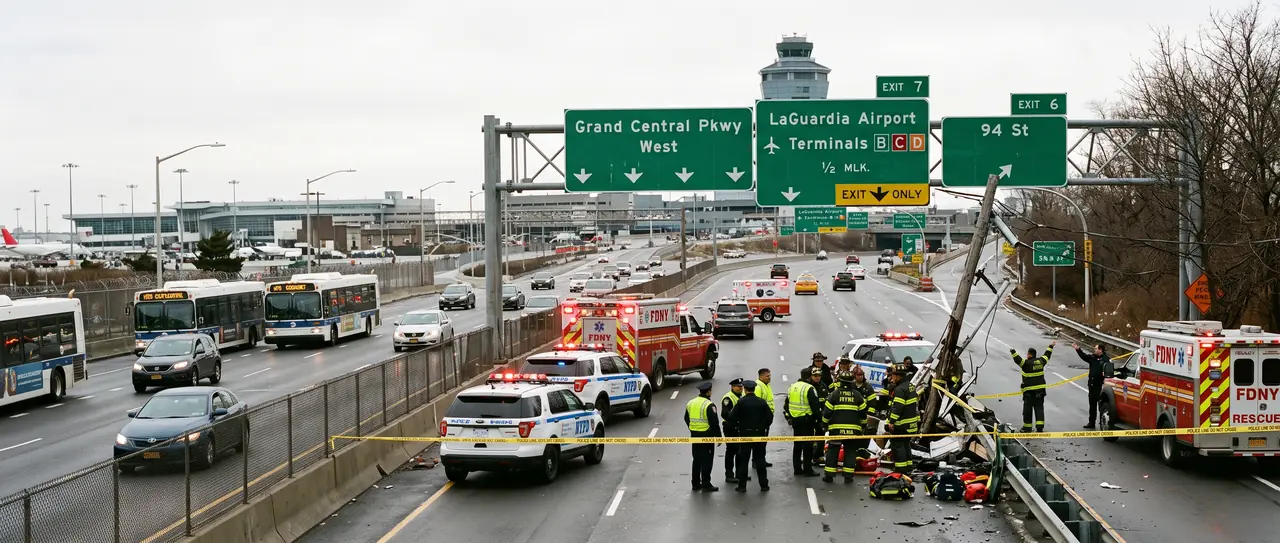
LaGuardia shows how fast a runway can turn deadly. On March 22, 2026, Air Canada Express Flight 8646 was involved in a collision on Runway 4 at LaGuardia. Both pilots were killed, and 39 people were taken to hospitals.
Each of those 39 people may have a claim, and so may the pilots’ families. A runway collision usually involves several parties, including the operating airline, the controllers who cleared the movement and the airport operator responsible for runway conditions. The first job is working out which party answers for which failure.
The same applies to rotorcraft. A helicopter accident attorney looks at the operator’s certificate, the pilot’s records and the maintenance history before anyone else rewrites them. International passengers also get treaty protections, explained below, that do not depend on proving fault. Domestic passengers and people on the ground build their cases under negligence law.
Commercial Airline vs. Private, Charter and Helicopter Flights
The rules the operator flew under shape your claim. Scheduled airlines operate under FAA Part 121, the strictest set of federal rules for pilot training, crew rest, maintenance and dispatch. Charter flights, air taxis and many helicopter tour operators fly under Part 135, which sets lighter requirements in several of those areas. A charter plane crash attorney compares what the operator actually did against the Part 135 standard it was bound by, because breaking those rules is strong evidence of negligence.
Private and small aircraft add a federal limit. The General Aviation Revitalization Act (GARA) bars most suits against the maker of an aircraft with fewer than 20 seats once 18 years have passed since its first delivery. A replacement part starts its own 18-year clock, so an engine component installed five years ago can still be targeted even when the airframe is decades old. A private plane accident lawyer checks delivery dates and logbooks first for that reason.
GARA does not apply to people who were not on board. A driver or homeowner hit by a falling small plane keeps the manufacturer claim no matter how old the aircraft is.
Who Is Liable for an Aviation Accident at JFK or LaGuardia?
Aviation cases rarely have only one defendant. Depending on what failed, responsibility can fall on:
- The airline or charter operator, for crew decisions, training and dispatch
- The pilots, whose errors are usually charged to their employer
- Maintenance contractors that serviced the engines, landing gear or avionics
- Manufacturers of the aircraft or a defective part, under product liability law
- The Port Authority of New York and New Jersey, which operates both JFK and LaGuardia, for runway, taxiway and airfield conditions
- JFK International Air Terminal LLC (JFKIAT), the private operator of JFK Terminal 4, for gate and jet-bridge hazards inside that terminal
- LaGuardia Gateway Partners, the private operator of LGA Terminal B, for the same kinds of hazards there
- The FAA, when an air traffic controller’s error contributed to the crash
Claims against the FAA go through the Federal Tort Claims Act, the law that lets you sue the United States over its employees’ negligence. The process differs from an ordinary lawsuit. You file an administrative claim with the agency first, and if the case goes to trial, a federal judge decides it without a jury.
An airline accident attorney names every party whose conduct contributed. Each defendant carries separate insurance, and each will try to blame the others.
What Is a Queens Aviation Accident Claim Worth?
What your claim is worth depends on your injuries, your lost income and which law governs, and the governing law depends on where your ticket took you. For international trips, the Montreal Convention controls the airline’s liability. Under Article 21, as revised effective December 28, 2024, liability works in two tiers:
- Up to 151,880 Special Drawing Rights (SDR) per passenger, the airline pays whether or not it was at fault. It cannot escape this tier by showing it was careful.
- Above 151,880 SDR there is no cap. The airline pays the full amount unless it proves the harm was not caused by its own negligence, or was caused only by a third party.
An SDR is a reserve unit set by the International Monetary Fund, and its value moves daily against major currencies. The second tier reverses the usual burden of proof. In most injury cases you have to prove fault, but here the airline has to disprove its own.
Domestic flights fall outside Montreal, so those claims proceed under negligence and product liability law without the tiers. An airplane accident attorney builds the damages case the same way under either system. For injured passengers, that means medical bills, lost wages, lost future earning capacity, and pain and suffering.
When the crash is fatal, New York’s wrongful-death and survival claims let the family and the estate recover:
- The financial support the person would have provided
- The value of household services, childcare and parental guidance the family lost
- Funeral and burial costs
- Medical bills from the crash until death
- The person’s conscious pain and suffering before death, claimed through the estate
Injured on the Ground in Belle Harbor, Howard Beach or East Elmhurst
Queens has been through this before. On November 12, 2001, American Airlines Flight 587 went down in Belle Harbor shortly after takeoff from JFK, killing 265 people. Five of them were on the ground.
Howard Beach sits beside JFK, and East Elmhurst borders LaGuardia. Families there live under approach and departure paths every day.
If an aircraft or falling debris injures you at home, in your car or on the sidewalk, your claim runs under ordinary New York negligence law. The Montreal Convention covers only passengers, so its liability tiers and its two-year filing window do not apply to you. The three-year injury deadline does, and a plane accident lawyer can pursue the manufacturer, the operator and the maintenance shop at the same time.
What Happens Next: The NTSB Investigation and Your Case
The National Transportation Safety Board investigates civil aviation crashes and takes control of the wreckage. It issues a short preliminary report first, setting out the basic facts. The final report, with the Board’s probable-cause finding, usually comes 12 to 24 months later.
Do not wait for that final report. Federal law bars the Board’s report from being used as evidence in a civil damages lawsuit, so your case needs its own experts. An airplane crash attorney gets them reviewing flight data and maintenance logs while the records are still intact.
Your own evidence matters just as much. Start with these steps:
- Keep your boarding pass, ticket confirmation and baggage tags. They prove you were a passenger and establish the itinerary that decides whether the Montreal Convention applies.
- Request your full records from Jamaica Hospital or Elmhurst Hospital. Both are Level I trauma centers, and the emergency notes written in the first hours are the most credible record of your injuries.
- Photograph your injuries, damaged belongings and anything you saw at the scene.
- Write down crew announcements and what you remember of the last minutes of the flight while your memory is fresh.
- Send every letter, email and form from the airline or its insurer to your lawyer before you sign anything.
Where Queens Aviation Cases Are Filed
Most Queens aviation cases end up in one of two courthouses. Queens County Supreme Court, at 88-11 Sutphin Boulevard in Jamaica, hears state-law claims such as ground-victim negligence suits, jet-bridge falls and claims against terminal operators. Cases involving the Montreal Convention, the FAA or parties from different states often go to the federal court for the Eastern District of New York, at 225 Cadman Plaza East in Brooklyn, which covers Queens. Claims against the FAA must be filed in federal court.
Montreal Article 33 adds what lawyers call the fifth jurisdiction. If Queens was your principal and permanent home when the accident happened, you can sue the airline here even if the crash happened overseas. The airline must fly passengers to or from the United States and do business here from premises it owns or leases, or through a partner carrier. Without this rule, a family from Jackson Heights hurt on a foreign carrier could be forced to sue in the airline’s home country.
An air disaster attorney chooses the court early, because that choice affects the jury pool and how fast your case moves.
What It Costs to Hire an Aviation Accident Lawyer
You pay nothing up front. Silver Law Group takes aviation cases on a contingency fee, which works like this:
- You owe no fee unless you recover money through a settlement or verdict.
- The fee is a percentage of the recovery, agreed in writing before we start.
- The fee comes only out of the recovery, never out of your savings or paycheck.
If there is no recovery, you owe no attorney’s fee. Because an airplane injury law firm paid this way only gets paid when you do, our interests line up with yours. Your first consultation with an aviation accident lawyer is free and carries no obligation to hire us.
Deadlines for Queens Aviation Accident Claims
Aviation claims can run on several clocks at once, and the shortest one controls your case. These are the main deadlines:
- CPLR 214: three years from the accident to sue for personal injury under New York law
- EPTL 5-4.1: two years from the date of death to bring a wrongful-death action
- Montreal Convention Article 35: two years from the date the plane arrived at its destination, should have arrived, or stopped its journey
- Port Authority claims: a notice of claim at least 60 days before you sue, and the lawsuit filed within one year, under Unconsolidated Laws §7107
- Federal Tort Claims Act: a written claim to the FAA within two years, and no lawsuit until the agency denies it or six months pass
The Port Authority deadline is the one that catches families off guard. A claim over an airfield hazard at JFK can be time-barred against the Port Authority after one year, while the claim against the airline still has years left. The Montreal two-year window is also shorter than New York’s three-year injury deadline, so international passengers cannot rely on the state clock.
Call 212-470-4544 so the earliest deadline in your case is on the calendar this week.
Why Queens Families Choose Silver Law Group
We prepare every aviation case for trial, in Jamaica or at Cadman Plaza, from the first week. Airlines and their insurers set their settlement offers based on whether the other side is ready to put the case in front of a jury.
What you get when you call:
- Consultations in English, Spanish and Russian, for international travelers coming through JFK and their families
- An attorney who comes to your home or your hospital room when you cannot travel
- A phone line answered 24/7 at 212-470-4544
- Meetings at our office at 49 West 37th Street, 7th Floor, New York, NY 10018, when you are ready to come in
Book your free case review today. Bring your boarding pass and any papers the airline has sent you.