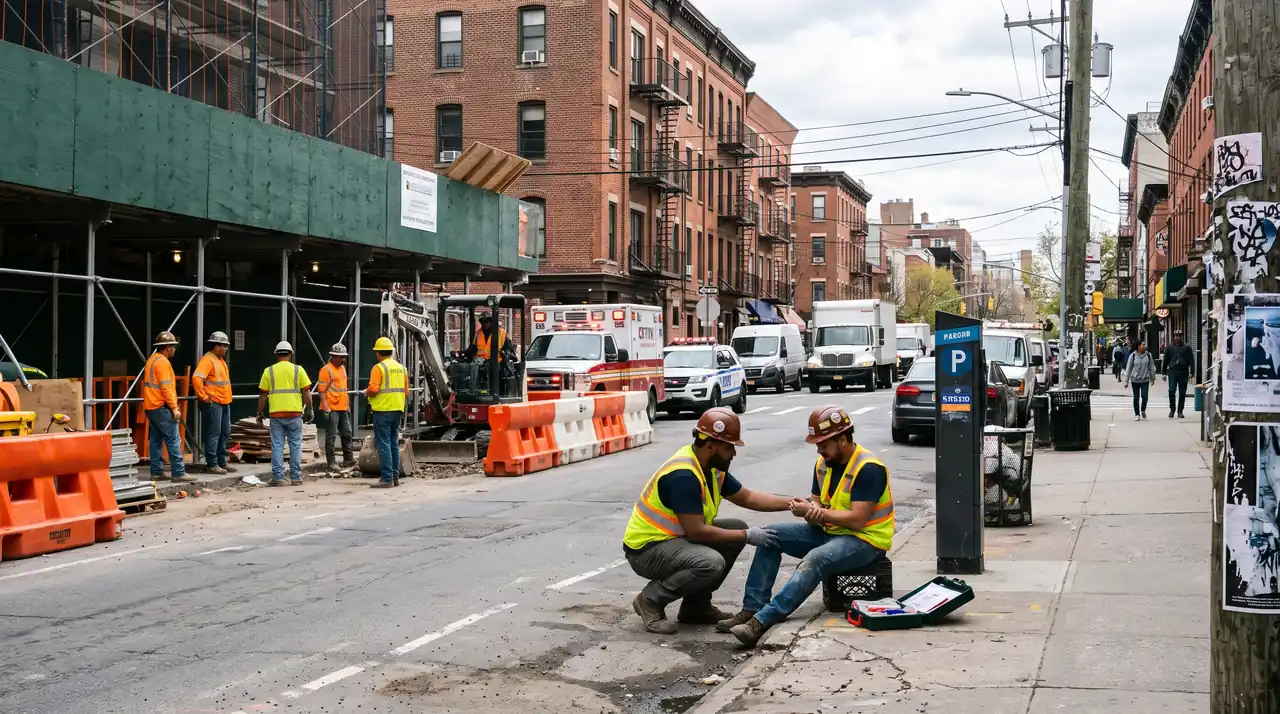
A Brooklyn workers’ compensation attorney at Silver Law Group answers 212-470-4544 at any hour, and your first consultation is free in English, Spanish, or Russian. You pay no attorney fee unless your claim produces benefits or a recovery. If your injury keeps you from traveling, the attorney comes to you at your apartment or your hospital bedside, anywhere in Brooklyn.
That first conversation answers three things the insurance carrier will not explain to you. You learn whether workers’ compensation covers your injury and how your weekly check should be figured. You also learn whether someone besides your employer can be sued for the losses comp never pays. The carrier starts building its file the day your employer reports the injury, so call before you sign anything or give a recorded statement.
Do You Qualify for Workers’ Comp After a Brooklyn Job Injury?
Fault is off the table. New York workers’ compensation is a no-fault system, so you do not have to prove your employer was careless, and your own mistake does not sink the claim. You do have to show two things: you were an employee, and the injury or illness came from your work.
Several groups of workers assume they are excluded when they are covered:
- Part-time employees, including people working a second job alongside a full-time one.
- Workers with an occupational illness, such as lung disease from years of dust exposure or a wrist condition from repetitive motion, where no single accident date exists.
- Workers whose pre-existing condition got worse on the job. If lifting on a loading dock aggravates an old back injury, the aggravation is compensable.
The same law covers every kind of Brooklyn workplace. A machinist at a Brooklyn Navy Yard manufacturing tenant files under it. So does a food-production worker at Industrial City in Sunset Park, a picker loading trucks in a Red Hook warehouse, and a laborer framing floors on a Downtown Brooklyn high-rise. They all get the same benefit formula.
The differences show up later. The high-rise laborer who falls may also have a construction-law claim against the building owner, and that claim pays damages that workers’ compensation never will.
What Workers’ Comp Pays Injured Brooklyn Workers
Weekly cash benefits replace two-thirds of your average weekly wage, up to a cap the state resets each July 1. Your rate depends on your date of injury, not on when you file:
- For injuries from July 1, 2026 through June 30, 2027, the maximum weekly benefit is $1,281.50.
- The minimum weekly benefit for the same period is $384.45.
- High earners hit the cap first, so a worker earning well above the average may receive much less than two-thirds of actual pay.
Cash benefits do not start on day one. Under Workers’ Compensation Law §12, the first seven days of disability are unpaid. If you are out of work for more than 14 days, the carrier must go back and pay those first seven days as well.
The two-thirds figure is only as accurate as the wage records behind it. Carriers sometimes calculate the average from incomplete payroll data. Your pay stubs and tax records are how you correct that.
Medical care is paid separately from the wage check. The carrier pays for treatment of the work injury, including emergency care, surgery, physical therapy, and prescriptions. You should not be paying copays or receiving bills for it.
Schedule Loss of Use and Permanent Disability Awards
Weekly checks cover the time you are out of work. A separate award covers what you lose permanently. Once your doctor finds that you have reached maximum medical improvement, the Board measures the lasting damage.
If the permanent injury is to an arm, leg, hand, or eye, you receive a schedule loss of use award. That is a set number of weeks of benefits based on the percentage of use you lost. For example, a 25% loss of use of a hand pays 25% of the weeks the law assigns to a hand, and you are paid whether or not you have returned to work.
Back, neck, and other injuries that are not on the schedule work differently. A non-schedule permanent partial disability award is tied to your lost wage-earning capacity, meaning how much the injury has shrunk the work you can still do. These awards can pay weekly benefits for years.
When a work injury is fatal, the worker’s dependents receive death benefits of two-thirds of the worker’s average weekly wage.
Suing a Third Party Beyond Workers’ Comp
In most cases you cannot sue your employer. In exchange for no-fault benefits, New York bars most lawsuits against the company that employs you, and workers’ compensation pays nothing for pain and suffering. Workers’ Compensation Law §29 gives you a second option: you can collect comp and also sue any other party whose negligence caused your injury.
On a Brooklyn job, that other party is often easy to find. The property owner and the general contractor on a Downtown Brooklyn tower are separate companies from the subcontractor who pays you. If a driver hits your work van, that driver is not your employer. Neither is the company that made a scissor lift with a guardrail that gave way.
Construction injuries carry extra legal weight. Labor Law §240(1) covers gravity hazards, meaning falls from scaffolds and ladders and loads that drop from above. It makes owners and contractors responsible when they fail to provide proper protection, and your own carelessness generally does not get them off the hook. Labor Law §241(6) applies when a specific Industrial Code safety rule was broken on a construction, excavation, or demolition site.
These lawsuits are filed in Kings County Supreme Court at 360 Adams Street. They can pay what workers’ compensation never will: pain-and-suffering damages, your full lost wages instead of two-thirds, and loss of future earnings.
There is one catch. The comp carrier holds a lien on your third-party recovery for the benefits it has already paid. Experienced workers’ compensation lawyers treat that lien as part of the lawsuit plan from the start, because how the lien is resolved affects how much of the verdict or settlement you actually keep.
What Happens After You Report a Brooklyn Work Injury
The first two weeks after a work injury create the record the carrier will rely on for the rest of your claim. Here is the sequence:
- Get emergency care and say the injury happened at work. At Kings County Hospital Center, Maimonides Medical Center, or NYU Langone Hospital–Brooklyn, tell the triage nurse and the doctor how you were hurt on the job, so the ER chart lists a work cause.
- Notify your employer in writing. A text to a foreman is not enough. Put the date, the location, and the injury on paper and keep a copy.
- File your own employee claim online with the Workers’ Compensation Board. Do not assume your employer’s report counts as your claim.
- Your employer must file its report of injury, Form C-2, within 10 days.
- The carrier then has 18 days to start paying or to file a dispute. If the 18 days pass without a check or a denial, a workplace injury attorney can push the claim to a hearing.
While this is happening, the adjuster may call you and ask for a recorded statement. You are not required to give one before you get legal advice.
Your Hearing at the WCB Brooklyn District Office
Brooklyn workers’ compensation hearings are handled through the Workers’ Compensation Board’s Brooklyn District Office at One Pierrepont Plaza, 300 Cadman Plaza West. Most workers never set foot there. Hearings are virtual by default, so you join by video or phone from home, and your attorney appears with you on the same session.
Since October 8, 2024, you can ask the judge to hold your hearing in person at the district office. In-person hearings make sense in some situations. One example is when your testimony about how the accident happened is central to the case. Another is when you want the judge to see an injury firsthand.
If you attend in person, arrive early. The building requires a security check-in before you can reach the hearing floor, and the line can eat into your scheduled time.
At the hearing, the judge decides questions such as whether the injury is work-related, what your average weekly wage is, and how disabled you are. A work-related injury attorney prepares your medical reports and wage proof in advance, because the judge decides from the documents in the file.
What If Your Claim Is Denied?
A carrier denial is a dispute, not a final answer. Carriers usually argue that the accident did not happen at work, that the injury is less serious than your doctor reports, or that you gave notice too late. The judge then weighs the medical evidence on both sides, takes testimony, and issues a decision.
If the judge rules against you, you have 30 days from the decision to request review by a Board panel under Workers’ Compensation Law §23. Miss that window and the decision generally stands. If the panel also rules against you, the next step is an appeal to the Appellate Division, Third Department.
Fired or Punished for Filing a Claim
New York makes it illegal to fire, demote, or otherwise punish you for using the workers’ compensation system. Workers’ Compensation Law §120 sets out how it works:
- Protection covers filing a claim, asking for claim forms, and testifying in a coworker’s case.
- You file a complaint on Form DC-120 with the Board within two years of the retaliation.
- If you win, you can be reinstated and paid the wages you lost.
- The employer also faces a fine of $100 to $500.
Keep every termination letter, schedule change, and text message from a supervisor that came after you reported the injury.
What a Brooklyn Workers’ Compensation Attorney Costs
Your lawyer does not set the fee in a comp case. Workers’ Compensation Law §24 requires a Board judge to approve every attorney fee, and the approved fee is paid out of your award. The current limits are:
- 15% of a schedule loss of use award
- 15% of a permanent disability award
- 15% of a Section 32 lump-sum settlement
- one-third of one week’s benefit for continuing temporary disability payments
You pay nothing upfront and never write a check to start the case. If the Board awards you nothing, there is no fee. A third-party lawsuit is handled on contingency the same way: the fee comes out of the recovery, and if there is no recovery, you owe no fee. You can afford an attorney from the first day, even if your paychecks have stopped.
Deadlines for Brooklyn Workers’ Comp and Injury Claims
A Brooklyn job injury can trigger several separate legal clocks, and the shortest one runs out first:
- 30 days to give your employer written notice of the injury, under Workers’ Compensation Law §18. The Board can excuse late notice in some cases, but the carrier will use any delay against you.
- Two years to file your claim (Form C-3) with the Workers’ Compensation Board.
- Three years to file a third-party negligence lawsuit under CPLR §214.
- Two years to file a wrongful death action under EPTL 5-4.1 when a worker is killed.
- 90 days to serve a Notice of Claim under General Municipal Law §50-e when the City of New York is the negligent party, for example a city vehicle that struck you during a delivery.
The 90-day city notice is the deadline injured workers miss most easily, because it runs while they are still recovering.
Why Brooklyn Workers Choose Silver Law Group
When a Brooklyn job injury involves a ladder, a scaffold, or another driver, it usually produces two claims. Those claims can work against each other if two different offices handle them. Silver Law Group handles the workers’ compensation claim and the third-party lawsuit together. What you testify to at a Board hearing then matches what you say at a Kings County deposition, and the same attorney who builds the lawsuit deals with the carrier’s lien.
Language is often the first barrier after a workplace injury. Russian-speaking workers from Brighton Beach and Sheepshead Bay can speak with the firm in Russian from the first call onward. So can Spanish-speaking workers from Sunset Park and Bushwick in Spanish. Your account of the accident reaches the file in your own words instead of passing through a coworker who translated for you.
Silver Law Group is a workers’ compensation law firm that also takes injury cases to trial. Every third-party case is prepared as if it will go before a jury, because defense lawyers base their offers on whether the other side is ready for trial.
The office is at 49 West 37th Street, 7th Floor, New York, NY 10018, in Midtown Manhattan. If your injury keeps you in Brooklyn, the attorney comes to your home or your hospital room. Call 212-470-4544, day or night, for a free consultation. Your fee comes only from what your claim recovers.