

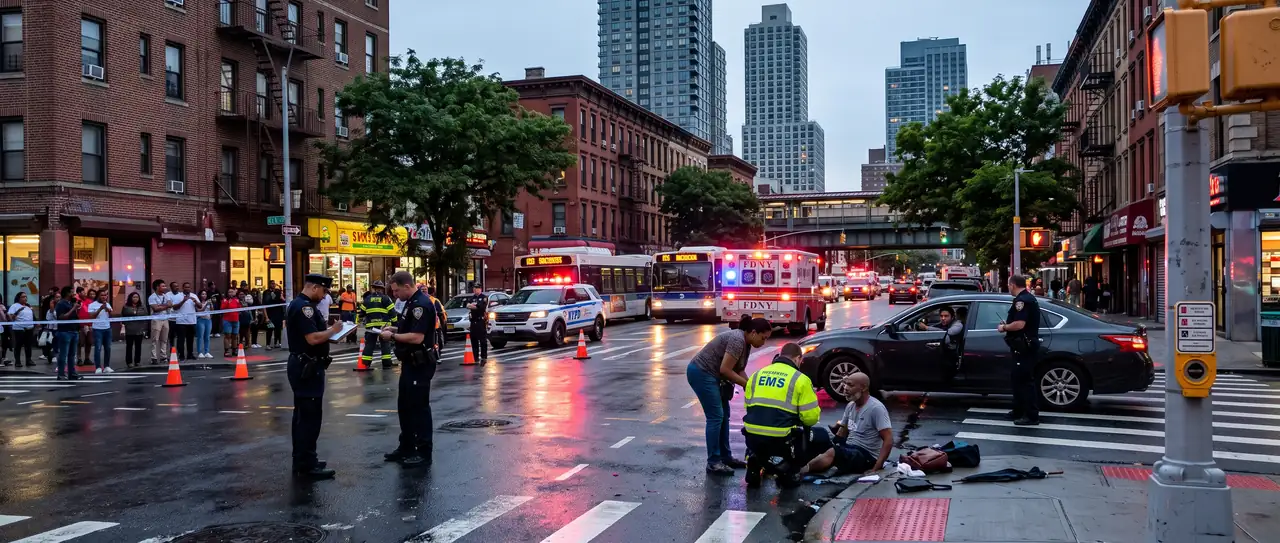
A Brooklyn pedestrian accident lawyer at Silver Law Group represents people hit by cars, trucks and buses anywhere in the borough, from a crosswalk on Atlantic Avenue to a bus stop on Flatbush Avenue. The driver who hit you almost never pays out of pocket. An insurance company pays, and its adjuster starts building a file on you within days of the crash. Your first call should go to a lawyer who works for you, not for that insurer. Call 212-470-4544 for a free consultation in English, Spanish or Russian, at any hour. You owe no fee unless we recover. If you are still at Kings County Hospital, Maimonides or NYU Langone–Brooklyn, an attorney can come to your bedside.
Do You Have a Case After Being Hit by a Car in Brooklyn?
You likely have a case if a driver failed to yield to you. New York law sets out that duty in two places:
- Vehicle and Traffic Law 1151 requires a driver to yield to a pedestrian crossing inside a crosswalk wherever traffic signals are not in place or not working. That covers the marked and unmarked crosswalks at thousands of Brooklyn side-street corners.
- NYC Administrative Code 19-190 makes it an offense for a driver to hit a pedestrian who has the right of way. If the driver’s failure to yield causes physical injury, the charge rises to a misdemeanor.
You do not need a 19-190 charge to sue. If police issue one, though, the insurer has to explain it away instead of arguing about who stepped where.
The driver is rarely the only party who can be held responsible. A pedestrian injury claim often reaches a party with more insurance coverage:
- The driver, through their personal auto liability policy
- The driver’s employer, if the driver was on the job in a company van, pickup or box truck
- Rideshare and delivery fleets, whose commercial policies can apply when the driver was logged into an app or carrying an order
- NYC Transit, when an MTA bus strikes you. Claims against it run on shorter public-entity deadlines, covered below.
Finding every responsible party early matters. A driver’s minimum policy can run out long before your medical bills stop.
Crossing Outside the Crosswalk or Against the Signal
Crossing mid-block is no longer illegal in New York City. A city law that took effect in October 2024 ended jaywalking enforcement, so police cannot ticket you for crossing outside a crosswalk or against the light.
That law did not give you the right of way. A pedestrian crossing mid-block or against the signal still has to yield to traffic, and the driver’s insurer will argue that you failed to.
That argument can lower your claim. It cannot end it. CPLR 1411 makes New York a pure comparative fault state, which means a jury reduces your damages by your share of the blame, and no share is high enough to bar recovery. If a jury puts 30 percent of the fault on you, you keep 70 percent of your damages. At 80 percent, you still keep 20.
Drivers keep their own duties no matter where you stepped off the curb. They have to watch the road ahead, drive at a safe speed and brake for a person they can see. A driver speeding down Linden Boulevard or reading a phone while turning carries fault of their own. The insurer’s percentage on you is only an opening offer, and our job is to bring that number down.
Hit-and-Run and Uninsured Drivers
A driver who flees or carries no insurance does not leave you without a claim. The Motor Vehicle Accident Indemnification Corporation (MVAIC), which operates under Insurance Law 5208, pays injury claims when no insurer stands behind the vehicle that hit you. It enforces two strict deadlines:
- Report a hit-and-run to police within 24 hours. Call 911 or go to the precinct, and keep the report number.
- File your MVAIC claim within 90 days of the accident.
Miss either one and MVAIC can deny the claim outright. If you or a relative in your household owns an insured car, that policy’s uninsured motorist coverage may apply instead, and we check that first.
Where Brooklyn Pedestrians Are Struck Most
NYC DOT counted 63 traffic deaths in Brooklyn in 2025. More than two-thirds of the people killed were pedestrians. Most of these crashes happen on a short list of wide, fast roads that cut through dense residential blocks:
- Atlantic Avenue, which carries heavy traffic from Downtown Brooklyn through Bedford-Stuyvesant to East New York, where wide lanes let turning drivers take corners fast
- Flatbush Avenue, from the Manhattan Bridge past Grand Army Plaza and south toward Marine Park, crowded with buses, double-parked delivery trucks and people crossing between them
- Linden Boulevard, a multi-lane road through East Flatbush, Brownsville and East New York, where some crossings are long enough that the light changes before you reach the far side
- Bedford Avenue, running the length of the borough from Williamsburg to Sheepshead Bay
- Rockaway Avenue, through Brownsville toward Canarsie
The corridor where you were hit shapes how we build your case. A crash at a busy Flatbush Avenue bus stop means there may be MTA bus camera footage. A corner on Atlantic Avenue is usually lined with storefronts that record the sidewalk. On a stretch of Linden Boulevard with few businesses, witnesses and the police report carry more of the weight. Knowing the street tells us where to look first.
Pedestrian Injuries and Brooklyn Trauma Care
A pedestrian has no steel frame or airbag. The bumper usually hits the legs first, and then the body strikes the hood, the windshield or the pavement. That sequence produces a predictable set of injuries:
- Traumatic brain injury, from the head hitting glass or asphalt. Concussion symptoms such as memory gaps, headaches and light sensitivity can show up days later.
- Pelvic and leg fractures, often to the tibia, fibula or femur, many of which need surgery and hardware
- Spinal injuries, from herniated discs to fractured vertebrae
- Knee injuries, including torn ligaments and damaged cartilage where the bumper made contact
Ambulances in Brooklyn take the most serious cases to the borough’s Level 1 trauma centers: Kings County Hospital in East Flatbush, Maimonides Medical Center in Borough Park and NYU Langone Hospital–Brooklyn in Sunset Park. Maimonides is Brooklyn’s only pediatric trauma center, so an injured child may be taken there from anywhere in the borough.
The trauma bay chart is the first medical record in your claim. It records how you arrived, what imaging showed and what the doctors saw before any insurer got involved. We request it early and complete.
What Your Brooklyn Pedestrian Injury Claim Is Worth
New York’s no-fault system decides whether you can ask for pain and suffering at all. Under Insurance Law 5102(d), you can sue the driver for non-economic damages only if you have a “serious injury.” The categories include a fracture, significant disfigurement and permanent limitation of a body organ or member. A broken leg from a bumper strike meets the threshold on its face. A soft-tissue back injury may meet it too, but only with MRI findings and measured loss of motion documented by your doctors.
Once you clear that threshold, your claim can include:
- Pain and suffering, past and future
- Lost wages beyond what no-fault pays
- Future medical care, such as surgeries, physical therapy and home help
- Lost earning capacity, if the injury keeps you from returning to your job or forces you into lower-paying work
We do not quote dollar averages, and you should doubt any pedestrian injury lawyer who names a figure before seeing your records. The value of your claim depends on facts specific to you. Those include how severe and permanent the injury is, any comparative fault the insurer can prove, how many insurance policies apply and how much each one covers.
The last factor is often the one that limits a recovery. A strong case against a driver with one small policy needs a second source of payment, such as an employer, a fleet or your own underinsured motorist coverage. We look for those sources before the first demand goes out.
Who Pays Your Medical Bills First
No-fault insurance pays your medical bills and part of your lost wages regardless of who caused the crash. That includes crashes where you were crossing mid-block. The policy that pays depends on this order:
- Your own auto policy’s personal injury protection (PIP), if you own an insured car
- The policy of a relative you live with, if you do not own a car
- The policy of the vehicle that hit you, if no one in your household has coverage
No-fault pays up to the $50,000 basic economic loss limit. For a pedestrian with surgery and months of physical therapy, that limit can run out, and bills above it become part of your injury claim against the driver.
The deadline is short. You must file a written no-fault application within 30 days of the accident. Late applications get denied, and then your hospital bills can go to collections while your injury case is still building. We file it for you in the first week.
What Happens After You Call Us
Your first call starts the work. Here is what happens next, in order:
- We canvass the scene. An investigator walks the block for storefront, residential and parking-garage cameras, and we send preservation letters before the footage is recorded over. If a bus was nearby, we request MTA bus camera video.
- We get the NYPD collision report and the officer’s notes, find the witnesses listed in them and look for witnesses the officer missed.
- We document your treatment. We gather ER records, imaging, surgical notes and therapy records, and we track the follow-up visits that show your injury is permanent. A gap in treatment is the first thing an adjuster looks for.
- We send a demand to the insurer. Once your condition is clear, the demand sets out liability, the serious-injury evidence, your lost wages and your future care.
- We file suit if the insurer will not pay what the case is worth. Brooklyn cases are filed at Kings County Supreme Court, 360 Adams Street in Downtown Brooklyn, where discovery, depositions and trial take place.
Most of this happens while you are recovering. You go to your appointments, and we handle the calls from adjusters.
What a Pedestrian Injury Lawyer Costs
Silver Law Group handles pedestrian cases on a contingency fee. You pay nothing to start, nothing while the case is open and nothing at all if we do not recover money for you. If we win a settlement or verdict, our fee is a percentage of that recovery. It is taken from the money the insurer pays, not from your savings or your paycheck. The written fee agreement states the percentage and explains how case expenses are handled before you sign it. This arrangement means the firm only gets paid when you do, so it has no reason to take a case it does not believe in.
Deadlines for Brooklyn Pedestrian Accident Claims
Your claim can face several deadlines at once, and the shortest one is the most dangerous. The deadline depends on who hit you and what happened:
- A private driver or company: CPLR 214 gives you three years from the accident date to file a lawsuit.
- A city vehicle or an NYC Transit bus: General Municipal Law 50-e requires a Notice of Claim within 90 days. The notice must state the time, place and nature of the claim.
- The lawsuit against the city or NYC Transit: GML 50-i requires you to file it within one year and 90 days of the crash, even after a timely Notice of Claim.
- A fatal crash: EPTL 5-4.1 gives the family two years from the date of death to bring a wrongful death action.
The 30-day no-fault application and the 90-day MVAIC filing described above run alongside these deadlines.
The 90-day public-entity deadline catches the most people. A pedestrian struck by a sanitation truck or an MTA bus can spend most of those 90 days in surgery and rehab. Call as soon as you can, even from your hospital bed.
Why Brooklyn Pedestrians Choose Silver Law Group
Most pedestrian accident law firms promise to fight hard. What matters is what you get once you hire one. With us, that means:
- Trial-ready preparation from day one. Every case is built as if it will be argued at 360 Adams Street. Insurers pay more when they know the lawyer across the table will try the case.
- An attorney who comes to you. If you cannot travel, we meet you at home in Brooklyn or at your hospital bedside, not at a Manhattan conference room.
- Service in English, Spanish and Russian. Your attorney explains every document in the language you think in, which matters in Brighton Beach as much as in Sunset Park.
- Availability 24/7. A crash on Flatbush Avenue at 2 a.m. does not wait for business hours, and the evidence does not either.
Talk to a Brooklyn Crosswalk Accident Attorney Today
Call 212-470-4544 to talk with a Brooklyn crosswalk accident attorney about your case. The consultation is free, any time of day or night, in English, Spanish or Russian. You can also visit our office at 49 West 37th Street, 7th Floor, New York, NY 10018, or ask us to come to you. Bring the police report number and any photos you have. If you have nothing yet, call anyway, and we will start gathering the evidence.