

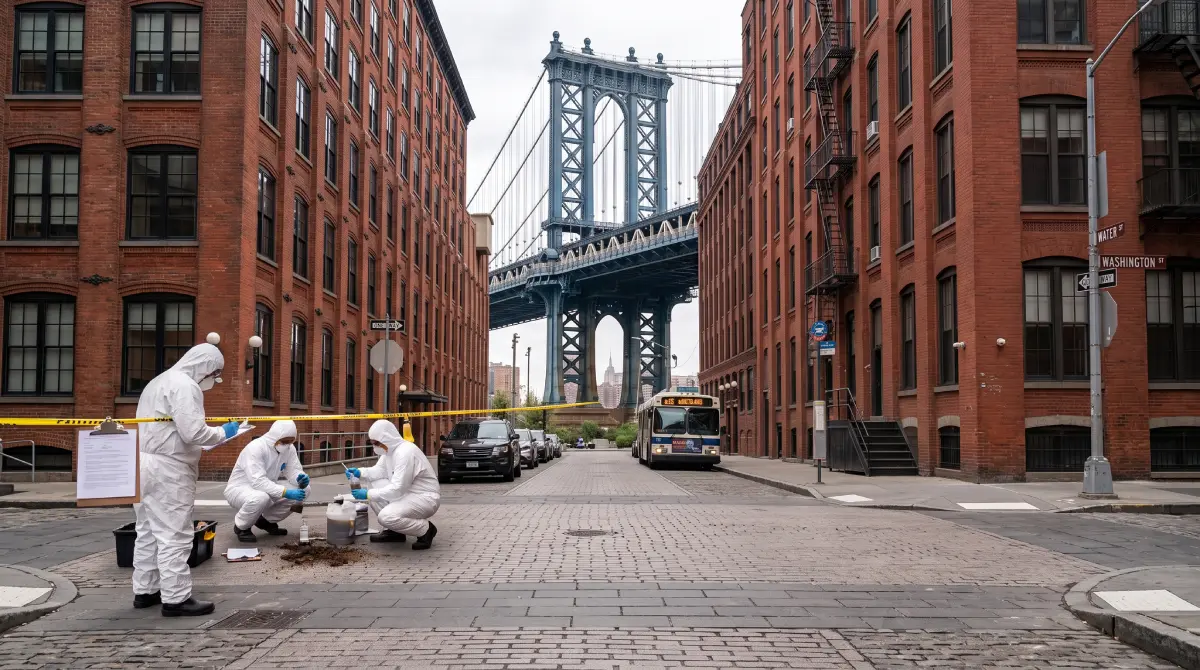
A toxic exposure that surfaces as illness years later still traces back to someone’s negligence, and a Brooklyn toxic tort lawyer’s job is to connect the two with proof a court will accept. Silver Law Group represents Brooklyn residents harmed by chemical and environmental exposure — asbestos from an old worksite, benzene on the job, contamination that seeped into a neighborhood — and builds each claim on medical evidence and expert testimony rather than assumption. These are hard cases against well-funded companies, and they turn on documented records and science, not sympathy. Your first conversation with us costs nothing. We answer 24/7, and the consultation is free in English, Spanish, and Russian. If your diagnosis makes travel hard, the attorney comes to your home or hospital room. Call 212-470-4544 to start; you pay no legal fee unless we recover money for you.
Do You Have a Brooklyn Toxic Tort Claim
You may have a claim even if you felt fine for years after the exposure, because most toxic injuries take that long to surface. The substances that most often lead to a Brooklyn toxic tort case include:
- Asbestos, which scars the lungs and can cause mesothelioma decades after the fibers were inhaled
- Benzene, a solvent linked to leukemia and other blood cancers, common in fuel, degreasers, and older industrial work
- Trichloroethylene (TCE), a degreasing chemical tied to kidney cancer and Parkinson’s disease
- PCBs, once used in electrical equipment and building caulk, which persist in structures and soil long after they were banned
- Industrial solvents and cleaning agents that damage the liver, kidneys, or nervous system over repeated contact
- Toxic mold, which can trigger lasting respiratory illness in water-damaged apartments and workplaces
Latent onset is what makes these cases different from a car crash. The disease can appear ten, twenty, or forty years after the last day of exposure, long after the job ended or the building changed hands. That gap does not defeat your claim, but it shapes how the law counts your deadline, because New York starts the clock when the illness is discovered rather than when the exposure happened.
Where the exposure came from decides who you sue. Occupational exposure happens at work, from a job or trade that put you near the substance daily. Residential exposure happens at home, from lead paint, mold, or contamination a landlord or prior owner left in place. Environmental exposure reaches whole neighborhoods, when a contaminated site leaches into groundwater, soil, or air that residents never chose to breathe. Many Brooklyn cases mix all three.
Brooklyn’s Superfund and Industrial Exposure Zones
Two of Brooklyn’s waterways are federal Superfund sites. The Gowanus Canal and Newtown Creek were both added to the EPA’s National Priorities List in 2010, after more than a century of industrial dumping left coal tar, heavy metals, PCBs, and volatile organic compounds in the sediment and surrounding soil. Residents near these sites can be exposed through contaminated groundwater, vapor rising into basements and ground-floor apartments, and dust stirred up during construction.
The Meeker Avenue Plume in Greenpoint runs underground near the Brooklyn-Queens Expressway, where decades of dry-cleaning and manufacturing solvents — mainly TCE and PCE — soaked into the soil and now off-gas into homes above. State and federal regulators have tracked that vapor intrusion into buildings across the area.
The Brooklyn Navy Yard carries legacy asbestos from its shipbuilding era, when insulation, gaskets, and pipe lagging were packed with it; workers and later tenants of the older structures can still encounter it during demolition or renovation. The Sunset Park manufacturing corridors along the waterfront held generations of metalworking and chemical tenants whose materials left contamination in buildings still in use today.
If you lived or worked near any of these, the location itself is evidence. It ties your illness to a documented source, which is exactly what a toxic tort claim needs to prove.
Proving Causation and Who Is Liable
Causation is where toxic tort cases are won or lost. You have to show not only that a substance is dangerous, but that this exposure caused this illness in your body, a link the defense will attack with its own experts. Building it takes specialists. A toxicologist explains the dose and biological pathway: how much of the chemical reached you, over how long, and how it produces the specific disease you have. An industrial hygienist reconstructs the exposure itself, measuring or modeling the levels present at your job site or home and comparing them to the safety limits that were supposed to protect you.
That evidence points to who pays. Depending on where and how you were exposed, the liable party may be:
- An employer who let exposure run past OSHA permissible limits or hid the hazard from workers
- A product manufacturer that made or sold the asbestos, solvent, or chemical without adequate warning
- A property owner or landlord who knew about contamination, lead, or mold and failed to fix it
- A government entity responsible for a contaminated site or public building
More than one of these is often on the hook at the same time. A factory worker exposed to a solvent might have a claim against the chemical’s manufacturer even when workers’ compensation covers the employer, because a product claim against an outside company is separate from the workplace system. Sorting out every responsible party early matters, since each one carries its own insurance and its own deadline.
Lead Paint and Brooklyn Landlord Liability
Brooklyn’s older housing stock — brownstones and prewar apartments across neighborhoods like Bed-Stuy, Crown Heights, and Bushwick — still holds lead paint under newer coats. Under New York City’s Local Law 1 of 2004, a landlord who owns a building constructed before 1960 must find and safely fix lead-paint hazards in any apartment where a child under six lives, without spreading dust in the process. The law presumes a hazard exists in those units unless the owner proves otherwise.
When a child’s blood-lead level comes back elevated, that reading is both a medical fact and legal evidence. It points to peeling or disturbed lead paint the landlord was required to handle, and it can establish the negligence a claim depends on. Lead harms a young child’s developing brain, and the damage, from lost cognitive function to learning and behavioral problems, does not reverse. If your landlord ignored the law and your child was poisoned, the elevated level in the medical record is often the starting point a toxic tort claim is built on.
What a Brooklyn Toxic Exposure Claim Is Worth
A toxic exposure claim is measured by what the illness takes from you, not by a fixed number. New York lets you recover several kinds of damages, and a serious diagnosis usually reaches most of them.
Medical care comes first. You can claim the cost of treatment you have already had and the care the disease will still require, from surgery and chemotherapy to oxygen therapy and lifelong monitoring. For a progressive illness like mesothelioma, future care is often the largest part of the claim.
Lost income covers the wages the exposure has already cost you. Diminished earning capacity goes further, covering what you can no longer earn because the illness cut your working life short or forced you into lighter work. A tradesperson who can no longer do physical labor has a real claim here even after returning to some kind of job.
Pain and suffering accounts for the physical pain, the treatment, and the way a terminal or chronic diagnosis reshapes your daily life and your family’s.
Punitive damages are separate and harder to win. They apply when a defendant knew a chemical was dangerous and hid it: buried study results, ignored its own safety data, kept selling a product it knew could kill. They punish that concealment rather than repay a specific loss, and New York reserves them for conduct a jury finds truly reckless.
What to Do After a Toxic Exposure Diagnosis
The record you build now decides what you can prove later, so start while the details are fresh and documents still exist.
- Get the medical records that name your diagnosis and, where possible, tie it to your exposure. A doctor’s note connecting your illness to a specific substance is the foundation of the claim.
- Pin down when and where you were exposed. Old addresses, job dates, and the years you spent in a particular building or role fix the exposure period the case turns on.
- Preserve your paper trail: employment and payroll records, union records, your lease, and any safety data sheets (SDS) that listed the chemicals you handled. These show what you were around and whether anyone warned you.
- Write down co-workers who were exposed alongside you. Their accounts corroborate yours, and some may already be sick, which strengthens the pattern.
- Talk to a lawyer before you sign anything from an insurer or treat a workers’ comp determination as the end of it.
That last point matters more than most people realize. Workers’ compensation may cover part of your loss, but it usually bars pain and suffering and caps what you get. A third-party product claim — against the manufacturer of the asbestos, solvent, or equipment that exposed you — is separate from workers’ comp and can reach damages the comp system never pays. Losing that claim by assuming comp was your only option is one of the most expensive mistakes in toxic exposure cases.
Filing Deadlines for Brooklyn Toxic Tort Claims
Toxic tort deadlines do not work like an ordinary injury case, and missing the right one usually ends the claim no matter how strong it is.
New York’s core rule for toxic exposure is CPLR 214-c, the discovery rule. It gives you three years to sue, but the clock starts when you discover the injury, the date you learn you are sick, not the date of the exposure that caused it. That is what keeps a decades-old asbestos exposure actionable: the three years run from your mesothelioma diagnosis, not from the job you left in the 1980s. In some cases you get a further window running from when you reasonably should have connected the illness to its cause.
CPLR 214-f adds a separate revival provision for people exposed at a federal Superfund site. For a site on the National Priorities List — the Gowanus Canal and Newtown Creek both qualify — it measures your deadline as the later of the ordinary discovery period or three years from the site’s federal listing, which can revive a claim the standard clock would otherwise have closed. If your illness traces to one of those sites, this statute is worth checking before anyone assumes you are too late.
If the exposure killed a family member, the wrongful death claim runs on EPTL 5-4.1, which gives the estate two years from the date of death. That deadline is independent of the injured person’s own three-year clock, so a family can still bring a wrongful death claim even after the personal injury window has closed.
When a government entity is responsible, such as a city agency, a public building, or a municipally owned site, a different rule comes first. Under GML 50-e, you must file a Notice of Claim within 90 days before you can sue a public entity at all. Ninety days is short, and skipping it can forfeit an otherwise valid claim. A toxic tort lawyer who catches which clock applies to your facts is often the reason the case survives to be heard.
What It Costs to Hire Silver Law Group
Nothing upfront. Silver Law Group takes toxic tort cases on contingency, which means your legal fee is a percentage of the recovery and comes out only if we win or settle your case. If there is no recovery, you owe no attorney’s fee at all, and the financial risk sits with us instead of you. That structure exists so a sick person facing lost income can still afford a lawyer against a corporation with a full legal team.
Toxic tort cases also cost real money to build, since toxicologists, industrial hygienists, medical experts, and records investigations are expensive. We advance those expenses as the case goes, so you are not paying out of pocket for the science your claim needs. The case evaluation itself is free, and you can find out whether you have a claim without spending anything to ask.
Why Brooklyn Residents Choose Silver Law Group
Corporate defendants in these cases settle cheaply when they think a firm will not try the case. Silver Law Group prepares every toxic tort claim for trial from the start, which changes how a manufacturer’s insurer values it, because a case built to be won in front of a jury is treated differently than one built only to settle. If your case does go to trial, it is heard at Kings County Supreme Court at 360 Adams Street in Downtown Brooklyn.
The practical parts matter too when you are sick. If your diagnosis keeps you home or in a hospital bed, the attorney comes to you rather than making you travel. Consultations are free and available 24/7, in English, Spanish, and Russian, so a late-night call or a family member translating is never the barrier to getting your questions answered.
The office is in Midtown Manhattan, at 49 West 37th Street, and one number reaches us for all of it. Call 212-470-4544 when you are ready to find out where your claim stands.