

Do You Have a Roofing Accident Case Under New York Labor Law?
New York gives roofers a protection almost no other state offers. Under Labor Law 240(1), often called the Scaffold Law, a property owner and general contractor are held liable when a worker falls from a height because proper protection was missing or defective. This is not ordinary negligence, where you must prove someone was careless. If you fell from a roof, a ladder, or a scaffold and the safety equipment that should have stopped the fall was absent, inadequate, or broken, liability is close to automatic, and the owner and contractor cannot shift blame onto you for how you worked.
That near-absolute standard matters because it removes the defense insurers lean on hardest: the claim that you caused your own fall. Under 240(1), your own carelessness rarely reduces the case, because the law puts the duty to supply harnesses, guardrails, secured ladders, and scaffolds on the people who control the site, not on the injured roofer.
Two other statutes back it up. Labor Law 241(6) ties liability to specific Industrial Code rules, meaning concrete requirements for things like ladder footing, roof edge protection, and debris control, so a violation of a coded safety standard becomes evidence of fault. Labor Law 200 is the general-duty statute: it holds owners and contractors responsible for keeping the worksite reasonably safe, and it applies when they created the hazard or knew about it and did nothing.
Which statute carries your case depends on how you fell and what failed. Most serious Brooklyn roofing falls involve 240(1), but a lawyer often files under all three so no theory of liability is left on the table.
How Brooklyn Roofing Accidents Happen
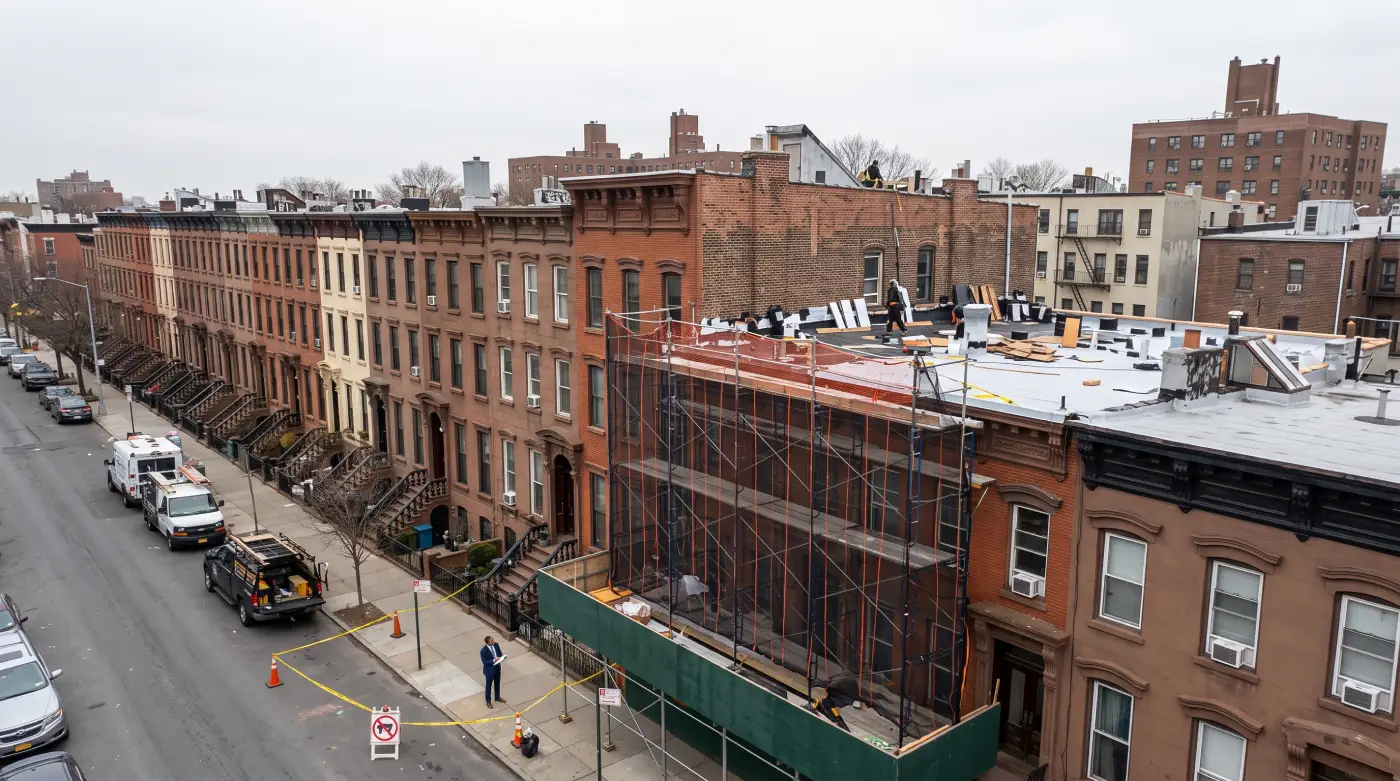
Most roofing work in Brooklyn happens on the borough’s own housing stock: two- and three-story brownstones and rowhouses being reroofed across Bedford-Stuyvesant, Park Slope, and Bushwick. On those jobs the danger is height with almost no margin. A slip near an unguarded edge, a ladder that kicks out on a stoop, or a soft spot in old sheathing can drop a worker two or three stories onto a sidewalk or an areaway.
The mid-rise construction in Williamsburg and Downtown Brooklyn brings different hazards. Higher elevations, crane loads, and shared scaffolding mean a fall or a dropped object travels farther and hits harder.
The failures that put roofers on the ground tend to repeat:
- No fall protection: no harness, no anchor point, or a harness nobody told the crew to clip into.
- A ladder that kicks out because it was unfooted or overreached on an uneven stoop or cellar entry.
- Roof collapse, where rotted decking or an overloaded surface gives way underfoot.
- Falling debris — tools, torn-off shingles, or material knocked from an upper level onto workers below.
Any one of these can trigger Labor Law 240(1), because each traces back to protection the owner or contractor was supposed to provide.
Common Roofing Injuries and Emergency Care in Brooklyn
A fall of even two stories loads the spine, skull, and limbs with force the body cannot absorb. The roofing injuries that follow are often permanent:
- Spinal cord damage that can cut off sensation or movement below the level of the break.
- Traumatic brain injury from a head strike, sometimes with no open wound and symptoms that surface hours or days later.
- Complex fractures of the legs, pelvis, wrists, and heels, the bones that take the impact of a feet-first or braced landing.
- Paralysis, partial or complete, when the cord is severed or crushed.
- Electrocution and burns from contact with power lines or live wiring near the roof edge.
Where you are treated shapes both your survival and your medical record. Serious Brooklyn roofing falls are routed to Kings County Hospital Center at 451 Clarkson Avenue, a Level I trauma center, the highest designation and staffed around the clock for the worst injuries. That trauma record becomes the backbone of your case: it documents the mechanism of the fall, the injuries at their most severe, and the treatment you needed before anyone had a chance to downplay it.
Get the head and spine imaged even if you walked away, because brain and internal injuries do not always announce themselves on day one.
Who Is Liable for Your Brooklyn Roofing Accident
The company that signs your paycheck is usually not the one you sue. New York’s workers’ compensation system generally bars you from suing your direct employer, as long as that employer carries workers’ comp insurance. In exchange for guaranteed medical and wage benefits, you give up the right to sue the boss for pain and suffering.
That bar does not touch anyone else. A roofing fall almost always involves several companies on the same site, and Labor Law 240(1) and 241(6) point directly at the ones with control:
- The property owner, who bears non-delegable liability for fall protection under the Scaffold Law even after hiring the work out.
- The general contractor running the site and responsible for coordinating safety across every trade.
- Other subcontractors whose crew created the hazard, like the demolition sub whose debris fell or the crew that left an opening unguarded.
- The manufacturer of a harness, ladder, scaffold, or lift that failed because it was defective.
These are your third-party defendants, and a claim against them is separate from and stacked on top of your workers’ comp. It is where the money for a permanent injury usually comes from, because it reaches damages workers’ comp will never pay.
Sorting out which company controlled which hazard is fact work. It depends on the contracts, the site logs, and who was standing where when you fell.
Workers’ Compensation vs. a Third-Party Lawsuit
You can have both claims running at the same time, and for a seriously hurt roofer, you usually should. They pay for different things and answer to different rules.
Workers’ compensation is a no-fault system. You do not have to prove anyone was careless; you only have to show the injury happened on the job. In return, what it pays is limited. Comp covers your medical treatment and part of your lost wages, capped by a state formula rather than your actual paycheck. It pays nothing for pain and suffering, nothing for the loss of your future earning power beyond its formulas, and nothing for what a permanent disability does to the rest of your life.
A third-party lawsuit fills that gap. Because it runs against the owner, contractor, or manufacturer rather than your employer, it is not capped the way comp is. A third-party case can recover your full lost earnings, past and future, the full cost of medical care and rehabilitation, and money for the pain, disfigurement, and permanent limits the injury leaves you with. On a Labor Law 240(1) fall, where liability is close to automatic, that is often the larger recovery by far.
Running both together takes coordination. When your third-party case recovers money, the workers’ comp insurer usually has a lien, meaning a right to be paid back for the benefits it already covered, and how that lien is negotiated affects what actually lands in your pocket. Handled well, the two claims work as a unit: comp keeps the lights on while the lawsuit is pending, and the third-party recovery covers everything comp left out.
The mistake is treating comp as the whole story. For a roofer facing surgery and months off a ladder, it rarely is.
If You’re Undocumented or Paid Off the Books
Your immigration status does not close the courthouse door. In Balbuena v. IDR Realty, New York’s highest court held that an undocumented worker can still recover lost wages after a construction injury. The Labor Law protects the worker on the roof, not the paperwork in a file.
Being paid in cash or off the books does not erase the claim either. It can make proving your wage loss more work, but pay records, tax filings, witness accounts, and industry wage data can all establish what you actually earned. The fall still happened on a jobsite the owner and contractor were bound by law to keep safe.
Everything you tell this office stays confidential, including your status. A consultation is a private legal conversation protected by attorney-client privilege, so nothing is reported to anyone and nothing you share is used against you.
Compensation Available After a Roofing Accident
A third-party roofing case is built to cover what the injury actually costs you, in two categories.
Economic damages are the ones with receipts and pay stubs behind them:
- Medical bills, from the trauma admission through surgery, hospital stays, and follow-up care.
- Lost earnings for every week the injury kept you off work.
- Future care and future lost income when the injury is permanent — the ongoing therapy, equipment, home health aid, and the earning power a disabled roofer will never get back.
Non-economic damages cover the harm that has no invoice but is just as real: the physical pain, the disfigurement and scarring from burns or surgery, and the loss of enjoyment when you can no longer do the physical work and daily activities you did before.
When a roofing fall kills a worker, the claim does not die with them. New York lets the surviving family bring a wrongful death case for the financial support the family lost, the medical and funeral costs, and, through a survival claim, the conscious pain the worker suffered before death. For a Brooklyn family that lost a breadwinner, that recovery is what keeps a household intact.
What your particular case can recover depends on the severity of the injury and how permanent it is. The more the fall took from you, the more the law lets you claim back.
What Hiring a Brooklyn Roofing Lawyer Costs
Nothing upfront. Silver Law Group takes Brooklyn roofing cases on a contingency fee, which means the attorney’s payment is a percentage of the money recovered for you and it comes out only if there is a recovery. You pay no hourly bill and no retainer to start. The firm advances the costs of building the case, including the investigators, the medical records, and the expert engineers, and if the case does not win, you owe no attorney’s fee. There is no financial risk to you in asking whether you have a claim.
That structure exists to line the lawyer’s interest up with yours: the firm gets paid more when you recover more. Compare that to the insurance adjuster who calls in the first days, sounding helpful, and offers a fast check. That number is almost always low, made before anyone knows whether your spine or brain injury is permanent. Once you sign a release for it, the claim is closed for good.
Deadlines to File a Brooklyn Roofing Accident Claim
A roofing injury in New York runs on more than one clock, and the shortest one you miss can end the claim before the others matter.
- Three years to sue for your injury. Under CPLR 214, you generally have three years from the date of the fall to file a personal injury lawsuit against the owner, contractor, or manufacturer. Miss it and the court will not hear the case, no matter how strong the Labor Law claim was.
- Two years for wrongful death. Under EPTL 5-4.1, a family bringing a wrongful death claim after a fatal roofing fall has two years from the date of death, a shorter window than the injury deadline and running from a different date.
- 30 days to notify your employer. For workers’ compensation, you must report the injury to your employer within 30 days. Wait too long and the comp insurer can fight or deny the benefits you need to pay for treatment right away.
- Two years to file your comp claim. Beyond notifying the boss, the formal workers’ compensation claim itself has to be filed within two years of the accident.
- 90 days if a public entity owns the building. When the property owner is a city or state agency, General Municipal Law 50-e requires a Notice of Claim within 90 days of the accident — far shorter than the three-year court deadline, and easy to blow past before you even know a public owner is involved.
Because these deadlines start on different dates and run for different lengths, the safe move is to have a lawyer identify every one that applies to your fall while there is still time to act on all of them.
Why Injured Brooklyn Roofers Choose Silver Law Group
Insurers settle for more when they believe a firm will actually try the case. Silver Law Group prepares every roofing claim as if it is going to a Kings County jury, and that posture shapes what the other side offers before trial is ever reached.
Preparation starts fast, because the evidence on a roofing site disappears fast. The firm runs its own investigation instead of waiting for the insurer’s version:
- Photographing the scene and the specific failure: the missing harness, the unguarded edge, the unfooted ladder.
- Finding and interviewing the workers who saw the fall.
- Sending evidence-preservation letters early to stop the owner or contractor from repairing or discarding the equipment and conditions that prove the Labor Law violation.
When a case is filed, it is filed where the injury happened: Kings County Supreme Court at 360 Adams Street in Downtown Brooklyn.
The first step is a free consultation, in English, Spanish, or Russian, answered any hour at 212-470-4544. If you cannot come in, the attorney comes to your home or hospital room. No fee unless the case recovers money for you.