

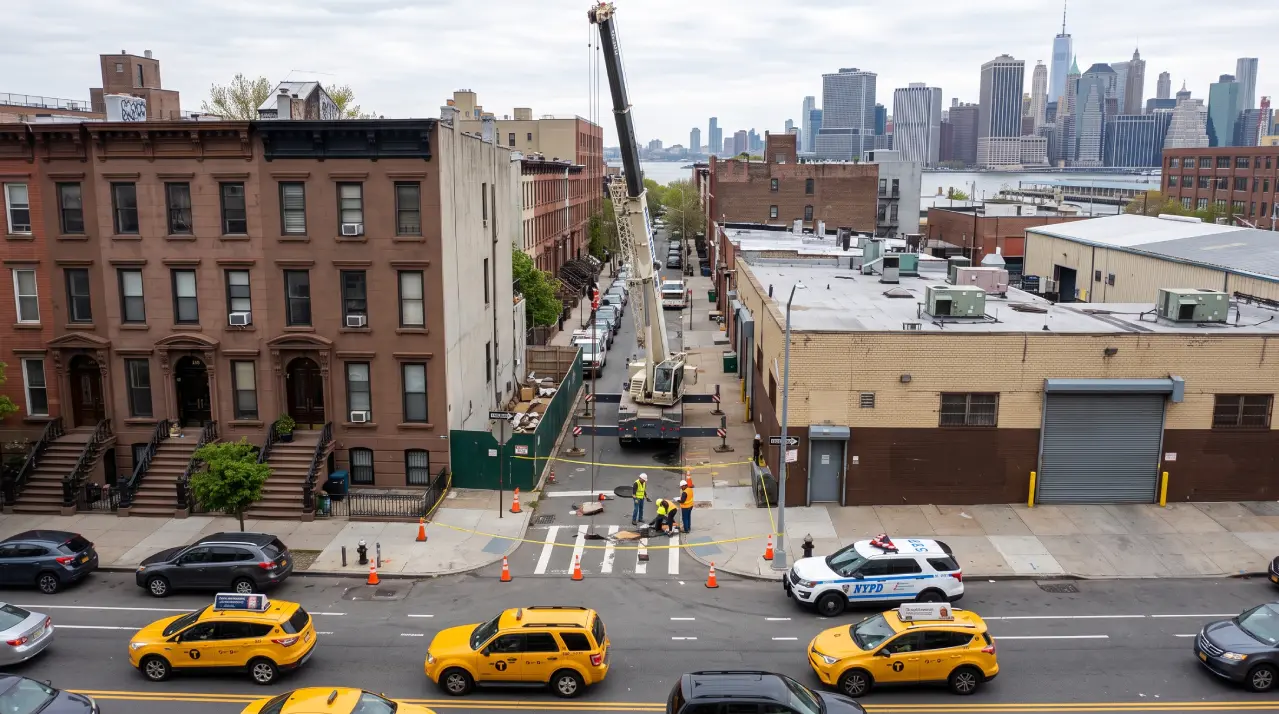
A crane accident on a Brooklyn construction site can end a career in seconds, and the hospital bills start before any insurance company admits fault. If a falling load, a collapsed boom, or a toppled tower crane hurt you, a Brooklyn crane accident attorney at Silver Law Group can tell you where you stand at no cost. Every case starts with a free consultation, and the firm works on contingency: you pay nothing up front and owe no legal fee unless it recovers money for you. Call 212-470-4544 any hour, day or night.
The people crane failures injure are not only ironworkers and riggers. Pedestrians, drivers, and passengers on the street below get struck by dropped steel and swinging loads, and their right to recover works differently from a worker’s. Whichever group you fall into, the firm can come to your Brooklyn home or hospital room to start the case.
Do You Have a Brooklyn Crane Accident Case?
New York gives crane accident victims on construction sites a level of protection that exists almost nowhere else in the country, and it comes from three sections of the Labor Law.
Labor Law §240(1), often called the Scaffold Law, imposes absolute liability when a worker falls from a height or is struck by a load that falls because it was not properly secured or hoisted. Crane work sits at the center of this statute. If a rigged load drops because the rigging failed, or a worker falls because a crane platform gave way, the property owner and general contractor are liable for the elevation-related hazard.
They cannot reduce what they owe by arguing you were careless, and that single feature makes §240(1) the strongest claim most injured crane workers have.
Labor Law §241(6) covers a wider set of hazards and ties liability to specific Industrial Code rules, the concrete regulations governing rigging, signaling, load limits, and site safety. To win under §241(6), your crane accident lawyer has to point to the exact code provision that was broken, which is why documenting the site matters so much.
Labor Law §200 is the codified version of ordinary negligence. It applies when the owner or contractor controlled the work or knew about a dangerous condition and left it alone.
The defendants in a Brooklyn crane accident case are rarely just one company. The property owner, the general contractor, the crane rental or operating company, the rigging subcontractor, and the crane manufacturer can each carry a share of fault. Naming all of them early protects your recovery when they start pointing at each other.
Common Brooklyn Crane Accidents and Injuries
Crane failures in Brooklyn tend to follow a handful of patterns, each with its own injury profile:
- Full crane collapse, where a tower or crawler crane comes down onto the site or the street
- A falling or swinging load that breaks free of the rigging or slips from the hook
- Electrocution when a boom or cable contacts an overhead power line
- Tower-crane failures during assembly, climbing, or dismantling
- Boom-truck and mobile-crane tip-overs on soft or overloaded ground
Two recent Brooklyn incidents show how far the danger reaches past the fence line. In 2025, a crane failure near Glenwood Road and Nostrand Avenue in Flatbush struck occupants of a dollar van passing below, turning bystanders into crane accident victims with no connection to the job site. In 2024, a crane incident on 44th Street in Borough Park again put people on a residential Brooklyn street in the path of construction equipment.
The injuries these forces cause are severe because the loads are heavy and the falls are long. Crush injuries happen when a load or a section of the crane pins a body against the ground or a fixed object, often destroying muscle and bone in the legs and pelvis. Spinal cord injuries from a fall or a strike can end movement below the point of damage, and the cost of lifelong care runs high. Traumatic brain injury is common when a hard hat is not enough against a multi-ton impact, and its effects — memory loss, personality change, seizures — can outlast every visible wound.
Workers’ Compensation Versus a Third-Party Lawsuit
If you were working when the crane failed, workers’ compensation is not the end of your recovery, but it is the ceiling on what you can get from your employer.
Under the exclusive remedy rule in the Workers’ Compensation Law, you cannot sue your own employer for a work injury. Comp pays your medical treatment and a portion of your lost wages regardless of who was at fault, which is its advantage. What it does not pay is anything for pain and suffering, and it replaces only part of your income, capped at a weekly maximum that rarely matches a skilled tradesperson’s real earnings.
The third-party lawsuit is where the rest of the recovery lives. Almost every Brooklyn construction site involves companies other than your direct employer: the property owner, the general contractor, the crane company that supplied and operated the equipment, the subcontractor that rigged the load. None of them are your employer, so none of them are shielded by the exclusive remedy rule. A suit against them under Labor Law §240(1), §241(6), and §200 can recover full lost earnings and lost future earning capacity, the pain and suffering comp ignores, and the cost of future medical care.
Running both claims at once takes coordination, because the workers’ comp insurer will assert a lien on part of your third-party recovery to get back what it paid. A crane accident lawyer handles the offset so the comp carrier does not quietly take a larger share than the law allows. For most injured workers, the third-party case is what covers the losses comp leaves on the table.
If You Were Not a Construction Worker
Workers’ compensation has nothing to do with your claim if you were simply near the site when the crane failed. Pedestrians on the sidewalk, drivers stopped at the light, and passengers like the dollar-van occupants struck near Glenwood Road bring an ordinary negligence claim, not a Labor Law or comp claim.
That distinction works in your favor. You face none of the exclusive-remedy limits that bind an injured employee, and you can pursue the full range of damages from the property owner, the contractor, and the crane company directly. Your case turns on proving the crane was operated or maintained carelessly and that the failure caused your injuries. Because you were never on anyone’s payroll, no comp lien reduces what you keep, and no employer stands between you and the companies that let the equipment fail.
What Your Brooklyn Crane Accident Claim May Be Worth
No two crane cases are worth the same amount, because the value tracks the injury and the injury depends on where the load landed. What a claim can include, though, follows a consistent set of categories.
- Past medical costs, from the emergency response and surgery through hospitalization and rehabilitation
- Future medical care, including additional surgeries, therapy, assistive equipment, and home health aides for injuries that never fully heal
- Lost wages for the time you could not work
- Lost earning capacity when the injury keeps you from returning to your trade or forces you into lower-paid work
- Pain and suffering for the physical pain and the mental toll, which workers’ compensation does not pay at all
- Compensation for permanent disability and disfigurement, such as an amputation, paralysis, or lasting scarring
The categories that end up driving a serious crane case are usually future care and lost earning capacity, not the initial hospital bill. A 40-year-old ironworker with a spinal cord injury faces decades of medical costs and a career that ended in one afternoon. Putting a number on those future losses takes medical experts and an economist, and it is the part of the case an insurer fights hardest to minimize. That is one reason to have a crane injury lawyer build the damages record early, before the proof of what you lost gets stale.
What to Do After a Crane Accident in Brooklyn
The hours after a crane accident shape the case as much as the accident itself. A few concrete steps protect both your health and your claim.
- Get medical care immediately, even for injuries that feel minor. Kings County Hospital Center in East Flatbush and Maimonides Medical Center in Borough Park both run trauma services, and the record they create is the starting point for proving what the crane did to you.
- Make sure the accident is reported to the NYC Department of Buildings and to OSHA. Crane collapses and serious construction injuries trigger DOB and federal investigations, and their findings can become evidence in your case.
- Photograph the scene if you safely can, or have someone do it for you: the crane, the rigging, the load, the ground conditions, and any warning signs that were or were not posted.
- Push to preserve the physical evidence. The rigging, the hook, the failed cable, and the crane’s maintenance and inspection logs can disappear or get repaired within days. A lawyer can send a preservation demand before that happens.
- Say nothing recorded to any insurance adjuster. The crane company’s or contractor’s insurer will call quickly and sound helpful, and a recorded statement taken while you are medicated or in shock gets used later to cut your recovery.
The single most useful move is to get a crane accident lawyer involved before the site is cleaned up and the equipment is back in service.
Deadlines to File a Brooklyn Crane Accident Claim
A crane accident claim in New York runs on several clocks at once, and the shortest one can end your case before you know it existed.
CPLR §214 gives you three years from the date of the accident to file a personal injury lawsuit for a crane injury. Three years feels long, but the evidence you need — the rigging, the logs, the witnesses — degrades fast, so the practical deadline to start building the case is far sooner.
If a crane accident killed a family member, EPTL §5-4.1 sets a shorter clock: two years from the date of death to bring a wrongful death action. The estate has to be opened and a representative appointed before suit, which eats into that time.
A separate and much shorter deadline applies when the crane work happened on city-owned property or involved a city agency. General Municipal Law §50-e requires a formal Notice of Claim within 90 days of the accident. Miss it and the claim against the city is usually gone, no matter how strong it was.
Injured workers face one more early deadline. The Workers’ Compensation Law requires written notice of the injury to your employer within 30 days. Giving that notice does not start your third-party lawsuit, but failing to give it can jeopardize the comp benefits that cover your treatment while the larger case is pending.
How Comparative Negligence Affects Your Claim
Partial fault does not bar your recovery in New York, which sets it apart from many other states. Under CPLR §1411, the state follows pure comparative negligence: if you are found partly responsible for the accident, your recovery is reduced by your percentage of fault but never eliminated. A worker found 30 percent at fault for a crane injury still recovers 70 percent of the damages; a worker found 90 percent at fault still recovers the remaining 10 percent.
Labor Law §240(1) goes further and takes comparative fault off the table entirely. For an elevation-related crane injury, a fall from height or a load that dropped because it was not secured, the owner and general contractor cannot reduce their liability by claiming you were careless. As long as the statute applies and a safety failure was a cause of your injury, your own conduct does not cut your recovery. Insurers know this, which is why they work hard to argue a case falls outside §240(1). Keeping the claim inside the statute is often the difference between a full recovery and a discounted one.
Why Choose Silver Law Group
You do not have to travel or even leave your hospital bed to start a crane accident case with Silver Law Group. If your injuries keep you home or admitted at Kings County or Maimonides, the attorney comes to you in Brooklyn.
The firm consults in English, Spanish, and Russian, so the details of what happened on the site do not get lost in translation — the facts that win a Labor Law case are technical, and they need to be captured in the language you actually speak. Someone answers 24 hours a day, seven days a week, because crane accidents do not wait for business hours, and neither does the insurance company trying to reach you first.
Every case is built as if it will be tried. Many injury claims settle, but a crane company’s insurer settles fairly only when it believes the firm is ready to put the case in front of a Brooklyn jury at Kings County Supreme Court. That readiness shapes every step, from the preservation demands sent in the first week to the experts retained months before trial.
The office is in Midtown Manhattan at 49 West 37th Street, a short trip from any Brooklyn courthouse, and it serves crane accident clients across Brooklyn. The consultation is free, and you owe no legal fee unless the firm recovers money for you. Call 212-470-4544 to talk through your case.