

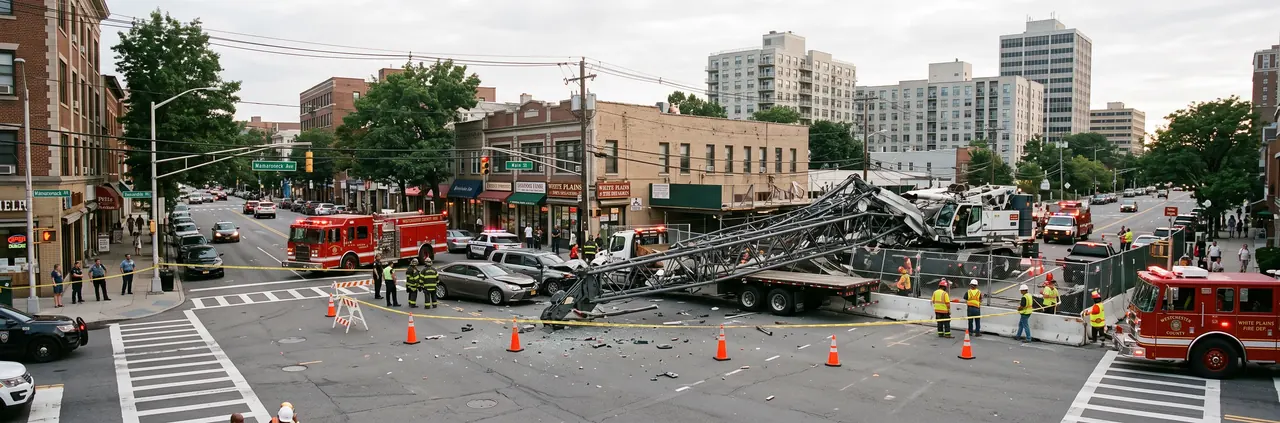
A crane that drops its load or tips over on a Yonkers, New Rochelle or White Plains job site can crush a worker in a second. The companies running that site usually start building their defense the same day, and as a Westchester County crane accident attorney, Silver Law Group starts building yours just as fast. We represent operators, riggers, ironworkers and laborers hurt on those sites, along with people struck on the sidewalk below. New York’s Labor Law puts most of the safety burden on property owners and general contractors, and that rule shapes almost every case on this page.
You do not have to come to Midtown to get answers. Call 212-470-4544 for a free consultation at any hour, and an attorney can meet you at home or in the hospital.
Do You Have a Westchester Crane Accident Case?
Most people hurt by a crane in Westchester have a claim against someone other than their employer. The workers who call us include:
- Crane operators injured when the machine tips or a component fails mid-lift
- Riggers who attach and balance the load
- Signal persons directing the lift from the ground or from a floor below
- Ironworkers setting the steel the crane hoists into place
- Laborers working inside the swing radius or under the load path
Height adds its own danger. On August 9, 2023, a worker was injured on a tower crane at 200 Hamilton Avenue in White Plains and had to be rescued from the crane. A worker hurt high on a tower crane depends on other people’s equipment and planning to get down safely, and the companies that controlled that site carry legal duties to those workers.
Who signed your paycheck matters less than you might expect. Your strongest claim usually runs against the owner and the contractors who controlled the site, under the Labor Law sections explained below.
How Crane Collapses and Dropped Loads Happen
Crane failures trace back to a short list of mechanical and planning errors, and each one points to a different defendant.
- A boom that buckles or collapses, often because the lift went past what the load chart allows at that radius
- Rigging that gives way because of worn slings, the wrong hitch, or hardware rated below the weight of the load
- Outriggers set on soft ground or left partly retracted, so the crane loses its footing and tips
- Overloading, where the pick weighs more than the crane can hold in that configuration
- Contact with overhead power lines, which sends current through the boom, the load line and anyone touching the load
- Wind that swings a suspended load or pushes the boom past its limits when the crew keeps lifting in conditions it should have waited out
In March 2023, a crane failed at the Amazon construction site in Hawthorne, off Saw Mill River Road. A worker suffered a partial leg amputation, and OSHA opened an investigation.
OSHA’s role is limited. It can inspect the site, document what went wrong and issue citations, but it does not pay injured workers anything. Its findings become evidence in your civil case, alongside the lift plan, the inspection log, the wind readings the crew had and the operator’s credentials. Those records decide who pays.
Pedestrians and Drivers Hurt by Falling Crane Loads
Downtown Yonkers, White Plains and New Rochelle all have construction sites that sit right against open sidewalks and traffic lanes. When a load falls outside the fence and hits a pedestrian or a car, the injured person is not a worker. Labor Law 240(1) and 241(6) protect workers only, so a bystander’s case is an ordinary negligence claim.
In a negligence claim, we have to prove that a contractor, crane company or owner failed to take reasonable care. Examples include swinging loads over an open sidewalk or lifting in wind the crew should have waited out. That burden is heavier than a worker’s, so site records and witness names gathered in the first weeks carry more weight for bystanders.
Labor Law 240(1) and 241(6): New York’s Crane Safety Protections
Section 240(1) of the New York Labor Law makes property owners and general contractors absolutely liable when a worker is hurt by a gravity-related hazard that proper safety devices should have prevented. On a crane job, that covers two situations: a load that falls because it was not properly hoisted or secured, and a worker who falls from height.
Absolute liability means the owner cannot escape by proving it was careful, or by pointing out that a subcontractor ran the lift. If the statute was violated and the violation caused your injury, the owner and the general contractor are liable even if neither one had anyone on site that day.
Your own mistakes do not cancel the claim. Defense lawyers will argue that you stood in the wrong spot or rushed a rigging job. Under 240(1), worker fault is no defense unless it was the sole proximate cause of the accident, meaning your conduct alone caused it and no missing or failed safety device played a part. If a violation contributed in any way, your share of the blame drops out of the liability question.
Section 241(6) covers hazards that have nothing to do with gravity. To win under it, your lawyer must show that a specific rule in the state Industrial Code was broken. Crane work has its own rules in 12 NYCRR Subpart 23-8, and the crane’s inspection records, setup and lift plan show whether the site followed them.
Like 240(1), section 241(6) holds the owner and general contractor responsible for a violation even when a subcontractor committed it. Many crane cases plead both sections, because one dropped load can involve both a gravity hazard and a broken crane rule.
Who Can Be Held Liable for a Westchester Crane Accident
A single crane lift on a Westchester project can involve five or more companies, and each can share the blame:
- The property owner, liable under Labor Law 240(1) and 241(6) no matter who ran the job
- The general contractor, which shares that statutory liability and controls safety across the site
- The crane owner or rental company, if it supplied a defective crane, skipped maintenance or sent an unqualified operator
- The rigging subcontractor that chose and attached the slings and hardware
- The manufacturer, when a defect in the boom, a load sensor or another component caused the failure
Operator credentials are often the first thing to check. Under General Business Law 482, crane operators in New York must hold a certificate of competence. If the operator on your site had none, or the certificate had lapsed, that gap is evidence against whichever company put that person at the controls.
Labor Law 200 adds a negligence claim against any party that controlled the work or knew about a dangerous condition and did nothing. It covers cases the other two sections can miss, such as a contractor who knew the ground under the outriggers was unstable and let the lift go ahead. A crane accident attorney will usually plead all three sections against every company that fits.
Workers’ Compensation and Third-Party Crane Lawsuits
Workers’ compensation pays your medical bills and part of your lost wages no matter who caused the accident. You do not have to prove anyone did anything wrong, and your own error does not reduce the benefit. Comp does not pay for pain and suffering, and its wage benefit replaces only part of what you earned.
A third-party lawsuit runs alongside your comp claim. You can collect comp now and sue the owner, general contractor, crane company or manufacturer at the same time, because none of them is your employer.
Your employer is the exception. Comp is the employer’s liability to you, and you cannot sue your own employer over the injury. WCL 11 creates one opening: when a worker suffers a grave injury, such as an amputation, the owner or contractor you sued can bring your employer into the case and seek contribution. That can put one more insurance policy into the settlement talks.
What each claim can pay for:
- Comp: medical treatment, partial wage replacement, no proof of fault needed
- Third-party suit: full lost earnings, lost future earning capacity, pain and suffering, and costs comp leaves uncovered
What Is a Westchester Crane Accident Claim Worth?
We will not quote averages, because no lawyer can honestly price your case from a web page. Value depends on what the crane did to your body, what work you can still do, and how strong the proof is against each defendant. The injuries we see most often from crane accidents include:
- Crush injuries to the chest, pelvis or limbs from a falling load or a toppled crane
- Amputations, either at the scene or later in surgery
- Traumatic brain injuries, including struck-by injuries with no skull fracture
- Spinal cord injuries with partial or complete paralysis
- Electrocution burns from power-line contact, which can damage nerves and organs under skin that looks intact
Economic damages cover losses you can document. That means past and future medical care, lost wages, lost earning capacity if you cannot return to crane or iron work, home modifications and paid help.
Non-economic damages pay for pain, the lost use of a limb and the life you can no longer lead. For a 35-year-old ironworker, that loss lasts for decades, and the jury hears about it from you, your family and your doctors.
How fault is shared depends on the claim. Under 240(1), your carelessness does not reduce the award unless it was the sole cause. In negligence-only claims, such as a bystander suit or a Labor Law 200 claim, CPLR 1411 applies. The jury assigns you a percentage of fault and reduces your damages by that percentage, so a finding of 20 percent fault means you collect 80 percent.
What Happens After You Call Silver Law Group
The evidence in a crane case is held by the companies that may be blamed for it, so the first weeks go to locking it down.
- We send preservation demands to the owner, general contractor and crane company for the crane inspection logs, maintenance records and lift plans.
- We get the load charts for the crane’s configuration that day and compare them with the weight of the pick.
- We check the operator’s certificate of competence and the qualifications of the rigging crew.
- We request the OSHA file, including inspection notes, photographs and any citations.
- We coordinate your medical care. If you were taken to Westchester Medical Center in Valhalla, a Level I trauma center, we track your treatment there and afterward so the records show the full extent of your injuries.
- We file suit in Westchester County Supreme Court in White Plains and prepare the case for trial from the first filing.
Your job during all of this is to follow your treatment plan and send every call from an insurer to us.
What Our Crane Accident Lawyers Cost
Silver Law Group handles crane cases on a contingency fee, so you pay nothing upfront and nothing by the hour. Our fee is a percentage of the money we recover for you, paid only when your case ends in a settlement or verdict. If there is no recovery, you owe no fee. The percentage is set out in writing before we start, so you know the terms from day one.
This matters in crane cases because the owner, contractor and crane company each have insurers and defense lawyers from the first day. A contingency fee lets you take on all of them without paying out of pocket.
Deadlines for Westchester Crane Accident Claims
A crane injury claim runs on several clocks at once, and the shortest one starts the day you are hurt.
- WCL 18 requires you to give your employer written notice within 30 days. Do this even if your foreman watched it happen.
- WCL 28 gives you two years to file your workers’ compensation claim.
- Under CPLR 214, you have three years from the accident to sue the owner, contractors, crane company or manufacturer.
- EPTL 5-4.1 gives a family two years from the date of death to bring a wrongful death suit.
Public projects run on a much shorter clock. If the site belongs to Westchester County, the City of Yonkers, another municipality or a school district, General Municipal Law 50-e requires a Notice of Claim within 90 days of the accident. GML 50-i then requires the lawsuit to be filed within one year and 90 days.
Missing the 90-day notice can end a claim before it starts, and court permission to file late is not guaranteed. If you are unsure whether a public entity owns the site you worked on, call before the 90 days run out, not after.
Why Westchester Crane Victims Choose Silver Law Group
Insurers make settlement offers based on how they expect a jury to react, so we prepare every case as if it will be tried. Here is what working with us looks like:
- Trial-ready preparation from the first preservation letter, not added later when talks stall
- 24/7 availability, including the night of the accident
- Free consultations in English, Spanish and Russian
- An attorney who comes to your home anywhere in Westchester or to your bedside at Westchester Medical Center
Our office is at 49 West 37th Street, 7th Floor, New York, NY 10018, in Midtown Manhattan. Most Westchester clients never need to make that trip until their case is well underway. Call 212-470-4544 to speak with a crane injury lawyer today.