

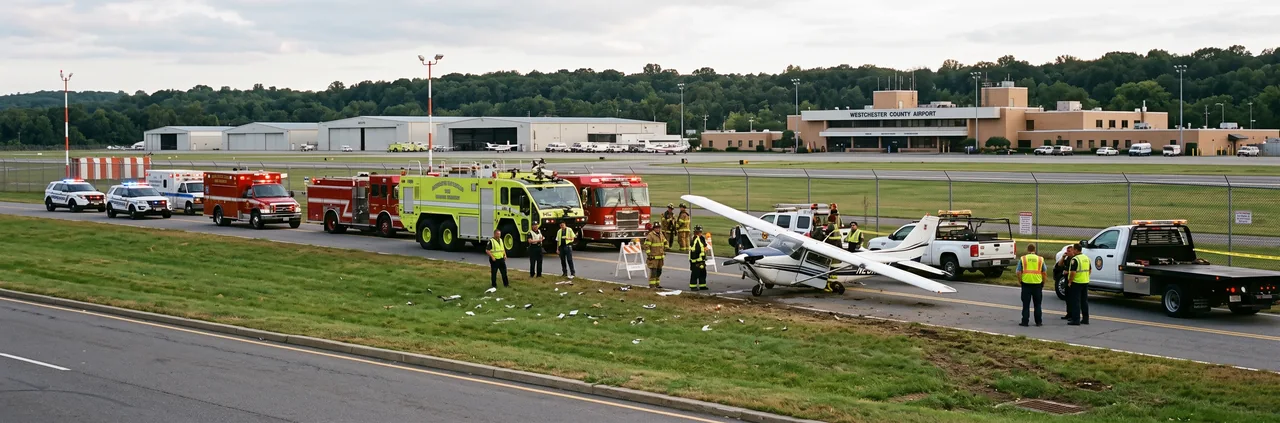
If a plane or helicopter crash injured you or killed someone in your family, a Westchester County aviation accident lawyer at Silver Law Group can start work on your case today. Every consultation is free, the phone line is answered 24/7, and you can speak with us in English, Spanish or Russian. The other side moves quickly after a crash. The owner’s insurer, the operator and the manufacturer send their own investigators within days, and the wreckage can be released and scrapped before anyone inspects it for you. Our attorney comes to you at home in White Plains, Yonkers or New Rochelle, or to your hospital bed, so you do not have to travel while you heal. Call 212-470-4544 to speak with a lawyer now.
Who Is Liable for a Plane or Helicopter Crash in Westchester
Most aviation crashes have more than one defendant, and each carries its own insurance. These are the parties an airplane accident lawyer examines first:
- The pilot, for decisions about weather, fuel, checklists and how the aircraft was flown
- The aircraft owner, who controls who flies the plane and whether its inspections are current
- The charter operator, which hires and trains the crew and decides how flights are dispatched
- The maintenance shop that inspected, repaired or signed off on the aircraft before its last flight
- The manufacturer of the airframe, the engine, or a single failed component such as a fuel pump or instrument
- Westchester County, which owns Westchester County Airport and answers for dangerous conditions on its property
- AvPORTS, the private company that manages the airport for the county and runs its day-to-day operations
Naming every responsible party matters because one private pilot’s policy may be far too small to pay for a severe burn or brain injury. When the maintenance shop or a parts manufacturer is added to the case, its insurance can be the one that actually pays for your care.
Fault is often shared, and insurers know it. New York uses pure comparative fault under CPLR 1411. If a jury finds you partly to blame, for example for an unfastened shoulder harness, your damages are reduced by that percentage. Your claim does not disappear.
A passenger found 30 percent at fault still recovers the other 70 percent. Adjusters raise fault early to justify a low offer. CPLR 1411 limits how far that tactic can go.
Private and Charter Plane Crashes Near Westchester County Airport (HPN)
Westchester County Airport sits on land in Harrison, North Castle and Rye Brook. That means a crash on approach or departure can come down near homes, along roads, or in the water and woods around the field.
On January 19, 2023, a Beechcraft A36 crashed near Rye Lake after its engine lost oil pressure, and two people died. A crash like that puts three things under investigation: the engine, its oil system, and the mechanics who last worked on them. A private plane accident lawyer requests the engine logbooks and recent work orders before the owner’s insurer has a chance to settle on its own explanation of the cause.
Charter flights add another layer. A charter operator holds a federal operating certificate and is responsible for how it trains pilots, schedules crews and maintains its fleet. A charter plane crash attorney asks for those training and dispatch records along with the pilot’s logbook. Many charter cases are decided by what the operator knew before the flight left HPN.
Helicopter, Boarding and Tarmac Injuries
A helicopter crash claim usually turns on mechanics or piloting, such as a tail rotor failure, a gearbox defect or a flight into bad weather. A helicopter accident attorney builds that case the way a plane crash case is built. The operator, owner, maintenance provider and manufacturer are all possible defendants.
Injuries at HPN that involve no crash at all follow different rules:
- A fall on wet terminal flooring
- Boarding stairs that were icy or missing a handrail
- A baggage tug or cart striking you on the ramp
These are premises claims against Westchester County as the property owner, or against the contractors who run the terminal and ramp. A claim against the county requires a Notice of Claim within 90 days, which is explained in the deadlines section below.
Commercial Airline Accidents and the Montreal Convention
International airline flights are governed by the Montreal Convention, a treaty that replaces ordinary New York negligence rules for passengers on covered trips. A ticket that departs from one treaty country and ends in another usually qualifies, even if you were hurt on a domestic connecting leg of that same ticket. The treaty changes your claim in four ways:
- The airline is strictly liable up to 151,880 Special Drawing Rights (a unit set by the International Monetary Fund) for death or injury losses on or after December 28, 2024. Up to that amount, you do not have to prove the airline was negligent.
- Above that amount, the airline can still be held liable. However, it can defend itself by proving that its own negligence did not cause the harm, or that a third party alone caused it.
- You must have suffered a bodily injury. Fear or distress with no physical injury generally does not qualify.
- Article 35 sets a two-year limit to file suit. If you miss it, the right to damages is gone, not just late.
That two-year limit is shorter than New York’s three-year injury rule. Courts treat it as a hard cutoff, not as a deadline that can be stretched. An airline accident attorney files on time even while the carrier is still discussing settlement, because airline talks can easily run past the two years.
What a Westchester Aviation Injury Claim Is Worth
No honest airplane crash attorney will quote a number at the first meeting. The value of your claim comes from your medical records and from how the injury changes your ability to work and live. A claim usually includes:
- Medical costs, from emergency surgery and intensive care through rehabilitation and prescriptions
- Lost earnings from the day of the crash until you return to work, if you can return
- Future care, such as home nursing, more surgeries, therapy, home modifications, and lower lifetime earning power
- Pain and suffering, including disfigurement, chronic pain and losing activities you can no longer do
Aviation injuries are often more severe than other injuries. Fuel fires cause burns that may need skin grafts in stages over years. A claim settled in the first few months can miss most of that cost.
Traumatic brain injury can show up as memory problems or personality changes weeks after the crash. That is why neurological testing belongs in your record even if your CT scan looked clean. Spinal injuries range from fractured vertebrae to cord damage that requires care for life.
Many seriously injured Westchester crash victims are taken to Westchester Medical Center in Valhalla, a Level I trauma center and verified burn center. Its trauma and burn unit records document the severity of your injuries from the first hour, and we request them early. Keep every discharge paper, follow-up appointment and therapy bill, because each one supports a part of the claim.
Wrongful Death Claims After a Fatal Crash
In New York, only the personal representative of the estate can file a wrongful death lawsuit. When the person who died lived in Westchester, that means starting with a petition to the Westchester Surrogate’s Court. If there is a will that names an executor, the court issues letters testamentary to that person. If there is no will, a close family member petitions for letters of administration.
EPTL 5-4.1 gives the estate two years from the date of death to file. That is a year shorter than the deadline a surviving injured passenger would have, and the Surrogate’s Court appointment has to happen first. Families who wait for the NTSB to finish its work can run out of time.
A wrongful death claim can recover:
- Funeral and burial costs
- The financial support the person would have provided over their working life
- Loss of parental guidance for children, which covers the care and instruction a parent would have given
We can help the family prepare the Surrogate’s Court petition while the crash investigation is still underway, so both move forward at the same time.
Crashes Across the Connecticut Line or Outside Westchester
HPN sits against the Connecticut border, and a flight in trouble does not stop at the state line. On December 12, 2024, a plane approaching HPN crashed on I-684 in Greenwich, Connecticut. Connecticut gives injured people two years to sue under CGS 52-584. That is a year less than New York’s rule, and a driver hurt on that highway who counted on three years could lose the claim.
Which state’s law applies depends on facts such as where the crash happened, where the flight started, and where the people involved live. The answer can change both the deadline and the damages available. Until a lawyer has worked through those facts, treat the shortest possible deadline as your real one.
Distance from the airport does not cut the connection to Westchester. On April 12, 2025, an MU-2B crashed in Copake, New York, after departing HPN, and six people died. In a multi-fatality crash like that, the evidence is spread out: departure and fueling records at HPN, the operator’s files wherever it is based, and the wreckage at the crash site. An air disaster attorney collects all three, because each defendant controls only part of the record.
What Happens Next: NTSB, FAA and Preserving Evidence
The National Transportation Safety Board leads the investigation of civil aviation crashes, and the Federal Aviation Administration handles regulatory questions such as pilot certification and airworthiness. The NTSB’s job is to find the probable cause and prevent the next crash. It does not assign legal fault or pay anyone. Manufacturers and operators often take part in the investigation as technical parties, but injured passengers and families do not.
The NTSB’s final report cannot carry your case. Under 49 U.S.C. 1154(b), no part of an NTSB report about an accident may be admitted into evidence or used in a civil lawsuit for damages. Your case has to be proved with its own evidence and its own experts, even if the NTSB reaches the same conclusion you do.
That makes the first weeks important. An airplane accident attorney sends preservation letters that demand each party keep:
- The wreckage, which must be held intact after the NTSB releases it to the owner or insurer instead of being salvaged or sold
- Maintenance logs for the airframe, engine and propeller, plus work orders and parts invoices
- Air traffic control audio, which can be recorded over on a routine schedule
- ADS-B data showing the aircraft’s position, altitude and speed during the final minutes
While those letters go out, there are two things you can do. Do not give a recorded statement to the owner’s insurer or the operator. Save your boarding pass, photos, texts and medical paperwork.
What It Costs to Hire Silver Law Group
Silver Law Group handles aviation cases on a contingency fee. You pay nothing up front and nothing by the hour. Our fee is a percentage of the money we recover for you through a settlement or verdict. If there is no recovery, there is no fee.
Aviation cases need experts that a typical injury case does not, such as wreckage reconstruction specialists, metallurgists, pilots and former maintenance inspectors. Their work costs money and has to start early, before the wreckage is gone. The written retainer you sign explains how those expert costs are handled and how they relate to the fee. You will know the full arrangement before any work begins. Ask any airplane injury law firm you are considering to give you the same thing in writing, and read it before you sign.
Deadlines for Westchester Aviation Claims
Several deadlines can apply to the same crash, and the shortest one controls your case:
- CPLR 214 gives you three years from the crash to sue a pilot, owner, operator, maintenance shop or manufacturer for personal injury.
- GML 50-e requires a Notice of Claim served on Westchester County within 90 days if the county’s airport property or conduct played a part.
- GML 50-i sets one year and 90 days to file the lawsuit against the county itself.
- The General Aviation Revitalization Act (GARA) bars most claims against the manufacturer of a general aviation aircraft once the aircraft is more than 18 years old, with narrow exceptions.
- The Federal Tort Claims Act (FTCA) requires a written administrative claim within two years if negligence by FAA air traffic controllers contributed to the crash. That claim must be filed before you can sue the United States.
Earlier sections covered three more: two years under the Montreal Convention, two years for wrongful death, and two years if Connecticut law applies. The 90-day county notice is the deadline most often missed, because families are still in the hospital when it runs out. A plane accident lawyer can serve that notice early to protect your rights while the rest of the case is built.
Why Westchester Families Call Silver Law Group
Families call us because of what we do on the first day:
- We speak English, Spanish and Russian, so no relative has to translate a doctor’s report over the phone.
- Our line is answered 24/7, including at 2 a.m. from a waiting room at Westchester Medical Center.
- An attorney comes to your bedside or your home anywhere in the county.
- We prepare every case as if it will go to trial, ready to file in Westchester Supreme Court at 111 Dr. Martin Luther King Jr. Blvd, White Plains.
- You pay no fee unless we recover money for you.
Our office is at 49 West 37th Street, 7th Floor, New York, NY 10018, in Midtown Manhattan. Call 212-470-4544 today. The first call is free, and the wreckage, maintenance logs and controller audio in your case will not be kept forever.