

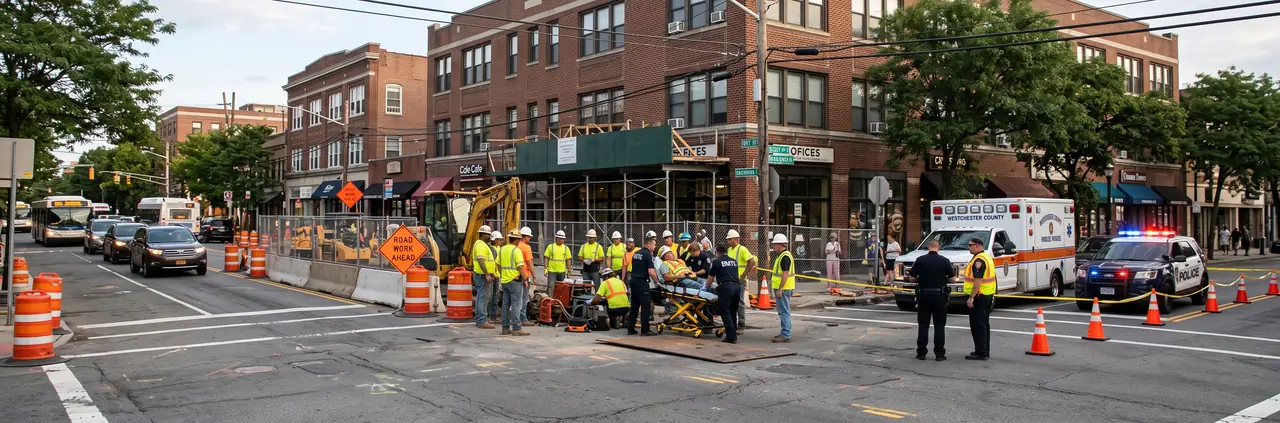
If you were hurt on a job site, a Westchester County construction worker lawyer can go after money that workers’ compensation never pays. Silver Law Group represents laborers, carpenters, ironworkers and electricians injured on Westchester projects, from waterfront towers in Yonkers to overpass work along the Taconic. Workers’ comp covers your medical bills and part of your wages. New York’s Labor Law lets you sue the property owner and general contractor for the rest, and in a scaffold or ladder fall your own mistake usually does not reduce that claim. Call 212-470-4544 for a free consultation in English, Spanish or Russian, at any hour.
Do You Have a Construction Injury Case in Westchester?
Most injured construction workers have two claims, and both can run at the same time.
- A workers’ compensation claim through your employer’s insurance carrier. You can file no matter who caused the accident. It pays for medical treatment and part of your lost wages, up to a weekly cap. It pays nothing for pain and suffering.
- A personal injury lawsuit against the other companies on the project. That can be the property owner, the general contractor, a subcontractor whose crew created the hazard, or the company that made a defective lift, saw or harness.
Your own employer is usually left out of the lawsuit. Under the comp bar, workers’ compensation is your only remedy against the company that pays you, even if that company was careless. This is the trade-off the law makes: you get benefits without proving fault, and your employer can’t be sued.
The owner and general contractor have no such protection. New York’s Labor Law puts safety duties on them directly, and the three statutes below decide how strong your third-party case is.
Scaffold Law 240(1) Falls and Falling Objects
Labor Law 240(1), known as the Scaffold Law, covers accidents caused by gravity. You fell from a height, or a load fell on you because it was not hoisted or secured properly. Owners and contractors must provide scaffolds, ladders, hoists and other devices that actually protect the worker. If a device was missing, collapsed or slipped, or was the wrong equipment for the task, and that failure caused your injury, they are liable.
Your own share of the blame does not reduce a 240(1) award. In most New York injury cases, a jury cuts your award by your percentage of fault. Under the Scaffold Law it does not, so leaning too far on an unsecured ladder will not defeat your claim if the ladder itself was inadequate.
Insurers rely on one narrow defense. In Blake v Neighborhood Housing Services of New York City, the Court of Appeals held that a worker cannot recover when the device was adequate and the worker’s own conduct was the sole proximate cause of the fall. If any violation of the statute contributed to the accident, that defense fails.
One exemption matters in Westchester’s suburbs. Owners of one- and two-family homes who hire contractors but do not direct or control the work are exempt. If you were hurt renovating a single-family house in Scarsdale, your claim usually runs against the contractor instead of the homeowner.
Labor Law 241(6) and Section 200 Claims
Labor Law 241(6) covers injuries that are not falls, but it demands precision. In Ross v Curtis-Palmer Hydro-Electric Co., the Court of Appeals held that the claim must be based on a breach of a specific, concrete rule in the Industrial Code (12 NYCRR Part 23). A general duty to keep the site safe is not enough. Rules that often support these claims cover:
- trench and excavation work, including shoring and sloping of trench walls
- demolition, including the order in which structures come down
- electrical hazards such as live circuits and nearby power lines
Section 200 is the backup claim. It writes the common-law duty of care into the Labor Law, but it applies only if the defendant controlled how your work was done, or knew or should have known about the hazard that hurt you, such as an uncovered floor opening or a broken stair. Because Section 200 is a negligence claim, your own share of fault counts against you.
Where Westchester Construction Workers Get Hurt
Westchester now has building at a scale that used to belong to Manhattan. Large projects like Hudson Piers on the Yonkers waterfront put crews on hoists, along open edges and under crane loads every day. Those are the exact hazards the Scaffold Law was written for.
New Rochelle’s 26-story The Leaf brought high-rise work into downtown New Rochelle. Exterior scaffolding, material hoists and work on upper floors all fall under 240(1). When a tower project injures someone, the owner and general contractor are usually large, well-insured companies, and they are the right defendants.
Highway and bridge work carries its own risks. In July 2026, a worker died after falling from a Taconic overpass in Hawthorne. When a public body owns the project, the notice deadlines are much shorter than on private jobs, as explained in the deadlines section below.
Trenches kill workers without warning. The 2021 trench collapse in Mamaroneck led to a criminal prosecution, which shows that excavation shortcuts can bring criminal charges on top of civil liability. Your civil case does not depend on a conviction, but a prosecution’s record of what went wrong can help prove it.
What a Westchester Construction Injury Claim Can Recover
Workers’ comp replaces only part of your paycheck. A lawsuit against the owner or contractor can recover what comp leaves out:
- Full lost wages, not the capped portion comp pays
- Lost earning capacity, meaning the gap between what you would have earned in your trade and what you can earn now, over the rest of your working life
- Future medical care, such as surgeries, therapy, pain management and equipment you will need years from now
- Pain and suffering, past and future, which comp never covers
The comp carrier gets repaid out of your lawsuit recovery. Under Workers’ Compensation Law Section 29, the carrier has a lien on that recovery for the medical and wage benefits it has already paid. Your lawyer has to account for the lien before any settlement number can be judged fair.
You also need the carrier’s written consent before you settle, or a court order approving the settlement. If you settle without either one, the carrier can stop your future comp benefits. We get that consent before you sign anything.
What to Do After a Westchester Job-Site Accident
The first few days create the evidence your case will rely on. Take these steps in this order where you can:
- Get treated at a trauma-level hospital. Westchester Medical Center in Valhalla is the Hudson Valley’s only Level I adult and pediatric trauma center. After a fall from a height, a head strike or a crush injury, ask for full imaging even if you can walk.
- Tell your foreman or supervisor, and make sure a written accident report is made. Photograph it or ask for a copy. Written notice to your employer also starts your comp claim.
- Photograph the scene before it gets cleaned up. Include the ladder or scaffold, missing guardrails, trench walls, the spot where you landed, and your injuries.
- Get the names and phone numbers of coworkers who saw the accident. Also write down the general contractor and subcontractors listed on the site sign or permits.
- Ask for OSHA records. If inspectors from OSHA’s Tarrytown Area Office visited your site, their inspection file and any citations can document the exact violations. A construction worker injury lawyer can request those records for you.
- Do not sign anything from an insurer or give a recorded statement until you have spoken with a lawyer.
We prepare every file as if it will be tried. Insurers can tell which firms will actually go to trial.
What a Westchester County Construction Worker Lawyer Costs
You pay nothing up front, and you pay no fee if there is no recovery. Silver Law Group handles construction injury cases on a contingency fee. The fee is a percentage of the settlement or verdict, and it is paid only out of that money, never out of your pocket.
This means the firm gets paid only if the owner and contractor pay you. The percentage is written into the agreement you sign before any work starts, so you know the terms from the first day. The consultation where a construction worker lawyer reviews your accident is free, whether or not you hire us.
Deadlines for Westchester Construction Injury Claims
Up to six deadlines can apply to the same accident, and the shortest ones are the easiest to miss:
- 30 days to give your employer written notice of the injury, under Workers’ Compensation Law Section 18
- Two years to file your comp claim with the Workers’ Compensation Board, under Section 28
- Three years to sue the owner, general contractor or other third parties, under CPLR 214
- Two years from the date of death for a wrongful death claim, under EPTL 5-4.1
- 90 days to serve a Notice of Claim on a city, town, village or the county, under General Municipal Law 50-e
- One year and 90 days to sue the City of Yonkers or Westchester County, under General Municipal Law 50-i
The 90-day notice catches workers on public jobs such as road, sewer and municipal building projects. If a local government owns the site, call a lawyer within weeks, not months.
Why Westchester Workers Call Silver Law Group
Injured workers usually call us when they are still in pain, already missing paychecks, and getting calls from an adjuster. Here is what happens when you call:
- You speak with us in English, Spanish or Russian.
- Someone answers 24/7, including nights and weekends after a weekend shift.
- An attorney can come to your home in Westchester or to your hospital bed, so you don’t have to travel to Manhattan.
- Your case is prepared for trial in White Plains from the first day.
Our office is at 49 West 37th Street, 7th Floor, New York, NY 10018, in Midtown. Call 212-470-4544 for a free case review with a construction worker attorney.