

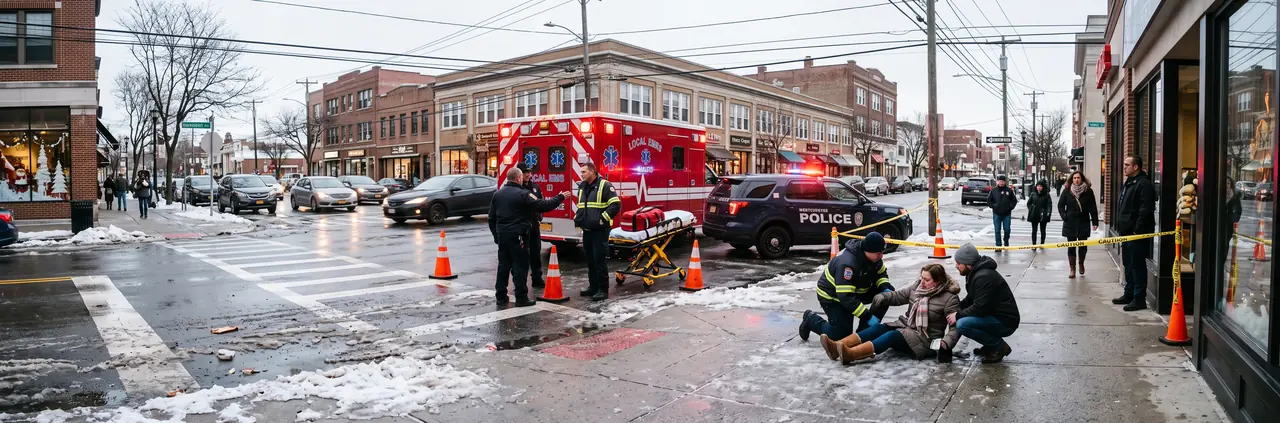
Call 212-470-4544 for a free consultation with a Westchester County slip and fall attorney at Silver Law Group, at any hour. The property owner’s insurer has probably opened a file on your fall already, and the adjuster works for the owner. Your first call should go to someone who works for you. We represent fall victims across the county, from the village of Port Chester on the Sound to the city of Peekskill on the Hudson. That includes falls in supermarkets, malls, apartment lobbies, parking lots and public sidewalks. Our office is at 49 West 37th Street in Midtown Manhattan, but an attorney will come to your home or hospital room anywhere in Westchester. You pay nothing to talk with us, and you don’t need to have every detail worked out before you call.
Do You Have a Slip and Fall Case in Westchester?
New York requires anyone who owns or controls property to keep it reasonably safe for the people expected to be there. A fall by itself does not prove the owner broke that duty. Your case depends on what the owner knew, or should have known, before you went down.
You can generally meet that standard in one of three ways:
- The owner or its staff created the hazard, for example by mopping an aisle and putting out no warning sign.
- The owner had actual notice. An employee saw the spill, a tenant complained about the broken step, or an earlier incident report describes the same defect.
- The owner had constructive notice. The hazard was visible and had been there long enough that a reasonable inspection would have found and fixed it.
Most cases are won or lost on constructive notice. Cleaning logs, inspection schedules and the timestamp on a store camera showing how long a puddle sat untouched become the proof, and the owner controls all of them. That is why we request those records early.
Expect the insurer to argue that the cracked step or raised edge was too small to count. In Hutchinson v Sheridan Hill House Corp. (2015), the New York Court of Appeals rejected any minimum height for an actionable defect. A low lip in a dim stairwell can support a claim, while a bigger gap in plain view in a well-lit spot may not. Courts look at the whole setting: lighting, foot traffic, the defect’s shape and where your eyes were naturally directed. Photos taken from your own eye level in the same light are the best evidence of that setting.
Falls in Westchester Stores, Malls, and Apartment Buildings
Large retail properties like The Westchester in White Plains and Cross County Shopping Center and Ridge Hill in Yonkers run maintenance crews on schedules and keep cameras on most walkways. Those systems create records. If a sweep log shows nobody checked the food court for two hours, that gap is evidence.
Falls in stores and malls usually come from a short list of hazards:
- spilled drinks, produce or cleaning fluid in aisles and food courts
- broken, uneven or worn stairs
- poor lighting in garages, corridors and stairwells
- entrance mats that are loose, curled or soaked through on rainy days
Apartment buildings work differently. The landlord controls the common areas, including stairwells, lobbies, hallways and laundry rooms. Missing handrails, loose treads, burned-out bulbs and lobby floors left wet after mopping are the landlord’s responsibility. If you or a neighbor reported the defect by text, email or a letter to management, that message is actual-notice evidence. Save it before anyone has a reason to delete it.
Snow and Ice Falls in Parking Lots and Walkways
Under the storm-in-progress rule, an owner has no duty to clear snow or ice while a storm is still going on, plus a reasonable period after it ends. Defense lawyers raise it in nearly every winter fall case.
Cerar v Jefferson Valley Mall (2d Dept 2024) shows how the defense works in practice. A shopper slipped on ice in the mall’s parking lot in Yorktown Heights. The defendants submitted a meteorologist’s report and certified weather records showing that drizzle and shifting temperatures were forming ice that evening. The court dismissed the claim. It found the plaintiff’s theory, that snow piles had melted and refrozen, too speculative to beat that evidence.
The lesson is that winter cases are proven with documents, and they have to be gathered quickly:
- certified weather records for the date and hour of your fall
- the owner’s snow-removal contract, which shows who was supposed to plow and salt, and when
- plow and salting logs, invoices and dispatch records
- photos of snow piles, drainage paths and melt patterns near where you fell
Who Is Responsible for a Westchester Sidewalk Fall?
The answer depends on which municipality you fell in, and Westchester has dozens of them.
As a general rule, the municipality is responsible for a public sidewalk, not the owner of the house or business next to it. An adjacent owner becomes liable only if they created the defect, made special use of that stretch of sidewalk, or an ordinance applies to them. Yonkers, White Plains, New Rochelle and Mount Vernon each have city codes that place sidewalk obligations on abutting property owners. That makes the property owner a possible defendant in those cities. But a code duty is not enough by itself.
In Lagawo v Myers (2017), a case over a Yonkers sidewalk, the Second Department applied the rule that an abutting owner answers to an injured pedestrian only where an ordinance expressly makes the owner liable. A local law that just tells owners to repair their sidewalks does not shift the lawsuit to them. Before naming a homeowner, we read the exact wording of the city code.
Villages and towns add a different obstacle. Village Law 6-628 and Town Law 65-a bar most claims against a village or town over a sidewalk defect unless someone gave it prior written notice of that specific defect before you fell. If you trip on a broken slab in a village like Port Chester or a town like Yorktown, the first question is whether a written complaint about that slab is on file. We request the clerk’s records to find out.
Depending on where and how you fell, the responsible party could be:
- the city, town, village or county that owns the sidewalk
- the adjacent owner, where a city ordinance expressly imposes liability
- a business that created the defect, such as a contractor who left a trench poorly patched
Common Slip and Fall Injuries
Falls cause more serious injuries than most people expect, and the worst ones don’t always hurt the most on the first day. These are the injuries we see most often:
- Hip fractures, especially in older adults, which often need surgery and months of rehabilitation.
- Wrist fractures from instinctively throwing a hand out to break the fall.
- Ankle fractures from rolling a foot on a broken step or curb edge.
- Traumatic brain injury from hitting your head on tile, concrete or a stair edge. Headaches, confusion and memory problems can surface days later.
- Spinal damage, including herniated discs and vertebral fractures, which can cause nerve pain into the arms or legs.
Westchester Medical Center in Valhalla is a Level I adult trauma center and takes the most serious fall injuries in the county. White Plains Hospital also treats many fall patients. Whichever emergency room you go to, that first chart entry links your injury to the fall. Insurers look for gaps in treatment, so keep every follow-up appointment and fill every prescription.
What Your Westchester Fall Claim Is Worth
Every case is valued differently, and no honest lawyer can give you a number on the first call. The value comes from documented losses in these categories:
- Medical bills, from the ambulance and ER through surgery, physical therapy and prescriptions.
- Lost wages for the time you couldn’t work, including sick and vacation days you had to use.
- Future care, such as more surgery, home help or reduced earning capacity if you can’t go back to your job.
- Pain and suffering, meaning the physical pain and the ordinary life the injury took away from you.
Expect the insurer to blame you. Adjusters routinely argue that the victim was looking at a phone, wearing the wrong shoes or should have seen the hazard. New York’s answer is CPLR 1411, the pure comparative fault rule. If a jury finds you partly responsible, your recovery shrinks by your share of the fault but is never wiped out. If you are found 30 percent at fault, you still recover 70 percent of your damages. That holds even if you are found mostly at fault.
That is why the adjuster’s percentage argument matters so much and why you shouldn’t concede any of it on a recorded call. A fall injury lawyer pushes back on blame with the footage, the maintenance logs and your preserved footwear.
What to Do After a Slip or Trip and Fall
Some of the most important evidence disappears within days. Take these steps in this order if you can, and get help from a family member if you’re hurt:
- Report the fall to the store manager, landlord or property owner, and ask for a copy of the incident report.
- Photograph the hazard before anyone cleans or repairs it, from your eye level and up close.
- Keep the shoes and clothes you wore in a bag, unwashed. The defense may claim your footwear caused the fall.
- Get the names and phone numbers of everyone who saw it happen, including employees.
- Send a written request for surveillance footage right away. Many systems record over old video automatically, sometimes within days.
- Get a medical evaluation the same day, even if you feel you can walk it off.
A trip and fall injury attorney can send the footage demand for you, often faster than you could arrange it yourself.
How a Westchester Slip and Fall Lawsuit Moves Forward
Your case starts with an investigation. We inspect and photograph the site, demand surveillance video and maintenance records, interview witnesses, and identify every party with control over the spot where you fell. That last step matters because the store, the landlord, the snow contractor and the municipality can each be a separate defendant.
Next we present your claim to the owner’s liability insurer, with your medical records and wage losses attached. Some cases settle at this stage, but not until your treatment has gone far enough to show what the injury will cost you over time.
If the insurer won’t pay fairly, we file a summons and complaint in Westchester County Supreme Court at 111 Dr. Martin Luther King Jr. Blvd. in White Plains. Discovery comes next. Both sides exchange records, and we push for cleaning logs, inspection schedules, prior complaints and the snow-removal contract. Depositions follow, which are sworn question-and-answer sessions with you, the store manager, the porter on duty and anyone else with knowledge.
Many cases go to mediation after depositions. A neutral mediator helps both sides test their positions. If that doesn’t resolve it, your case goes to a jury in White Plains. We prepare every file from the start as if it will reach that courtroom, because insurers make better offers on cases they know are ready for trial.
What a Slip and Fall Lawyer Costs
You pay no attorney fee upfront and nothing by the hour. Silver Law Group works on contingency. Our fee is a percentage of whatever we recover for you, through a settlement or a jury verdict, and it comes out of that recovery when the case ends. If there is no recovery, you owe no attorney fee. The fee percentage is set out in a written agreement before any work starts, so you know exactly how the money will be divided. This arrangement also means we only make money when you do, so we have every reason to build the case properly and no reason to take on a claim we can’t win.
Deadlines for Westchester Slip and Fall Claims
Who owns the property where you fell decides which deadline applies, and the gap between the shortest and longest is huge. These are the main deadlines:
- CPLR 214: three years from the date of the fall to sue a private owner, such as a store, mall, landlord or homeowner.
- GML 50-e: 90 days to serve a Notice of Claim when the property belongs to the county, a city, a town or a village.
- GML 50-i: one year and 90 days to start the lawsuit against that same public owner.
- EPTL 5-4.1: two years from the date of death for a family’s wrongful death claim.
The 90-day rule catches people. A fall on a Yonkers city sidewalk, a village-owned walkway or the grounds of a county building puts you on the short clock. If you miss it, the three-year deadline doesn’t help you. Many people don’t learn the sidewalk was public property until it’s too late, which is why we confirm ownership in the first week.
Why Westchester Fall Victims Call Silver Law Group
You get a lawyer who prepares your case for a jury from day one and comes to you. That means:
- trial-ready preparation, with evidence gathered for the White Plains courtroom and not just for a quick settlement
- free consultations in English, Spanish and Russian
- someone answering at 212-470-4544 day and night, including weekends
- an attorney who visits you at home or in the hospital anywhere in Westchester, from Valhalla to Port Chester to Peekskill
- no fee unless you recover
Our office is at 49 West 37th Street, 7th Floor, in Midtown Manhattan. You never have to make the trip there for us to take your case. Call 212-470-4544 now. Tell us where you fell and when, and we’ll tell you which deadline applies and what evidence to secure this week.