

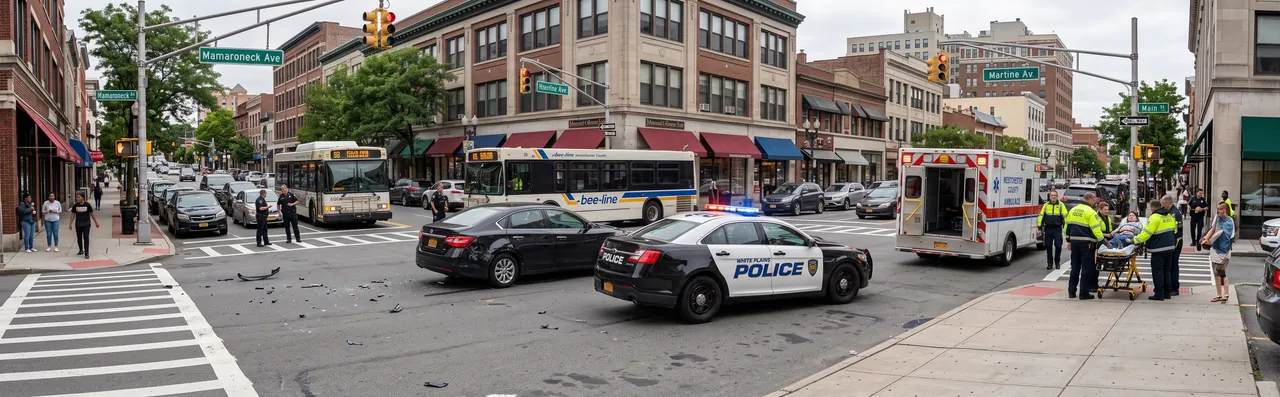
A passenger almost never causes the crash, so a passenger’s injury claim usually starts from a stronger position than any other claim in a car case. Silver Law Group is a Westchester County passenger injuries law firm for people hurt in the back seat of a friend’s car, in an Uber on the Cross Westchester Expressway, or on a Bee-Line bus. You didn’t hold the wheel, pick the speed, or decide when to merge. The law treats you that way, and the insurance policies of every driver involved may owe you money.
That still doesn’t make your claim automatic. The driver’s insurer will argue that your injury falls short of New York’s serious injury threshold. It may also say a missing seatbelt should cut what you are owed. Several deadlines start running the day of the crash, and the shortest is 30 days.
Call 212-470-4544 for a free consultation. A lawyer will read the police report, tell you which policies cover you, and give you the exact deadlines for your claim in English, Spanish, or Russian.
Do You Have a Passenger Injury Claim in Westchester?
In most crashes you do, and you may have more than one person to claim against. A passenger can sue the driver of their own car, the driver of the other car, or both. You controlled neither vehicle, so the fight over fault is between the two drivers. Your claim goes forward whichever of them a jury blames more.
These are the parties who may owe you:
- The driver of the car you were in, if they were speeding, looking at a phone, or following too close
- The driver of the other vehicle
- Both drivers together, when each one’s mistake added to the crash
- The owner of either vehicle, even if the owner was not in the car
The last item comes from Vehicle and Traffic Law § 388. Under VTL 388, a vehicle’s owner is liable for the negligence of anyone driving it with permission. This matters when your driver borrowed a parent’s car or a coworker’s SUV: the owner’s insurance policy covers your claim, not only the driver’s.
Where the crash happened shapes the case too. The I-287 Cross Westchester Expressway carries heavy commuter and truck traffic across the county from east to west. The Hutchinson River, Saw Mill River, and Bronx River Parkways are older roads where a sudden stop or a late merge leaves little room to recover. The road decides which police agency responded, which report we request, and often which drivers’ accounts conflict. A passenger is usually the one witness with no reason to shade the story.
When a Friend or Spouse Was Driving
Most passengers worry that a claim against a friend or relative means taking that person’s money. It doesn’t. The claim is made against the driver’s auto insurance policy. The insurer pays any settlement up to its limits and hires a lawyer to defend the driver. Your friend’s savings are not the target, and many drivers want their passenger’s medical bills paid.
Spouses are the exception to watch. Under Insurance Law § 3420(g), a New York auto policy does not cover your injury claim against your own spouse unless the policy includes supplementary spousal liability coverage. Insurers must offer this coverage, but many households never add it. We check the policy’s declarations page early, because whether this coverage exists can decide the whole case.
Uber and Lyft Passengers in Westchester
Rideshare coverage in Westchester comes from VTL § 1693, and the amount depends on what the app showed at the moment of impact. During a trip, the company’s policy must carry $1.25 million in liability coverage plus $1.25 million in supplementary uninsured/underinsured motorist (SUM) coverage. That SUM layer protects you if the other driver had little or no insurance. When the driver is logged on and waiting for a request, the required liability coverage drops to $75,000 per person and $150,000 per accident.
New York City works differently. Section 1693(12) excludes cities with a population of one million or more, so rideshare cars in the five boroughs fall under separate rules. A crash in New Rochelle or Yonkers is governed by § 1693. We ask the company for the trip record quickly, since the trip status at the moment of the crash decides which policy pays.
Bee-Line Bus Passengers
Westchester County owns the Bee-Line buses, and Liberty Lines operates them under contract with the county. That split catches passengers off guard. A claim against the county requires a Notice of Claim served within 90 days of the injury under General Municipal Law § 50-e.
Davis v. County of Westchester, 78 AD3d 698, shows how this goes wrong. The passenger was hurt getting off a county-owned bus. She believed Liberty Lines owned it, so she did not serve the county within 90 days. The Supreme Court in Westchester denied her request to file late, and she had to take the case to the Appellate Division to get permission. Serve the right owner on time and you never have to fight that battle.
No-Fault Benefits and the Serious Injury Threshold
No-fault insurance pays up to $50,000 in basic economic loss no matter who caused the crash. That covers your medical treatment, part of your lost wages, and certain out-of-pocket costs. You get these benefits even if both drivers blame each other for months.
They come with a short deadline. Under 11 NYCRR 65-1.1, you must give the insurer written notice of your claim within 30 days of the accident. Miss that window and the insurer can deny benefits, which leaves your hospital bills unpaid while the liability case is still at the start. We file this notice first.
No-fault covers money losses only. To sue a driver for pain and suffering, your injury must meet one of the “serious injury” categories in Insurance Law § 5102(d):
- Death
- Dismemberment
- Significant disfigurement
- A fracture
- Loss of a fetus
- Permanent loss of use of a body organ, member, function, or system
- Permanent consequential limitation of use of a body organ or member
- Significant limitation of use of a body function or system
- A medically determined injury that keeps you from performing substantially all of your usual daily activities for at least 90 of the 180 days right after the crash
A fracture qualifies on its own. Soft-tissue injuries are where insurers fight hardest, and they send you to their own doctor for an exam to argue you have healed. Range-of-motion testing, MRI findings, and steady treatment records are what beat that exam. Gaps in your care give the insurer its best argument.
What a Westchester Passenger Injury Claim Is Worth
Your claim’s value comes from losses no-fault does not pay, along with the limits of every policy that covers the crash. Once your injury clears the serious injury threshold, you can claim:
- Medical costs beyond no-fault, including treatment after the $50,000 runs out and future surgery or therapy
- Lost earnings above what no-fault paid, plus reduced earning ability if you cannot go back to the same work
- Pain and suffering, past and future, including the loss of activities you did before the crash
CPLR 1411 is New York’s comparative fault rule. It reduces your damages only by your own share of fault. A passenger rarely has any, which is why passenger claims often hold their value better than drivers’ claims. The insurer’s main tool against you is usually the seatbelt.
Under VTL § 1229-c(8), not wearing a seatbelt can never be used to decide who caused the crash. The defense may raise it only to argue for lower damages. Even then, it has to connect the unbuckled belt to specific injuries a belt would have prevented or reduced. A broken wrist from a side impact may have nothing to do with the belt. A passenger injuries lawyer who knows this rule keeps the seatbelt argument confined to the injuries it actually touches.
Common Passenger Injuries and Where Westchester Victims Are Treated
Passengers take the force of a crash without the warning a driver gets. You don’t brace, because you didn’t see it coming. The injuries we see most often:
- Whiplash and neck or back disc injuries, which can take days to show and often need an MRI to document
- Fractures of the wrist, ribs, collarbone, and pelvis from the seatbelt, door, or dashboard
- Brain injury in the rear seat, where a passenger’s head can strike the seatback, a window, or another passenger
Rear-seat passengers face a particular risk. People buckle up less often in the back, and a concussion can look like simple confusion at the scene. Get examined the same day if you hit your head, even if you never lost consciousness.
Where you were treated becomes part of your evidence. Westchester Medical Center in Valhalla is the Hudson Valley’s only ACS-verified Level I trauma center, and the most serious crash injuries from across the county are brought there. White Plains Hospital and St. John’s Riverside Hospital in Yonkers treat many other crash patients. The emergency room chart is the first medical record of your injury. Insurers compare everything that follows against it, so tell the ER staff about every part of your body that hurts.
What Happens After You Call Us
The first call is free and costs you nothing to make. After that, the case moves in this order:
- We get the police report from the department that responded. In Westchester that might be a city force like Yonkers or White Plains, the Westchester County Police, or the State Police.
- We file your no-fault application inside the 30-day window so your medical bills start getting paid.
- We collect your medical records from the ER onward, along with imaging and treating doctors’ notes, and track your recovery against the serious injury categories.
- We identify every policy that applies, including the driver’s, the owner’s under VTL 388, any rideshare coverage, and SUM coverage, and then negotiate with the insurers.
- If the insurers will not pay a fair amount, we file suit in Westchester County Supreme Court, 111 Dr. Martin Luther King Jr. Blvd, White Plains.
Most of the work in steps 1 through 4 happens while you are still in treatment. You go to your appointments. We handle the adjusters.
What It Costs to Hire Our Westchester County Passenger Injuries Law Firm
You pay nothing upfront to hire us. We work on a contingency fee, which means no fee unless we recover money for you. The fee is a percentage set in your written retainer agreement, and it comes out of the settlement or verdict when the case ends. It never comes out of your pocket while the case is open. If there is no recovery, you owe us no fee. This lets you hire a passenger injuries attorney the same week as the crash, while evidence is fresh, without worrying about how you would pay a lawyer while you are out of work.
Deadlines for Westchester Passenger Claims
Every passenger claim has a filing deadline, and the deadline depends on who you are suing:
- Three years from the crash to sue a driver or owner under CPLR 214
- Two years from the date of death for a wrongful death claim under EPTL 5-4.1
- One year and 90 days to sue Westchester County under GML 50-i, for claims such as a Bee-Line bus injury, and that is on top of the 90-day Notice of Claim
- One year and 90 days for claims against Metro-North under Public Authorities Law § 1276
The county and Metro-North deadlines are the ones people miss. They are shorter, and they come with notice steps that must be completed before you can file suit. A case filed one day late is usually dismissed, however strong it is.
Why Westchester Passengers Choose Silver Law Group
Passengers hire us for practical reasons:
- Your consultation and every later call can be in English, Spanish, or Russian
- You can reach us 24/7, including the night of the crash
- An attorney will come to your home or your hospital bed at Westchester Medical Center or anywhere else you are being treated
- Every case is prepared as if it will be tried in White Plains, because insurers pay more when they see a file built for a jury
Our office is at 49 West 37th Street, 7th Floor, New York, NY 10018, in Midtown Manhattan. You don’t need to travel there, since we come to you.
Call 212-470-4544 to book a no-cost case review. Bring the police report number if you have it and the names of any insurers who have already called you.