

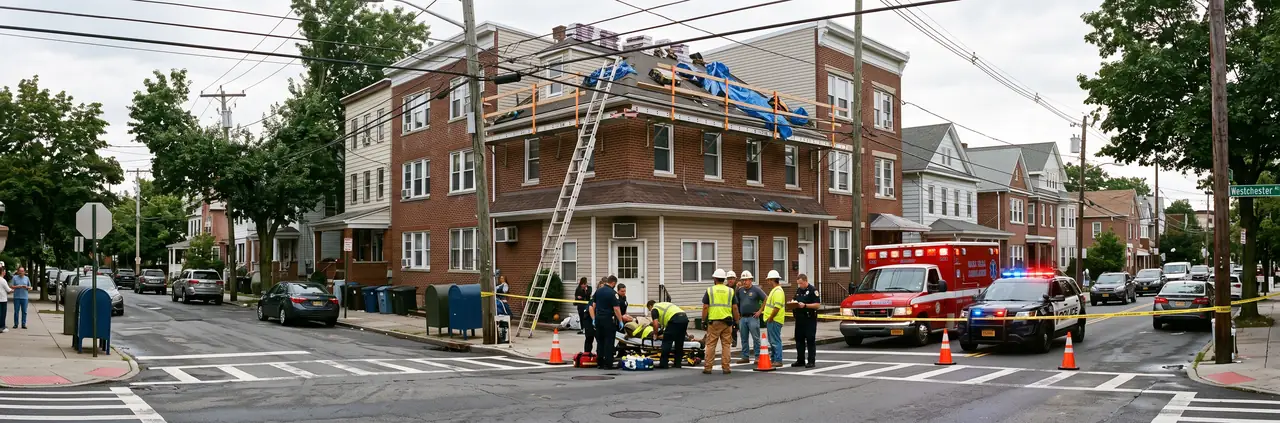
A fall from a roof on a Westchester job site is usually governed by Labor Law 240(1), New York’s Scaffold Law. That law makes the property owner and general contractor pay for missing fall protection, and Silver Law Group gives roofers hurt in New Rochelle, Mount Vernon, Peekskill, Ossining and every other part of the county a free consultation with a Westchester County roofing accident lawyer. In that first conversation you will learn who owned the building, who ran the job, and whether the gear on your roof met the legal standard.
If you are still in the hospital or recovering at home, you do not have to travel. The attorney comes to you. Call 212-470-4544 at any hour, including the night of the accident.
Do You Have a Roofing Fall Case in Westchester?
Most roofers who fall have a claim, and the reason is the way Labor Law 240(1) assigns responsibility. The statute requires every owner and contractor on a building job to provide ladders, scaffolding, ropes, hoists and other devices built and placed to give proper protection to the worker. When that protection is missing or fails and you fall, the owner and contractor are liable even if neither of them ever climbed onto the roof. Courts call this absolute liability.
A 240(1) violation on a roofing job usually looks like one of these:
- No harness issued, or a harness with nothing to tie off to
- Roof anchors never installed, or anchors that pulled loose under your weight
- An open roof edge with no guardrail
- A ladder that was not secured at the top or footed at the base, and slid or tipped
- Scaffold planks that shifted, split or were never fastened
The insurance company will argue that you caused your own fall. Maybe you unclipped to move a bundle of shingles, or stepped closer to the edge than you should have. Under 240(1), that argument wins only if your conduct was the sole proximate cause of the fall, meaning the right equipment was there for you and the fall traced back to your choice alone.
If the owner or contractor failed to provide an adequate device, your own carelessness does not defeat the claim. A roofer who slipped while rushing still recovers when there was no anchor point to tie off to.
The first question in your case is what equipment was on that roof. What you did on it comes second.
Fell From a Single-Family Home? The Homeowner Exemption
Falls from houses come with one defense that commercial jobs do not have. Sections 240(1) and 241(6) exempt owners of one- and two-family dwellings who contract for the work but do not direct or control it. A homeowner in Ossining who hires a roofing company and stays inside while the crew works will usually fall within that exemption.
The exemption is narrower than insurers make it sound. It disappears when the homeowner tells the crew how to do the job, picks the method, or decides where the ladder goes. It also protects only the homeowner. The roofing contractor or general contractor who ran the job keeps full 240(1) and 241(6) liability, and on most house jobs that contractor is the defendant who matters.
Labor Law 200 has no homeowner exemption at all. It codifies the ordinary duty to keep a workplace reasonably safe, so a claim under it requires proof that the owner was negligent, such as knowing the roof deck was rotted and saying nothing to the crew.
Steep Roofs and Industrial Code Violations
Section 241(6) claims rest on violations of specific Industrial Code rules, and 12 NYCRR 23-1.24 was written for roofing work. It sets two requirements that come up again and again in fall cases:
- On any roof with a slope steeper than one in four, workers must be given roofing brackets, crawling boards or safety belts.
- On roofs more than 20 feet above the ground without a parapet at least 2.5 feet high, the Code calls for a ground-supported scaffold.
A slope of one in four means the roof rises one foot for every four feet of horizontal run. If your crew worked a steeper pitch with nothing but sneakers and a hand on the ridge, the contractor broke a specific, written rule.
That matters because 241(6) gives your case a second route to the owner and contractor. If a defense weakens the 240(1) claim, a proven 23-1.24 violation can still carry the case.
How Roofing Accidents Happen
Federal OSHA rules set the baseline every Westchester roofing contractor is measured against. Under 29 CFR 1926.501, fall protection is required once a worker is six feet or more above a lower level. Most roofs on a two-story house put you well past that line before you take your first step.
OSHA also limits the shortcuts. Warning lines and safety monitors are allowed only on roofs with a slope of 4:12 or flatter. On anything steeper, a contractor who relies on a chalk line or a coworker watching for the edge instead of a harness or guardrail is breaking the rule.
The falls that bring roofers to our office tend to follow familiar patterns:
- stepping onto an unguarded skylight that gives way
- ice or frost on the roof surface on a winter morning
- a harness with a frayed lanyard or a failed buckle
- a lanyard clipped to a vent pipe or anything else that cannot hold a falling body
- working a steep pitch with no brackets or crawling boards
- a ladder kicking out at the base during the climb to the eave
These risks have already cost lives in this county. In 2023, a roofing contractor died after falling about 30 feet from a three-story house on Park Hill Avenue in Yonkers.
Workers’ Compensation Plus a Third-Party Lawsuit
Workers’ compensation pays no matter who caused your fall, and that no-fault design is also its limit.
Comp gives you two things:
- medical treatment for the injury
- a portion of your lost wages, not your full paycheck
In exchange, your employer is immune from a lawsuit by you. Comp pays nothing for pain and suffering, no matter how severe the injury.
A third-party lawsuit fills that gap. It is filed against anyone other than your employer whose failure contributed to the fall, and on a roofing job there are usually several candidates:
- The property owner, under Labor Law 240(1) and 241(6)
- The general contractor running the site
- The manufacturer of a harness, lanyard or anchor that failed when it should have held
Those defendants can be made to pay what comp never covers, including pain and suffering and your full lost earnings, past and future. You can collect comp benefits and pursue the lawsuit at the same time. The two are separate claims.
Workers’ Compensation Law §11 adds another layer. Normally an owner or contractor you sue cannot pass the bill to your employer. The exception is a grave injury, a short list in the statute that includes death, paraplegia or quadriplegia, amputation or permanent total loss of use of an arm, leg, hand or foot, and a brain injury causing permanent total disability. When a roof fall causes one of those injuries, the defendants can bring your employer into the case, which puts another insurance policy behind your recovery.
Non-Union and Undocumented Roofers Can Recover
The workers most likely to die on New York construction sites are often the ones least likely to call a lawyer. NYCOSH’s 2026 Deadly Skyline report found that non-union workers accounted for 81% of construction deaths statewide in 2024. Latino workers made up 18.6% of the construction workforce but 25.8% of the deaths.
Many roofers on small residential crews fit both descriptions, and many assume that filing a claim will expose them to immigration trouble. Immigration status does not bar a Labor Law claim in New York. The owner’s duty to provide a harness or a secured ladder is the same for a non-union laborer paid in cash as it is for a union journeyman, and a roof fall injury lawyer should be asking how you fell, not where you were born. Your consultation can be held entirely in Spanish.
What Your Roofing Injury Claim Is Worth
Nobody can honestly put a number on your case in a first phone call, and Silver Law Group does not quote averages. The value depends on how badly you were hurt and what the injury takes from your working life.
Roof falls produce some of the most serious injuries in construction:
- spinal cord injuries, including partial or complete paralysis
- traumatic brain injury from striking the ground or debris
- fractures of the heels, pelvis, hips, wrists and vertebrae
- crush injuries when materials or equipment land on you
Each of those injuries drives several categories of damages in a third-party case:
- Future earnings. A roofer with a fused spine or rebuilt heel rarely goes back on a roof, and the claim covers the career you lost.
- Lifetime care, including surgeries, rehabilitation, home modifications and attendant care.
- Pain and suffering, the category comp never pays.
Medical records carry all of it. Serious falls in the county are often taken to Westchester Medical Center in Valhalla, a Level I adult and pediatric trauma center. The trauma team’s notes from the first hours, the imaging, and every follow-up visit become the proof of what the fall did to you.
What Happens After a Roof Fall
The first days after a fall decide how much of your case can be proven later. Take these steps as far as your injuries allow:
- Get treatment, and tell every doctor you fell from a roof at work, with the height if you know it.
- Give your employer written notice of the accident. A phone call to the foreman is not enough for workers’ comp, so put it in writing and keep a copy.
- Photograph the roof edge, the anchor points, the ladder and your harness, or ask a coworker to do it before the crew cleans up the site.
- Identify the property owner and the general contractor. The work permit posted at the site, your pay records and the company name on the trucks are good places to start.
- Refuse recorded statements to any insurer, including the owner’s and the contractor’s carriers. Anything you say about unclipping or rushing will be used to argue sole proximate cause.
If the case is filed in court, it will usually be venued in Westchester County Supreme Court at 111 Dr. Martin Luther King Jr. Blvd in White Plains. That is where the owner and contractor will have to answer for the equipment that was missing from your roof.
What It Costs to Hire a Westchester County Roofing Accident Lawyer
Silver Law Group works on contingency. You pay nothing upfront: no retainer, no hourly bill. The fee is a percentage of what you recover, taken only when the case settles or wins at trial, and if there is no recovery you owe no fee. The firm gets paid only by proving your case, which is the reason every file is built to win.
Getting to a law office should not be your problem with a broken pelvis. An attorney will come to your home or your hospital bedside anywhere in Westchester, from Yonkers to Peekskill.
Deadlines for Westchester Roofing Accident Claims
A roofing fall can start six separate clocks, and the shortest one runs out in a month.
- 30 days to give your employer written notice of the accident (Workers’ Compensation Law §18)
- Two years to file your comp claim with the Workers’ Compensation Board (WCL §28)
- Three years from the accident to sue the owner, contractor or equipment manufacturer (CPLR 214)
- Two years from the date of death for a family’s wrongful death action (EPTL 5-4.1)
- 90 days to serve a Notice of Claim when the roof belongs to a public building (General Municipal Law §50-e)
- One year and 90 days to file the lawsuit itself against that public owner (GML §50-i)
The public-building deadlines are the ones that catch roofers off guard. A fall from a roof owned by a city, town, village or Westchester County gives you 90 days, not three years, to file the first paper. If there is any chance a public entity owns the building you were working on, call before that window closes.
Why Westchester Roofers Choose Silver Law Group
Many roofers would rather explain a fall in their first language, so consultations are available in English, Spanish and Russian. The rest of what the firm offers is practical:
- Phones answered 24/7, so you can call from the emergency room or the night after you are discharged.
- Trial-ready preparation from the first week. Evidence is gathered, witnesses are found and experts are lined up as if the case will go before a White Plains jury, and insurers value a case differently when they know it can.
- An attorney who travels to you anywhere in the county.
Silver Law Group’s office is at 49 West 37th Street, 7th Floor, New York, NY 10018, in Midtown Manhattan. Call 212-470-4544 to speak with a roofing accident attorney today. The consultation is free, and the first thing you will be asked is what safety equipment was on that roof when you fell.