

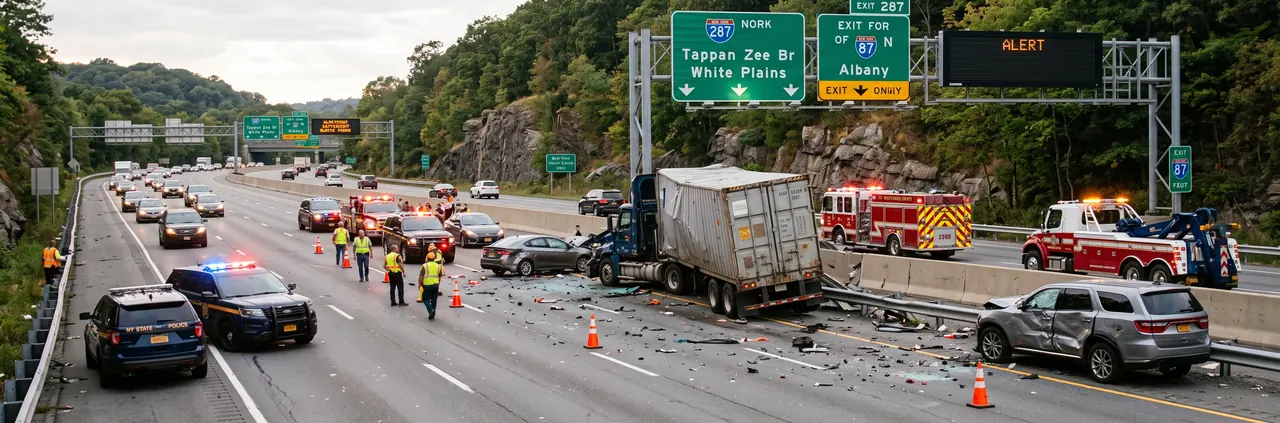
A Westchester County truck accident lawyer from Silver Law Group will review your crash in a free consultation, ideally before the trucking company’s insurer gets your account on tape. You do not need to travel to Manhattan for it. An attorney will meet you at home or in the hospital in White Plains, Yonkers, New Rochelle, Mount Vernon, Peekskill or anywhere else in the county.
In the first few weeks, truck cases move faster than car cases. Carriers often send their own investigators to the scene within hours. The electronic records that show how long the driver had been behind the wheel can be overwritten unless someone demands them in writing.
Call 212-470-4544 at any hour. Consultations are available in English, Spanish and Russian.
Where Truck Crashes Happen Across Westchester County
Most heavy freight in the county moves on four interstates, and each one tends to produce its own kind of crash.
- I-287, the Cross Westchester Expressway, runs across the middle of the county through White Plains. Tractor-trailers there merge and change lanes beside commuter traffic at busy interchanges, which leads to sideswipes and rear-end crashes.
- I-87 and the Mario Cuomo Bridge carry long-haul trucks across the Hudson and south toward the Bronx. At highway speed a loaded trailer needs far more distance to stop than a car does, so a sudden slowdown on the bridge or its approaches can end in a chain-reaction crash or a jackknife.
- I-95, the New England Thruway, runs through New Rochelle in tight, stop-and-go traffic. Trucks there sideswipe and underride smaller vehicles.
- I-684 runs north through the quieter part of the county. Trucks hold steady speeds there, and that is where a tired driver drifts out of the lane.
The county’s parkways are a separate problem. Commercial vehicles are banned from the Hutchinson River Parkway and the other Westchester parkways because the old overpasses are too low for a trailer to clear. Trucks get on them anyway.
In June 2026, a southbound tractor-trailer struck the Mamaroneck Road bridge over the Hutchinson River Parkway in Scarsdale late at night. The southbound lanes stayed closed for much of the night while crews removed the truck.
If a truck that had no legal right to be on a parkway caused your crash, the ban becomes part of your evidence. The driver chose a prohibited route, and the carrier’s dispatch and routing records show whether the company allowed it.
Driver Fatigue, Logbooks and Black Box Data
Federal law caps how long a commercial driver can drive. Under 49 CFR 395.3, a property-carrying driver may drive no more than 11 hours. Those hours must fall within a 14-hour window that starts when the driver comes on duty after 10 consecutive hours off. A crash in the twelfth hour of driving is a fatigue case before anyone examines the driver.
Paper logbooks were easy to fake. Most interstate trucks now carry an electronic logging device, which records driving time straight from the engine. The truck’s engine control module, often called the black box, separately stores speed, braking and throttle data from the seconds before impact.
None of this data is safe on its own. Devices overwrite old data, and carriers clear out files on their own schedules. A preservation letter puts the carrier on written notice to keep the ELD records, the engine download, the dispatch logs, the driver’s cell phone records and the truck itself. If the carrier destroys any of it after receiving that letter, the court can hold it against the carrier.
Who Is Liable for a Westchester Truck Accident
A truck crash usually has several possible defendants, and each one has its own insurance.
- The driver, for speeding, fatigue, phone use or taking a banned route
- The motor carrier that hired, trained and dispatched the driver, which answers for an employee’s negligence on the job
- The owners of the tractor and the trailer, which are often two different companies. Under New York Vehicle and Traffic Law 388, an owner is liable for crashes caused by anyone driving its vehicle with permission.
- The shipper or loader, when an overweight or badly secured load shifted and tipped the trailer
- The maintenance contractor that last worked on the brakes, tires or lights
- The manufacturer of a defective part, such as a brake component or a tire that failed
Experienced 18 wheeler accident attorneys name every party the records support. A defendant left out of the case is an insurance policy left unclaimed.
There is one important exception. The federal Graves Amendment, 49 USC 30106, protects bona fide rental and leasing companies from owner liability when they were not negligent themselves. Whether a lessor qualifies depends on the facts, so the lease agreement is one of the first documents we demand.
No-Fault Benefits and the Serious Injury Threshold
Your own auto insurance pays first, even though the truck caused the crash. New York’s no-fault system covers basic economic loss up to $50,000, which includes your medical bills and part of your lost wages, no matter who was at fault. You must file the no-fault application within 30 days of the crash, or the insurer can deny it.
No-fault does not pay for:
- pain and suffering
- medical bills and lost wages above the $50,000 limit
To claim pain and suffering from the truck driver or carrier, your injury must meet the definition of serious injury in Insurance Law 5102(d). In truck cases, the categories that come up most often are:
- a fracture
- a permanent limitation in the use of a body part, organ or function
- a medically documented injury that kept you from your usual daily activities for at least 90 of the first 180 days after the crash
A loaded truck can weigh many times as much as a car, so truck crash injuries often meet this threshold. The carrier’s lawyers will still dispute it. What proves it is steady treatment records that start in the first week, not a single ER visit followed by months with no care.
What Your Westchester Truck Accident Claim Is Worth
A truck claim is valued by adding up your losses first and then comparing that total to the insurance available to pay it.
- Medical costs, past and future, including surgery, rehabilitation and home care beyond what no-fault paid
- Lost earnings, plus lost future earning capacity if you cannot go back to your old work
- Pain and suffering, including the parts of your life the injury took away
Insurance coverage is the main difference between truck cases and car cases. Under 49 CFR 387.9, interstate for-hire carriers hauling general freight must carry at least $750,000 in liability coverage. Many also carry excess or umbrella policies on top of that minimum.
Semi truck accident attorneys need to identify each of those coverage layers early. The primary insurer and the excess insurer may both have to pay, and each will try to shift the cost to the other.
The defense will almost always argue that you were partly to blame, for example that you braked suddenly, sat in the truck’s blind spot or were going too fast. New York’s pure comparative fault rule, CPLR 1411, reduces your recovery by your share of fault but does not take it away. If you are found 20 percent at fault, you keep 80 percent of your damages.
Catastrophic Injuries Treated at Westchester Medical Center
Many of the county’s most seriously injured truck crash patients are taken to Westchester Medical Center in Valhalla, the only Level I adult and pediatric trauma center in the Hudson Valley. The injuries treated there are the ones that change how a claim has to be built.
- Traumatic brain injury, which can affect memory, mood and the ability to work long after the scans look stable
- Spinal cord injury, including partial or complete paralysis
- Amputation, whether at the scene or in surgery afterward
- Crush injuries from being pinned under a trailer or inside a crushed cab, often followed by repeat operations
With these injuries, the claim has to cover decades of care, not just months. A life care planner projects your future surgeries, equipment, home modifications and attendant care. An economist then calculates what that care will cost over your lifetime. Both reports are based on your treating doctors’ records from Valhalla, and they are what the carrier’s excess insurer actually reviews when it decides what to pay.
What Happens After You Hire Us
Hiring a tractor trailer accident law firm in the first days gives it time to secure evidence the carrier would rather lose. Here is what happens from there.
- We send evidence demands to the carrier, the truck and trailer owners and any lessor, asking for the ELD data, engine download, dispatch records, the driver qualification file and maintenance logs.
- We get the police crash report. Westchester County Police handle parkway crashes, and New York State Police handle crashes on the interstates.
- Reconstruction experts study the scene, the vehicle damage and the black box data to work out speed, braking and timing.
- We collect your medical records and wage documents and handle the no-fault paperwork so your benefits keep coming.
- If the insurers will not pay what the evidence supports, we file suit in Westchester County Supreme Court, 111 Dr. Martin Luther King Jr. Blvd, White Plains.
- We take depositions of the driver, the dispatcher and the safety manager and prepare the case for a jury.
You focus on your recovery and your doctors. We handle the adjusters.
What a Westchester County Truck Accident Lawyer Costs
You pay nothing upfront. Silver Law Group works on a contingency fee, which means the fee is a percentage of the money we recover for you. That percentage is set in a written agreement before any work begins. The fee comes only out of a settlement or verdict, and if there is no recovery, you owe no fee.
Because of this arrangement, the firm gets paid only when you do. A firm paid that way has every reason to spend early on reconstruction and expert work, because that work is what makes a carrier pay.
Filing Deadlines for Westchester Truck Accident Claims
Two statutes set the final deadlines for most truck cases against private carriers.
- Personal injury: three years from the date of the crash, under CPLR 214
- Wrongful death: two years from the date of death, under EPTL 5-4.1. That date can be later than the crash if your family member died after days or weeks in the hospital.
Treat these as the last possible dates to file, not as goals. ELD and engine data can be lost long before either deadline. And if a public body is involved, the deadline is much shorter.
Claims Involving Westchester County or the Thruway Authority
If a county-owned vehicle, such as a public works truck, hit you, or a defect on a county-maintained road caused the crash, General Municipal Law 50-e requires a written Notice of Claim within 90 days. Under GML 50-i, you must then file the lawsuit within one year and 90 days of the crash. If you miss the notice deadline, you may lose the claim against the county even though you still have time against a private carrier.
Crashes on Thruway property follow different rules. The Mario Cuomo Bridge, the I-87 Thruway mainline and the New England Thruway are run by the Thruway Authority, and claims against it are heard in the New York Court of Claims, not Supreme Court. Court of Claims Act section 10 requires you to file a claim, or a notice of intention to file one, within 90 days, and it must be served on the Authority.
Ninety days goes by quickly when you are recovering from surgery. If a public vehicle, road or bridge may have played a part in your crash, call before you leave the hospital so the notice can be prepared and served on time.
Why Westchester Families Choose Silver Law Group
Insurers decide what to offer based partly on what the other side has actually done. Here is how the firm works:
- Every case is prepared for trial in Westchester County Supreme Court from the first week. A truck accident attorney who has not built the case for a jury negotiates from a weaker position, and the carrier’s adjusters know it.
- The firm answers calls 24/7, so a crash on I-684 at 2 a.m. does not have to wait until Monday.
- Consultations are offered in English, Spanish and Russian, so a relative does not have to translate your medical history to a lawyer.
- The attorney comes to your home or hospital room anywhere in Westchester. The office is at 49 West 37th Street, 7th Floor, New York, NY 10018, in Midtown Manhattan.
Call 212-470-4544 for a free consultation. If you have them, have the crash report number, your photos from the scene and the name of any insurer that has already contacted you.