

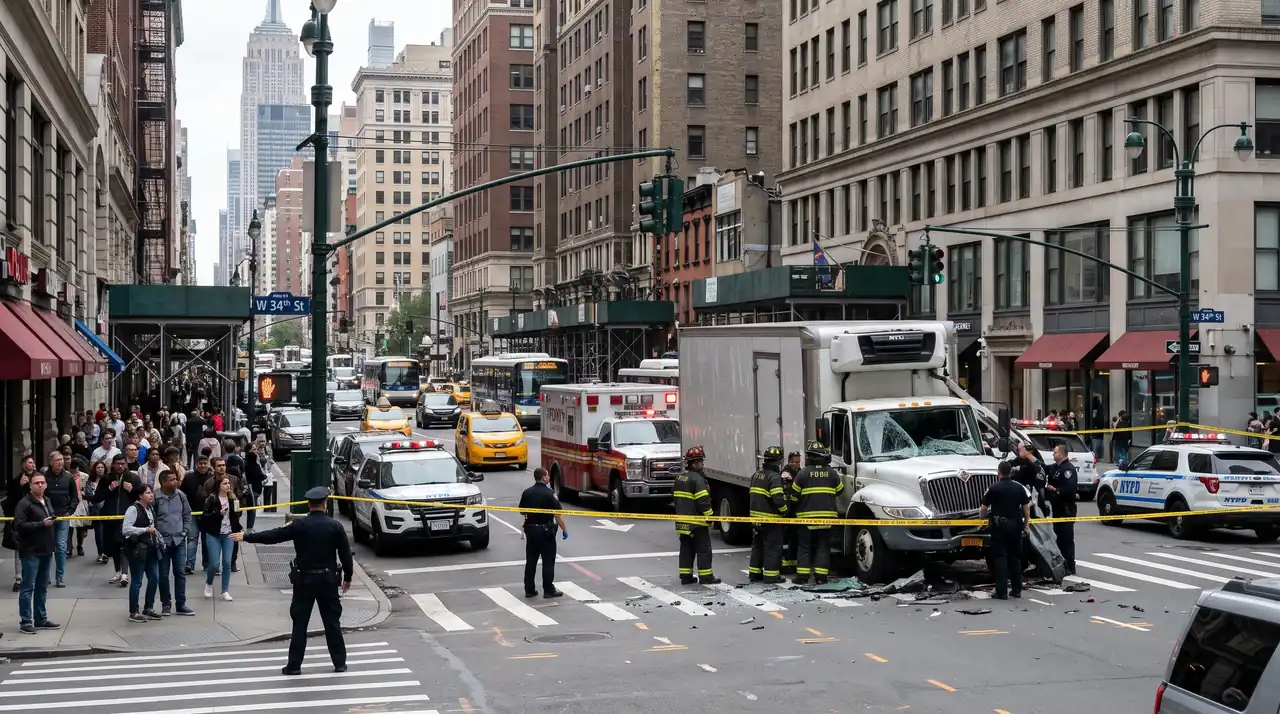
A Manhattan truck accident lawyer at Silver Law Group represents people hurt by tractor-trailers, semi trucks, box trucks and delivery vans on Manhattan streets, from the Canal Street approach to the Holland Tunnel up through Harlem. If a commercial vehicle hit you, the trucking company’s insurer has probably opened its file already, so your first call should go to someone working for you.
Truck cases work differently from car cases. More parties can be liable, federal rules limit how long the driver could legally be behind the wheel, and the most important evidence sits on the carrier’s own systems, where the law lets the carrier delete it after six months.
Call 212-470-4544 for a free consultation at any hour, in English, Spanish or Russian. You pay no fee unless you recover. If you are still in the hospital, an attorney will come to you.
Do You Have a Manhattan Truck Accident Case?
You have a claim when four elements line up and your injury meets New York’s threshold for a lawsuit.
- Duty: every truck driver and motor carrier must use reasonable care on the road and follow traffic law and federal safety rules.
- Breach: the driver ran a light, swung wide into a crosswalk or drove past the federal hours limit, or the carrier sent out a truck with worn brakes.
- Causation: the breach caused the crash and your injuries. It did not just happen alongside a condition you already had.
- Damages: medical bills, lost pay and physical harm you can document.
New York then adds a gate. Under Insurance Law 5102(d), you can sue for pain and suffering only if you have a “serious injury.” The statute lists these categories:
- death
- dismemberment or significant disfigurement
- a fracture
- loss of a fetus
- permanent loss of use of a body organ, member, function or system
- permanent consequential limitation of use of a body organ or member
- significant limitation of use of a body function or system
- a medically determined injury that kept you from substantially all of your usual daily activities for at least 90 of the 180 days after the crash
A loaded tractor-trailer weighs many times more than a sedan, so fractures are common in these crashes. A fracture qualifies on its own. Neck, back and soft-tissue injuries can also qualify, but they need proof: range-of-motion testing, imaging and a treating doctor who ties the limitation to the crash. Defense lawyers attack this threshold first. Building the medical record early is how you get past it.
Hit by a Truck as a Pedestrian or Cyclist
On October 20, 2025, a box truck crash at Eighth Avenue and West 30th Street in Chelsea injured 10 people. Eight of them were pedestrians.
Most truck-versus-pedestrian cases come back to the same two problems. The first is the wide right turn. To get a long trailer around a corner, the driver swings left or starts the turn from an inner lane, and the trailer cuts across the corner as it follows. A cyclist in the bike lane or a pedestrian at the curb ends up inside the turn. The second is the blind spot. A driver sitting high in the cab cannot see the space just in front of the bumper, a long stretch down the right side, or anything directly behind the trailer.
Neither one excuses the driver. Commercial drivers are trained on both, and a driver who turns without checking the mirrors, or without waiting for the crosswalk to clear, has breached the duty of care. If you had the walk signal or were riding in a marked bike lane, that fact sits at the center of your claim.
Where 18-Wheeler and Box Truck Crashes Happen in Manhattan
Trucks in Manhattan are allowed on certain streets only. New York City’s Truck Route Network, set out in 34 RCNY 4-13, designates the streets trucks may use and limits how far a truck may leave them to make a delivery. A redesigned network took effect on October 4, 2026, so the map in force on the date of your crash controls.
These are the corridors where route violations come up most:
- FDR Drive, where trucks are banned. A truck on the FDR is breaking the rules before anything else happens.
- Henry Hudson Parkway, where the same ban covers the West Side.
- Canal Street, where heavy truck traffic toward the Holland Tunnel runs alongside crowded Chinatown crosswalks.
- Midtown and Chelsea avenues, where box trucks double-park, make deliveries and turn across busy crosswalks all day.
A truck that was off the network, or on a parkway it was barred from, gives you evidence of negligence. The route rules exist to keep heavy vehicles off streets that were not built for them. A driver who ignored them took a risk the city had already decided was unsafe. Our 18-wheeler accident attorneys compare the truck’s GPS and logging data against the route map in effect that day. That comparison often shows why the truck was on your block at all.
Who Is Liable for a Manhattan Truck Crash
A truck crash usually has more than one defendant, and each one may carry its own insurance policy.
- The driver, for the turn, the speed, the phone or the skipped mirror check.
- The motor carrier, under respondeat superior, a rule that makes an employer answer for an employee’s negligence on the job. Carriers sometimes label drivers independent contractors. How much control the carrier actually had over routes and schedules is what we examine.
- The truck’s owner, under Vehicle and Traffic Law 388. That statute makes a vehicle’s owner liable for the negligence of anyone driving it with permission.
- The shipper or loader, if overloaded or badly secured cargo shifted and caused a rollover or a braking failure.
- The maintenance shop, if brakes, tires or lights failed after it serviced or inspected the truck.
Rental trucks are the main exception to VTL 388. The federal Graves Amendment, 49 USC 30106, blocks claims against a rental or leasing company based only on the fact that it owns the vehicle. The shield falls away when the lessor was negligent itself, for example by renting out a truck it knew had failing brakes. If the truck that hit you was a rental, the case turns on the driver, the driver’s employer and anything the rental company did wrong on its own.
Federal Trucking Rules and Evidence Preservation
Under 49 CFR 395.3, a property-carrying driver may drive no more than 11 hours, and may not drive at all after the 14th hour on duty, until taking 10 consecutive hours off. A log showing the driver was in hour 13 of a shift when the crash happened is direct evidence of fatigue.
Electronic logging devices (ELDs) record those hours automatically, along with location data at set intervals. Many trucks also carry dash cameras and telematics systems that record braking and speed. The problem is time. Under 49 CFR 395.8(k), a carrier has to keep driver logs and supporting documents for only six months. After that, it can delete them legally.
Our semi truck accident attorneys stop that clock with a preservation letter:
- You retain the firm, and the letter goes to the carrier within days.
- The letter demands that the carrier keep the ELD data, logs, dash-cam video, dispatch messages, maintenance and inspection records, and the driver’s qualification file.
- Once the carrier has that notice, destroying the records exposes it to court sanctions.
Every week you wait gives the carrier more room to argue that the data was gone before anyone asked for it.
What Your Truck Accident Claim Is Worth
No honest lawyer can value your case from a web page, and we publish no averages. The value of your claim comes from your own records, and it usually includes:
- Medical expenses, past and future, from the emergency room through surgery and physical therapy.
- Lost wages, plus lost earning capacity if you cannot go back to the same work.
- Future care, such as home health aides, mobility equipment and changes to your home.
- Pain and suffering, which opens up only after you clear the 5102(d) serious-injury threshold.
Insurance coverage matters as much as the injuries. Under 49 CFR 387.9, interstate carriers hauling general freight must carry at least $750,000 in liability coverage. That number is a federal minimum for the policy. It says nothing about what your case is worth, but it does mean a carrier usually has real coverage behind it, unlike many passenger-car crashes.
Your own conduct can reduce your recovery. New York uses pure comparative fault under CPLR 1411. If a jury finds you 20 percent responsible, for example for crossing against the signal, your award drops by 20 percent. You can still recover even if you are found mostly at fault. Expect the carrier’s lawyers to push your share as high as they can, which is one more reason the scene evidence matters.
What to Do After a Truck Accident in Manhattan
The steps you take in the first week shape the claim. In order:
- Get trauma care. Bellevue on First Avenue is the only Level I adult trauma center south of 68th Street. NewYork-Presbyterian/Weill Cornell on the Upper East Side is also Level I, and Harlem Hospital is a Level II center serving Upper Manhattan.
- Photograph the USDOT number on the cab door. It identifies the carrier in federal records, even when the truck has a different company’s name painted on the side. Get the license plate and trailer number too.
- Get the NYPD report number from the officers at the scene.
- File your no-fault application within 30 days. No-fault pays your first medical bills and part of your lost wages regardless of who caused the crash, but a late application can be denied.
- Refer the trucking company’s adjuster to your lawyer.
- Call 212-470-4544 so the preservation letter goes out.
A settlement can happen at any point on that list, and it ends the case on terms you agree to. A verdict is decided by a jury, and the losing side can appeal. Carriers base their offers partly on how prepared the other side looks for trial, so we prepare every file for trial from the start. We will not promise a timeline. Your medical treatment and the court’s calendar control it.
What a Manhattan Truck Accident Lawyer Costs
You pay nothing up front and nothing by the hour. Silver Law Group works on a contingency fee: our fee is a percentage of the money recovered for you, and it is taken only from the settlement or verdict when that money comes in. If there is no recovery, you owe no attorney’s fee.
The firm also advances the case expenses. In a truck case those can include downloading and analyzing ELD data, accident reconstruction, medical expert testimony and deposition transcripts, and they come due long before any settlement. The percentage and the handling of expenses are written into your retainer agreement before work begins, so you know the terms from the first day. Hiring a lawyer for a truck accident case should not depend on how much you have in savings.
Deadlines for Manhattan Truck Accident Claims
Several deadlines run at once, and the shortest one that applies to your case controls.
- Three years from the crash to sue for personal injury, under CPLR 214.
- Two years from the date of death to bring a wrongful death claim, under EPTL 5-4.1.
- 90 days to serve a Notice of Claim on the City under General Municipal Law 50-e, if a city vehicle such as a DSNY sanitation truck hit you.
- One year and 90 days to file suit against the City, under General Municipal Law 50-i.
The city deadlines catch people off guard. A garbage truck crash on a residential block in Harlem or on the Lower East Side feels like any other truck crash, but the 90-day notice clock starts on the day of the crash. Missing it means asking a court for permission to file late, and the court does not have to grant it. The notice also starts a separate process in which the City can question you before you sue.
The three-year limit is not the deadline that matters most in a private carrier case. The six-month log retention period and your 30-day no-fault window both close long before it. If you wait for the statute of limitations, the evidence may be gone before you file.
Why Choose Silver Law Group for Your Truck Case
Silver Law Group is a tractor-trailer accident law firm based in Midtown Manhattan. Here is what you get:
- An office at 49 West 37th Street, 7th Floor, New York, NY 10018, a short trip from anywhere in the borough.
- Consultations in English, Spanish and Russian, with no interpreter in between.
- A phone line answered 24/7, including nights after a crash.
- An attorney who comes to you at Bellevue, Weill Cornell, Harlem Hospital or your home.
- A file built for trial at 60 Centre Street from the first week.
The consultation is free, and the evidence clock is already running. Call 212-470-4544.