

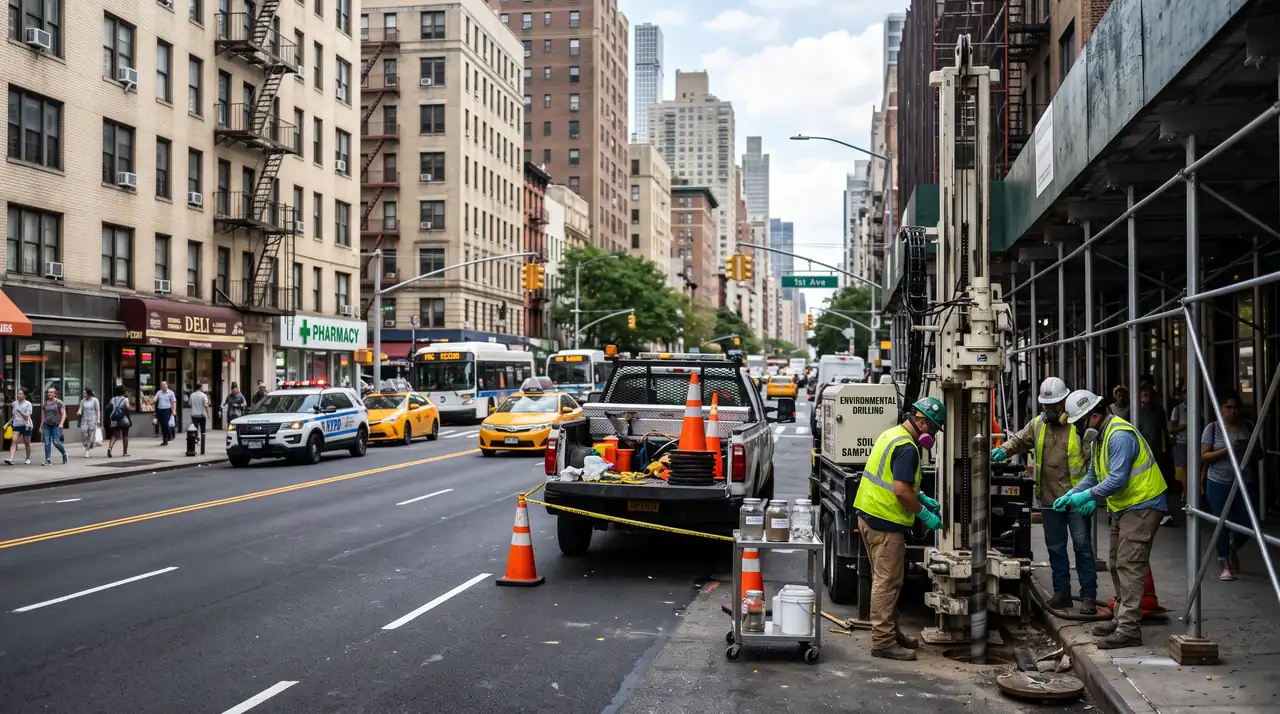
Silver Law Group’s Manhattan Toxic Tort Lawyers represent people made sick by asbestos, lead, mold, benzene, and other toxic substances found in this borough’s apartments, job sites, and streets. If a doctor has given you a diagnosis and you suspect something you breathed, touched, or swallowed caused it, call 212-470-4544 for a free consultation. You can also meet a toxic tort lawyer in person at our office at 49 West 37th Street, 7th Floor, in Midtown Manhattan. If you are too sick to travel, the attorney comes to you. Toxic exposure deadlines can start running before you know what made you sick, so calling early keeps more of your options open.
Do You Have a Toxic Tort Case in Manhattan?
A toxic tort lawyer looks for four facts before filing suit for you. If one is missing, the case stalls.
- A hazardous substance that science links to the kind of illness you have, such as asbestos fibers, lead, benzene, silica dust, or mold.
- Exposure, meaning the substance reached your body at a level and for a length of time that matters medically.
- A diagnosed illness, documented by a physician and not just suspected.
- A responsible party that owed you a duty and failed it: a landlord who ignored a leak, a contractor who cut corners on abatement, a manufacturer that sold a product without a warning.
New York law defines exposure broadly. Under CPLR 214-c(1), exposure can be direct or indirect and can happen through absorption, contact, ingestion, inhalation, implantation, or injection. That wide definition matters in Manhattan, where the route is often one people don’t notice. A toddler swallows lead dust from a windowsill. A mechanic absorbs solvents through his hands. A tenant inhales mold spores from a wall cavity for two winters before anyone opens it up.
If you can confirm three of the four elements and strongly suspect the fourth, a free review is worth your time. Investigating the missing piece is part of what a lawyer does.
Toxic Exposure Claims Our Manhattan Lawyers Handle
Most Manhattan toxic exposure cases trace back to old buildings, active construction, or fuel. These are the substances behind most of the claims we review:
- Asbestos in pipe insulation, boiler wrap, and floor tile, released when pre-war walk-ups are gutted or rewired
- Lead in paint layered on the walls of older apartments, which turns to dust at friction points like windows and doors
- Mold growing behind walls and ceilings after chronic leaks that go unrepaired
- Benzene from gasoline vapor, a daily exposure for people who work at gas stations and fuel depots
- Silica dust from cutting concrete, brick, and stone during high-rise renovations
- Pesticides applied in apartments and commercial buildings without proper ventilation or notice
- Defective chemical products, meaning cleaners, solvents, and industrial compounds sold without adequate warnings
Chemical exposure lawsuits over these substances do not all follow the same rules. Housing claims, workplace claims, and 9/11 claims each run under different laws, as the sections below explain.
Lead Paint and Mold in Manhattan Apartments
Two city laws give tenants an advantage that most toxic exposure plaintiffs don’t have: a written duty the landlord either met or didn’t.
Local Law 1 of 2004 covers buildings constructed before 1960 that contain three or more apartments. When a child under six lives in a unit, the owner must find and safely fix lead-paint hazards. Peeling paint in a pre-war Manhattan walk-up with a young child in the home is not a gray area under this law.
Local Law 55 of 2018 requires building owners to inspect for indoor allergen hazards, including mold, to remove them, and to fix the underlying cause, which usually means the leak. A landlord who paints over a stain without stopping the water has not complied.
These laws prove the landlord was careless. They do not prove the mold or lead made you sick, and courts treat those as separate questions. In Cornell v. 360 W. 51st St. Realty (2014), the Court of Appeals dismissed the claims of a Hell’s Kitchen tenant who blamed mold in her building for her illness. Her experts could not show, through accepted science, that mold exposure of that kind causes the conditions she had.
For you, the lesson from Cornell is practical. Medical proof has to be built from the start, with physicians who can connect the substance to your diagnosis. A building violation alone is not enough.
Chemical Exposure at Work and on Construction Sites
Workers’ compensation pays your medical bills and part of your lost wages after a workplace exposure, no matter who was at fault. In exchange, you generally cannot sue your own employer, and compensation pays nothing for pain and suffering.
A third-party suit fills that gap. If the chemical came from a manufacturer that failed to warn, or the exposure happened on property owned or controlled by someone other than your employer, a chemical exposure attorney can sue that party for full damages while your comp claim continues. On Manhattan construction sites, where a building owner, a general contractor, and several subcontractors share the same floor, there is often more than one party outside your employer to name.
The comp deadline works differently from the lawsuit deadline. Under Workers’ Compensation Law §28, you must file an occupational-disease claim within two years after disablement and after you knew, or should have known, that the disease came from your work. Both conditions have to be met before that two-year clock starts. Many workers don’t connect a lung condition to a job they held years earlier, and this rule is written for them.
9/11 Dust and Lower Manhattan Exposure
If you lived, worked, or went to school in Lower Manhattan after the attacks, the federal programs for 9/11 illness may cover you. The NYC Disaster Area includes Manhattan south of Houston Street. People who were there during the covered period, not only first responders, can qualify.
The September 11th Victim Compensation Fund accepts claims until October 1, 2090. Registration is a separate step with its own, earlier deadline, and that date depends on your circumstances, including when the WTC Health Program certified your condition. Missing registration can close the fund to you decades before the claim deadline.
Certification usually starts with the WTC Environmental Health Center, which serves community members at two Manhattan sites: Bellevue and Gouverneur. A certified condition from the WTC Health Program supports your VCF claim. Your lawyer can work with that medical file rather than starting a new one.
Who Is Liable for Toxic Exposure in Manhattan
Toxic exposure cases often have more than one defendant, and each one may carry a different share of the blame. These are the parties who most often answer for the harm:
- Landlords and managing agents who leave leaks, lead paint, or crumbling asbestos in place
- Manufacturers and distributors of products that release toxic chemicals or fibers
- Contractors and subcontractors who disturb hazardous materials without containment
- Utilities whose infrastructure fails and releases hazardous material into public space
The last category is not hypothetical. On July 19, 2018, a utility steam pipe burst at Fifth Avenue and East 21st Street in the Flatiron District and released asbestos into the surrounding streets and buildings. People in the area had done nothing but be nearby.
New York has a rule under CPLR Article 16 that can shrink what you collect. Normally, a defendant found 50 percent or less at fault pays only its proportional share of your non-economic damages, such as pain and suffering. If the most responsible party can’t pay, you absorb the loss.
Two exceptions matter in toxic tort litigation. CPLR 1602(9) removes the limit for any party held liable for unlawfully releasing a hazardous substance into the environment, so that defendant can be made to pay the full amount. CPLR 1602(10) applies in product cases where the manufacturer is not a party and could not be brought into a New York court with due diligence. A defendant still in the case can then be held responsible for the manufacturer’s share. Your lawyer decides which defendants to name with these exceptions in mind.
Proving the Chemical Caused Your Illness
Causation is where most toxic tort cases are won or lost. You have to prove two things: that the substance can cause your disease, and that your exposure did cause it. Defense lawyers attack the second point hardest, usually by arguing your dose was too small.
The Court of Appeals set the standard in Parker v. Mobil Oil (2006), a case brought by a gas station attendant who developed leukemia and blamed the benzene in gasoline. The court held that experts do not have to measure your exposure with mathematical precision, since almost no one has air-monitoring data from their own past. Experts do have to express the level of exposure in a scientifically valid way, using methods other scientists accept, such as comparing your job tasks to studied groups of workers. The experts in Parker failed that test, and the claim did not survive.
In practice, your case depends on the quality of your exposure history. Where did you work, for how long, doing what tasks, with what ventilation and protective gear? Which building did you live in, which rooms, and during which years? A toxic exposure attorney collects these details early, while coworkers can still be found and records still exist.
Occupational medicine physicians create the kind of record that holds up. The Mount Sinai Selikoff Centers for Occupational Health, at 1468 Madison Avenue, diagnose work-related illness and record detailed exposure histories. Records like these give your experts something concrete to build on, and Parker shows that experts without that foundation fail.
What Your Toxic Exposure Claim Is Worth
No honest lawyer can give you a number at the first meeting. What we can do is show you what the claim is built from. A toxic exposure claim can include:
- Medical costs already paid or billed, including testing and specialist care
- Lost earnings, past and future, if the illness forced you to cut hours or stop working
- Future care, such as ongoing treatment, medication, and home help as the disease progresses
- Pain and suffering, covering physical pain, loss of normal life, and the fear that comes with a serious diagnosis
Your own conduct does not end the case. CPLR 1411 sets a pure comparative fault rule: if a jury finds you partly responsible, your award is reduced by your percentage and is not barred. A worker found 20 percent at fault for skipping a respirator still recovers 80 percent of the damages.
Three factors move value more than anything else. The first is disease severity: a progressive, fatal cancer is valued differently from asthma that improves once you move out. The second is latency. A disease that appears decades after exposure can mean older evidence, but it can also mean years of future care that must be paid for. The third is the number of defendants. Several responsible parties usually means more insurance coverage, and the Article 16 rules above decide how the shares are divided.
Asbestos cases follow a separate track. The New York City Asbestos Litigation docket, known as NYCAL, sits in New York County Supreme Court and handles asbestos cases with any connection to New York City. A firm that knows the NYCAL schedules and procedures moves your case through that docket faster than one learning it on your file.
What a Toxic Tort Lawyer Costs
Silver Law Group handles toxic tort cases on a contingency fee. You pay no fee unless you recover. If the case succeeds, our fee is a percentage of the settlement or verdict, taken from that recovery and never billed to you up front or by the hour. Toxic cases often require expensive experts and testing. The written retainer you sign at the start sets out how those case expenses are handled, so you know the terms before any work begins. If there is no recovery, there is no fee.
Deadlines for Manhattan Toxic Tort Claims
Toxic exposure claims in New York run on discovery-based deadlines, because the disease may appear years after the exposure. Each clock below is separate, and the shortest one that applies controls your case.
- Three years under CPLR 214-c, counted from the date you discovered your injury or should reasonably have discovered it, not from the date of exposure.
- One extra year under CPLR 214-c(4) if you learn the cause of your illness later. You must discover the cause within five years of discovering the injury, and you must show that the technical, scientific, or medical knowledge needed to identify the cause was not available earlier.
- Two years from the date of death under EPTL 5-4.1, if a family member died from the exposure and the estate brings a wrongful death claim.
- 90 days to serve a Notice of Claim under General Municipal Law 50-e when the City of New York or another public entity is responsible.
- One year and 90 days to file the lawsuit itself against that public entity under GML 50-i.
The public-entity deadlines catch people most often. A tenant in a city-owned building, or someone exposed by a city agency’s work, can lose the claim by missing the 90-day notice even though the three-year private deadline is still open.
Deciding exactly when your injury was discovered can be disputed. Defendants will argue for the earliest possible date, often a first complaint of symptoms in an old chart. Bring your medical history to the first consultation so your lawyer can work out which deadline applies and how much time is left.
Why Manhattan Clients Choose Silver Law Group
Insurers pay closer attention when the other side is ready to try the case. We prepare every toxic exposure claim for a New York County jury from the first day. That means retaining the experts and building the exposure history from the start, before any settlement talks.
How we work with you:
- If mesothelioma or another illness keeps you home, the attorney comes to your apartment or your hospital room.
- Intake runs 24/7, so a call after a diagnosis on a Sunday night gets answered.
- Consultations are available in English, Spanish, and Russian, without an interpreter between you and your lawyer.
- Our office at 49 West 37th Street, 7th Floor, is in Midtown Manhattan, a short trip from most of the borough.
Call 212-470-4544 for a free consultation. Bring your diagnosis, a list of the places you have lived and worked, and any letters from an insurer or landlord.