

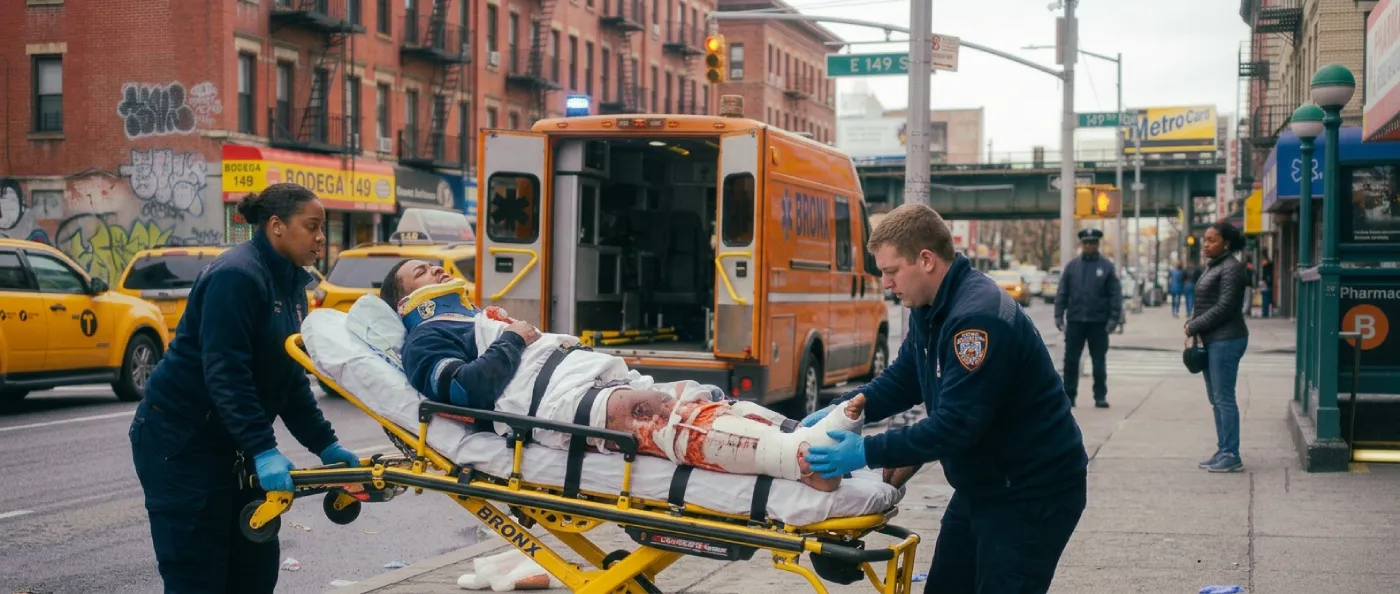
Do You Have a Pedestrian Accident Case in the Bronx?
Most pedestrians struck by vehicles in the Bronx have a valid claim against the at-fault driver. The key question is whether someone else’s negligence caused your injury — and in the vast majority of strikes, the answer is yes.
Your case is likely valid if any of the following apply:
- A driver ran a red light or failed to yield at a crosswalk
- You were struck while walking in a marked pedestrian zone
- A distracted or speeding driver hit you at an intersection
- A commercial truck, delivery vehicle, or bus was involved
- The accident happened due to a road defect or poor signage
- You were hit in a parking lot or driveway
New York law does not require you to be 100% fault-free to recover compensation. Even if you were crossing mid-block, a lawyer for pedestrian hit by car can still build a strong case if the driver bore most of the fault.
Who Can Be Held Liable for Your Injuries?
Liability may extend well beyond the individual driver. Multiple parties can share responsibility for a single pedestrian accident.
Potentially liable parties include:
- The driver — for speeding, distraction, impairment, or failure to yield
- The driver’s employer — if the driver was on the job at the time
- The City of New York — for dangerous road conditions, broken signals, or missing crosswalk markings
- The MTA — if a bus or MTA-operated vehicle struck you
- A property owner — if a parking lot or private road created the hazard
- A vehicle manufacturer — in brake failure or defect cases
When the City of New York or MTA Is Responsible
Government entities require a different legal process. A Notice of Claim must be filed within 90 days of the accident — not 3 years. Miss that window and your claim against the City or MTA is permanently barred, regardless of how serious your injuries are.
If an NYPD vehicle, city bus, sanitation truck, or MTA bus struck you, contact an attorney immediately. The 90-day clock starts on the date of the accident, not the date you realize you have a claim.
Hit-and-Run and Uninsured Driver Claims
A driver fleeing the scene does not mean you have no options. New York’s Motor Vehicle Accident Indemnification Corporation (MVAIC) provides a recovery path for pedestrians struck by:
- Uninsured drivers
- Hit-and-run drivers who were never identified
- Stolen vehicles
MVAIC claims have strict eligibility rules and filing requirements. A pedestrian accidents attorney can determine whether you qualify and handle the filing on your behalf.
Common Causes of Bronx Pedestrian Accidents
Failure to yield at intersections is the leading cause of pedestrian injuries in the Bronx, followed closely by distracted driving and speeding. These aren’t freak accidents — they follow predictable patterns.
Common causes include:
- Failure to yield at crosswalks, turning corners, or exiting parking lots
- Distracted driving — phone use, GPS, food, or passenger distraction
- Speeding in residential zones, school zones, and near transit stops
- Running red lights or stop signs
- Driving under the influence of alcohol or drugs
- Backing up without checking for pedestrians in driveways or lots
- Aggressive driving — sudden acceleration or illegal turns
- Poor visibility conditions — no headlights, obstructed sightlines
Each of these causes has a corresponding theory of negligence. Your attorney documents which one — or which combination — applies to your case.
Most Dangerous Streets and Intersections in the Bronx
The Bronx consistently ranks among New York City’s most dangerous boroughs for pedestrian fatalities. Certain corridors account for a disproportionate number of injuries.
High-risk locations include:
- Grand Concourse — heavy traffic volume, frequent failure-to-yield crashes
- Fordham Road — high pedestrian density near transit hubs and retail
- Jerome Avenue — elevated train structure creates visibility problems
- Webster Avenue — speeding and red-light violations reported consistently
- East Tremont Avenue
- Boston Road
- Gun Hill Road
- Third Avenue near Melrose and Mott Haven
If your accident occurred at any of these locations, documented crash history at that site can strengthen your case. Pedestrian accident law firms use prior incident records to establish that a dangerous condition was known — or should have been known — before your accident.
Injuries Pedestrians Typically Suffer After a Bronx Accident
A pedestrian has no protection against a 3,000-pound vehicle. Injuries in these accidents are severe, often permanent, and generate months or years of medical costs.
Common injuries include:
- Traumatic brain injury (TBI) — from head striking pavement, hood, or windshield
- Spinal cord injuries — herniated discs, nerve damage, partial or full paralysis
- Pelvic and hip fractures — frequent in lower-body vehicle contact
- Leg and ankle fractures — often requiring surgery and hardware
- Internal organ damage — liver, spleen, kidney injuries from blunt force
- Soft tissue injuries — torn ligaments, rotator cuff, knee damage
- Lacerations and road rash — requiring skin grafts in severe cases
- Psychological trauma — PTSD, anxiety, and phobia following impact
Many of these injuries are not immediately apparent. A head CT may look normal while a brain bleed develops. This is one reason why seeking medical care immediately — even if you feel okay — directly protects your legal claim.
What Compensation Can You Recover?
Injured pedestrians in New York may recover two categories of damages: economic losses with documented dollar values, and non-economic losses like pain and suffering.
Economic damages include:
- Emergency room and hospital costs
- Surgery, hardware, and follow-up procedures
- Physical and occupational therapy
- Prescription medications and medical equipment
- Lost wages during recovery
- Reduced future earning capacity if disability is permanent
- In-home care or assistance
Non-economic damages include:
- Pain and suffering
- Emotional distress and trauma
- Loss of enjoyment of life
- Permanent disfigurement or scarring
- Loss of consortium (impact on family relationships)
How New York No-Fault Insurance Affects Your Claim
New York is a no-fault state. This means your own auto insurance — or the driver’s no-fault coverage — pays your initial medical bills up to $50,000, regardless of who caused the accident. That sounds helpful. It comes with a critical limitation.
No-fault insurance does not compensate you for pain and suffering. To pursue those damages — which are often the largest part of a pedestrian injury claim — you must meet New York’s “serious injury” threshold:
- Significant disfigurement
- Bone fracture
- Permanent limitation of use of a body organ or member
- Significant limitation of use of a body function or system
- A medically determined injury preventing you from performing substantially all daily activities for 90 of the first 180 days after the accident
Most pedestrians struck by vehicles meet this threshold. Your attorney documents the medical evidence needed to establish it.
How Much Is a Bronx Pedestrian Accident Case Worth?
There is no average settlement number that applies to all cases. Settlement value depends on specific factors that vary with every claim.
Factors that increase case value:
- Severity and permanence of injury — spinal cord damage, TBI, amputation
- High pre-accident income — lost earning capacity multiplies economic damages
- Clear liability — red-light camera footage, witnesses, police report
- Egregious conduct — DUI driver, road rage, multiple prior violations
- Young victim — decades of future losses compound the total
Factors that reduce case value:
- Shared fault on the pedestrian’s part (jaywalking, phone use while crossing)
- Gaps in medical treatment or delayed care
- Pre-existing conditions affecting the same body parts
- Limited insurance coverage on the at-fault vehicle
New York’s comparative negligence rule means shared fault reduces your recovery proportionally — it does not eliminate it. A pedestrian found 20% at fault recovers 80% of proven damages.
What to Do Immediately After a Bronx Pedestrian Accident
The steps you take in the first 24 hours directly affect what you can recover. Evidence disappears fast — skid marks wash away, witnesses scatter, and surveillance footage gets overwritten within 24–72 hours.
- Call 911 — get police on scene; a police report documents the collision
- Get medical attention immediately — even if symptoms are mild; document everything
- Photograph everything at the scene — vehicle, license plate, road conditions, your injuries, skid marks, traffic signals
- Get driver information — name, license, insurance, vehicle registration
- Collect witness contacts — names and phone numbers before they leave
- Do not give a recorded statement to any insurance company without a lawyer
- Do not accept any settlement offer before understanding the full extent of your injuries
- Contact a pedestrian injury lawyer — the earlier, the better for evidence preservation
If you were too severely injured to do any of this, it does not bar your claim. Your attorney can still investigate and reconstruct the accident.
Steps a Bronx Pedestrian Injury Lawyer Takes on Your Case
Your case involves more than filing paperwork. A pedestrian accidents lawyer builds a record that insurance companies and juries find difficult to dispute.
Here is what Silver Law Group does after you hire them:
- Investigate the accident scene — visit the location, photograph conditions, identify camera positions
- Obtain surveillance footage — subpoena traffic cameras, business cameras, and MTA footage before it’s deleted
- Secure the police report and request additional NYPD records
- Retain accident reconstruction experts if liability is contested
- Gather and preserve medical records documenting every injury, treatment, and prognosis
- Obtain a medical expert opinion on future care costs and long-term impact
- Document lost income with employer verification and tax records
- Handle all insurance communications — so adjusters cannot pressure you into an early low offer
- Negotiate a full settlement or file suit and litigate if the offer is inadequate
- Resolve any medical liens so you receive the maximum net recovery
You focus on recovery. Every case starts with a free consultation — no obligation, no fee unless Silver Law Group recovers for you.
How Long You Have to File a Bronx Pedestrian Injury Claim
New York’s statute of limitations for personal injury gives you 3 years from the date of the accident to file a lawsuit. Miss that deadline and your case is dismissed — permanently, regardless of how serious your injuries are.
Critical exceptions that shorten the deadline:
- Claims against the City of New York or MTA — Notice of Claim required within 90 days
- Claims on behalf of a deceased victim — wrongful death must be filed within 2 years
- Claims involving minors — the clock may toll until the child turns 18, but government claim rules still apply
Do not assume you have time. Evidence degrades. Witnesses become unavailable. Insurance companies use delay to their advantage. The sooner an attorney investigates, the stronger the evidence record.
What It Costs to Hire a Bronx Pedestrian Accident Lawyer
Silver Law Group handles pedestrian injury cases on a contingency fee basis. You pay no attorney fees unless and until they recover compensation for you. There are no upfront costs, no hourly bills, and no retainer.
If Silver Law Group does not recover money for your case, you owe nothing.
Consultations are free, available in English, Spanish, and Russian, and can take place in person, by phone, or virtually.