

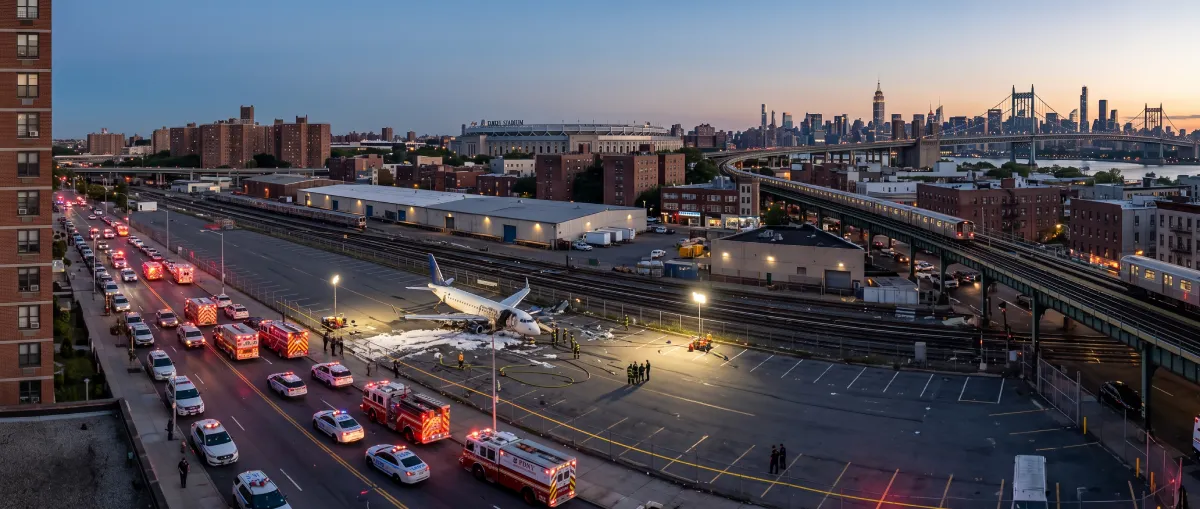
A Bronx aviation accident lawyer handles some of the most legally complex injury cases in New York — and the stakes are almost always catastrophic. If you were hurt in a plane crash, helicopter accident, or any aviation-related incident, Silver Law Group can investigate who caused it, identify every party responsible, and fight to recover every dollar your injuries cost you. Silver Law Group works on contingency: you pay no legal fees unless we recover money for you. Your first consultation is free.
Do You Have a Case After a Bronx Aviation Accident?
Not every aviation incident results in a lawsuit — but most serious injuries do qualify. The question is who was negligent and how that negligence caused your harm.
You may have a claim if you were injured as:
- A passenger on a commercial airline
- A passenger on a charter or private plane
- A helicopter passenger or crew member
- A bystander injured by a crash or debris
- A family member of someone killed in an aviation accident
You do not need to prove the pilot intentionally caused the crash. Aviation accident claims are built on negligence — meaning someone had a duty to keep you safe, failed that duty, and that failure caused your injuries. That standard applies whether the at-fault party is an airline, a maintenance contractor, or an aircraft manufacturer.
One call can tell you whether you have a case. You don’t need to have all the answers before reaching out.
Who Can Be Held Liable for Your Aviation Accident?
Aviation accidents rarely have a single cause. Multiple parties — each with their own lawyers and insurers — may share fault.
Potentially liable parties include:
- The airline or aircraft operator — for crew negligence, inadequate training, or operational failures
- The pilot or flight crew — for errors in judgment, improper procedures, or impaired performance
- Aircraft manufacturers — for defective designs or faulty components
- Maintenance companies — for improper repairs or failure to catch mechanical problems
- Air traffic controllers — for routing errors, communication failures, or incorrect instructions
- Airport operators — for unsafe ground conditions or inadequate safety infrastructure
- Fuel suppliers or third-party contractors — for errors that contribute to mechanical failure
Identifying all liable parties matters because it directly affects the total compensation available to you. Suing one defendant when three are responsible means leaving money on the table.
Federal Oversight and How It Affects Your Claim
The Federal Aviation Administration (FAA) sets mandatory safety standards for every aspect of U.S. aviation — pilot certification, aircraft maintenance, air traffic procedures, and more. The National Transportation Safety Board (NTSB) investigates accidents and issues official findings.
When a pilot, airline, or maintenance crew violates FAA regulations, that violation is direct evidence of negligence in your civil case. An experienced airplane accident attorney knows how to use those federal records — including NTSB accident reports, FAA inspection histories, and maintenance logs — to build your claim.
Federal preemption rules can also limit certain state-law claims against airlines. Understanding which laws apply to your specific case requires a lawyer who handles aviation claims, not just general personal injury.
When the Manufacturer or Maintenance Crew Is at Fault
Mechanical failure accounts for a significant percentage of aviation accidents. When it does, liability may fall entirely outside the airline.
- A manufacturer may be liable if a defective part — a faulty sensor, a failed hydraulic component, or a flawed design — contributed to the accident.
- A maintenance company may be liable if improper repairs, missed inspections, or the use of substandard parts caused a mechanical failure.
These are product liability and contractor negligence claims, not standard airline litigation. They involve different defendants, different legal theories, and often different insurance coverage. Your attorney must identify these chains of responsibility early, before evidence is lost or altered.
Common Causes of Aviation Accidents in New York
Every aviation accident investigation starts with the same question: what went wrong, and who was responsible for preventing it?
The most frequently cited causes include:
- Pilot error — improper responses to weather, mechanical issues, or air traffic instructions
- Mechanical failure — engine problems, hydraulic failures, landing gear malfunctions
- Air traffic control error — incorrect routing, missed radio communication, or improper sequencing
- Inadequate maintenance — missed inspections, improper repairs, or unauthorized part substitutions
- Weather-related negligence — flying into known dangerous conditions against protocol
- Runway and airport hazards — debris, lighting failures, or surface defects
- Overloading or improper weight distribution — especially common in charter and private plane accidents
- Fuel contamination or improper fueling — a maintenance error with catastrophic consequences
A private plane accident lawyer investigates these causes using black box data, maintenance records, air traffic communications, weather data, and witness statements. The earlier an attorney is involved, the better chance there is of preserving that evidence.
Injuries Victims Commonly Suffer in Aviation Accidents
Aviation accidents produce some of the most severe injuries seen in personal injury law. The forces involved — sudden deceleration, fire, structural collapse, pressurization failure — cause injuries that affect victims for life.
Common injuries include:
- Traumatic brain injuries (TBI) — from impact, pressure wave, or oxygen deprivation
- Spinal cord damage — including partial or complete paralysis
- Crush injuries and fractures — from structural collapse or violent impact
- Severe burns — from fire, fuel ignition, or electrical failure
- Smoke inhalation and lung damage — chemical exposure in cabin fires
- Lacerations and amputations — from debris, shattered materials, or mechanical contact
- Post-traumatic stress disorder (PTSD) — common among survivors; recognized as a compensable injury in New York
- Internal organ damage — from blunt force trauma or rapid decompression
Even injuries that seem manageable at the scene can evolve into permanent disability. Medical bills for serious aviation injuries routinely run into the hundreds of thousands of dollars — before long-term rehabilitation, lost income, and ongoing care are factored in.
What Compensation Can You Recover?
New York law allows aviation accident victims to pursue full compensation for every economic and non-economic loss caused by someone else’s negligence.
Recoverable damages include:
- Past and future medical expenses — emergency care, surgery, hospitalization, rehabilitation, long-term treatment
- Lost wages — income you could not earn while injured and recovering
- Lost earning capacity — if your injuries permanently reduce your ability to work
- Pain and suffering — physical pain and emotional distress caused by the accident and recovery
- Disability and disfigurement — permanent changes to your body and how you live
- Wrongful death damages — available to surviving family members who lost a loved one
There is no cap on compensatory damages in New York aviation cases involving private parties. The full scope of your losses — economic and human — is on the table.
How Settlement Amounts Are Calculated in Aviation Cases
Settlement value in aviation accident cases is driven by several concrete factors:
- Injury severity — the more serious and permanent the injury, the higher the potential recovery
- Liability clarity — cases with clear, documented negligence settle for more than disputed-fault cases
- Number of defendants — multiple responsible parties mean multiple sources of insurance coverage
- Federal vs. state law — some federal statutes cap certain damages; others do not apply at all
- Future cost of care — a life-care planner’s report projecting long-term medical needs significantly increases case value
- Lost income documentation — tax records, employment history, and expert testimony establish economic losses
Insurance companies for airlines and manufacturers have experienced adjusters whose job is to minimize what they pay you. An airline accident attorney levels that playing field.
Filing Deadlines You Cannot Afford to Miss
New York has hard deadlines for aviation accident lawsuits. Miss them, and your right to sue is gone permanently — regardless of how strong your case is.
Key deadlines:
- 3 years from the date of injury to file a personal injury lawsuit (CPLR §214)
- 2 years from the date of death to file a wrongful death claim (EPTL §5-4.1)
- 90 days to file a notice of claim if a government entity (like the Port Authority) is involved
- International flights may be governed by the Montreal Convention, which imposes separate notice and filing requirements
Three years sounds like a long time. It is not. Aviation investigations take months. Finding all liable parties takes months. Building a damages case takes months. Attorneys who handle aviation claims know that waiting until year two creates unnecessary risk.
If a government-operated airport or federal agency is involved, the 90-day notice requirement is absolute. Missing it bars your claim against that defendant entirely.
How the Investigation Process Works in Aviation Cases
Aviation accident cases are not investigated like car accident cases. The process is longer, more technical, and involves multiple overlapping authorities.
Your attorney works in parallel with the government investigation — not after it. Waiting for the NTSB report before hiring a lawyer is one of the most common and costly mistakes aviation accident victims make.
Steps to Take Immediately After an Aviation Accident
The actions you take in the first days after an aviation accident directly affect your case.
Do these things:
- Get medical care immediately — even if you feel fine. Adrenaline masks pain. Some injuries — including brain trauma and internal bleeding — appear hours or days later. A medical record created at the scene is essential evidence.
- Document everything you can — photos of the scene, your injuries, your belongings. Write down what happened while it is fresh.
- Keep every document — boarding passes, tickets, baggage claim stubs, hospital bills, prescription receipts, and any communication from the airline.
- Record witness information — names and contact details of anyone who saw the accident or its aftermath.
- Note any statements made by airline or airport staff — write them down word for word.
Do not do these things:
- Do not give a recorded statement to any insurance company before speaking with an attorney. Adjusters use recorded statements to limit your claim.
- Do not accept any early settlement offer. A fast offer from an airline’s insurer is designed to close your claim before you know the full extent of your injuries or your legal rights.
- Do not sign any release or waiver presented by the airline or its representatives.
Insurance companies move fast after aviation accidents. So should you — in the opposite direction.
Why Aviation Accident Cases Require a Specialist
Aviation accident cases are categorically different from standard personal injury claims.
They involve:
- Federal regulations (FAA, DOT) that govern airline operations, pilot standards, and aircraft maintenance
- International treaties (Montreal Convention, Warsaw Convention) that apply to international flights and affect what damages you can claim
- Multiple defendants across multiple industries — airlines, manufacturers, maintenance contractors, air traffic authorities
- Complex causation that requires engineering experts, accident reconstructionists, and aviation safety specialists
- Long investigation timelines that demand early evidence preservation and parallel legal action
- Large institutional defendants with experienced in-house legal teams and significant litigation budgets
A general personal injury lawyer who occasionally handles aviation cases is not the same as an airplane injury law firm that focuses on these claims. Aviation defendants know the difference — and they adjust their litigation strategy accordingly.
Silver Law Group has the resources and experience to go up against airlines, manufacturers, and their insurers. Your case will not be handed to a paralegal.
No Fee Unless We Win Your Case
Silver Law Group represents Bronx aviation accident victims on a contingency fee basis. That means:
- No retainer required
- No hourly billing
- No legal fees of any kind unless we recover compensation for you
- If we do not win, you owe us nothing
This model exists because serious aviation injuries should not require you to have money in the bank before you can fight for justice. You are already dealing with medical bills and lost income. Legal fees should not be another obstacle.
Every case begins with a free consultation — in English, Spanish, or Russian. You describe what happened. We tell you what it may be worth and what your next steps are. No obligation.
Call Silver Law Group today. The sooner you act, the more we can do to protect your case.