

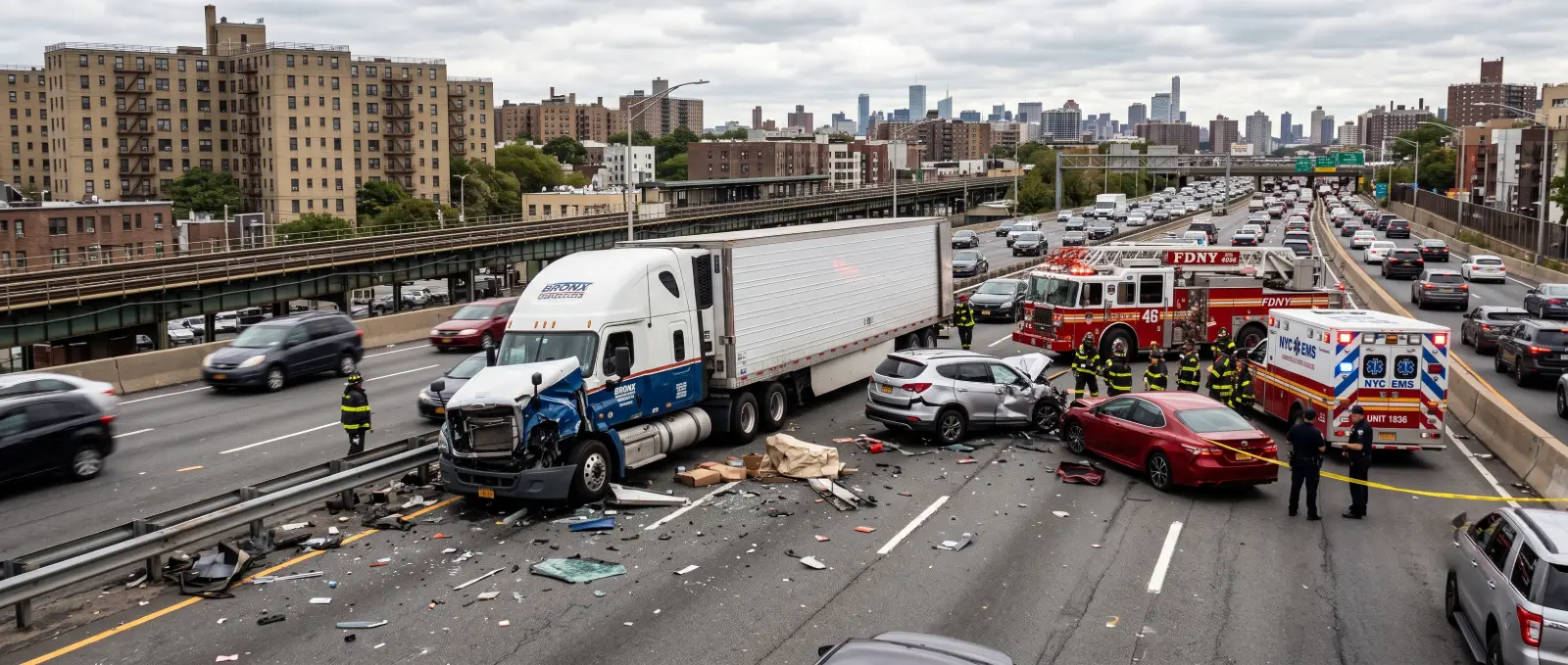
A Bronx truck accident lawyer at Silver Law Group can tell you exactly what your case is worth — before you sign anything or accept a dime from an insurer. If you were hurt in a collision with a commercial truck, the law gives you the right to recover medical bills, lost wages, and long-term care costs. The question is whether you have the right team working that claim before evidence disappears.
Silver Law Group takes no fee unless they recover money for you. There is no hourly rate, no retainer, no upfront cost. You call, you learn what your case is worth, and you decide whether to move forward.
Why Bronx Truck Accidents Are Different From Car Accidents
Commercial trucks create legal complexity that standard car accident cases simply do not involve.
A collision between a passenger car and an 80,000-pound tractor-trailer is not just physically different — it is legally different. Truck crashes involve:
- Federal regulations under the FMCSA that govern driver hours, vehicle weight, load limits, and inspection records
- Multiple potentially liable parties beyond the driver — companies, cargo loaders, manufacturers, and leasing entities
- Black box data, hours-of-service logs, and maintenance records that exist in truck cases and not in car cases
- Insurance policies that can exceed $1 million — and insurers with dedicated legal teams activated within hours of a crash
- Evidence that begins to disappear fast, sometimes within days
An attorney experienced with 18 wheeler accident cases knows which records to demand, which federal rules apply, and which parties to name before the window closes.
Who Can Be Held Liable After a Bronx Truck Crash
Multiple parties — beyond just the driver — often share legal responsibility for a single collision.
Truck accident claims regularly involve more than one defendant. Identifying all of them is one of the most consequential decisions your attorney makes early in your case.
The Trucking Company’s Role in Your Claim
The company employing or contracting the driver may bear direct liability for:
- Pressuring drivers to exceed legal hours-of-service limits
- Skipping required vehicle inspections or delaying known repairs
- Hiring drivers with prior moving violations or disqualifying history
- Failing to train drivers adequately for the routes or cargo they handle
Under a legal doctrine called respondeat superior, employers can be held responsible for the negligence of employees acting within the scope of their job. Even independent contractors may qualify depending on how the company controlled the work relationship.
Third Parties You May Not Have Considered
Several other parties are frequently liable in truck crashes but rarely investigated without an attorney’s push:
- Cargo loading companies — improperly secured or overweight loads cause rollovers, jackknifes, and catastrophic shifts
- Parts manufacturers — defective brakes, tires, or steering systems can create strict product liability claims
- Leasing and maintenance contractors — third-party companies responsible for upkeep may share fault for mechanical failures
- Government entities — if a dangerous road condition contributed, a municipality may carry partial liability
Common Causes of Truck Accidents on Bronx Roads
Federal hours-of-service violations, distracted driving, and unsecured cargo are among the leading causes — and each one creates a specific evidentiary trail your attorney will pursue.
- Driver fatigue — FMCSA rules limit how long a driver can operate before mandatory rest. Violations appear in electronic logging device (ELD) data
- Distracted driving — phone records, cab camera footage, and GPS data document exactly what a driver was doing at impact
- Speeding and aggressive driving — black box data records speed, braking, and steering inputs in the seconds before a crash
- Improper lane changes — large trucks have significant blind spots; failure to check mirrors properly is a documented cause of sideswipe and merge crashes on the Cross Bronx
- Brake or tire failure — mechanical failures that stem from skipped maintenance create direct claims against the company or its contractors
- Overloaded or unsecured cargo — loads that shift in transit destabilize a truck at highway speed and fall within the cargo handler’s chain of liability
- Driving under the influence — drug and alcohol testing is federally required after serious crashes; results must be preserved
Bronx-Specific Factors That Affect Your Case
The Bronx is not a generic New York borough for truck accident purposes. Local infrastructure creates specific negligence evidence opportunities.
- Designated truck routes — New York City restricts commercial truck travel to specific corridors. A truck outside those routes without a permit is operating illegally, which may constitute per se negligence
- Parkway restrictions — the Bronx River Parkway and other limited-access roads prohibit commercial trucks over a certain weight. Violations are documentable from tollway and camera records
- High-density intersections — the Cross Bronx Expressway, I-278, and the Bruckner Expressway carry heavy freight traffic through one of the most congested urban environments in the country
- NYPD and DOT records — local crash reports, inspection records, and prior violations on specific corridors can support pattern-of-negligence arguments
Injuries Commonly Sustained in Bronx Truck Accidents
The size disparity between commercial trucks and passenger vehicles makes catastrophic outcomes far more likely than in car-to-car collisions.
Injuries seen in commercial truck crashes include:
- Traumatic brain injuries (TBI) — ranging from concussion to severe TBI with permanent cognitive effects
- Spinal cord injuries — including partial or complete paralysis requiring lifetime care
- Herniated and bulging discs — often requiring surgery, physical therapy, and resulting in chronic pain
- Broken bones — pelvis, femur, ribs, and facial fractures are common at high-impact speeds
- Internal organ damage — blunt force trauma from intrusion damage or seat belt loading
- Crush injuries and amputations — particularly in underride crashes where a smaller vehicle slides beneath the truck
- Severe burns — fuel tank ruptures after impact
Many of these injuries are not immediately apparent. Adrenaline suppresses pain. MRI and CT scans ordered 48–72 hours after a crash frequently reveal injuries that felt minor at the scene.
What Your Bronx Truck Accident Claim May Be Worth
Case value depends on injury severity, lost income, long-term care needs, and available insurance coverage — not on what an adjuster first offers you.
Economic damages (calculable losses):
- All past and future medical bills: emergency care, surgery, rehabilitation, medication, assistive devices
- Lost wages from time missed at work
- Diminished earning capacity if your injuries limit you permanently
- Cost of future medical care, including home health aides and long-term therapy
Non-economic damages (real losses without a receipt):
- Physical pain and suffering
- Emotional distress and psychological trauma, including PTSD
- Loss of enjoyment of life
- Loss of consortium — the effect your injuries have on your family relationships
Commercial trucking policies often carry $1 million or more in liability coverage. That does not mean insurers pay willingly. It means the stakes are high enough that their legal team starts working against your claim immediately.
The first settlement offer from an insurer is almost never the correct number. It is a number designed to close your case before you know what it is actually worth.
What to Do Immediately After a Truck Accident in the Bronx
Early actions — including preserving black box data — directly affect the strength of your legal case.
At the scene (if physically able):
- Call 911 — get police on-site and demand a crash report number
- Document everything: photos of all vehicles, road markings, skid marks, signage, and your injuries
- Get the truck’s DOT number, license plate, and the driver’s commercial license information
- Collect names and contact information from all witnesses
- Do not make statements about fault to anyone except police
After the scene:
- Seek medical evaluation immediately — even if you feel fine
- Follow all treatment recommendations and document every appointment
- Do not speak with the trucking company’s insurer or accept any settlement offer
- Contact a lawyer for truck accident cases before giving a recorded statement
Why Trucking Companies Move Fast and You Must Too
Corporate rapid-response teams begin protecting their interests within hours of a crash occurring.
Large carriers and their insurers deploy accident response teams — sometimes called “go teams” — who arrive at crash scenes while victims are still in the emergency room. Their job is to:
- Document the scene in ways that favor the company
- Preserve or discard evidence on a schedule that protects their client
- Contact witnesses before your attorney can
Black box data — technically the Electronic Control Module (ECM) — records speed, braking, engine RPM, and other critical data in the 30 seconds before impact. That data can be overwritten by normal truck operation within days. A spoliation letter from your attorney, demanding preservation, must go out immediately.
How New York’s Comparative Fault Rule Affects Your Recovery
Even if you share partial blame, New York law still allows you to collect a proportionate damages award.
New York follows a pure comparative negligence rule. If you are found 20% at fault for a crash, your recovery is reduced by 20% — but you still recover the remaining 80%. You are not barred from recovery unless you are 100% responsible.
This matters because:
- Trucking companies and their insurers routinely argue that the victim shares blame
- Adjuster tactics often include leading questions in recorded statements designed to elicit admissions
- The more clearly your attorney documents the truck driver’s and company’s fault, the smaller any comparative fault reduction becomes
Do not let an insurer’s claim that you were “partially at fault” end your pursuit of a claim.
Deadlines for Filing a Bronx Truck Accident Lawsuit
New York’s three-year statute of limitations is strict — missing it permanently bars your recovery, regardless of how strong your case is.
Key deadlines to know:
- Personal injury claims: 3 years from the date of the accident
- Wrongful death claims: 2 years from the date of death
- Claims against a government entity (city, MTA, DOT): 90-day notice of claim required, often followed by a 1-year-and-90-day deadline to file suit
The government entity deadline is the one that catches victims off guard. If a pothole, missing signage, or a government-operated vehicle contributed to your crash, the 90-day clock starts immediately.
Three years feels long. It is not. Building a truck accident case — gathering federal logs, reconstructing the accident, locating witnesses — takes time. Starting early protects your options.
Semi truck accident attorneys at Silver Law Group handle all of this — investigations, filings, negotiations, and trial preparation — while you focus on recovery.
Fees, Costs, and What a Free Consultation Actually Means
Truck accident attorneys at Silver Law Group work on contingency — you pay nothing unless compensation is recovered for you.
Here is exactly how it works:
- No retainer. You do not pay anything to start your case.
- No hourly fees. The firm advances all litigation costs — filing fees, expert witnesses, investigation expenses.
- No fee unless you recover. If the case does not result in a settlement or verdict in your favor, you owe nothing.
- The fee comes from the recovery. If you win, the firm’s fee is a percentage of what they recover for you — agreed upon in writing before the case begins.
A free consultation means a real conversation with an attorney about your specific situation. You describe what happened. The attorney tells you whether you have a claim, what it may be worth, and what the path forward looks like. You make the decision with complete information and zero financial pressure.
Silver Law Group offers consultations in English, Spanish, and Russian.