

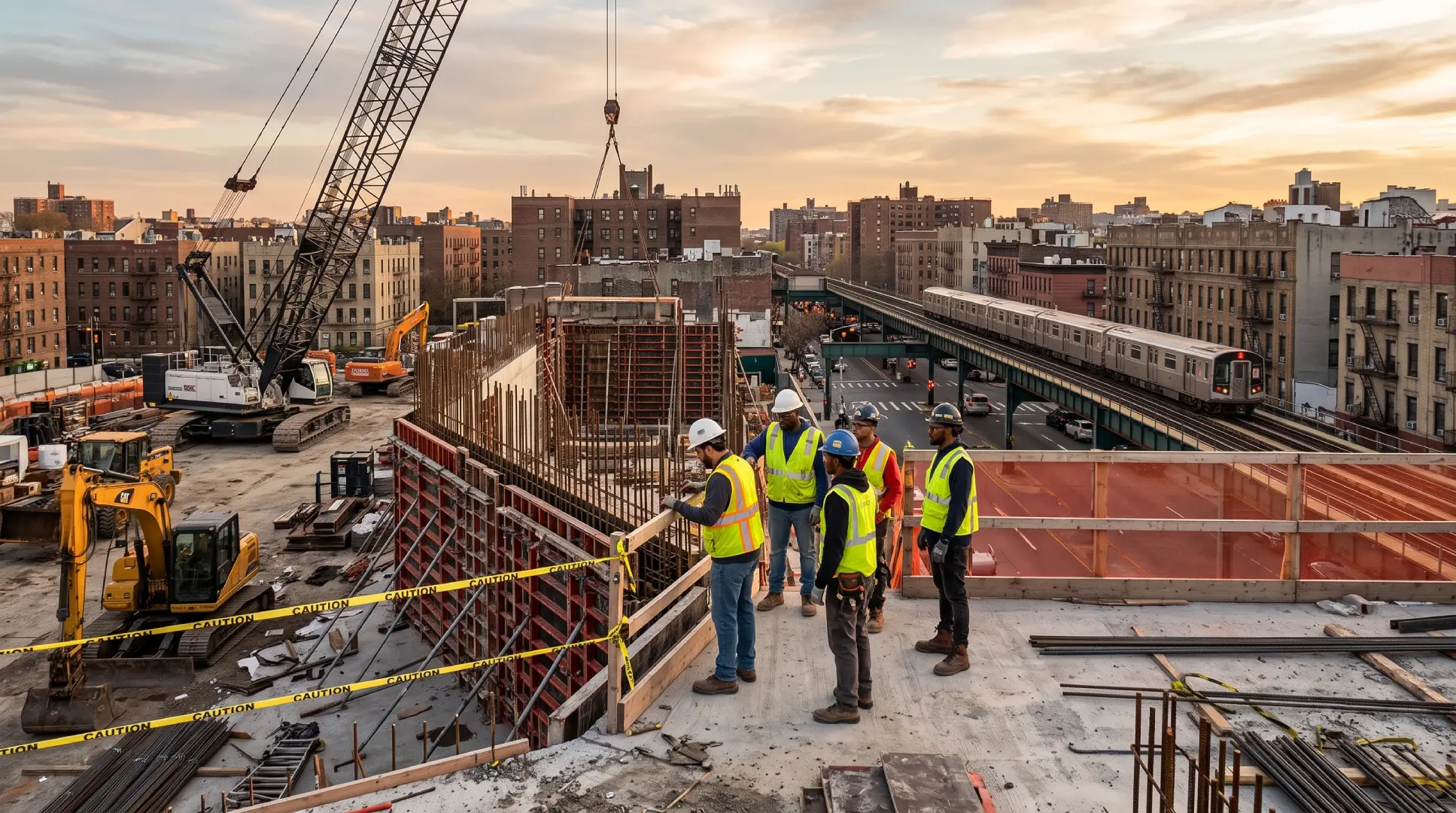
A Bronx construction worker lawyer can be the difference between a lowball workers’ compensation settlement and a full recovery that covers every dollar you lost. If you were hurt on a job site in the Bronx, you may have two separate legal claims — and most injured workers don’t know about both of them.
Silver Law Group represents construction workers across New York City. Your first consultation is free. If we take your case, we work on contingency: you pay nothing unless we recover money for you. That means no upfront costs, no hourly fees, no bill at the end if we don’t win.
Do You Have a Case? Understanding Your Legal Options
New York law gives construction workers two distinct recovery paths: workers’ compensation and third-party personal injury claims. Many injured workers settle for one when they qualify for both.
Workers’ Compensation vs. Third-Party Lawsuit
These two claims are not mutually exclusive — filing one does not prevent you from pursuing the other.
- Workers’ compensation covers your medical bills and a portion of lost wages, regardless of who was at fault
- A third-party personal injury lawsuit can recover pain and suffering, full lost earnings (not the capped workers’ comp rate), future medical costs, and permanent disability damages
- Workers’ comp is paid by your employer’s insurer; a third-party suit targets a different party — a property owner, general contractor, or equipment manufacturer
- The combined value of both claims is almost always higher than either one alone
Who Can Be Held Liable Beyond Your Employer
In New York, suing your employer directly for negligence is generally barred — but that does not mean you are limited to workers’ comp.
Parties who can be sued separately include:
- Property owners of the job site
- General contractors who control site safety
- Subcontractors whose workers or equipment caused the hazard
- Equipment and machinery manufacturers when a defective product contributed to the injury
- Architects and engineers who designed unsafe conditions into the project
New York Labor Laws That Protect Bronx Construction Workers
Labor Law §240, §241, and §200 give injured workers powerful legal tools that go far beyond standard injury claims. These statutes were written specifically for construction workers — and they shift significant liability onto property owners and contractors.
Labor Law §240: The Scaffold Law Explained
New York Labor Law §240 is one of the strongest worker-protection statutes in the country.
- It imposes strict liability on property owners and general contractors for gravity-related accidents
- “Strict liability” means the injured worker does not need to prove the owner or contractor was negligent — only that the accident involved a fall or a falling object, and that proper safety equipment was not provided
- Covered accidents include: falls from scaffolding, ladders, roofs, and elevated platforms; objects falling onto workers below
- Property owners cannot escape liability by claiming they had no direct control over the work
If your accident involved a height or a falling object, Labor Law §240 is likely your most powerful legal tool.
Labor Law §241 and §200: Additional Protections
These statutes extend liability to a broader set of job site hazards.
- Labor Law §241 requires construction sites to comply with the New York Industrial Code; violations of specific code provisions can establish liability without proving negligence
- Labor Law §200 codifies the general duty to maintain a reasonably safe work site
- Under §241 and §200, property owners, general contractors, and sometimes subcontractors can all be held liable
- Common triggers: inadequate lighting, unguarded floor openings, improper material storage, missing barriers near excavations
How Much Is a Bronx Construction Accident Case Worth
Case value depends on injury severity, lost earning capacity, liability under Labor Law §240, and whether permanent disability results. No attorney can quote you a number before reviewing your records — but the factors that drive value are well established.
Key determinants of compensation:
- Medical costs — surgery, hospitalization, rehabilitation, future care
- Lost wages and earning capacity — both past and future, especially if you cannot return to construction work
- Pain and suffering — physical and emotional, with no statutory cap in most New York personal injury cases
- Permanent disability or disfigurement
- Applicability of Labor Law §240 — strict liability cases typically resolve at higher values because liability is harder to dispute
- Comparative fault — if you were partly at fault, your recovery is reduced by that percentage (but not eliminated)
A worker who falls three stories from unsecured scaffolding, suffers spinal fractures, and cannot return to work faces lifetime earnings loss that can push case value into seven figures. The same injury with a clear Labor Law §240 violation is significantly stronger than one without it.
Common Construction Accidents We Handle in the Bronx
Falls from scaffolding and ladders, struck-by-object incidents, electrocutions, and caught-in accidents are the most frequent injury types seen on Bronx job sites.
Silver Law Group handles cases involving:
- Scaffold collapses and falls — defective planking, missing guardrails, improper assembly
- Ladder accidents — unsecured ladders, wrong ladder for the task, no spotter
- Falling objects — tools, debris, materials dropped from above
- Electrocutions — contact with live wires, unprotected electrical equipment
- Trench and excavation collapses — improper shoring, OSHA violations
- Caught-in/between accidents — machinery entanglement, equipment crushing injuries
- Forklift and crane accidents — operator error, equipment failure, improper load securing
- Slip and fall on job sites — wet surfaces, debris, uneven flooring
Injuries That Qualify for Maximum Compensation
Spinal cord damage, traumatic brain injury, crush injuries, and fractures typically produce the highest settlement and verdict values — because they carry the highest lifetime costs.
Injuries that regularly result in significant recovery include:
- Spinal cord injuries — partial or complete paralysis, requiring lifetime care
- Traumatic brain injury (TBI) — cognitive impairment, personality changes, lost earning capacity
- Crush injuries — loss of limb, compartment syndrome, permanent functional loss
- Severe fractures — especially hip, femur, pelvis, and vertebral fractures requiring surgery
- Burns — from electrical contact or fires on site
- Internal organ damage — from falls or crushing
- Wrongful death — when a family member was killed in a construction accident
If your injury required surgery, left you unable to work, or caused any permanent limitation, the claim is worth pursuing seriously.
What to Do Immediately After a Construction Accident
Reporting your injury promptly, preserving evidence, and avoiding recorded statements protect your right to full compensation. The steps you take in the first 48 hours matter.
- Seek medical care immediately — even if you feel you can push through. Delayed treatment is used by insurers to argue the injury is minor or unrelated to the accident.
- Report the accident to your employer or supervisor in writing. Get confirmation.
- Document everything — photograph the scene, the equipment, and any hazard that caused the accident before anything is moved or repaired.
- Get names and contact information for any witnesses, including coworkers.
- Do not give a recorded statement to any insurance company — your employer’s or anyone else’s — before speaking with a lawyer.
- Save all medical records, bills, and communications from the day of the accident forward.
- Contact a Bronx construction worker attorney before filing any claim on your own.
Insurance adjusters contact injured workers quickly — sometimes within 24 hours — with settlement offers. Those offers are calculated to be accepted before you understand what your case is worth. A fast offer is almost always a low offer.
Workers’ Compensation Claims: What Injured Bronx Workers Must Know
New York requires most employers to carry workers’ comp, but insurers routinely deny or undervalue legitimate construction injury claims. Understanding the system protects you from leaving money behind.
Key facts about workers’ comp in New York:
- You must notify your employer of the injury within 30 days of the accident
- You must file a formal claim with the Workers’ Compensation Board within two years
- Benefits cover medical treatment and two-thirds of your average weekly wage, up to a state maximum
- Workers’ comp does not cover pain and suffering — that is available only through a personal injury lawsuit
- Your employer’s insurer has a financial incentive to limit or deny your claim
What to Do If Your Workers’ Comp Claim Is Denied
A denial is not the end of the process. It is the beginning of a different one.
- You have the right to appeal a denial to the New York Workers’ Compensation Board
- An attorney can gather independent medical evidence, depose witnesses, and represent you at the hearing
- Many denied claims are won on appeal when properly documented and argued
- If a third party caused or contributed to your injury, the personal injury claim proceeds independently of the comp case
How Long Do You Have to File a Construction Accident Claim in New York
Personal injury claims must be filed within three years of the accident date; workers’ comp notices must be given within 30 days.
Critical deadlines for Bronx construction workers:
- 30 days — notify your employer of the injury (workers’ comp)
- 2 years — file the formal workers’ comp claim with the Board
- 3 years — file a personal injury lawsuit in New York civil court
- 90 days — if a government entity owns the property (e.g., a city agency), you must file a Notice of Claim within 90 days or lose the right to sue
- 1.5 years — for wrongful death claims, the statute of limitations is shortened
The three-year window sounds long. It is not. Evidence disappears, witnesses move on, job sites are cleaned up, and surveillance footage is overwritten. Cases built early are cases built stronger.
If you are unsure whether your deadline has passed, speak with a construction worker injury lawyer before assuming it has.
What a Bronx Construction Worker Lawyer Does for You
An attorney investigates the site, identifies all liable parties, and handles both your comp and personal injury cases simultaneously — so you can focus on recovery.
Specifically, a Bronx construction worker attorney at Silver Law Group will:
- Conduct an independent site investigation — before evidence is removed or altered
- Identify every liable party — employer, property owner, contractor, subcontractor, equipment manufacturer
- Preserve critical evidence — safety inspection records, OSHA reports, site photographs, maintenance logs
- Retain expert witnesses — engineers, accident reconstruction specialists, medical experts, vocational experts to document lost earning capacity
- Handle all insurer communications — so adjusters cannot pressure you into a premature settlement
- File and coordinate both your workers’ comp and personal injury claims
- Negotiate for a full settlement — or take the case to trial if the offer does not reflect your real losses
Most construction accident cases settle before trial. But the cases that settle well are the ones prepared as if they are going to trial.
No Fee Unless We Win: How Construction Accident Cases Are Paid
Silver Law Group handles construction accident cases on a contingency fee basis. That means:
- No retainer, no hourly rate, no upfront payment of any kind
- We cover the costs of investigation, experts, and litigation while the case is pending
- You owe nothing if the case does not result in a recovery
- Our fee is a percentage of what we recover — agreed upon before we start
This model exists so that injured workers who can’t afford a lawyer still get full legal representation. The contingency structure also aligns our interests with yours: we only get paid when you do.
Free consultations are available in English, Spanish, and Russian.