

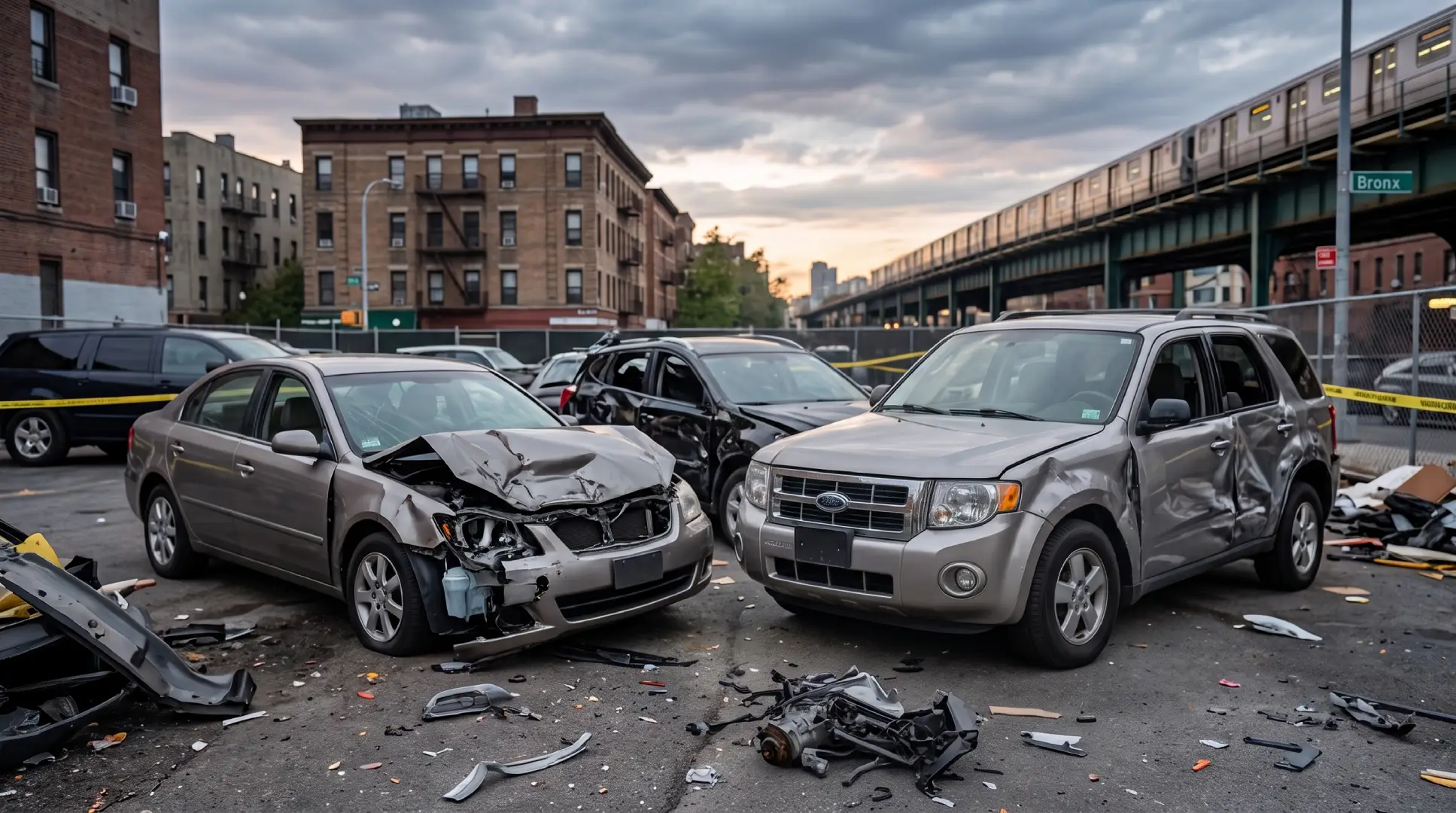
A Bronx total loss attorney can be the difference between accepting a lowball check and recovering the full amount that New York law actually requires the insurer to pay you. If your car was declared a total loss and the offer feels wrong, it probably is — insurance companies use automated valuation tools designed to minimize payouts, not reflect what your vehicle was actually worth on the Bronx market.
Silver Law Group represents crash victims in the Bronx and across New York City. Every case starts with a free consultation in English, Spanish, or Russian. We handle total loss and personal injury claims on contingency: you pay nothing unless we recover money for you. That means no upfront fees, no hourly billing, no risk to you.
What Makes a Car a Total Loss in New York
New York declares a vehicle a total loss when the cost to repair it exceeds 75 percent of its actual cash value (ACV).
This threshold triggers specific legal obligations for the insurer — obligations they do not always meet.
- The insurer must calculate ACV using comparable vehicles in your market
- They must include applicable sales tax and registration fees in the settlement offer
- They must provide you with the data they used to calculate their offer
- You have the right to dispute their number before signing anything
The 75% rule sounds objective. The ACV calculation beneath it is not — and that’s where disputes begin.
How Insurance Companies Calculate Your Car’s Value
Insurers use depreciation formulas and comparable sales data that frequently understate your vehicle’s true Bronx market worth.
They run your vehicle through automated valuation platforms — tools like CCC One or Mitchell — that pull regional comps. The problem: those comps can reflect vehicles with lower trim levels, higher mileage, or worse condition than yours. One wrong data point can reduce your offer by thousands.
What ACV Means and Why It Matters
Actual cash value is not what you paid for your car. It is not what you owe on your loan. ACV is the market value of your vehicle at the moment of the crash — the baseline for your settlement.
Errors in any of the following can significantly lower the ACV figure the insurer uses:
- Mileage (incorrect or estimated high)
- Trim level (base model used as comp instead of your actual package)
- Condition (rated lower than the vehicle’s actual pre-crash state)
- Upgrades and modifications (aftermarket features omitted from valuation)
- Local market pricing (comps pulled from outside the Bronx or NYC)
What New York Law Requires Insurers to Include
Under New York state law and Department of Financial Services regulations, a total loss settlement offer must include:
- The vehicle’s actual cash value
- Sales tax on the replacement vehicle
- Title and registration fees
- Any other applicable transfer fees
Many insurers skip the tax and fee components by default. If yours did, they owe you more — and an attorney can compel them to pay it.
Why Insurance Low-Ball Offers Are Common in the Bronx
Insurers use automated valuation tools that routinely ignore local market conditions and vehicle-specific upgrades.
This is not an accident. Every dollar they shave off your settlement stays in their column. The Bronx presents particular challenges for insurers trying to suppress valuations: vehicle demand is high, inventory in NYC is limited, and replacement costs are consistently above national averages. Automated tools often fail to capture that reality.
Common tactics insurers use to reduce your total loss payout:
- Selecting comparable vehicles from lower-cost markets outside NYC
- Applying excessive condition adjustments without inspection
- Omitting required sales tax and fees from the initial offer
- Pressuring you to accept quickly — before you can contest the number
- Releasing a check that, if cashed, constitutes acceptance of their figure
If an adjuster has already called you with an offer, do not sign or cash anything yet. Call a total loss attorney first.
How a Bronx Total Loss Attorney Disputes a Low Offer
An attorney challenges the insurer’s ACV by presenting independent appraisals and comparable local vehicle sales data.
Silver Law Group disputes low total loss offers through a documented, evidence-based process:
- Request the insurer’s full valuation report — every comp they used, every adjustment they applied
- Commission an independent appraisal from a licensed appraiser using current Bronx market data
- Identify errors in condition, trim, mileage, and market selection — any discrepancy is a basis for revision
- Present the corrected valuation in writing — with supporting comparable sales from the local market
- Negotiate directly with the insurer’s claims department — or invoke the appraisal clause in your policy if they refuse to move
- File a complaint with the New York Department of Financial Services if the insurer acts in bad faith
Most insurers revise their offers when presented with a documented rebuttal. Those that don’t face potential bad faith liability — an exposure serious enough that most carriers prefer to settle.
What Happens to Your Car Loan After a Total Loss
If your loan balance exceeds the ACV payout, GAP insurance or a legal claim against the at-fault driver may cover the difference.
This situation — being “upside down” on a car loan after a crash — is one of the most financially damaging outcomes a Bronx accident victim can face.
- Your lender expects the full loan balance, regardless of what the insurer pays
- If the ACV payout is $18,000 but you owe $24,000, you are responsible for the $6,000 gap
- GAP insurance, if you purchased it, covers this difference
- If the crash was caused by another driver, their liability coverage may be pursued for the shortfall
What to do:
- Locate your financing agreement and check whether you purchased GAP coverage
- Contact your lender immediately — they have a lien on the vehicle and will be involved in the settlement
- Do not accept the insurer’s payout without confirming whether GAP applies
- Speak with an attorney before releasing any claims against the at-fault party
Your Right to a Rental Car During a Total Loss Claim
Many Bronx accident victims do not know they can claim rental reimbursement while the insurer processes the total loss.
Your right to a rental depends on who is paying the claim:
- Your own collision coverage: Your policy’s rental reimbursement endorsement governs. Most policies cover 30 days; check your declarations page.
- The at-fault driver’s liability coverage: Their insurer is responsible for your transportation costs from the date of the crash until you are paid for the total loss — not when you accept it, when you are paid.
- New York No-Fault (PIP): Does not cover vehicle damage or rental costs — this is a separate property damage claim.
If the insurer delays your payout and your rental coverage expires, document every additional transportation cost. Those costs are recoverable.
Total Loss Plus Injury: How the Two Claims Work Together
When your car is totaled in a crash that also caused injuries, property and personal injury claims must be managed separately — and the timing of how you resolve them matters enormously.
These are two distinct legal claims:
- Property damage claim: Covers your vehicle’s ACV, rental, taxes, fees, and GAP shortfall. Paid by the at-fault driver’s property damage liability coverage — or your collision coverage.
- Personal injury claim: Covers medical bills, lost wages, pain and suffering, and long-term disability. Governed by New York’s No-Fault system first, then a liability claim if your injuries meet the serious injury threshold.
The two claims are handled separately, but they are often linked — by the same crash, the same insurer, and the same adjuster who benefits from settling both as cheaply as possible.
Do Not Sign Any Release Until Both Claims Are Resolved
Signing the property damage release too early can inadvertently affect your ability to pursue full injury compensation.
This is one of the most common and costly mistakes Bronx crash victims make:
- The insurer sends a property damage settlement check with a release attached
- You sign to get the money for your car — before you know the full extent of your injuries
- The release language is broad enough to bar your injury claim entirely
A properly drafted property damage release should be limited to vehicle damage only. Many insurers use broader language hoping you won’t notice. Never sign any release without having an attorney review it first.
What Your Total Loss Claim May Actually Be Worth
Beyond the vehicle value, you may recover sales tax, registration fees, rental costs, and loan payoff shortfalls.
The full scope of a Bronx total loss claim can include:
- Actual cash value of the vehicle — the core of the claim
- New York sales tax on a replacement vehicle (currently 8.875% in NYC)
- Title and registration transfer fees
- Rental car reimbursement for the full period of the claim
- GAP shortfall if the ACV is less than your loan balance
- Diminished value in some circumstances — the reduced market value of a repaired vehicle
- Out-of-pocket transportation costs caused by insurer delays
On a $30,000 vehicle, the tax and fees alone add more than $3,000 to what the insurer owes you. Many people never collect those amounts because they accept the first offer without reviewing it.
Deadlines and Steps You Cannot Afford to Miss in the Bronx
New York’s statute of limitations and the 30-day no-fault filing window make prompt action essential after any crash.
Key deadlines after a Bronx motor vehicle accident:
- 30 days: File your No-Fault (PIP) application with your own insurer. Miss this window and you lose access to no-fault medical and wage benefits — no exceptions.
- 3 years: New York’s statute of limitations for personal injury claims. Clock starts on the date of the crash.
- 3 years: Statute of limitations for property damage claims in New York.
- 90 days: If a government vehicle caused your crash (MTA bus, NYPD, city-owned vehicle), you must file a Notice of Claim within 90 days or lose the right to sue.
Steps to take immediately after a Bronx total loss accident:
- Call 911 and get a police report number
- Photograph the damage to both vehicles and the scene
- Get the other driver’s insurance information and policy number
- Report the crash to your own insurer — but do not give a recorded statement yet
- Request a copy of the police report from the NYPD
- Contact a Bronx total loss attorney before responding to any adjuster’s offer
No Fee Unless You Win: How Our Bronx Total Loss Lawyers Work
Silver Law Group handles total loss and injury claims on contingency. You pay nothing unless we recover money for you — no retainer, no hourly rate, no upfront costs of any kind.
Here is how it works when you call us:
- Free consultation — in English, Spanish, or Russian — to review what happened and what your claim is worth
- We gather your vehicle records, valuation reports, loan documents, and accident report
- We issue a formal dispute to the insurer with independent valuation evidence
- We negotiate the property damage and injury claims simultaneously, protecting both
- We ensure no release is signed until every element of your claim is resolved
- You collect. Our fee comes from the recovery — not from you.
Silver Law Group serves Bronx residents and families across New York City. The call is free. There is no obligation. And there is no reason to accept less than what New York law requires them to pay you.
Call Silver Law Group today for a free consultation with a Bronx total loss attorney.