

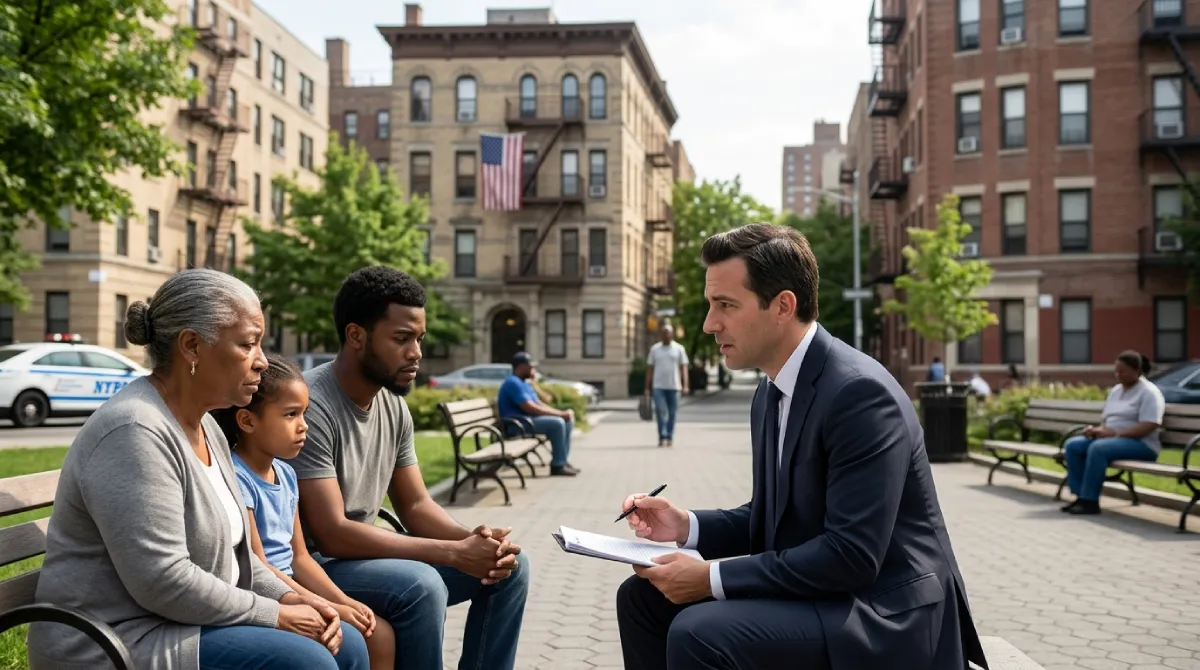
A Bronx wrongful death lawyer at Silver Law Group can help your family pursue financial accountability when someone’s negligence takes a life. If your loved one died because a driver ran a red light, a construction site ignored safety codes, or a hospital made a fatal error, New York law gives you the right to seek compensation — and you do not need money upfront to start. Silver Law Group works on a contingency fee basis: no attorney’s fee unless they recover money for your family. Every case starts with a free consultation in English, Spanish, or Russian.
What Qualifies as a Wrongful Death Claim in New York
New York’s wrongful death statute — Estates, Powers and Trusts Law Section 5-4.1 — defines wrongful death as a death caused by the wrongful act, neglect, or default of another person or entity. The standard is direct: if the deceased would have had a viable personal injury claim had they survived, the family has grounds for a wrongful death lawsuit.
That means four elements must exist. First, the defendant owed a duty of care. Second, the defendant breached that duty. Third, the breach caused the death. Fourth, surviving family members suffered measurable financial loss as a result. All four must be present for a claim to proceed. If even one is missing, the legal theory collapses — which is why early investigation by an attorney for wrongful death matters.
Wrongful Death vs. Survival Action: Two Claims, Two Purposes
These are two separate legal claims that often run together in New York wrongful death cases, and the distinction matters when calculating what your family can recover.
A wrongful death claim belongs to the estate and compensates the surviving distributees — spouses, children, parents — for their financial losses going forward. Lost income, lost parental guidance, funeral and burial expenses: these are wrongful death damages.
A survival action, by contrast, belongs to the deceased themselves. It recovers what the deceased experienced before death: conscious pain and suffering, medical bills incurred after the injury but before death, and lost earnings between the accident and the moment of death. Where the wrongful death claim looks forward, the survival action looks back. Both can be filed simultaneously, and in many cases, both should be.
What Happens If Your Loved One Was Partly at Fault
New York follows pure comparative negligence. That means a defendant cannot escape liability simply by pointing to the deceased’s own actions. Even if your loved one was 40 percent at fault for the accident that killed them, your family can still recover 60 percent of the total damages.
Insurance companies understand this rule better than most families do — and they use it to lowball settlements. An adjuster who tells you your loved one “contributed to the accident” is not telling you your case is over. They are setting up a negotiation they expect to win. A wrongful death attorney can counter that argument with accident reconstruction data, eyewitness testimony, and expert analysis that accurately assigns fault.
Who Can File a Wrongful Death Lawsuit in the Bronx
New York law limits who may actually file. Under EPTL 5-4.1, only the personal representative of the deceased’s estate — typically the executor named in the will, or an administrator appointed by Surrogate’s Court — may bring the lawsuit. That representative acts on behalf of the qualifying distributees: the people entitled to share in the recovery.
Distributees generally include the surviving spouse, children, and in some cases parents or siblings, depending on the family structure and who was financially dependent on the deceased. The representative does not keep all the money. They collect it on behalf of everyone with a legal interest, and the Surrogate’s Court ultimately approves how it is divided.
If no estate has been opened and no personal representative has been appointed, that process must happen before the lawsuit can be filed. Silver Law Group can refer you to a probate attorney if needed or coordinate the process to avoid delay.
Common Causes of Wrongful Death in the Bronx
The Bronx sees fatal accidents across a wide range of circumstances. The legal theory changes depending on who caused the death and how, but the core obligation — to prove duty, breach, causation, and damages — applies in every case.
Car and truck accidents account for a significant share of wrongful death cases in the Bronx. A fatal collision on the Cross Bronx Expressway, the Bruckner Interchange, or on surface streets in Mott Haven or Fordham can involve a distracted driver, a commercial truck with faulty brakes, or an employer who put an unqualified driver on the road. Each of those scenarios may produce a different defendant — and a different insurance policy — but all of them fall within the reach of a wrongful death accident lawyer.
Construction site deaths are another recurring cause of action. New York Labor Law Sections 200, 240, and 241 impose strict duties on property owners and general contractors. When a worker falls from an unsecured scaffold or is struck by falling materials, those statutes give the family powerful legal leverage that does not exist in most other states.
Medical malpractice wrongful death cases arise when a hospital, surgeon, or nursing facility fails to meet the standard of care and a patient dies as a result. Delayed diagnosis of a treatable condition, surgical error, or a medication overdose in a nursing home can all form the basis of a wrongful death medical malpractice claim. These cases require expert medical testimony, careful review of records, and an attorney who understands both medical standards and litigation strategy.
Nursing home neglect, pedestrian accidents, defective products, and construction site falls also routinely produce fatal injuries in the Bronx. Each category involves its own liability framework, its own set of defendants, and its own evidentiary demands.
Damages Available in a Bronx Wrongful Death Case
New York’s wrongful death statute defines what the family can recover. The categories are financial, not emotional — a distinction that has real implications for how claims are valued.
Lost financial support is typically the largest component. Courts look at what the deceased would have earned over their expected working life, discounted to present value. A 35-year-old with a steady income and decades of earning potential generates a far larger damages calculation than a retiree, though every case has individualized factors.
Funeral and burial expenses are recoverable directly. Medical bills incurred between the injury and the death are recoverable through the survival action claim. Lost household services — cleaning, cooking, childcare, home maintenance — are recoverable based on the economic value of what the deceased provided. Parental guidance and nurturing, for families with minor children, can be calculated by economists and are recoverable as well.
What New York Law Does Not Allow You to Recover
This is a gap that surprises many families. New York is one of the few states that does not permit recovery for grief, anguish, or emotional suffering in a wrongful death claim. The loss of companionship and the pain of losing a spouse or parent are real — but under current New York law, they do not translate into a dollar figure in a wrongful death lawsuit.
Legislators have periodically debated expanding the statute to include non-economic damages, but as of now the law remains financial in focus. What your family can recover is real and often substantial. It simply must be grounded in economic loss.
How Much Is a Bronx Wrongful Death Case Worth
There is no standard number. The value of a wrongful death case depends on facts specific to the deceased and the surviving family.
Age matters because it determines the remaining earning years being calculated. A 42-year-old with 25 years of projected income represents a larger economic loss than a 68-year-old approaching retirement. Income matters because lost support is calculated from actual or projected earnings. Health matters because it affects life expectancy assumptions. Family structure matters because the number and financial dependence of surviving beneficiaries shapes the damages analysis.
The defendant’s conduct matters too. Cases involving egregious negligence — a drunk driver, a construction site that ignored multiple safety violations, a nursing home with a pattern of neglect — may support a stronger settlement position. The strength of the evidence, the credibility of witnesses, and the defendant’s insurance coverage are also factors every lawyer for wrongful death case must account for.
Silver Law Group has recovered millions of dollars for clients across New York City. The only way to estimate what your specific case is worth is to evaluate the facts.
How Long You Have to File in the Bronx: Statute of Limitations
New York’s wrongful death statute of limitations is 2 years from the date of death. That sounds like sufficient time, but it is not a reason to wait.
Evidence deteriorates. Witnesses move. Surveillance footage gets deleted. The sooner an investigation begins, the stronger the factual foundation of your case. An attorney can send spoliation letters to preserve security camera footage, subpoena records before they are destroyed, and begin the reconstruction process while physical evidence still exists.
Shorter deadlines apply when a government entity is involved. If your loved one died because of a defective city road, a dangerous condition in an MTA subway station, or negligence by a city-operated hospital, you may have as little as 90 days to file a notice of claim. Missing that window can permanently bar your family from recovery, regardless of how strong the underlying case is.
If you are unsure whether a government entity bears any responsibility, assume the tighter deadline applies and call immediately.
How a Bronx Wrongful Death Attorney Builds Your Case
An experienced wrongful death attorney does not wait for the insurance company to make a move. They start building the case from day one.
That process begins with evidence preservation. Accident scene photographs, police reports, medical records, employment records, and witness statements all need to be gathered and secured before they become unavailable. In construction cases, OSHA investigation records and site inspection reports are critical. In medical malpractice wrongful death cases, the attorney retains a medical expert to review the records and identify where the standard of care was violated.
The attorney then identifies every potential defendant. In a fatal truck accident, that may include the driver, the trucking company, the vehicle manufacturer, and a cargo loading contractor. In a construction death, it may include the property owner, the general contractor, and multiple subcontractors. Naming the right defendants — all of them — determines which insurance policies are in play and what the total recovery ceiling looks like.
Comparative fault arguments are anticipated and countered before they reach a negotiation table. Insurers and defense attorneys routinely attempt to shift blame to the deceased. Experienced accidental death attorneys know those strategies and prepare rebuttals with expert testimony, accident reconstruction, and documentary evidence.
How Wrongful Death Settlements Are Approved in New York
This is a procedural step that surprises families who have never been through the process. Under New York’s Estates, Powers and Trusts Law Section 5-4.6, any settlement of a wrongful death claim requires approval by the Surrogate’s Court before the funds can be distributed to beneficiaries.
The court reviews the settlement to ensure it is reasonable and that the distribution among beneficiaries is fair. That means even after a defendant agrees to pay, there is a court proceeding before money changes hands. An experienced attorney will handle that application and guide the personal representative through the process. Families who attempt to navigate this without legal help often encounter delays, errors, or disputes among beneficiaries that could have been avoided.
What It Costs to Hire a Bronx Wrongful Death Lawyer
Accidental death attorneys at Silver Law Group work on a contingency fee. That means no upfront payment, no hourly billing, and no out-of-pocket cost during the case. Silver Law Group only collects a fee if they recover money for your family. If there is no recovery, there is no fee.
This model exists because most families dealing with wrongful death are also dealing with immediate financial strain — lost income, funeral costs, outstanding medical bills. The contingency structure removes the financial barrier to hiring qualified legal representation.