

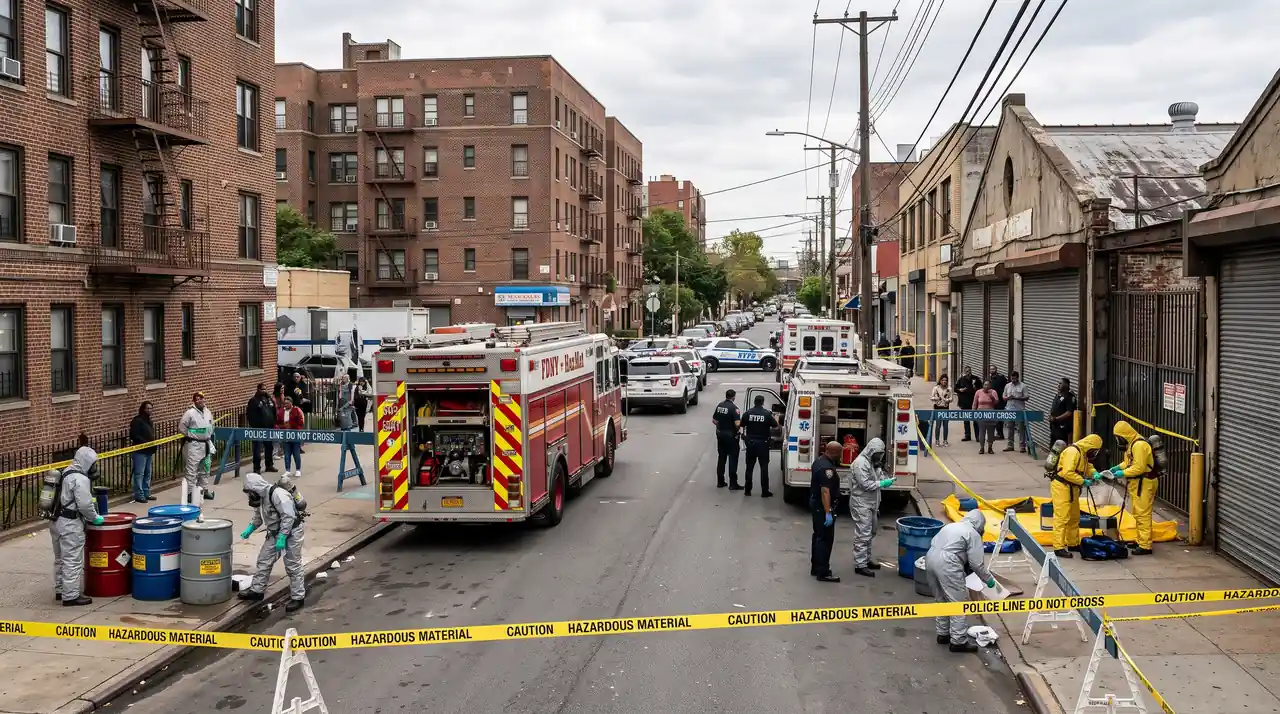
Silver Law Group’s Bronx toxic tort lawyers represent residents who got sick from lead paint, toxic mold, asbestos and chemical exposure in their homes and workplaces. If a landlord left peeling paint in the room where your child slept, or a contractor ripped out pipe insulation without sealing off the area, the party that created the hazard can be held responsible for the illness that followed. These claims are won on medical and scientific proof. That proof starts to disappear the day a landlord repaints or a job site shuts down.
Call 212-470-4544 for a free consultation. A lawyer answers 24/7, and you pay nothing up front.
Do You Have a Toxic Tort Case in the Bronx?
A diagnosis and a hazardous apartment are not enough on their own. In Parker v. Mobil Oil Corp. (2006), New York’s Court of Appeals set the proof standard that governs every toxic tort case in the state, including yours. Parker, a gas station worker, blamed his leukemia on years of exposure to benzene in gasoline. The court held that his experts had to connect the chemical to the disease through accepted science.
Under Parker, you have to prove three things:
- Exposure. You came into contact with the substance, and the record shows how often and for how long.
- General causation. The substance can cause the illness you have, as asbestos can cause mesothelioma and benzene can cause certain leukemias.
- Specific causation. Your dose was high enough to cause your illness. Having been exposed at some point is not enough.
Parker does not demand an exact number. An expert can estimate your dose with accepted methods, such as comparing your exposure to levels recorded in scientific studies. The estimate still has to rest on data, not on the expert’s say-so.
The Court of Appeals showed how strictly it enforces that rule in Nemeth v. Brenntag North America (2022). A jury had ruled for a woman who developed mesothelioma after years of using talcum powder said to contain asbestos. The court reversed that asbestos verdict because her experts never showed that the amount she inhaled was enough to cause her cancer.
For you, Nemeth means the dose analysis has to be at the center of your case from the first week. In toxic tort litigation, proving you were exposed is where the case starts, not where it ends.
Common Sources of Toxic Chemical Exposure in the Bronx
A toxic chemical exposure attorney starts by identifying which substance reached you, because each one has its own proof problems and its own defendants:
- lead paint in older apartments, swallowed as chips or breathed in as dust from windows and doors
- mold behind walls and under sinks where leaks went unrepaired
- asbestos in pipe insulation, floor tiles and boiler rooms, released when renovation crews disturb it
- carbon monoxide from defective boilers, blocked flues and badly vented gas appliances
- pesticides applied by exterminators in amounts or places the label does not allow
- benzene in gasoline, solvents and industrial products
- contaminated water from lead plumbing or from chemicals that move off landfills and industrial sites
Carbon monoxide cases usually begin in an emergency room. In the Bronx, carbon monoxide poisoning is treated in the hyperbaric chamber at Jacobi Medical Center, where patients breathe pure oxygen under pressure to clear the gas from their blood. If you or a family member was treated there, the Jacobi records document both the poisoning and how severe it was. Those records become the first exhibit in a claim against the building owner or the company that serviced the boiler.
Lead Paint Poisoning in Older Bronx Apartments
Local Law 1 of 2004 is the city’s lead paint law, and it puts the burden on the landlord. In a building constructed before 1960, the owner of any apartment where a child under six lives must inspect for lead paint hazards at least once a year and fix peeling paint. The law presumes that paint in these buildings contains lead unless the owner proves otherwise.
That law affects your case in three specific ways:
- A skipped annual inspection is evidence that the landlord ignored a duty the law spelled out.
- Peeling paint left unfixed after a complaint shows the owner knew about the hazard and did nothing.
- HPD inspection records and violations are public and dated, so a landlord has a hard time disputing them.
If you see chipped or peeling paint, call 311 and file a complaint. HPD inspects lead paint complaints within 10 days, and a violation written by an HPD inspector becomes a dated, official record your claim can rely on.
Have your child’s blood lead level tested by a pediatrician. Lead can damage a young child’s developing brain without any visible symptoms, so the blood test is often the only early warning. The same test result also serves as the dose evidence Parker requires.
Toxic Mold in Bronx Rental Buildings
Local Law 55 of 2018 requires owners of buildings with three or more units to inspect every apartment each year for mold and other indoor allergen hazards. When mold appears, the owner has to remove it and repair the leak or moisture problem causing it. A coat of paint over the stain leaves the violation in place.
HPD violations are the strongest liability evidence in a mold claim. HPD sorts them by severity:
- Class B, hazardous
- Class C, immediately hazardous
A Class B or C mold violation that stayed open for months proves a city agency told the landlord in writing and the landlord still did not fix it. Your medical records then have to connect the mold to your asthma, respiratory infections or other illness, and the Parker causation rules apply here too. Take dated photos of the mold and the leak before the landlord’s crew arrives.
Workplace Chemical and Asbestos Exposure
Workers’ compensation is the only claim you have against your own employer for an illness caused by your job, even if the employer was careless. Comp pays for medical care and part of your lost wages. It pays nothing for pain and suffering.
A lawsuit can be brought against everyone else. A chemical exposure attorney looks past your employer to the companies that did not sign your paycheck:
- the manufacturer of the asbestos product, solvent or benzene-containing chemical, if the product was defective or sold without adequate warnings
- a general contractor or subcontractor that disturbed asbestos or ran an unsafe site where you worked for a different company
- the owner of the building or facility where the exposure happened
You can collect workers’ compensation and sue these third parties at the same time. Pain and suffering and your full lost earnings can only come from the third-party case, so finding every defendant other than your employer early on changes what your claim is worth.
Bring your employment and union records, the names of the job sites you worked on, and the brand names of the products you handled. Asbestos and benzene illnesses can show up decades after the exposure, and these details are often the only way to trace the companies responsible.
The Pelham Bay Landfill Case and Bronx Environmental Claims
The Pelham Bay Landfill is the Bronx’s clearest example of an environmental exposure case against the City of New York. Families living near the city-run landfill in the northeast Bronx alleged that hazardous chemicals from the site had reached their neighborhood and that their children developed leukemia as a result.
The city fought the claims on causation. In 2007, the Court of Appeals ruled in Nonnon v. City of New York that the residents’ claims could go forward, finding that their epidemiological and expert evidence was enough to put causation in front of a jury.
In 2013, six years after that ruling, the city settled with 12 families whose children had developed leukemia. The city did not admit fault.
The case carries several lessons for any Bronx environmental claim. A claim against the city requires a Notice of Claim within 90 days, so the first deadline is far shorter than most families expect. Causation is fought with epidemiology and dose experts, under the same Parker framework that applies to a single apartment. These cases take years, and families who write down early where they lived, for how long, and when symptoms began give their experts the exposure history the court will demand.
What a Toxic Exposure Lawsuit Can Recover
A successful claim pays for the harm the exposure caused, both what has already happened and what is still to come. A toxic exposure attorney documents each category separately, because a New York jury decides damages one category at a time:
- Medical bills already paid or still owed, including emergency care, hospital stays and specialist visits.
- Future treatment, such as cancer care, lung care, chelation for lead poisoning, or developmental and educational services for a child poisoned by lead.
- Lost earnings, meaning both the paychecks you missed and the earning ability the illness took from you.
- Pain and suffering, covering the illness itself, its treatment and the parts of your life you can no longer take part in.
Defendants often argue that you share the blame. A worker skipped a respirator. A tenant waited to report a leak. Under CPLR 1411, that argument can lower your award but cannot wipe it out. If a jury finds you 20 percent responsible, your damages are reduced by 20 percent and you keep the other 80.
Adjusters sometimes raise partial fault to push an early, low offer. Under the statute, the most that argument can do is cut your award by a percentage, so it is no reason to settle before your medical picture is complete.
What Happens After You Call Our Bronx Toxic Tort Lawyers
The first call is a free consultation. If you cannot travel to our Midtown office, a toxic tort attorney will meet you at home or at the hospital. After that, your case is built in this order:
- We collect your medical records and diagnosis, from the emergency room through every specialist who treated you.
- In lead cases, we get every blood lead test result, because the dates and levels show when the poisoning began and how severe it became.
- We pull your building’s HPD violation history, including lead and mold complaints, inspection results, and the dates violations were opened and closed.
- We gather product and employment records, such as brand names, safety data sheets, job site logs and union records, to identify who made the substance and who controlled the site.
- We hire experts to do a dose analysis, which turns your exposure history into an estimate of how much of the substance you absorbed and whether that amount can cause your illness. This is the proof Parker and Nemeth require.
- We file your lawsuit in Bronx County Supreme Court at 851 Grand Concourse, where a Bronx jury hears the case if it goes to trial.
Defense experts will attack the dose analysis in every case. We answer them while the evidence is still being gathered, because records and testimony that are not collected early may not exist later.
What a Toxic Tort Lawyer Costs
You pay nothing up front to hire a toxic tort lawyer at Silver Law Group. We work on a contingency fee, which means our fee is a percentage of the money we recover for you, set out in a written agreement you sign before we start. If we recover nothing, you owe no attorney’s fee. Because we only get paid out of a recovery, building the strongest possible case is in our interest as much as yours.
Deadlines for Bronx Chemical Exposure Lawsuits
Toxic illness often appears years after the exposure, so New York law starts most clocks at discovery rather than at the moment of contact. Which deadline applies to chemical exposure lawsuits depends on what you found out, when you found it out, and who you are suing:
- CPLR 214-c gives you three years from the date you discovered your injury, or the date you reasonably should have discovered it, whichever came first.
- CPLR 214-c(4) adds a one-year extension when the cause was found later. If you discover the cause within five years of discovering the injury, you can sue within one year of that discovery, but you must show the science needed to identify the cause did not exist earlier.
- CPLR 214-f covers exposure at a designated Superfund site, allowing suit within the 214-c period or within three years of the site’s designation, whichever is later.
- EPTL 5-4.1 gives a family two years from the date of death to bring a wrongful death claim.
Claims against public entities add a much shorter first step:
- NYCHA tenants must serve a Notice of Claim within 90 days under Public Housing Law 157.
- Claims against the City of New York, including exposure from a city-run site, require a Notice of Claim within 90 days under General Municipal Law 50-e.
A missed Notice of Claim can end a case against NYCHA or the city before anyone looks at the medical evidence. If you live in a NYCHA development or suspect a city-run site, call the week you get a diagnosis.
Why Bronx Families Choose Silver Law Group
We prepare every toxic tort case for trial in front of a Bronx jury, starting with the expert proof that Parker demands. Here is what that looks like for you:
- Available 24/7, so a carbon monoxide hospitalization on a holiday weekend gets an answer that day.
- Free consultations in English, Spanish and Russian, so you can explain your case yourself without a relative translating.
- An attorney who comes to your home or hospital bedside when you are too sick to travel.
- Trial-ready preparation, with dose experts and HPD records lined up before the defense makes its first offer.
Our office is at 49 West 37th Street, 7th Floor, New York, NY 10018, in Midtown Manhattan. Call 212-470-4544 now, before the landlord repaints or a 90-day Notice of Claim deadline passes.