

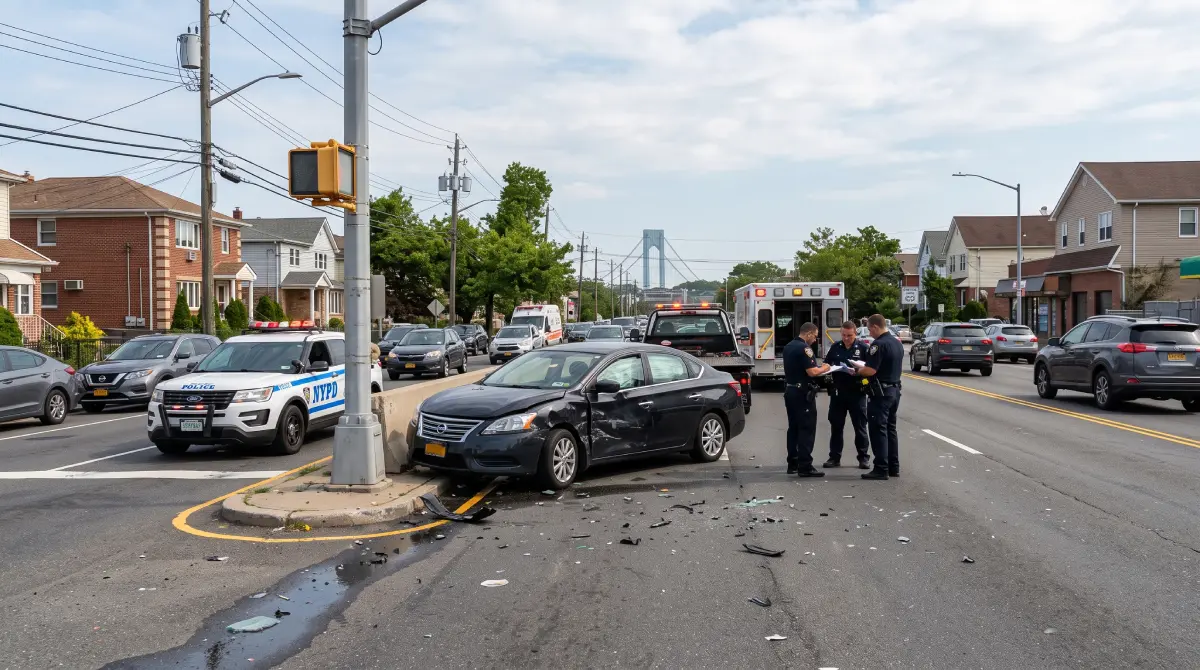
A drunk driver who hit you on Staten Island can be held responsible in a civil case that runs entirely separate from whatever the district attorney does about the DWI. A Staten Island drunk driver accident attorney at Silver Law Group builds that civil case, the one that pays for your medical bills, your lost paychecks, and the pain you are living with. Your first consultation is free, available any hour of the day or night, and offered in English, Spanish, and Russian. You pay no attorney’s fee unless we recover money for you; the fee then comes as a share of that recovery, so hiring us costs nothing out of your pocket while the case is pending. If you cannot come to our Midtown office, an attorney can meet you at your home or your hospital bed.
Do You Have a Drunk Driving Injury Case
The criminal case and your injury case are two different proceedings with two different jobs. The prosecutor’s DWI charge asks whether the driver broke the law and deserves punishment; your civil claim asks whether that driver owes you money for the harm the crash caused. You are not a party to the criminal case, the People of the State of New York are, and that case can end in a plea, a dismissal, or an acquittal without touching your right to sue.
The reason this matters is the burden of proof. To convict, the prosecutor must prove intoxication beyond a reasonable doubt, the highest standard in the law. Your civil case runs on a much lower one: preponderance of the evidence, meaning it is more likely than not that the driver was impaired and that the impairment caused the crash. A jury can find a driver not guilty of DWI and still find that same driver liable to you.
So a case that never produces a conviction can still produce a recovery. Prosecutors drop charges for reasons that have nothing to do with whether the driver was drunk, like a bad traffic stop or a broken chain of custody on the breath test. What decides your claim instead is the evidence you and your lawyer assemble: the police accident report, the responding officers’ observations, hospital toxicology if you were treated, and testimony from anyone who saw the driver before the crash.
Who Is Liable Beyond the Drunk Driver
The driver is the first defendant, but rarely the only one worth pursuing. New York law reaches back to the people who put alcohol in that driver’s hands when they should have known better. Two statutes do this work:
- Dram shop liability under GOL 11-101 lets you sue a bar, restaurant, or store that sold or served alcohol to someone already visibly intoxicated, when that sale contributed to the crash. The key is visible intoxication, the slurred speech and stumbling a server is trained to catch, at the time of the last drink.
- Social host liability under GOL 11-100 reaches a private person who furnished alcohol to someone under 21 who then caused the crash. This one does not require visible intoxication; furnishing alcohol to the underage drinker is enough.
Why chase a second defendant at all? Coverage. A drunk driver often carries only the state minimum in liability insurance, and that number may not come close to a serious injury. A bar that overserved carries commercial liquor liability coverage, and a social host may have homeowner’s coverage. Each added defendant can mean another policy that pays toward your bills.
Proving a dram shop case takes work an ordinary crash claim does not. Your lawyer subpoenas the bar’s receipts and point-of-sale records, pulls surveillance video before it is overwritten, and finds the other patrons who watched the driver keep drinking. That evidence disappears fast, which is one reason getting counsel involved in the first days after the crash matters.
How New York’s 2026 Fault Rule Affects Your Recovery
Your own share of fault used to reduce your recovery but never erase it. That changed for crashes litigated under the new rule. CPLR 1411(b) now bars your recovery entirely when your share of fault is greater than the defendant’s, and it applies to motor-vehicle actions commenced on or after May 26, 2026. Below that line the old math still runs: your damages drop by your percentage of fault, so a driver found 20 percent at fault keeps 80 percent of the award.
For a drunk driving case this rule usually works in your favor, because the impaired driver typically carries the larger share of fault. But insurers know the threshold and will try to push your percentage past the defendant’s to zero out the claim. Expect the adjuster to argue you were speeding, distracted, or crossing outside a crosswalk.
That is why the fault investigation starts on day one. Skid marks, the driver’s blood alcohol level, the sequence of the crash, and independent witnesses all fix where fault sits. The higher the driver’s intoxication, the harder it is for the insurer to move enough fault onto you to reach the bar. Your lawyer’s job is to keep your percentage well under the defendant’s, where the statute still lets you recover.
What Your Staten Island Drunk Driving Case Is Worth
No lawyer can name your number in the first meeting, because the value of a drunk driving case is built from categories that only become clear as your treatment and recovery play out. What an honest lawyer can do is show you the categories and how each is proven. Your claim generally covers:
- Medical costs, including emergency care, surgery, hospital stays, rehabilitation, and the future treatment your doctors say you will still need. Get the future costs documented; they are often the largest piece and the easiest to undercount.
- Lost earnings, meaning the wages you missed while hurt, plus lost earning capacity if the injury keeps you from the work you did before.
- Pain and suffering, the physical pain and the effect on your daily life, which carries no receipt and depends on how well your medical record and your own testimony describe what changed.
Punitive damages sit in a separate category. New York allows them when a driver’s conduct was reckless enough to deserve punishment rather than just compensation, and driving drunk can meet that bar. They are meant to punish the driver and deter the next one, but they are never guaranteed, require proof beyond ordinary negligence, and cannot be promised at the outset.
Two cases with the same broken leg can be worth very different amounts. The difference is documentation, the completeness of your medical records, the strength of the lost-wage proof, and how clearly the long-term effect on your life is shown.
No-Fault Coverage and the Serious Injury Threshold
New York is a no-fault state, so the first money after a crash comes from your own insurance, not the drunk driver’s. Personal Injury Protection, the PIP coverage on your auto policy, pays your medical bills and a portion of lost wages regardless of who caused the crash, including when a drunk driver did. That coverage gets you treated without waiting for a fault fight to resolve.
No-fault has a ceiling, though, and it does not pay for pain and suffering. To step outside no-fault and sue the drunk driver directly for the full range of damages, your injury has to clear the serious injury threshold in Insurance Law 5102(d). That statute lists the qualifying categories, including:
- Bone fracture
- Significant disfigurement, such as noticeable scarring
- Permanent loss or limitation of use of a body organ, member, or function
- Death
One category is changing. The so-called 90/180-day threshold, which let people qualify by showing a non-permanent injury that kept them from their usual daily activities for at least 90 of the 180 days after the crash, has been repealed effective in 2026. If your claim would have leaned on that category, the change matters to how the case is framed, and it is worth confirming which categories your injuries fit before you assume the threshold is met.
Clearing the threshold is often the fight that decides your case. Insurers hire doctors to say your fracture healed or your limitation is not permanent, so matching your treatment records to the exact statutory language is how your lawyer keeps the door to a lawsuit open.
The 30-Day No-Fault Application Deadline
No-fault benefits are not automatic. You have to apply for them, and the clock is short: written notice to your no-fault insurer is due within 30 days of the crash. Miss that window and the insurer can deny your PIP benefits outright, leaving you to pay for early treatment yourself even though the coverage existed.
Thirty days passes fast when you are in a hospital bed or in and out of appointments. The application asks for details about the crash and your injuries, and mistakes on it give the insurer reasons to delay. This is one of the first things a lawyer handles for you, so the notice goes in correctly and on time while you focus on treatment.
Deadlines to File a Staten Island Drunk Driving Claim
Three deadlines govern a Staten Island drunk driving claim, and the shortest one can end your case before you know it existed.
The main deadline is three years. Under CPLR §214 you generally have three years from the date of the crash to file a personal injury lawsuit. That sounds long, but the evidence a dram shop case needs, like bar receipts, surveillance video, and witness memory, decays long before then.
If the drunk driver killed a family member, the deadline is shorter. EPTL §5-4.1 gives the estate two years from the date of death to bring a wrongful death action. That claim belongs to the estate, not directly to you, which adds the step of opening an estate before suit.
A separate and much tighter deadline applies when a government driver was the drunk one, such as a city vehicle, an MTA bus, or a New York City Transit Authority driver. Then GML §50-e requires a Notice of Claim within 90 days of the crash, before any lawsuit. Blow the 90 days and you can lose the right to sue the public agency even though the three-year clock has barely started. Because you may not know at the scene that the other driver was on the job, the safe move is to get the vehicle and employer identified early, while the 90-day option is still open.
Where Staten Island Drunk Driving Cases Are Filed
A Staten Island injury lawsuit is filed in Richmond County Supreme Court, at 26 Central Avenue in St. George. Richmond County is Staten Island’s own county, so your case is heard before judges and juries drawn from the borough where the crash happened, not moved to Manhattan.
Where the crashes cluster shows up in NYPD alcohol-involvement records. A handful of Staten Island roads carry more than their share:
- The Staten Island Expressway (I-278), the borough’s main artery, where high speeds turn an impaired driver’s reaction lag into a serious collision
- The West Shore Expressway on the borough’s western edge
- Hylan Boulevard, the long surface road running down the East Shore, dense with intersections and late-night traffic
- Bay Street, near the St. George nightlife and ferry area, where alcohol and pedestrians mix
These locations matter beyond geography. The responding precinct, the availability of traffic and business cameras, and the pattern of DWI enforcement on a given road all shape what evidence exists. A lawyer who works Staten Island cases knows which agencies to reach for the crash and arrest records tied to these corridors, and how quickly to move before footage is recycled.
Steps to Take After a Staten Island Drunk Driving Crash
What you do in the first hours shapes what your case can prove later. Work through these in order if you are able, or have someone do them for you.
- Call 911. A police response puts officers on scene who can test the driver and create the accident report your case will lean on.
- Tell the police you suspect the driver is drunk. Say it plainly, so the officer runs a field sobriety or breath test and puts their own observations into the report.
- Photograph everything you safely can: the vehicles, their positions, the road, any open containers, and your injuries, before anything is moved or cleaned up.
- Get hospital care the same day, even if you feel able to wait. A gap between the crash and treatment is the first thing an insurer uses to argue you were not really hurt.
- Refuse to give the insurer a recorded statement until you have spoken with a lawyer. Adjusters call within days and use recorded answers to lock in admissions that shrink your claim.
Say as little as possible to the other driver’s insurer beyond confirming the basic facts.
Why Injured Staten Islanders Choose Silver Law Group
Silver Law Group represents injured Staten Islanders from a Midtown Manhattan office at 49 West 37th Street, and the way the firm works is built around people who are hurt and worried about money.
- Free consultation, contingency fee. The first meeting costs nothing, and you owe no attorney’s fee unless the firm recovers for you.
- Service in English, Spanish, and Russian, so you explain your case in your own language with no detail lost in translation.
- Available 24 hours a day, because a crash does not keep business hours and neither does intake.
- The attorney comes to you. If your injuries keep you home or in the hospital, a lawyer meets you there.
- Trial-ready from the start, which is what makes an insurer take a settlement number seriously rather than lowballing a firm that never files.
If a drunk driver injured you or someone in your family on Staten Island, call 212-470-4544 for a free consultation, any hour, in your language.