

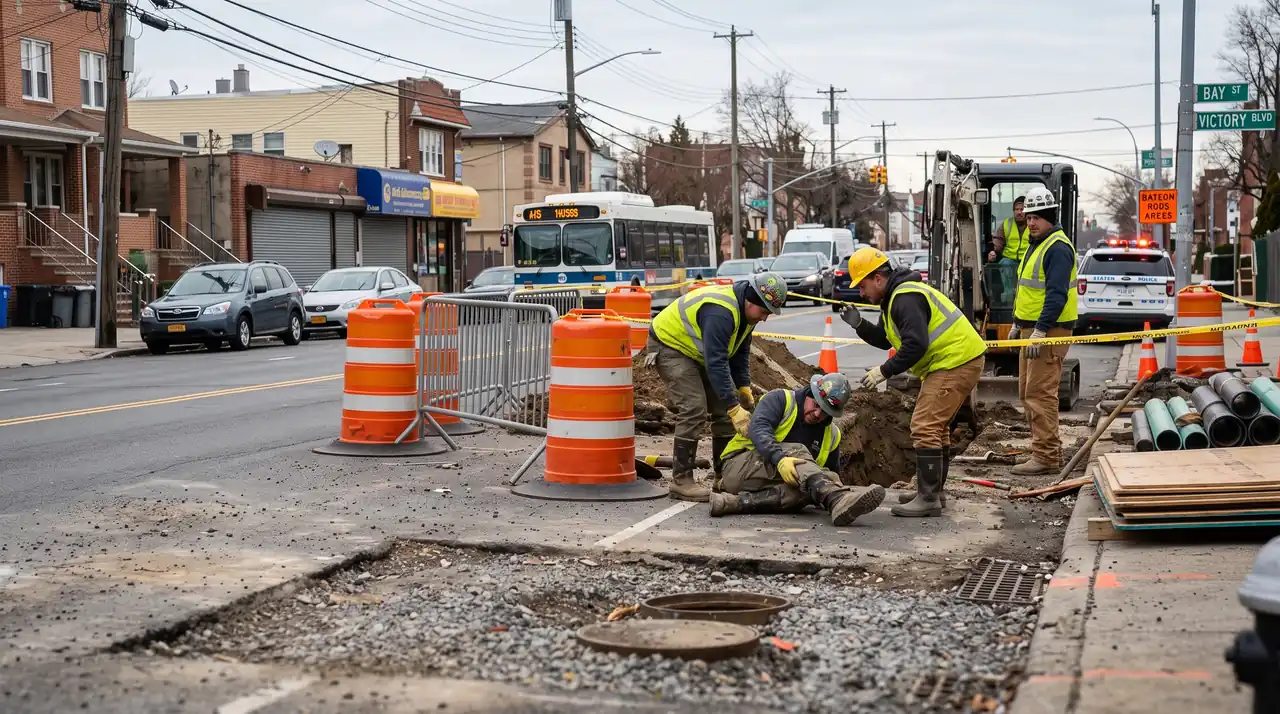
A fall from a scaffold in Mariners Harbor or a beam dropped on a West Shore jobsite can end your ability to work in a single afternoon, and the hospital bills start before you leave the emergency room. A Staten Island construction worker injury lawyer at Silver Law Group can tell you, in one free call, whether your case reaches past workers’ compensation into a lawsuit that pays for pain, permanent injury, and the years of wages you stand to lose. We handle construction cases from St. George to the West Shore. The first consultation costs nothing, and you pay no fee unless we win money for you. Call 212-470-4544 at any hour, including nights and weekends. Intake runs in English, Spanish, and Russian, and the attorney can come to your home or your hospital bedside if you cannot travel to Midtown.
Do You Have a Claim Beyond Workers’ Compensation?
Workers’ compensation pays your medical bills and part of your lost wages no matter who caused the accident, but it never pays a dollar for pain and suffering. That is the gap a third-party lawsuit fills. Comp is a no-fault system: you get medical coverage and roughly two-thirds of your average weekly wage up to a state cap, and in exchange you give up the right to sue your own employer. For many injured workers, that trade leaves the largest losses uncovered — the pain, the permanent limits on what your body can do, the career you can no longer return to.
A third-party claim runs alongside your comp case, not instead of it. It targets the parties who are not your employer: the property owner who let a hazard sit, the general contractor who skipped a safety measure, a subcontractor whose crew created the danger. Against them you can recover full pain and suffering, the complete value of your lost earnings rather than the capped comp portion, future medical care, and the loss of your ability to earn over a lifetime.
The two cases interact. If your third-party lawsuit recovers money, the comp insurer that paid your benefits usually holds a lien and gets repaid from your award, which is one reason the numbers and the negotiation need a construction worker injury lawyer watching both files at once. Running comp alone often means leaving the compensation that matters most unclaimed, because comp was never built to make you whole. It was built to pay fast and pay partial. A lawyer reviews how your fall or struck-by injury happened, identifies every non-employer who owed you a safe site, and brings the claim comp cannot.
New York Labor Law Protections for Construction Workers
Three sections of New York’s Labor Law give construction workers protection that ordinary negligence law does not, and they are the backbone of most third-party construction cases.
Labor Law 240(1), known as the scaffold law, covers injuries caused by height. If you fell from a scaffold, ladder, or roof, or if an object fell on you because it was not secured, the owner and general contractor can be held to absolute liability. Once you prove the elevation hazard caused your injury and no proper safety device protected you, their liability is fixed, and they cannot reduce what they owe by arguing you were careless. This is the strongest tool an injured construction worker has, because it removes the fault fight that defeats most injury claims. It applies to falls from a height and to falling objects that strike a worker below, the two ways gravity injures people on a jobsite.
Labor Law 241(6) reaches injuries that are not about height. It requires owners and contractors to follow the specific safety rules in New York’s Industrial Code — concrete commands about trench shoring, floor openings, debris removal, and protective equipment. To use 241(6), your lawyer identifies the exact code provision that was violated and ties it to how you were hurt. Unlike the scaffold law, a worker’s own carelessness can reduce a 241(6) recovery, but a proven code violation still puts the owner and contractor on the hook.
Labor Law 200 is the general duty to provide a safe place to work. It applies when an owner or contractor controlled the work or knew about a dangerous condition and did nothing. It is broader than the other two but harder to prove, because you must show the defendant had authority over the hazard or notice of it.
These duties fall on the people at the top of the job, the owner and the general contractor, even when a subcontractor’s mistake is what hurt you. That is what lets an injured worker reach past a small, underinsured sub to the parties who actually carry the coverage.
Construction Injuries and Accidents We Handle
Silver Law Group handles the full range of jobsite injuries that send Staten Island construction workers to the hospital. The type of accident often decides which Labor Law section applies and which parties you can sue.
- Falls from height — off scaffolds, ladders, roofs, and unguarded floor edges, the leading killer on construction sites and the core of a scaffold-law claim.
- Scaffold and ladder collapses, where the equipment itself fails under a worker who did nothing wrong.
- Falling objects — tools, materials, or debris dropped from an upper level onto workers below.
- Trench and excavation cave-ins, which bury workers and turn on Industrial Code rules about shoring and sloping.
- Crane and hoist accidents, including loads that swing loose or drop.
- Forklift and heavy-equipment strikes on crowded sites where operators cannot see workers on foot.
- Electrocutions from live wires, ungrounded tools, and contact with overhead power lines.
- Burns from fires, explosions, hot materials, and electrical arcs.
Burns are their own category of catastrophe. A serious burn can mean months of surgery, skin grafts, and permanent scarring, and the closest specialty care sits at Staten Island University Hospital’s Ocean Breeze campus, home to the regional burn center that treats the borough’s worst jobsite burns. The cost of that treatment, and the disfigurement that follows, is exactly the kind of loss workers’ comp underpays and a third-party claim can fully address.
Who Can Be Held Liable for Your Injury
The people who owe you money are usually not your boss. New York’s workers’ compensation deal blocks you from suing your direct employer for a jobsite injury, since comp benefits are the exclusive remedy against the company that signs your checks. But that bar stops at your employer’s door. Everyone else on the site is fair game for a third-party claim.
Property owners top the list. Labor Law 240 and 241 place non-delegable duties on them, so an owner can be liable for a height or code injury even if they never set foot on the site. General contractors carry the same duties for coordinating safety across every trade on the job. Subcontractors can be sued when their crew created the hazard that hurt you, as long as they are not your own employer. And when a defective tool, ladder, lift, or safety harness fails, the manufacturer of that equipment can be brought in on a product liability theory.
Sorting out who controlled the hazard takes investigation — contracts, site logs, the chain of subcontractors, and the ownership behind the property. A construction worker attorney pulls those records early, before a site is cleaned up and the paper trail thins, so the right defendants are named while the evidence still exists.
What Your Staten Island Construction Claim Is Worth
No calculator or website can value your Staten Island construction claim, and any that promises a number is guessing. Worth comes from your specific injury, your job, and how the accident changed what your future looks like. A third-party case can recover categories comp never touches:
- Medical costs already incurred, from surgery and hospital stays to imaging, medication, and therapy.
- Future medical care, from follow-up operations to years of physical therapy and assistive equipment.
- Lost wages for the time you could not work, at your full rate rather than the capped comp fraction.
- Diminished earning capacity when your injury forces you into lower-paying work or out of the trade entirely.
- Lost union benefits — the pension credits, annuity contributions, and health coverage that stop accruing when you cannot report to the job.
- Pain and suffering for the physical pain, the limits on daily life, and the permanent nature of a serious injury.
The last two categories are where construction cases separate from ordinary injury claims. A union worker in the prime earning years of a trade loses far more than a paycheck when a fall ends a career, and the pension math plus the decades of foregone wages often dwarf the medical bills. Putting a real number on that requires vocational and economic proof, not an online estimate, which is why these cases are built by a lawyer and not a form.
What to Do After a Construction Injury on Staten Island
What you do in the first days after a jobsite injury shapes both your comp benefits and your lawsuit. Move through these steps as soon as you are able.
- Report the injury to your employer in writing. New York gives you 30 days to notify your employer, and a missed deadline can cost your workers’ compensation benefits outright.
- Get real medical treatment, fast. For a serious injury, Richmond University Medical Center in West Brighton runs the borough’s trauma center; go there the same day and follow through on every referral, because gaps in treatment are the first thing an insurer uses against you.
- Photograph the scene and your injuries. Capture the scaffold, the ladder, the opening, the missing guardrail, and the equipment involved before anything is moved or repaired.
- Preserve the equipment that hurt you. A failed harness, a broken rung, or a defective tool is evidence in a product case, and it disappears once the site is cleared.
- Get the names and numbers of coworkers who saw what happened. Witnesses scatter to other jobs, and a phone number now is worth more than a search later.
- Call a construction worker injury lawyer before records vanish. Site logs, surveillance video, and daily reports get overwritten or discarded within weeks, and once they are gone, proving how you were hurt gets much harder.
Deadlines for Staten Island Construction Injury Claims
Your Staten Island construction case runs on several clocks at once, and the shortest one you miss can end the whole claim. Track all of them from the day of the accident.
The main deadline to sue is three years. Under CPLR 214, you have three years from the date of your injury to file a personal injury lawsuit against a negligent owner, contractor, or manufacturer. Miss it and the court will not hear the case, no matter how strong it is.
If a construction accident kills a worker, the family’s wrongful death claim runs on a shorter clock. EPTL 5-4.1 gives the estate two years from the date of death to sue. That is one year less than the injury deadline, and it starts from death rather than from the accident, so a grieving family cannot afford to wait.
Workers’ compensation has its own early trigger. You must give your employer written notice of the injury within 30 days, separate from and much sooner than the lawsuit deadline. Report late and you risk losing benefits you would otherwise be owed.
A public project changes the timeline sharply. If the owner is a city or state entity, such as a school, a public building, or a government job, you must serve a Notice of Claim under GML 50-e within 90 days of the injury before you can sue at all. Ninety days passes fast when you are in a hospital bed, and this deadline traps workers who assume they have years.
Lawsuits on Staten Island are filed in Richmond County Supreme Court at St. George, near the ferry terminal. A construction worker injury lawyer calendars every one of these dates at intake, because in New York the deadline, not the merits, is what quietly kills most late claims.
Injured Immigrant and Undocumented Construction Workers
Your immigration status does not bar you from recovering for a construction injury in New York. The Labor Law protects every worker on a jobsite, and the courts have held that an undocumented worker hurt on a site can bring the same third-party claim as anyone else. An owner or contractor cannot escape liability by pointing at your paperwork.
You can recover lost wages without work authorization. Earnings are proven the ordinary way — through pay stubs, cash payment records, tax filings, and testimony about what you actually earned and would have kept earning. What matters is the money the injury took from you, not the documents in your wallet.
Fear of immigration consequences keeps many injured workers silent while their deadlines run out, which is the outcome a negligent contractor is counting on. A consultation is confidential, and it runs in Spanish or Russian as easily as in English. You can learn what your case is worth without putting anything at risk, and the sooner you call, the more of the evidence survives.
Why Injured Workers Choose Silver Law Group
You pay nothing up front, and no fee at all unless we win money for you. Silver Law Group takes construction injury cases on contingency: our fee is a percentage of the recovery, paid only if we get you a settlement or verdict, and if the case recovers nothing, you owe us no attorney’s fee. That structure exists so an injured worker with no paycheck coming in can still hire a lawyer who takes on well-funded insurance companies. We front the costs of building the case, and you decide whether to accept any offer.
We prepare every case as if it will be tried. Insurers track which firms fold at the courthouse steps and which are ready to put a construction case in front of a Richmond County jury, and they value the ready ones higher. Building for trial from the first day is what gives a settlement demand its weight.
If your injury keeps you home or in a hospital bed, the attorney comes to you — to your house, to Richmond University Medical Center, wherever you are. The first consultation is free, and we take calls 24 hours a day in English, Spanish, and Russian. Call 212-470-4544 today, while the site evidence and the deadlines are still on your side. Our office is at 49 West 37th Street, 7th Floor, in Midtown Manhattan.