

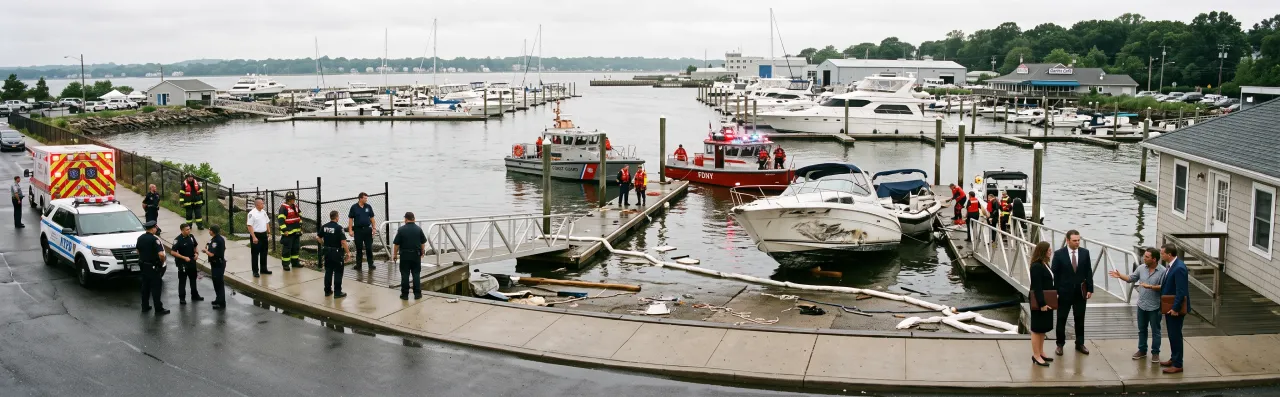
A propeller strike off Great Kills Harbor, or a wake that throws you against the deck in Raritan Bay, can break bones and end incomes in seconds. If a boat crash on Staten Island’s waters left you hurt, a Staten Island boat accident lawyer can tell you in one phone call whether an operator, owner, or charter company owes you money. That call is free, it runs 24 hours a day, and we take it in English, Spanish, or Russian. You pay nothing unless we recover for you. Silver Law Group works out of Midtown Manhattan at 49 West 37th Street, and the attorney can come to your home or hospital room on Staten Island if you cannot travel. Call 212-470-4544 now.
Do You Have a Staten Island Boat Accident Case?
A boat case rises or falls on negligence. To recover, you have to show that the operator or the owner did something a careful boater would not have done — ran too fast for the chop, drove after drinking, ignored a crossing vessel, or sent you into the water with an avoidable wake — and that the choice caused your injury. There is no automatic payout for getting hurt on the water.
This is where boat claims split hard from car claims. If you crash a car in New York, no-fault insurance pays your first medical bills and lost wages no matter who caused the wreck, and you can only sue for pain and suffering if your injury clears the serious-injury threshold in Insurance Law 5102(d). None of that machinery touches a boat. New York’s no-fault law covers motor vehicles, not watercraft. There is no 30-day no-fault claim to file with a boat insurer, no basic economic loss coverage that pays before fault is sorted out, and no 5102(d) threshold you must cross before you can sue.
For you that cuts two ways. The good news: you are not boxed in by the serious-injury categories that stop many car victims from suing over real but “minor” harm. The hard part: nobody pays your bills automatically, so proving who was negligent is the whole case from day one. That makes early evidence — the Coast Guard report, the vessel’s condition, the operator’s certificate and sobriety — the thing your recovery is built on.
Who Is Liable for Your Boating Accident
More than one party can owe you money after a boat crash, and the right defendant is not always the person at the wheel.
- The operator, if inexperience, speed, distraction, or alcohol caused the crash.
- The boat owner, who is separately responsible for handing the controls to someone unfit to run the vessel, or for sending out a boat with bad steering, a dead bilge pump, or missing safety gear.
- A rental or charter company that put you on the water without a safety briefing, overloaded the boat, or rented to an obviously impaired customer.
- The manufacturer, when a fuel line, throttle, or propeller guard was defective.
- A marina or dock owner whose broken cleat, unlit slip, or rotted pier caused the injury.
Brianna’s Law tightens the case against a careless operator. As of January 1, 2025, anyone operating a motorized vessel in New York must have completed a state-approved boating safety course and carry the certificate. An operator running your boat without that certificate is breaking the Navigation Law, and that violation is direct evidence of negligence — proof the person at the helm was not qualified to be there. If the operator who hurt you never took the course, that fact strengthens your claim before anyone argues about how the crash happened.
When the Staten Island Ferry or a City Vessel Is Involved
A crash on a city-owned boat runs on a different and much shorter clock. The Staten Island Ferry is run by the City of New York, and suing the City means following rules that do not apply to a private-boat case. The stakes here are not hypothetical. On October 15, 2003, the Andrew J. Barberi slammed into the maintenance pier at the St. George terminal, killing 11 passengers and injuring dozens more.
If a City vessel injured you, General Municipal Law 50-e requires you to file a formal Notice of Claim with the City within 90 days of the crash. This is not the lawsuit; it is a written notice that must reach the City first, describing how, when, and where you were hurt. Miss the 90 days and you can lose the right to sue the City at all, no matter how clear its fault was. Ninety days passes fast while you are still in treatment, which is why a ferry or city-vessel injury is the kind of case to bring to a boat accident attorney within the first week.
What Your Boat Accident Claim Is Worth
No two boat claims are worth the same, because the money tracks two things: how badly you were hurt and how clearly someone else is at fault. New York law lets you recover for both the costs you can add up and the harm that has no receipt.
The costs you can document come first. Your claim includes the medical bills already piling up and the future care a serious injury demands: surgery, rehab, a wheelchair, home modification. It includes the wages you lost while you could not work. If the injury keeps you from earning what you used to, say a dock worker who can no longer lift or a captain who loses a license after a head injury, it also includes diminished future earning capacity — the gap between what you would have made and what you now can.
Then there is the harm no invoice captures. Pain and suffering compensates the physical pain and the life you cannot live the same way. Disfigurement — burns, scars, an amputation from a propeller strike — is its own category, because a permanent change to your body is a permanent loss. Loss of consortium lets your spouse recover for the companionship and support the injury took from your marriage. And when a boat crash kills someone, a wrongful death claim lets the family recover for what the death cost them.
What moves the number is severity and liability together. A catastrophic injury with a clearly negligent, insured operator supports a large claim; the same injury with muddy fault or a defendant who has nothing supports far less. Anyone who quotes you a figure before seeing the medical records and the Coast Guard report is guessing.
What to Do After a Staten Island Boating Accident
What you do in the first hours after a Staten Island boat crash shapes what your claim is worth months later.
- Get medical care the same day. Some boat injuries hide — a concussion, internal bleeding, or carbon monoxide exposure can feel mild for a day, then turn serious. The record a doctor creates now links your injury to the crash, and a gap in treatment is the first thing an insurer uses to argue you were not really hurt.
- Report the crash. New York requires boating accidents involving injury, death, or serious damage to be reported. On Staten Island’s waters that means notifying the NYPD, the Richmond County Sheriff, or Park Police, depending on where it happened, which starts an official record.
- Preserve the Coast Guard report. Serious boating accidents trigger a U.S. Coast Guard investigation and report. That document often carries the findings your case turns on. Get it, and do not rely on the other side to produce it.
- Photograph everything: the vessel, the damage, the water conditions, the registration numbers, any alcohol on board, and your own injuries. Boats get repaired and repainted fast, and the evidence disappears with them.
- Collect witness contacts. Other passengers, nearby boaters, and people on the dock saw what you may not remember. Names and phone numbers now are worth more than statements you try to track down a year later.
Common Causes and Injuries in Staten Island Boat Accidents
Most Staten Island boat crashes trace back to the person running the boat, and the injuries that follow are worse than a car’s because water adds ways to die that pavement does not.
The usual causes are avoidable. Operator inexperience puts someone at the helm who cannot read a crossing situation or handle a wake. Intoxication is a constant on summer weekends, and it slows reaction the same way it does behind a wheel. Excessive speed leaves no room to stop in crowded harbor water, and a dangerous wake can throw a passenger across the deck or swamp a smaller boat. Propeller strikes — a swimmer or a person thrown overboard hit by a spinning prop — cause some of the most brutal injuries on the water.
The injuries split into two kinds. There are the harms the water itself causes: drowning, hypothermia in the cold months even close to shore, and carbon monoxide poisoning from exhaust that pools around a swim platform or in an enclosed cabin. Then there are the impact injuries: traumatic brain injury, spinal cord damage that can mean paralysis, and amputations from propellers or from crushing between boat and dock. Many of these are permanent, which is why they anchor the largest claims.
Where Boat Accidents Happen Around Staten Island
Staten Island sits ringed by busy, mixed-traffic water, and each stretch has its own hazard.
Great Kills Harbor, the island’s main recreational boating hub on the eastern shore, packs marinas, moorings, and a narrow channel into tight space, which is where inexperienced operators and weekend congestion collide. The Arthur Kill and the Kill Van Kull, the industrial straits on the western and northern sides, carry heavy tanker and tug-and-barge traffic; a small recreational boat that misjudges a commercial vessel’s speed or wake in these channels has almost no margin. Raritan Bay to the south opens wider but brings its own trouble — chop, wind, and fast recreational traffic running between New York and New Jersey.
Closer to the terminals, Lower New York Bay and Upper New York Bay funnel ferries, cargo ships, and pleasure craft through the same water, and the Verrazzano-Narrows squeezes all of it into the passage under the bridge, where currents run hard and crossing traffic is constant. A crash in any of these waters can pull in more than one set of rules — recreational, commercial, or, near the St. George terminal, the City’s ferry operation — which changes who you sue and how fast you have to act.
Deadlines to File a Staten Island Boat Accident Claim
A boat claim can run on several deadlines at once, and the shortest one that fits your case is the only one that matters. Miss it, and it does not matter how strong your proof is.
For a standard injury case against a private operator or owner, CPLR 214 gives you three years from the date of the crash to sue. That feels like a long time, but the evidence on the water — the boat, the witnesses, the Coast Guard findings — decays long before the deadline does, so three years is a reason to start early, not to wait.
If the crash killed someone, a different clock governs the wrongful death claim. EPTL 5-4.1 gives the estate two years from the date of death to sue, a year shorter than the injury deadline, and it is the estate’s representative, not just any family member, who has to bring it.
When the accident happened on navigable water, federal maritime law can also apply. Under 46 U.S.C. 30106, maritime personal injury and death claims carry their own three-year limit, which can overlap with the state deadlines depending on where and how the crash occurred.
The trap is the ferry ticket. If you were hurt on a passenger vessel, the ticket or passage contract can carry a limit far shorter than any of these — sometimes a written-notice requirement within months and a one-year deadline to sue, and courts often enforce those terms. That is why a ferry or excursion-boat injury cannot sit. The clock in the fine print may already be running, and it may be the shortest one of all.
Why Staten Island Boaters Choose Silver Law Group
You pay us nothing up front, and nothing at all unless we win money for you. Silver Law Group works on a contingency fee: our fee is a percentage of the recovery, taken only if we recover, so the legal help costs you nothing out of pocket while you are hurt and out of work. If we do not recover for you, you owe us no fee. That keeps the risk on us, not on a family already worried about bills.
We prepare every case as if it will be tried. Insurers settle fairly when the file shows a lawyer ready to put the case in front of a jury, and a claim built for trial from the start is worth more than one built to settle cheap.
You do not have to come to us. The consultation is free, it is available 24 hours a day in English, Spanish, and Russian, and if your injury keeps you home or in the hospital, the attorney will come to you on Staten Island. Call 212-470-4544 to start.