

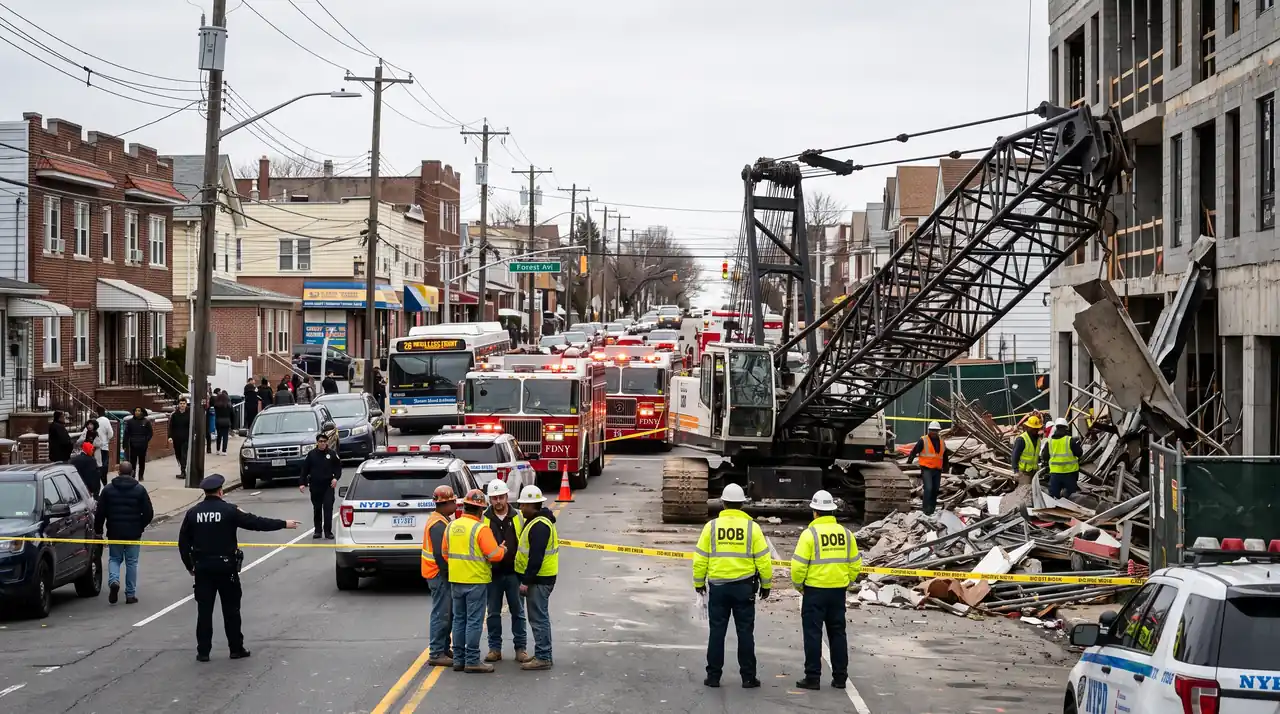
A crane failure on a Staten Island job site can put you in a hospital bed before you understand what went wrong. A Staten Island crane accident attorney at Silver Law Group can start protecting your claim the same day you call 212-470-4544, and the phone is answered around the clock, weekends and nights included. The first consultation costs you nothing. We represent the operator in the cab when the boom gave way, the laborer struck by a falling load, and the pedestrian who was simply walking past a lift when rigging failed overhead. We also stand with families who lost a worker in a collapse and now face a wrongful death claim on top of their grief. If you cannot come to the office, the attorney will come to you, at your home or at your hospital bedside while you are still admitted. Every conversation is free and confidential, and you owe no fee unless money is recovered for you. You can speak with us in English, Spanish, or Russian, so nothing about your own case gets lost in translation.
Do You Have a Staten Island Crane Accident Case?
You likely have a case if someone with control over the job site failed to keep it safe and you were hurt because of it. New York gives injured construction workers unusually strong protection through the Labor Law, which holds property owners and general contractors responsible for elevation and gravity hazards even when they never touched the crane. That is a higher standard than ordinary negligence, where you would have to prove that a specific party acted carelessly. Both routes are open to you. A rigging crew that overloaded a sling, a rental company that sent out a crane with a worn cable, a site manager who let work continue under a swinging load — each can be a negligent party you pursue. Partial fault does not end your claim. Under CPLR 1411, New York uses pure comparative negligence, so even if a jury decides you were partly responsible, your recovery is reduced by your share rather than erased. A worker found 30 percent at fault still collects 70 percent of the damages. Cranes run across Staten Island’s industrial and infrastructure corridors: the container terminals around Howland Hook, the towers and approaches of the Bayonne Bridge, and the constant roadwork along the Staten Island Expressway. Workers and pedestrians struck near these sites have brought exactly these claims.
Who Is Liable Under New York’s Labor Laws
Three sections of New York’s Labor Law decide who pays after a crane accident, and each targets a different failure. Labor Law 240(1), the “Scaffold Law,” is the strongest tool you have. It imposes absolute liability on property owners and general contractors for injuries caused by elevation and gravity-related hazards, which is exactly what a crane produces: loads lifted overhead, workers hoisted to height, booms that swing and fall. When a load drops because it was not properly secured, or a worker falls because no adequate safety device was provided, the owner and general contractor are liable even if they were nowhere near the controls. They cannot shift the blame onto you to escape that duty. Labor Law 241(6) reaches violations of the Industrial Code, the detailed state safety regulations that govern how crane and hoisting work must be done. If the rigging, the ground conditions, or the load-securing on your site broke a specific Industrial Code rule, that violation supports your claim against the owner and contractor. Labor Law 200 is the baseline duty to provide a safe workplace. It applies where an owner or contractor controlled the work, or knew about a dangerous condition and let it stand. The defendants these statutes reach are usually the site’s owner, the general contractor running the project, and often the crane rental company that supplied the equipment and, in many cases, the operator. A rental firm that leased out a poorly maintained machine can be pursued directly. Identifying every liable party matters because their insurance policies, not your employer’s limited workers’ compensation coverage, are what fund a full recovery.
How Crane Accidents Happen on Staten Island Sites
Most crane accidents trace back to a handful of failures, and the pattern on a busy site is rarely a freak event.
- A load that slips from a hook or a failed sling drops with enough force to kill a worker on the deck below.
- An overloaded or fatigued boom buckles and drops steel across the work area.
- A crane set on soft or uneven ground, common near waterfront fill and fresh roadwork, tips over under load.
- Worn cables, defective brakes, and slings rated below the weight they carry give way in mid-lift.
- A boom that swings into an overhead power line electrocutes the operator and anyone touching the machine.
Struck-by incidents dominate the fatal numbers. According to the Bureau of Labor Statistics, objects striking workers cause just over half of all fatal crane injuries, and crane-related deaths average around 44 a year nationally. On Staten Island sites, that means the workers and passersby standing in the load’s path below often face more danger than the operator in the cab.
Serious Injuries These Accidents Cause
The forces in a crane accident are measured in tons, so the injuries tend to be catastrophic rather than minor. A load that pins a limb causes crushing injuries that can destroy muscle and bone and sometimes force amputation. A fall from height or a blow to the back can sever the spinal cord and leave you with paralysis that never fully reverses. A struck-by impact to the head causes traumatic brain injury, changing memory, speech, and the ability to work. Electrical contact and equipment fires produce severe burns that require skin grafts and months of care. And too often a collapse or dropped load kills the worker outright, turning the matter into a wrongful death claim for the family left behind. Injuries this severe need documented trauma care immediately, both for your health and for your claim. Staten Island’s two trauma centers, Richmond University Medical Center and Staten Island University Hospital, are equipped to treat crush and head trauma. Get evaluated the day of the accident even if adrenaline is masking your pain; the medical record created in those first hours is what later ties your injuries to the crane, and gaps in treatment are the first thing an insurer will use against you.
What Your Crane Accident Claim Is Worth
No two crane injuries carry the same value, but every claim is built from the same two categories of damages. Economic damages are the costs you can put a number on. They include your emergency and ongoing medical bills, the surgeries and rehabilitation ahead of you, the wages you lost while you could not work, and, often the largest figure, the future earnings you will never collect if the injury keeps you off the tools for good. A crane operator or ironworker who can no longer do physical work has a lifetime earnings loss that a good claim accounts for in full. Non-economic damages cover what the injury took that has no invoice: the pain, the permanent limitation, the loss of the life you had before. These are real and recoverable, and in serious crane cases they are frequently the larger part of the recovery. Here is why the distinction between claims matters to your total recovery. If you were on the clock, workers’ compensation pays a portion of your lost wages and your medical treatment, but it does not pay for pain and suffering at all, and its wage benefits are capped at a statutory maximum that rarely matches what you actually earned. That is the ceiling of a workers’ compensation claim. A third-party lawsuit against a non-employer defendant, such as the site owner, the general contractor, or the crane rental company, has no such cap. It reaches the full economic and non-economic value of your injury. That is why identifying every party outside your direct employer is the difference between a capped benefit and a full recovery, and you can pursue both at once: workers’ compensation now, the lawsuit alongside it.
What Hiring a Crane Accident Lawyer Costs
Nothing, unless you win. Silver Law Group takes crane accident cases on a contingency fee, which means you pay no money upfront and no hourly bills while your case is pending. The firm’s fee is a percentage of the recovery, and it is owed only if money is actually recovered for you. If the case does not succeed, you owe the firm no fee. The costs of building the case, from accident reconstruction and engineering experts to medical records and court filing fees, are advanced by the firm, not billed to you along the way. Those expenses come out of the recovery at the end, so you are never asked to fund your own case out of pocket while you are hurt and out of work. That structure exists so that a laborer with no savings can take on a site owner and its insurance company on equal footing. Your case review is free. You can have it by phone at 212-470-4544, at your kitchen table if you cannot travel, or at your hospital bedside if you are still admitted.
Deadlines to File a Staten Island Crane Claim
A crane claim runs on several clocks, and the shortest one can end your case before you have even left the hospital. Under CPLR 214, you generally have three years from the date of the accident to file a personal injury lawsuit in New York. Miss that deadline and the court will not hear the case, no matter how clear the liability. If a worker was killed, the wrongful death clock is shorter. EPTL 5-4.1 gives the family two years from the date of death to bring a wrongful death action, so the families of collapse victims have less time than injured survivors do. Public and quasi-public projects add an early hurdle. Many Staten Island infrastructure jobs, including bridge, roadway, and port work, involve a government or Port Authority entity, and under GML 50-e you must serve a Notice of Claim within 90 days of the accident before you can even sue. Skip that notice and the underlying case can be lost regardless of the three-year rule. And if you are pursuing workers’ compensation, you must notify your employer of the injury in writing within 30 days. That short window is separate from your lawsuit deadlines and easy to miss while you are focused on treatment. Because these deadlines overlap and the earliest is only 30 days out, the safest move is to have every date calendared by a lawyer within the first week.
Why Choose Silver Law Group
Insurance companies settle for less when they believe the lawyer across the table will not try the case. Silver Law Group prepares every crane accident claim as if it is going to a jury, and when a fair settlement does not come, the firm is ready to file and try your case at the Richmond County Supreme Court, 26 Central Avenue, St. George. You can work with the firm in English, Spanish, or Russian, so a language barrier never keeps you from understanding your own case. Consultations are free and available 24/7, because a crane accident does not wait for business hours. If your injuries keep you from traveling, the attorney comes to your home or your hospital room instead of asking you to come in. The office is at 49 West 37th Street, 7th Floor, in Midtown Manhattan, and it serves crane accident clients across Staten Island. One phone call starts everything: 212-470-4544.